Виявлення впливу технологічних чинників на мікроструктурні та реологічні показники соусів з емульсійною структурою
DOI:
https://doi.org/10.15587/1729-4061.2025.325417Ключові слова:
соуси з емульсійною структурою, термічне обробляння, мікроструктурні показники, реологічні показникиАнотація
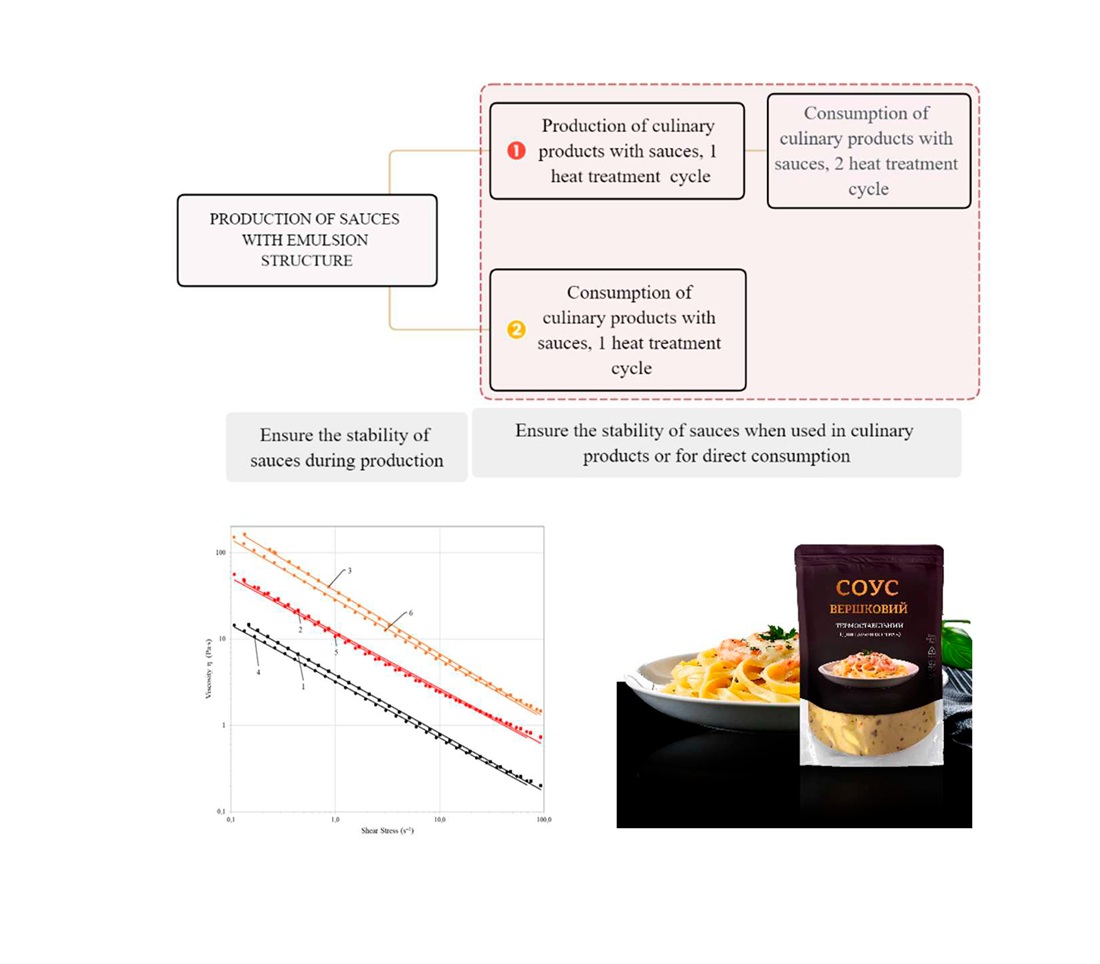
Об’єктом дослідження є соуси гарячі з емульсійною структурою, а саме їх мікроструктурні та реологічні показники. Основною проблемою, яка вирішувалася в рамках дослідження, було виявлення можливості двоциклічного термообробляння соусів з максимальним збереженням їх властивостей. Це дозволить суттєво розширити їх технологічне використання, зокрема, у складі готових до споживання страв індустріального виробництва. Такий підхід сприяє обґрунтуванню технологічного використання соусів за одночасного визначення показників, які є точками контролю в технологічному потоці їх виробництва.
Дослідження мікроструктури соусів продемонстрували бімодальний характер розподілу частинок з двома вираженими піками, які знаходяться в діапазоні 2.42–4.03 µm та 31.10–36.30 µm. Індекс SPAN знаходиться в діапазоні 1.62–1.72, відображає помірну полідисперсність. Одно- та двоциклічне термообробляння соусів сприяє зменшенню питомої поверхні та зростанню значень об’ємно-поверхневого діаметра частинок, що свідчить про зміну мікроструктурних характеристики соусів. Соуси є структурованими харчовими системами, які демонструють типову неньютонівську поведінку. Під час циклічного термообробляння соусів має місце підвищення в’язкості, модулів накопичення та втрат в ряду «соус свіжевиготовлений ® соус після 1 циклу термообробляння ® соус після 2 циклу термообробляння».
Відмінна особливість експериментальних результатів полягає у дослідженні соусів, які споживаються гарячими, що визначає додаткові вимоги до їх стабільності. Запропоновані в роботі технологічні рішення спрямовані на виробництво їх у вигляді напівфабрикатів високого ступеня готовності
Посилання
- Klymenko, N., Voronenko, I., Nehrey, M., Rogoza, K., Rogoza, N. (2023). Risk assessment of shock periods and investment attractiveness of agroholdings of Ukraine. Agricultural and Resource Economics: International Scientific E-Journal, 9 (2). https://doi.org/10.51599/are.2023.09.02.07
- Ivanov, V., Shevchenko, O., Marynin, A., Stabnikov, V., Gubenia, O., Stabnikova, O. et al. (2021). Trends and expected benefits of the breaking edge food technologies in 2021–2030. Ukrainian Food Journal, 10 (1), 7–36. https://doi.org/10.24263/2304-974x-2021-10-1-3
- Market Research Report on Sauces n Ukraine. 2025 Year. Available at: https://pro-consulting.ua/en/issledovanie-rynka/analiz-rynka-sousov-v-ukraine-2025-god
- Goralchuk, A., Grinchenko, O., Riabets, O., Kotlyar, О. (2019). Food dispersion systems process stabilization. A review. Ukrainian Food Journal, 8 (4), 699–732. https://doi.org/10.24263/2304-974x-2019-8-4-4
- Krstonošić, V., Dokić, L., Nikolić, I., Milanović, M. (2015). Influence of xanthan gum on oil-in-water emulsion characteristics stabilized by OSA starch. Food Hydrocolloids, 45, 9–17. https://doi.org/10.1016/j.foodhyd.2014.10.024
- Agama-Acevedo, E., Bello-Perez, L. A. (2017). Starch as an emulsions stability: the case of octenyl succinic anhydride (OSA) starch. Current Opinion in Food Science, 13, 78–83. https://doi.org/10.1016/j.cofs.2017.02.014
- Hedayati, S., Shahidi, F., Koocheki, A., Farahnaky, A., Majzoobi, M. (2020). Influence of pregelatinized and granular cold water swelling maize starches on stability and physicochemical properties of low fat oil-in-water emulsions. Food Hydrocolloids, 102, 105620. https://doi.org/10.1016/j.foodhyd.2019.105620
- Hrynchenko, O., Radchenko, A., Dehtiar, V., Grynchenko, N., Serik, M. (2025). Development of technology for food products with emulsion structure based on pea groats and pea aquafaba. Eastern-European Journal of Enterprise Technologies, 1 (11 (133)), 17–27. https://doi.org/10.15587/1729-4061.2025.323339
- Jo, M., Chang, M. J., Goh, K. K. T., Ban, C., Choi, Y. J. (2021). Rheology, Microstructure, and Storage Stability of Emulsion-Filled Gels Stabilized Solely by Maize Starch Modified with Octenyl Succinylation and Pregelatinization. Foods, 10 (4), 837. https://doi.org/10.3390/foods10040837
- Degner, B. M. (2013) Freeze stabilty enhancement of dairy emulsions by microparticulated whey protein. ETD collection for University of Nebraska-Lincoln. AAI3603563. Available at: https://digitalcommons.unl.edu/dissertations/AAI3603563
- Ianushkevich, O., Grynchenko, N. (2023). Justification of the choice of food ingredients for obtaining thermostable emulsion systems as the basis of hot sauces. Science Bulletin of Poltava University of Economics and Trade. Series "Technical Sciences", 1, 19–24. Available at: http://puet.poltava.ua/index.php/technical/article/view/189
- Hernández-Carrión, M., Guardeño, L. M., Carot, J. M., Pérez-Munuera, I., Quiles, A., Hernando, I. (2011). Structural stability of white sauces prepared with different types of fats and thawed in a microwave oven. Journal of Food Engineering, 104 (4), 557–564. https://doi.org/10.1016/j.jfoodeng.2011.01.017
- Ramirez-Sucre, M. O., Allende, D. B. (2016). Effect of Thermal Treatment on the Rheological Behavior of Habanero Chili (Capsicum chinense) Sauces Added with Guar and Xanthan Gums. Agrociencia, 50 (7), 837–847. Available at: https://www.scielo.org.mx/scielo.php?script=sci_arttext&pid=S1405-31952016000700837&lng=es&nrm=iso&tlng=en
- Herranz, B., Martínez, A., Alvarez, M. D. (2019). Influence of Fiber Addition on White Sauces Made with Corn Starch: Effect on Their Freezing/Thawing Stability. Journal of Food Science, 84 (8), 2128–2138. https://doi.org/10.1111/1750-3841.14700
- McClements, D. J. (2015). Food Emulsions. CRC Press. https://doi.org/10.1201/b18868
- Alvarez, M., Fuentes, R., Canet, W. (2015). Effects of Pressure, Temperature, Treatment Time, and Storage on Rheological, Textural, and Structural Properties of Heat-Induced Chickpea Gels. Foods, 4 (2), 80–114. https://doi.org/10.3390/foods4020080
- Sudheesh, C., Sunooj, K. V., Sinha, S. K., George, J., Kumar, S., Murugesan, P. et al. (2019). Impact of energetic neutral nitrogen atoms created by glow discharge air plasma on the physico-chemical and rheological properties of kithul starch. Food Chemistry, 294, 194–202. https://doi.org/10.1016/j.foodchem.2019.05.067
- Guimarães, C. F., Gasperini, L., Ribeiro, R. S., Carvalho, A. F., Marques, A. P., Reis, R. L. (2020). High-throughput fabrication of cell-laden 3D biomaterial gradients. Materials Horizons, 7 (9), 2414–2421. https://doi.org/10.1039/d0mh00818d
- Mezger, T. G. (2012). The Rheology Handbook. Vincentz Network. https://doi.org/10.1515/9783748600367
- Bortnowska, G., Balejko, J., Tokarczyk, G., Romanowska-Osuch, A., Krzemińska, N. (2014). Effects of pregelatinized waxy maize starch on the physicochemical properties and stability of model low-fat oil-in-water food emulsions. Food Hydrocolloids, 36, 229–237. https://doi.org/10.1016/j.foodhyd.2013.09.012
- Yanushkevych, O. I., Hrynchenko, N. H. (2023). Study of the influence of technological factors on the viscosity of pasteurized dispersions of native and modified starches. Food production equipment and technologies, 1 (46), 26–33. Available at: https://oblad.donnuet.edu.ua/index.php/tehnolog/article/view/204/179
##submission.downloads##
Опубліковано
Як цитувати
Номер
Розділ
Ліцензія
Авторське право (c) 2025 Oleksandr Ianushkevych, Nataliya Grynchenko, Anna Radchenko, Iryna Smetanska, Andrii Marynin, Olha Hrynchenko

Ця робота ліцензується відповідно до Creative Commons Attribution 4.0 International License.
Закріплення та умови передачі авторських прав (ідентифікація авторства) здійснюється у Ліцензійному договорі. Зокрема, автори залишають за собою право на авторство свого рукопису та передають журналу право першої публікації цієї роботи на умовах ліцензії Creative Commons CC BY. При цьому вони мають право укладати самостійно додаткові угоди, що стосуються неексклюзивного поширення роботи у тому вигляді, в якому вона була опублікована цим журналом, але за умови збереження посилання на першу публікацію статті в цьому журналі.
Ліцензійний договір – це документ, в якому автор гарантує, що володіє усіма авторськими правами на твір (рукопис, статтю, тощо).
Автори, підписуючи Ліцензійний договір з ПП «ТЕХНОЛОГІЧНИЙ ЦЕНТР», мають усі права на подальше використання свого твору за умови посилання на наше видання, в якому твір опублікований. Відповідно до умов Ліцензійного договору, Видавець ПП «ТЕХНОЛОГІЧНИЙ ЦЕНТР» не забирає ваші авторські права та отримує від авторів дозвіл на використання та розповсюдження публікації через світові наукові ресурси (власні електронні ресурси, наукометричні бази даних, репозитарії, бібліотеки тощо).
За відсутності підписаного Ліцензійного договору або за відсутністю вказаних в цьому договорі ідентифікаторів, що дають змогу ідентифікувати особу автора, редакція не має права працювати з рукописом.
Важливо пам’ятати, що існує і інший тип угоди між авторами та видавцями – коли авторські права передаються від авторів до видавця. В такому разі автори втрачають права власності на свій твір та не можуть його використовувати в будь-який спосіб.