Development of approaches for the bioconversion of dietary fibers in flax meal using cellulolytic enzymes
DOI:
https://doi.org/10.15587/1729-4061.2025.325418Keywords:
cellulolytic enzymes, dietary fiber, flaxseed meal, α-linolenic acid, antioxidantsAbstract
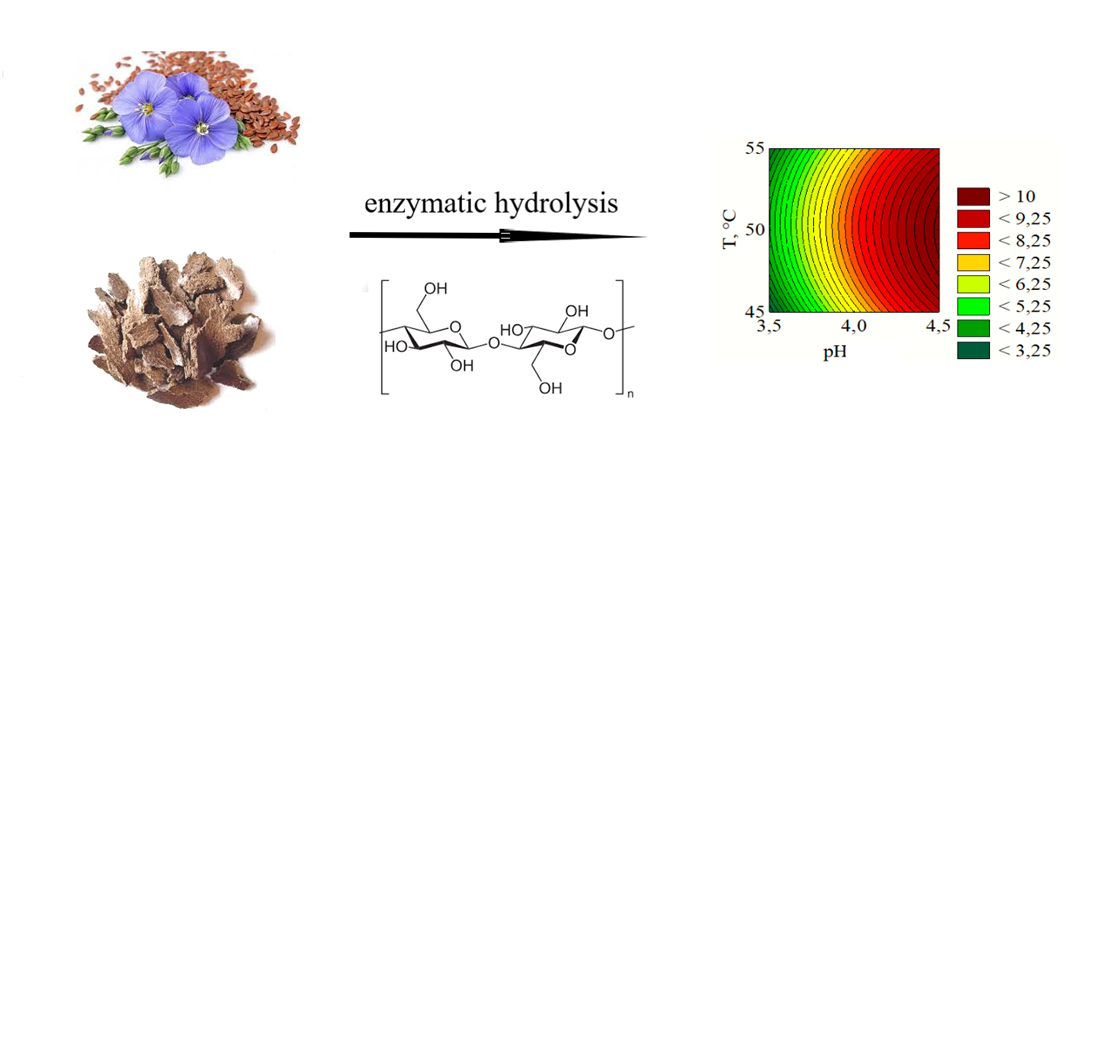
The object of the study is the process of enzymatic hydrolysis of dietary fiber in flax meal, aimed at the bioconversion of cellulose into soluble sugars. The work considers the use of cellulolytic enzymes and an antioxidant for the hydrolysis of cellulose in flax meal. This allows to increase the bioavailability of soluble sugars and other nutritional compounds, as well as to preserve polyunsaturated fatty acids (PUFA) of the lipid component of the meal, in particular alpha-linolenic acid (ALA), from oxidative destruction. The rational parameters of the enzymatic hydrolysis process are determined: pH 4.5 and temperature 50 °C, which ensure the maximum yield of soluble sugars (11.4 %) with minimal losses of ALA (9.0 %). The use of an antioxidant – sodium salt of erythorbic acid (E 316) to protect PUFA from oxidative damage during enzymatic hydrolysis is also considered. The most effective concentration of sodium erythorbate was 0.03–0.035 %, which minimizes ALA losses to 1.4 %. The results of the research are important for the development of new technologies for processing flaxseed meal, which will contribute to improving the quality of products and their preservation for a long period. The results obtained are explained by biochemical and chemical interactions between the components of the reaction mixture (enzyme, buffer, antioxidant) and the components of flaxseed meal (dietary fiber, lipid complexes). This leads to an increase in the efficiency of cellulose hydrolysis and the preservation of PUFA from oxidation. The results obtained allow to consider flaxseed meal with hydrolyzed cellulose as a promising product for the food industry and feed production
References
- Makarova, A., Baurin, D., Gordienko, M., Kudryavtseva, E., Grosheva, V., Yakubovich, L. (2017). Algorithm of multi-criterion green process assessment for renewable raw materials bioconversion. Journal of Cleaner Production, 162, 380–390. https://doi.org/10.1016/j.jclepro.2017.06.013
- Stankevych, S., Gorbunov, K., Zabrodina, I., Popov, M., Kalyna, V., Novozhylova, T. et al. (2024). Identification of the oxidation and hydrolysis products content influence on the rapeseed oil oxidation induction period. Technology Organic and Inorganic Substances, 4 (6 (130)), 6–13. https://doi.org/10.15587/1729-4061.2024.308907
- Belinska, A., Bliznjuk, O., Masalitina, N., Bielykh, I., Zviahintseva, O., Gontar, T. et al. (2023). Development of biotechnologically transesterified three-component fat systems stable to oxidation. Eastern-European Journal of Enterprise Technologies, 5 (6 (125)), 21–28. https://doi.org/10.15587/1729-4061.2023.287326
- Kaur, M., Singh, A. K., Singh, A. (2023). Bioconversion of food industry waste to value added products: Current technological trends and prospects. Food Bioscience, 55, 102935. https://doi.org/10.1016/j.fbio.2023.102935
- Mishra, A. P., Devkota, H. P., Nigam, M., Adetunji, C. O., Srivastava, N., Saklani, S. et al. (2020). Combination of essential oils in dairy products: A review of their functions and potential benefits. LWT, 133, 110116. https://doi.org/10.1016/j.lwt.2020.110116
- Petik, I., Litvinenko, O., Stankevych, S., Zabrodina, I., Ponomarova, M., Kotliar, O. et al. (2024). Determination of the cellulose- and lipid-containing components influence on the extrudate technological indicators. Eastern-European Journal of Enterprise Technologies, 2 (6 (128)), 6–13. https://doi.org/10.15587/1729-4061.2024.301843
- Abilmazhinov, Y., Bekeshova, G., Nesterenko, A., Dibrova, Z., Ermolaev, V., Ponomarev, E., Vlasova, V. (2023). A Review on The Improvement of Extruded Food Processing Equipment: Extrusion Cooking in Food Processing. Food Science and Technology, 43. https://doi.org/10.5327/fst.80621
- Al-molah, M. I., Kloor, I. S. (2023). The Effect of Substituting De-Hulled Sunflower Meal Instead of Soybean Meal with or Without Adding Xylanase Enzyme to the Ration on Productive Performance and Carcass Characteristics of Broiler Chicks. IOP Conference Series: Earth and Environmental Science, 1259 (1), 012074. https://doi.org/10.1088/1755-1315/1259/1/012074
- Lannuzel, C., Smith, A., Mary, A. L., Della Pia, E. A., Kabel, M. A., de Vries, S. (2022). Improving fiber utilization from rapeseed and sunflower seed meals to substitute soybean meal in pig and chicken diets: A review. Animal Feed Science and Technology, 285, 115213. https://doi.org/10.1016/j.anifeedsci.2022.115213
- Petik, I., Litvinenko, O., Kalyna, V., Ilinska, O., Raiko, V., Filenko, O. et al. (2023). Development of extruded animal feed based on fat and oil industry waste. Eastern-European Journal of Enterprise Technologies, 2 (11 (122)), 112–120. https://doi.org/10.15587/1729-4061.2023.275509
- Bochkarev, S., Chaika, T., Stankevych, S., Zabrodina, I., Balandina, I., Obolentseva, L. et al. (2024). Development of an extruded system with enhanced content of alpha-linolenic polyunsaturated fatty acid. Eastern-European Journal of Enterprise Technologies, 6 (11 (132)), 15–23. https://doi.org/10.15587/1729-4061.2024.315246
- Belinska, A., Ryshchenko, I., Bliznjuk, O., Masalitina, N., Siedykh, K., Zolotarova, S. et al. (2024). Development of a method for inactivating lipoxygenases in linseed using chemical reagents. Technology Organic and Inorganic Substances, 4 (6 (130)), 14–21. https://doi.org/10.15587/1729-4061.2024.309079
- Hyde, K. D., Xu, J., Rapior, S., Jeewon, R., Lumyong, S., Niego, A. G. T. et al. (2019). The amazing potential of fungi: 50 ways we can exploit fungi industrially. Fungal Diversity, 97 (1), 1–136. https://doi.org/10.1007/s13225-019-00430-9
- Talwar, B., Chopra, R., Taneja, N. K., Chand, M., Homroy, S., Dhiman, A. et al. (2025). Use of flaxseed cake as a source of nutrients in the food industry and possible health benefits- a review. Food Production, Processing and Nutrition, 7 (1). https://doi.org/10.1186/s43014-024-00294-w
- Song, Y., Sun, L., Wang, H., Zhang, S., Fan, K., Mao, Y. et al. (2023). Enzymatic fermentation of rapeseed cake significantly improved the soil environment of tea rhizosphere. BMC Microbiology, 23 (1). https://doi.org/10.1186/s12866-023-02995-7
Downloads
Published
How to Cite
Issue
Section
License
Copyright (c) 2025 Anna Belinska, Igor Ryshchenko, Olga Bliznjuk, Nataliia Masalitina, Maryna Chuiko, Yana Svishchova, Tatiana Gavrish, Maryna Ponomarova, Mykola Denysenko, Olexii Varypaiev

This work is licensed under a Creative Commons Attribution 4.0 International License.
The consolidation and conditions for the transfer of copyright (identification of authorship) is carried out in the License Agreement. In particular, the authors reserve the right to the authorship of their manuscript and transfer the first publication of this work to the journal under the terms of the Creative Commons CC BY license. At the same time, they have the right to conclude on their own additional agreements concerning the non-exclusive distribution of the work in the form in which it was published by this journal, but provided that the link to the first publication of the article in this journal is preserved.
A license agreement is a document in which the author warrants that he/she owns all copyright for the work (manuscript, article, etc.).
The authors, signing the License Agreement with TECHNOLOGY CENTER PC, have all rights to the further use of their work, provided that they link to our edition in which the work was published.
According to the terms of the License Agreement, the Publisher TECHNOLOGY CENTER PC does not take away your copyrights and receives permission from the authors to use and dissemination of the publication through the world's scientific resources (own electronic resources, scientometric databases, repositories, libraries, etc.).
In the absence of a signed License Agreement or in the absence of this agreement of identifiers allowing to identify the identity of the author, the editors have no right to work with the manuscript.
It is important to remember that there is another type of agreement between authors and publishers – when copyright is transferred from the authors to the publisher. In this case, the authors lose ownership of their work and may not use it in any way.








