Розробка складу стабілізаційної системи для соусів-дресингів
DOI:
https://doi.org/10.15587/1729-4061.2025.325772Ключові слова:
стабілізаційна система, соуси-дресинги, ефіри жирних кислот та сахарози, рН водної фази, стабільність емульсіїАнотація
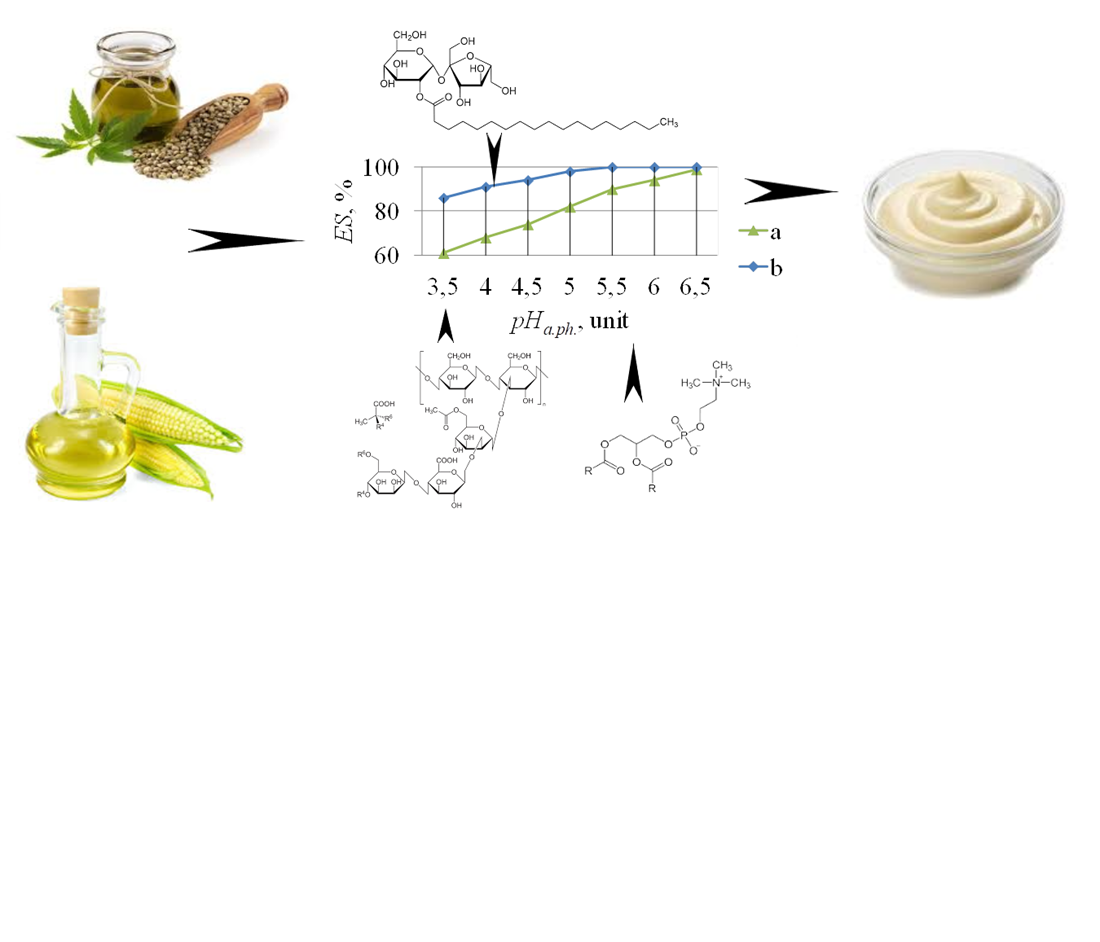
Об’єктом дослідження є стабільність модельної емульсії з стабілізаційною системою, що включає рідкий соєвий лецитин, ксантанову камідь та ефіри жирних кислот та сахарози (E 473) під впливом змін рН водної фази. Розглянуто шлях вирішення проблеми стабілізації емульсійних систем у кислому середовищі (рН від 4,0 до 5,5) шляхом раціоналізації складу стабілізаційної системи соусів-дресингів. Визначено, що стабільність емульсійної системи, стабілізованої соєвим лецитином та ксантановою каміддю, зростає зі збільшенням рН. При цьому у діапазоні рН 3,5–5,0 залишається на відносно низькому рівні (60–82 %), що потребує удосконалення стабілізаційної системи для соусів-дресингів. Обґрунтовано раціональний діапазон концентрації E 473 у стабілізаційній системі для соусів-дресінгів. Встановлено, що введення E 473 у концентрації 0,3 % сприяє суттєвому підвищенню стабільності модельних зразків емульсії в умовах низьких значень рН. Запропоновано апроксимаційну залежність стабільності емульсійної системи від концентрації E 473 та рН водної фази, яка дозволяє прогнозувати ефективність стабілізаційної системи в заданих умовах. Особливістю отриманих результатів є те, що використання E 473 забезпечує значне підвищення стабільності емульсійної системи, що є критично важливим для збереження фізико-хімічних властивостей соусів-дресингів, які найчастіше мають кисле середовище. З практичної точки зору розробка дозволяє ефективно стабілізувати харчові емульсійні системи в широкому діапазоні рН, зменшуючи ризик фазового розшарування. Прикладним аспектом використання отриманого наукового результату є можливість моделювання та розробки нових рецептур емульсійних продуктів, зокрема соусів-дресінгів, із покращеними структурно-механічними характеристиками
Посилання
- Khalesi, H., Lu, W., Nishinari, K., Fang, Y. (2020). New insights into food hydrogels with reinforced mechanical properties: A review on innovative strategies. Advances in Colloid and Interface Science, 285, 102278. https://doi.org/10.1016/j.cis.2020.102278
- Stankevych, S., Gorbunov, K., Zabrodina, I., Popov, M., Kalyna, V., Novozhylova, T. et al. (2024). Identification of the oxidation and hydrolysis products content influence on the rapeseed oil oxidation induction period. Technology Organic and Inorganic Substances, 4 (6 (130)), 6–13. https://doi.org/10.15587/1729-4061.2024.308907
- Batchelor, D. V. B., Armistead, F. J., Ingram, N., Peyman, S. A., Mclaughlan, J. R., Coletta, P. L., Evans, S. D. (2021). Nanobubbles for therapeutic delivery: Production, stability and current prospects. Current Opinion in Colloid & Interface Science, 54, 101456. https://doi.org/10.1016/j.cocis.2021.101456
- Zhang, A.-Q., Li, X.-Y., Han, Y.-N., Liu, B.-H., Zhang, H.-L., Gao, J.-H., Zhang, Y.-H. (2022). Improving interface properties of zein hydrolysis and its application in salad dressing through dispersion improvement assisted by potassium oleate aqueous solution. Food Hydrocolloids, 130, 107719. https://doi.org/10.1016/j.foodhyd.2022.107719
- Putyatin, B., Bliznjuk, O., Masalitina, N., Bezpal’ko, V., Zhukova, L., Filenko, O. et al. (2024). Identifying the influence of the concentration of surfactants on the technological indicators of aerosol emulsion. Eastern-European Journal of Enterprise Technologies, 6 (6 (132)), 6–15. https://doi.org/10.15587/1729-4061.2024.317819
- Sukumar, A., Gurumoorthi, P., Athmaselvi, K. A. (2023). Effect of ultrasonication on emulsion formulation, encapsulation efficiency, and oxidative stability of spray dried chia seed oil. Journal of Food Science and Technology, 60 (6), 1761–1771. https://doi.org/10.1007/s13197-023-05716-0
- Sivabalan, S., Sablani, S. (2022). Design of β-Carotene Encapsulated Emulsions for Thermal Processing and Storage. Food and Bioprocess Technology, 15 (2), 338–351. https://doi.org/10.1007/s11947-021-02754-4
- Kunitsia, E., Popov, M., Gontar, T., Stankevych, S., Zabrodina, I., Stepankova, G. et al. (2024). Determination of the influence of hemp oil-based emulsion systems composition on the oxidation products content during storage. Eastern-European Journal of Enterprise Technologies, 3 (6 (129)), 6–13. https://doi.org/10.15587/1729-4061.2024.304466
- Kalyna, V., Stankevych, S., Zabrodina, I., Shubina, L., Chuiko, M., Mikheeva, O. et al. (2024). Development of the composition of anoxidation-stable dressing with high nutritional value. Eastern-European Journal of Enterprise Technologies, 1 (11 (127)), 29–37. https://doi.org/10.15587/1729-4061.2024.296621
- Felix-Sagaste, K. G., Garcia-Carrasco, M., Picos-Corrales, L. A., Gonzalez-Ruelas, T., Rodriguez-Mercado, J. A. (2023). Plant-animal extracts and biocompatible polymers forming oil-in-water emulsions: Formulations for food and pharmaceutical industries. Hybrid Advances, 3, 100072. https://doi.org/10.1016/j.hybadv.2023.100072
- Shirvani, A., Goli, S. A. H., Varshosaz, J., Salvia-Trujillo, L., Martín-Belloso, O. (2023). Edible Wax-Based Nanoparticles as Novel Stabilizers for Oil-in-Water Pickering Emulsion. Food and Bioprocess Technology, 16 (6), 1356–1373. https://doi.org/10.1007/s11947-023-03014-3
- Ashfaq, A., Osama, K., Yousuf, O., Younis, K. (2024). Protein-based Emulsion Hydrogels and Their Application in the Development of Sustainable Food Products. Plant Foods for Human Nutrition, 79 (4), 759–768. https://doi.org/10.1007/s11130-024-01214-6
- Zhu, T., Ma, L., Jiang, H., Li, W., Guo, X., Yang, C., Bu, G. (2023). Functional, structural properties of pea protein isolate-xylooligosaccharide glycosylated conjugate and its application in O/W emulsion preparation. Journal of Food Measurement and Characterization, 17 (6), 6135–6143. https://doi.org/10.1007/s11694-023-02102-4
- Vélez-Erazo, E. M., Silva, I. L., Comunian, T., Kurozawa, L. E., Hubinger, M. D. (2020). Effect of chia oil and pea protein content on stability of emulsions obtained by ultrasound and powder production by spray drying. Journal of Food Science and Technology, 58 (10), 3765–3779. https://doi.org/10.1007/s13197-020-04834-3
- Liu, X., McClements, D. J., Cao, Y., Xiao, H. (2016). Chemical and Physical Stability of Astaxanthin-Enriched Emulsion-Based Delivery Systems. Food Biophysics, 11 (3), 302–310. https://doi.org/10.1007/s11483-016-9443-6
- Tirgarian, B., Farmani, J., Farahmandfar, R., Milani, J. M., Van Bockstaele, F. (2023). Switchable pH-responsive Biopolymeric Stabilizers Made by Sonothermal Glycation of Sodium Caseinate with κappa-carrageenan. Food Biophysics. https://doi.org/10.1007/s11483-023-09778-7
- Shi, L., Cheng, Y., Jia, C., Lin, H., Zhang, W., He, J. (2024). Stable complex of sodium caseinate and hexaglycerol monooleate with improved oil-in-water emulsion stability and curcumin encapsulation. Food Biophysics, 19 (2), 321–333. https://doi.org/10.1007/s11483-024-09828-8
##submission.downloads##
Опубліковано
Як цитувати
Номер
Розділ
Ліцензія
Авторське право (c) 2025 Katerina Kunitsa, Aliona Dikhtyar, Oleh Kotliar, Svitlana Andrieieva, Tatiana Gontar, Serhii Stankevych, Iryna Balandina, Larysa Obolentseva, Oleg Kolontaievskyi, Anton Ryabev

Ця робота ліцензується відповідно до Creative Commons Attribution 4.0 International License.
Закріплення та умови передачі авторських прав (ідентифікація авторства) здійснюється у Ліцензійному договорі. Зокрема, автори залишають за собою право на авторство свого рукопису та передають журналу право першої публікації цієї роботи на умовах ліцензії Creative Commons CC BY. При цьому вони мають право укладати самостійно додаткові угоди, що стосуються неексклюзивного поширення роботи у тому вигляді, в якому вона була опублікована цим журналом, але за умови збереження посилання на першу публікацію статті в цьому журналі.
Ліцензійний договір – це документ, в якому автор гарантує, що володіє усіма авторськими правами на твір (рукопис, статтю, тощо).
Автори, підписуючи Ліцензійний договір з ПП «ТЕХНОЛОГІЧНИЙ ЦЕНТР», мають усі права на подальше використання свого твору за умови посилання на наше видання, в якому твір опублікований. Відповідно до умов Ліцензійного договору, Видавець ПП «ТЕХНОЛОГІЧНИЙ ЦЕНТР» не забирає ваші авторські права та отримує від авторів дозвіл на використання та розповсюдження публікації через світові наукові ресурси (власні електронні ресурси, наукометричні бази даних, репозитарії, бібліотеки тощо).
За відсутності підписаного Ліцензійного договору або за відсутністю вказаних в цьому договорі ідентифікаторів, що дають змогу ідентифікувати особу автора, редакція не має права працювати з рукописом.
Важливо пам’ятати, що існує і інший тип угоди між авторами та видавцями – коли авторські права передаються від авторів до видавця. В такому разі автори втрачають права власності на свій твір та не можуть його використовувати в будь-який спосіб.