Чисельна оптимізація стратегій керування зв’язаними коливальними системами
DOI:
https://doi.org/10.15587/1729-4061.2025.326029Ключові слова:
принцип максимуму Понтрягіна, хвильове рівняння, метод прямих, функціональна збіжністьАнотація
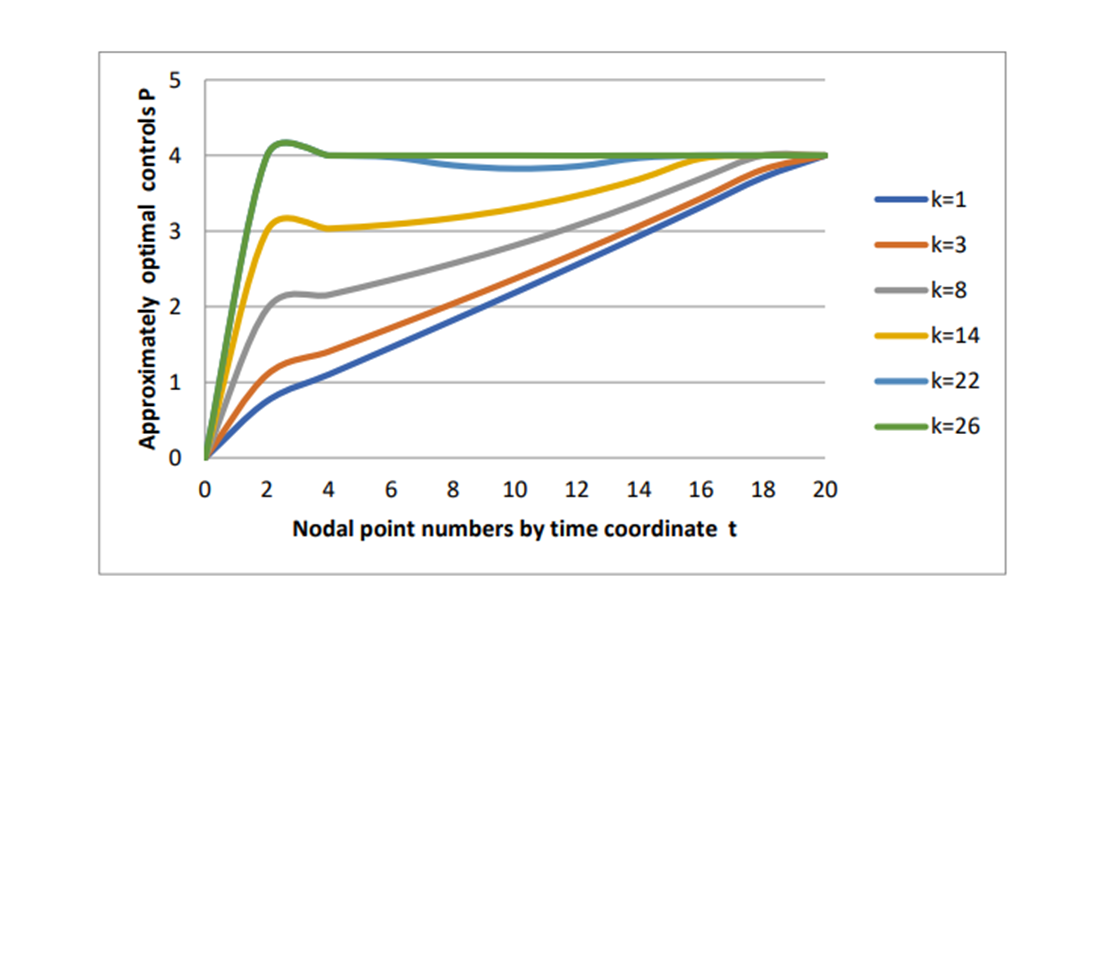
Досліджено чисельне розв’язування задач контролю вібрації у зв’язаній системі, що складається з двох взаємодіючих об’єктів. Задача розв’язується в припущенні, що ліва межа розподіленої системи є фіксованою, а об’єкт із зосередженими параметрами приєднаний до правої межі, де до розподіленої системи також застосовується дія керування межею. Особливу увагу приділено отриманню чисельного розв’язку задачі. До розв’язання підходять два методи: метод градієнтної проекції та, внаслідок лінійності крайової задачі щодо фазових координат і керуючих входів, метод послідовних наближень. Введенням додаткової змінної одновимірне хвильове рівняння апроксимується методом ліній, перетворюючи його на систему звичайних диференціальних рівнянь 2n-го порядку. Отримана варіаційна задача для системи із зосередженими параметрами потім чисельно розв’язується на основі принципу максимуму Понтрягіна. Наближені оптимальні керування, отримані методом градієнтної проекції зі спеціально підібраним розміром кроку, утворюють мінімізуючу послідовність керування. На основі чисельних результатів встановлено функціональну збіжність. Метод послідовних наближень забезпечує оптимальне рішення керування вже на другій ітерації, незалежно від початкового керування. Це свідчить про ефективність і надійність методу для вирішення лінійних задач оптимального керування. Розроблені чисельні методи можуть бути застосовані для оптимізації динамічної поведінки складних механічних конструкцій, підвищення стабільності системи та підвищення ефективності роботи в різних інженерних додатках
Посилання
- Fagerholt, K., Psaraftis, H. N. (2015). On two speed optimization problems for ships that sail in and out of emission control areas. Transportation Research Part D: Transport and Environment, 39, 56–64. https://doi.org/10.1016/j.trd.2015.06.005
- Entner, D., Fleck, P., Vosgien, T., Münzer, C., Finck, S., Prante, T., Schwarz, M. (2019). A Systematic Approach for the Selection of Optimization Algorithms including End-User Requirements Applied to Box-Type Boom Crane Design. Applied System Innovation, 2 (3), 20. https://doi.org/10.3390/asi2030020
- Alharbi, F., Luo, S., Zhang, H., Shaukat, K., Yang, G., Wheeler, C. A., Chen, Z. (2023). A Brief Review of Acoustic and Vibration Signal-Based Fault Detection for Belt Conveyor Idlers Using Machine Learning Models. Sensors, 23 (4), 1902. https://doi.org/10.3390/s23041902
- Okba, A. C., Salah, K. (2022). Analytical and numerical-graphical optimization of dynamic vibration absorber based on two-fixed point theory. International Journal of Mechanics and Control, 22.
- Fayyaz, Bashmal, S., Nazir, A., Khan, S., Alofi, A. (2025). Damping Optimization and Energy Absorption of Mechanical Metamaterials for Enhanced Vibration Control Applications: A Critical Review. Polymers, 17 (2), 237. https://doi.org/10.3390/polym17020237
- Lariviere, O., Chadefaux, D., Sauret, C., Thoreux, P. (2021). Vibration https://doi.org/10.1002/9780470411353Transmission during Manual Wheelchair Propulsion: A Systematic Review. Vibration, 4 (2), 444–481. https://doi.org/10.3390/vibration4020029
- Alba, E., Blum, C., Isasi, P., León, C., Gómez, J. A. (Eds.) (2008). Optimization Techniques for Solving Complex Problems. John Wiley & Sons. https://doi.org/10.1002/9780470411353
- Poley, R. (2020). Control Theory Fundamentals. CreateSpace Independent Publishing Platform.
- Rodriguez-Loya, J., Lerma, M., Gardea-Torresdey, J. L. (2023). Dynamic Light Scattering and Its Application to Control Nanoparticle Aggregation in Colloidal Systems: A Review. Micromachines, 15 (1), 24. https://doi.org/10.3390/mi15010024
- Omar, N., Serra-Capizzano, S., Qaraad, B., Alharbi, F., Moaaz, O., Elabbasy, E. M. (2024). More Effective Criteria for Testing the Oscillation of Solutions of Third-Order Differential Equations. Axioms, 13 (3), 139. https://doi.org/10.3390/axioms13030139
- Mamtiyev, K., Rzayeva, U. (2024). Finding and implementing the numerical solution of an optimal control problem for oscillations in a coupled objects system. Eastern-European Journal of Enterprise Technologies, 2 (2 (128)), 64–74. https://doi.org/10.15587/1729-4061.2024.301714
- Liu, H., Cui, S., Liu, Y., Ren, Y., Sun, Y. (2018). Design and Vibration Suppression Control of a Modular Elastic Joint. Sensors, 18 (6), 1869. https://doi.org/10.3390/s18061869
- Ram, Y. M., Inman, D. J. (1999). Optimal control for vibrating systems. Mechanical Systems and Signal Processing, 13 (6), 879–892. https://doi.org/10.1006/mssp.1999.1239
- Zhang, J. F. (2002). Optimal control for mechanical vibration systems based on second-order matrix equations. Mechanical Systems and Signal Processing, 16 (1), 61–67. https://doi.org/10.1006/mssp.2001.1441
##submission.downloads##
Опубліковано
Як цитувати
Номер
Розділ
Ліцензія
Авторське право (c) 2025 Kamil Mamtiyev, Ulviyya Rzayeva, Rena Mikayilova

Ця робота ліцензується відповідно до Creative Commons Attribution 4.0 International License.
Закріплення та умови передачі авторських прав (ідентифікація авторства) здійснюється у Ліцензійному договорі. Зокрема, автори залишають за собою право на авторство свого рукопису та передають журналу право першої публікації цієї роботи на умовах ліцензії Creative Commons CC BY. При цьому вони мають право укладати самостійно додаткові угоди, що стосуються неексклюзивного поширення роботи у тому вигляді, в якому вона була опублікована цим журналом, але за умови збереження посилання на першу публікацію статті в цьому журналі.
Ліцензійний договір – це документ, в якому автор гарантує, що володіє усіма авторськими правами на твір (рукопис, статтю, тощо).
Автори, підписуючи Ліцензійний договір з ПП «ТЕХНОЛОГІЧНИЙ ЦЕНТР», мають усі права на подальше використання свого твору за умови посилання на наше видання, в якому твір опублікований. Відповідно до умов Ліцензійного договору, Видавець ПП «ТЕХНОЛОГІЧНИЙ ЦЕНТР» не забирає ваші авторські права та отримує від авторів дозвіл на використання та розповсюдження публікації через світові наукові ресурси (власні електронні ресурси, наукометричні бази даних, репозитарії, бібліотеки тощо).
За відсутності підписаного Ліцензійного договору або за відсутністю вказаних в цьому договорі ідентифікаторів, що дають змогу ідентифікувати особу автора, редакція не має права працювати з рукописом.
Важливо пам’ятати, що існує і інший тип угоди між авторами та видавцями – коли авторські права передаються від авторів до видавця. В такому разі автори втрачають права власності на свій твір та не можуть його використовувати в будь-який спосіб.