Identifying of rational conditions for etherification of sunflower soapstock fatty acids
DOI:
https://doi.org/10.15587/1729-4061.2025.326031Keywords:
butyl esters of fatty acids, esterification of fatty acids, waste from the oil and fat industryAbstract
The object of the study is the process of esterification of sunflower soapstock fatty acids with butanol.
Soapstock is a waste of the oil and fat industry, which is formed in the process of alkaline neutralization of oils. The processing of soapstock to obtain fatty acids is promising, since the disposal of waste is difficult and dangerous, and fatty acids are an industrially valuable product. Fatty acids obtained from soapstock are an available raw material for the production of fatty acid esters of low molecular weight alcohols, which are the basis of alternative biodiesel fuel.
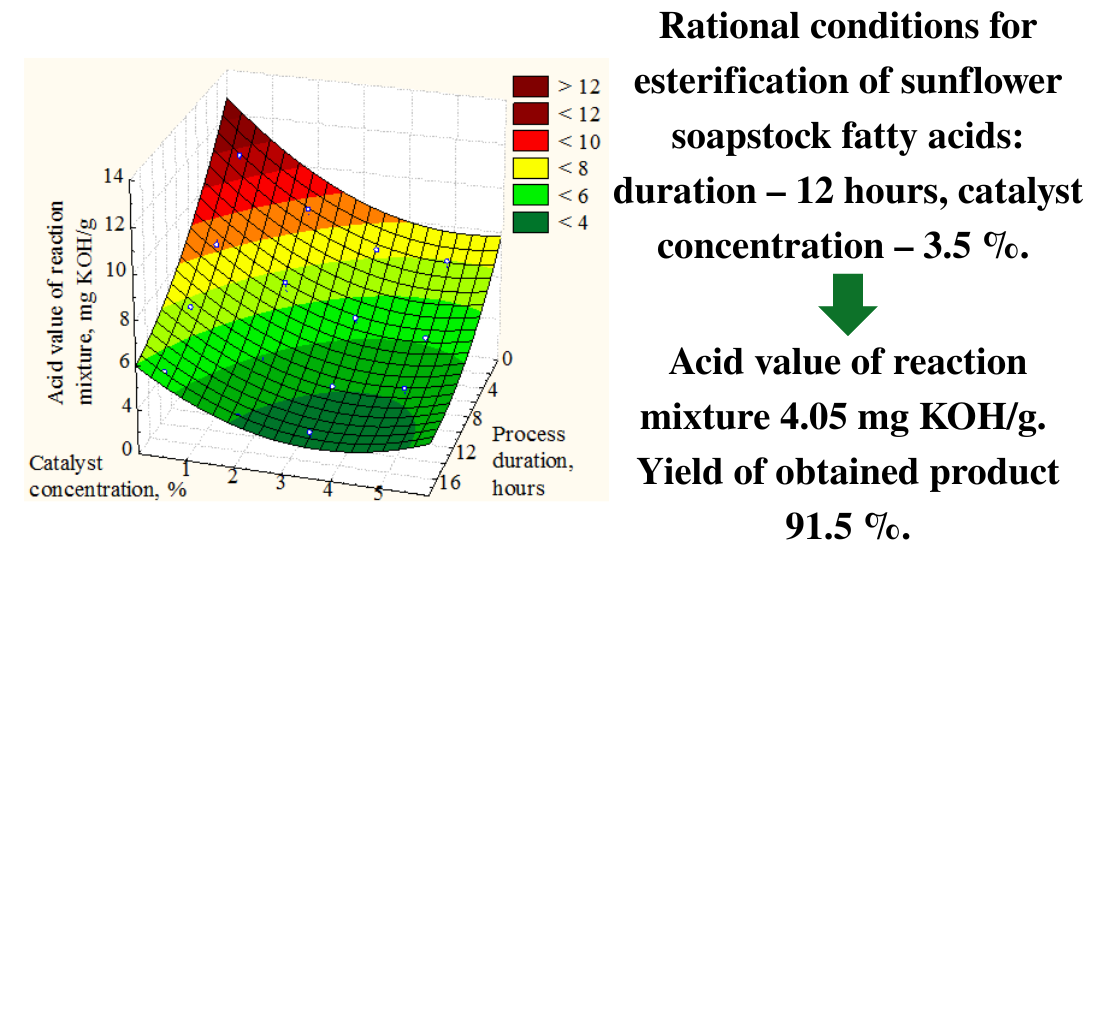
The influence of the conditions of esterification of fatty acids from sunflower soapstock (CAS Number 61788-66-7) with butanol (CAS Number 71-36-3) in the presence of an alkylbenzenesulfonic acid catalyst on the acid value of the reaction mixture was studied. This indicator reflects an increase in the content of butyl esters.
The fatty acids used, obtained from soapstock by decomposition with sulfuric acid, meet the requirements of DSTU 4860 for first-grade fatty acids. The neutralization number of fatty acids is 186.0 mg KOH/g, the mass fraction of moisture and volatile substances is 1.7 %, the mass fraction of total fat is 97.5 %, the depth of cleavage is 67.1 % of oleic acid.
Rational conditions for the esterification process have been established, which correspond to the maximum reduction in the acid value of the reaction mixture: duration is 12 hours, catalyst concentration is 3.5 %. In this case, the acid value of the reaction mass was 4.05 mg KOH/g. The product yield was 91.5 %. Product parameters: mass fraction of esters – 92.7 %, mass fraction of total glycerol – 0.20 %, mass fraction of moisture 0.04 %, density at the temperature of 15 °C – 840 kg/m3.
The results obtained make it possible to obtain a high-quality base for biodiesel fuel using soapstock fatty acids under rational conditions
References
- Babadi, A. A., Rahmati, S., Fakhlaei, R., Barati, B., Wang, S., Doherty, W., Ostrikov, K. (Ken). (2022). Emerging technologies for biodiesel production: Processes, challenges, and opportunities. Biomass and Bioenergy, 163, 106521. https://doi.org/10.1016/j.biombioe.2022.106521
- Mahlia, T. M. I., Syazmi, Z. A. H. S., Mofijur, M., Abas, A. E. P., Bilad, M. R., Ong, H. C., Silitonga, A. S. (2020). Patent landscape review on biodiesel production: Technology updates. Renewable and Sustainable Energy Reviews, 118, 109526. https://doi.org/10.1016/j.rser.2019.109526
- Sytnik, N., Kunitsia, E., Mazaeva, V., Kalyna, V., Chernukha, A., Vazhynskyi, S. et al. (2021). Rational conditions of fatty acids obtaining by soapstock treatment with sulfuric acid. Eastern-European Journal of Enterprise Technologies, 4 (6 (112)), 6–13. https://doi.org/10.15587/1729-4061.2021.236984
- Kurczyński, D., Wcisło, G., Leśniak, A., Kozak, M., Łagowski, P. (2022). Production and Testing of Butyl and Methyl Esters as New Generation Biodiesels from Fatty Wastes of the Leather Industry. Energies, 15 (22), 8744. https://doi.org/10.3390/en15228744
- Ali Ijaz Malik, M., Zeeshan, S., Khubaib, M., Ikram, A., Hussain, F., Yassin, H., Qazi, A. (2024). A review of major trends, opportunities, and technical challenges in biodiesel production from waste sources. Energy Conversion and Management: X, 23, 100675. https://doi.org/10.1016/j.ecmx.2024.100675
- Konovalov, S., Patrylak, L., Zubenko, S., Okhrimenko, M., Yakovenko, A., Levterov, A., Avramenko, A. (2021). Bench Motor Testing of Blended Fuels on their Basis. Chemistry & Chemical Technology, 15 (1), 105–117. https://doi.org/10.23939/chcht15.01.105
- Konovalov, S. V., Zubenko, S. O., Patrylak, L. K., Yakovenko, A. V. (2021). Fuel-grade sunflower oil butyl esters: synthesis, purification, oxidation stability. Catalysis and Petrochemistry, 32, 40–53. https://doi.org/10.15407/kataliz2021.32.040
- Navas, M. B., Lick, I. D., Bolla, P. A., Casella, M. L., Ruggera, J. F. (2018). Transesterification of soybean and castor oil with methanol and butanol using heterogeneous basic catalysts to obtain biodiesel. Chemical Engineering Science, 187, 444–454. https://doi.org/10.1016/j.ces.2018.04.068
- Gaide, I., Makareviciene, V., Sendzikiene, E., Gumbytė, M. (2023). Rapeseed Oil Transesterification Using 1-Butanol and Eggshell as a Catalyst. Catalysts, 13 (2), 302. https://doi.org/10.3390/catal13020302
- Sathish Kumar, R., Krupa Vara Prasad, A. (2019). Environment friendly butyl ester biodiesel production from mahua oil: optimization and characterization. SN Applied Sciences, 1 (8). https://doi.org/10.1007/s42452-019-0913-6
- Ilmi, M., Abduh, M. Y., Hommes, A., Winkelman, J. G. M., Hidayat, C., Heeres, H. J. (2018). Process Intensification of Enzymatic Fatty Acid Butyl Ester Synthesis Using a Continuous Centrifugal Contactor Separator. Industrial & Engineering Chemistry Research, 57 (2), 470–482. https://doi.org/10.1021/acs.iecr.7b03297
- Sousa, R. R. de, Lázaro, C. da C., Gomes, C. B. de S. M. R., Silva, A. S. da, Fernandez-Lafuente, R., Ferreira-Leitão, V. S. (2023). Butyl-esters synthesis from palm fatty acid distillate catalyzed by immobilized lipases in solvent-free system – Optimization using a simplified method (SER). Process Biochemistry, 128, 158–166. https://doi.org/10.1016/j.procbio.2023.02.030
- Todeschini, J. K. P., Aguieiras, E. C. G., Castro, A. M. de, Langone, M. A. P., Freire, D. M. G., Rodrigues, R. C. (2016). Synthesis of butyl esters via ultrasound-assisted transesterification of macaúba (Acrocomia aculeata) acid oil using a biomass-derived fermented solid as biocatalyst. Journal of Molecular Catalysis B: Enzymatic, 133, S213–S219. https://doi.org/10.1016/j.molcatb.2017.01.007
- Wallis, C., Cerny, M., Lacroux, E., Mouloungui, Z. (2017). Recovery of slaughterhouse Animal Fatty Wastewater Sludge by conversion into Fatty Acid Butyl Esters by acid-catalyzed esterification. Waste Management, 60, 184–190. https://doi.org/10.1016/j.wasman.2016.07.003
Downloads
Published
How to Cite
Issue
Section
License
Copyright (c) 2025 Gabriella Birta, Nadiya Levoshko, Vladyslav Knysh, Svitlana Usenko, Anatolii Shostia, Tetiana Ovsiannikova, Tetiana Falalieieva, Larysa Marushko, Yevhen Semenko, Sergii Zygin

This work is licensed under a Creative Commons Attribution 4.0 International License.
The consolidation and conditions for the transfer of copyright (identification of authorship) is carried out in the License Agreement. In particular, the authors reserve the right to the authorship of their manuscript and transfer the first publication of this work to the journal under the terms of the Creative Commons CC BY license. At the same time, they have the right to conclude on their own additional agreements concerning the non-exclusive distribution of the work in the form in which it was published by this journal, but provided that the link to the first publication of the article in this journal is preserved.
A license agreement is a document in which the author warrants that he/she owns all copyright for the work (manuscript, article, etc.).
The authors, signing the License Agreement with TECHNOLOGY CENTER PC, have all rights to the further use of their work, provided that they link to our edition in which the work was published.
According to the terms of the License Agreement, the Publisher TECHNOLOGY CENTER PC does not take away your copyrights and receives permission from the authors to use and dissemination of the publication through the world's scientific resources (own electronic resources, scientometric databases, repositories, libraries, etc.).
In the absence of a signed License Agreement or in the absence of this agreement of identifiers allowing to identify the identity of the author, the editors have no right to work with the manuscript.
It is important to remember that there is another type of agreement between authors and publishers – when copyright is transferred from the authors to the publisher. In this case, the authors lose ownership of their work and may not use it in any way.








