Devising a method for stabilizing control over a load on a cluster gateway in the internet of things edge layer
DOI:
https://doi.org/10.15587/1729-4061.2025.326040Keywords:
Internet of Things, stabilizing control, information packet, buffer overload, boundary calculationsAbstract
The object of this study is the process of managing overload at the boundary layer of the geographically distributed Internet of Things.
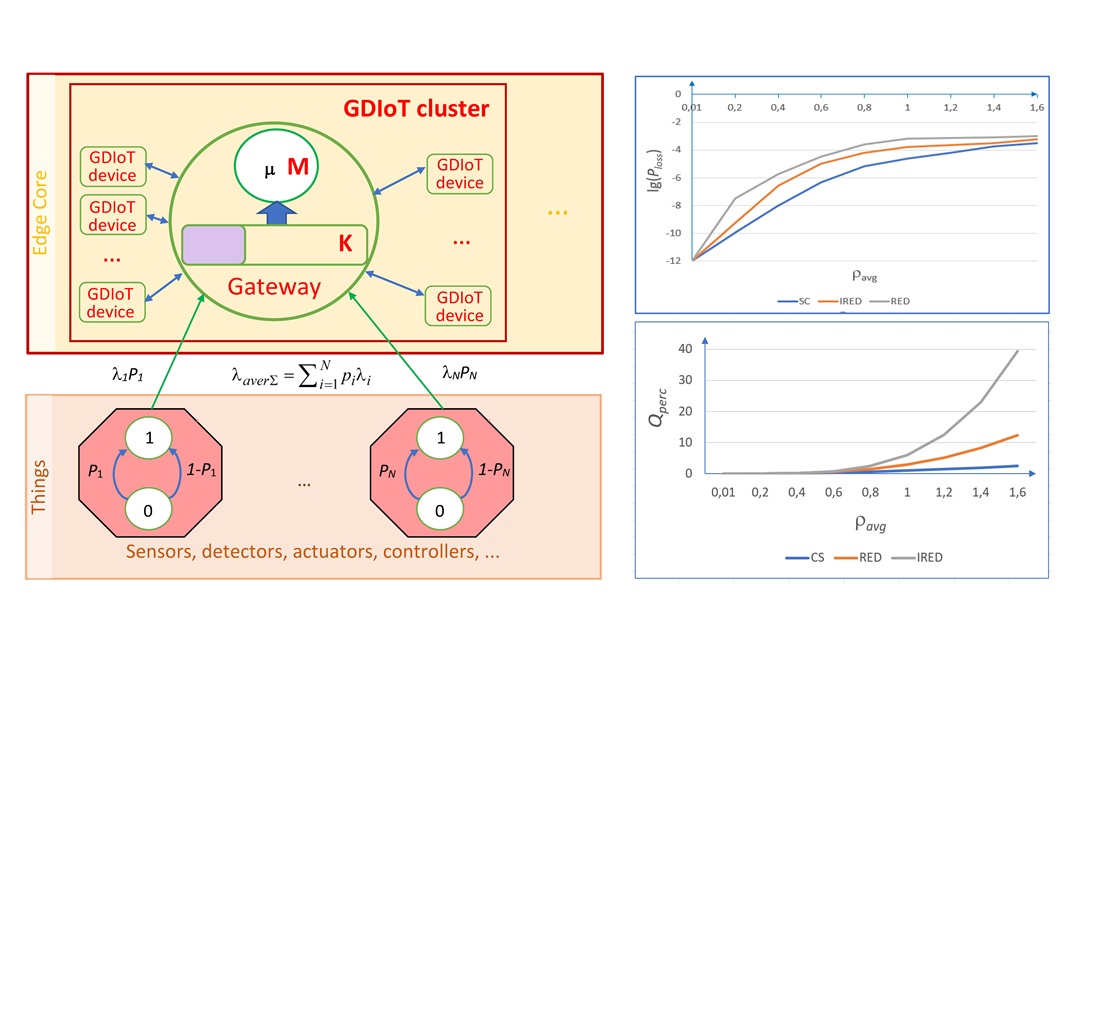
The task addressed is reducing the number of losses of information packets of the geographically distributed Internet of Things arriving at the boundary layer gateway. For this purpose, it was proposed to use fast temporal horizontal scaling and stabilizing control over the load formed in the gateway buffer.
In the process of conducting research, a temporal horizontal scaling algorithm was developed for the boundary layer cluster gateway. The evolutionary Firefly Algorithm with a fitness function based on the Lorenz function was used in the development. This made it possible to speed up the search for a cluster node for operational temporal scaling of the gateway for the period of gateway buffer overload.
The standard algorithm for intelligent queue management has been modified. The modification is based on the proposed method for stabilizing load control over the boundary layer cluster gateway of the geographically distributed Internet of Things. The method takes into account the features of the boundary layer architecture. The proposed method made it possible, in case of reaching the upper threshold of the queue, to scale the gateway until its buffer is filled. As a result, the number of information packet losses arriving at the boundary layer gateway was reduced. Studies of the proposed method showed that the number of information packet losses is reduced compared to existing methods. The research results can be explained by the use of temporary horizontal scaling of the gateway and fixing the thresholds of the information packet queue buffer. The method is effective at an average load level on the cluster gateway from 0.2 to 1.2
References
- Gamboa, A., Villazón, A., Meneses, A., Ormachea, O., Orellana, R. (2024). Altitude’s Impact on Photovoltaic Efficiency: An IoT-Enabled Geographically Distributed Remote Laboratory. Smart Technologies for a Sustainable Future, 133–144. https://doi.org/10.1007/978-3-031-61905-2_14
- Singh, S. P., Kumar, N., Kumar, G., Balusamy, B., Bashir, A. K., Dabel, M. M. A. (2025). Enhancing Quality of Service in IoT-WSN through Edge-Enabled Multi-Objective Optimization. IEEE Transactions on Consumer Electronics, 1–1. https://doi.org/10.1109/tce.2025.3526992
- Yan, M. (2024). Receive wireless sensor data through IoT gateway using web client based on border gateway protocol. Heliyon, 10 (11), e31625. https://doi.org/10.1016/j.heliyon.2024.e31625
- Kuchuk, N., Kashkevich, S., Radchenko, V., Andrusenko, Y., Kuchuk, H. (2024). Applying edge computing in the execution IoT operative transactions. Advanced Information Systems, 8 (4), 49–59. https://doi.org/10.20998/2522-9052.2024.4.07
- Kuchuk, H., & Malokhvii, E. (2024). Integration of IoT with cloud, fog, and edge computing: a review. Advanced Information Systems, 8 (2), 65–78. https://doi.org/10.20998/2522-9052.2024.2.08
- Alwakeel, A. M. (2021). An Overview of Fog Computing and Edge Computing Security and Privacy Issues. Sensors, 21 (24), 8226. https://doi.org/10.3390/s21248226
- Naveen, S., Kounte, M. R., Ahmed, M. R. (2021). Low Latency Deep Learning Inference Model for Distributed Intelligent IoT Edge Clusters. IEEE Access, 9, 160607–160621. https://doi.org/10.1109/access.2021.3131396
- Hao, L., Naik, V., Schulzrinne, H. (2022). DBAC: Directory-Based Access Control for Geographically Distributed IoT Systems. IEEE INFOCOM 2022 - IEEE Conference on Computer Communications, 360–369. https://doi.org/10.1109/infocom48880.2022.9796804
- Samir, A., Dagenborg, H. (2023). Adaptive Controller to Identify Misconfigurations and Optimize the Performance of Kubernetes Clusters and IoT Edge Devices. Service-Oriented and Cloud Computing, 170–187. https://doi.org/10.1007/978-3-031-46235-1_11
- Cui, H., Tang, Z., Lou, J., Jia, W. (2023). Online Container Scheduling for Low-Latency IoT Services in Edge Cluster Upgrade: A Reinforcement Learning Approach. 2023 IEEE/CIC International Conference on Communications in China (ICCC), 1–6. https://doi.org/10.1109/iccc57788.2023.10233668
- Kuchuk, H., Mozhaiev, O., Kuchuk, N., Tiulieniev, S., Mozhaiev, M., Gnusov, Y. et al. (2024). Devising a method for the virtual clustering of the Internet of Things edge environment. Eastern-European Journal of Enterprise Technologies, 1 (9 (127)), 60–71. https://doi.org/10.15587/1729-4061.2024.298431
- Vaiyapuri, T., Parvathy, V. S., Manikandan, V., Krishnaraj, N., Gupta, D., Shankar, K. (2021). A Novel Hybrid Optimization for Cluster‐Based Routing Protocol in Information-Centric Wireless Sensor Networks for IoT Based Mobile Edge Computing. Wireless Personal Communications, 127 (1), 39–62. https://doi.org/10.1007/s11277-021-08088-w
- Azimi, S., Pahl, C., Shirvani, M. (2020). Particle Swarm Optimization for Performance Management in Multi-cluster IoT Edge Architectures. Proceedings of the 10th International Conference on Cloud Computing and Services Science. https://doi.org/10.5220/0009391203280337
- Kuchuk, H., Kalinin, Y., Dotsenko, N., Chumachenko, I., Pakhomov, Y. (2024). Decomposition of integrated high-density IoT data flow. Advanced Information Systems, 8 (3), 77–84. https://doi.org/10.20998/2522-9052.2024.3.09
- Kuch Kuchuk, H., Husieva, Y., Novoselov, S., Lysytsia, D., Krykhovetskyi, H. (2025). Load balancing of the layers IoT fog-cloud support network. Advanced Information Systems, 9 (1), 91–98. https://doi.org/10.20998/2522-9052.2025.1.11
- Hunko, M., Tkachov, V., Kovalenko, A., Kuchuk, H. (2023). Advantages of Fog Computing: A Comparative Analysis with Cloud Computing for Enhanced Edge Computing Capabilities. 2023 IEEE 4th KhPI Week on Advanced Technology (KhPIWeek). https://doi.org/10.1109/khpiweek61412.2023.10312948
- Simaiya, S., Shrivastava, A., Keer, N. P. (2014). IRED Algorithm for Improvement in Performance of Mobile Ad Hoc Networks. 2014 Fourth International Conference on Communication Systems and Network Technologies, 283–287. https://doi.org/10.1109/csnt.2014.62
- Qasim, M., Sajid, M. (2024). An efficient IoT task scheduling algorithm in cloud environment using modified Firefly algorithm. International Journal of Information Technology, 17 (1), 179–188. https://doi.org/10.1007/s41870-024-01758-5
- Li, J., Zhou, T. (2024). Data-Driven Fully Distributed Load Frequency Control for an IoT-Based Interconnected Grid Considering a Performance-Based Frequency Regulation Market. IEEE Internet of Things Journal, 11 (17), 28692–28704. https://doi.org/10.1109/jiot.2024.3402274
- Petrovska, I., Kuchuk, H., Kuchuk, N., Mozhaiev, O., Pochebut, M., Onishchenko, Y. (2023). Sequential Series-Based Prediction Model in Adaptive Cloud Resource Allocation for Data Processing and Security. 2023 13th International Conference on Dependable Systems, Services and Technologies (DESSERT), 1–6. https://doi.org/10.1109/dessert61349.2023.10416496
- Carvalho, D., Sullivan, D., Almeida, R., Caminha, C. (2022). A Machine Learning Approach to Solve the Network Overload Problem Caused by IoT Devices Spatially Tracked Indoors. Journal of Sensor and Actuator Networks, 11 (2), 29. https://doi.org/10.3390/jsan11020029
- Sobchuk, V., Pykhnivskyi, R., Barabash, O., Korotin, S., Omarov, S. (2024). Sequential intrusion detection system for zero-trust cyber defense of IOT/IIOT networks. Advanced Information Systems, 8 (3), 92–99. https://doi.org/10.20998/2522-9052.2024.3.11
- Sundaram Paulraj, S. S., Kannabiran, V. (2024). Neuro‐fuzzy‐based cluster formation scheme for energy‐efficient data routing in IOT‐enabled WSN. International Journal of Communication Systems, 38 (3). https://doi.org/10.1002/dac.5984
Downloads
Published
How to Cite
Issue
Section
License
Copyright (c) 2025 Heorhii Kuchuk, Oleksandr Mozhaiev, Serhii Tiulieniev, Mykhailo Mozhaiev, Nina Kuchuk, Liliia Tymoshchyk, Andrii Lubentsov, Yurii Gnusov, Sergii Klivets, Alexander Kuleshov

This work is licensed under a Creative Commons Attribution 4.0 International License.
The consolidation and conditions for the transfer of copyright (identification of authorship) is carried out in the License Agreement. In particular, the authors reserve the right to the authorship of their manuscript and transfer the first publication of this work to the journal under the terms of the Creative Commons CC BY license. At the same time, they have the right to conclude on their own additional agreements concerning the non-exclusive distribution of the work in the form in which it was published by this journal, but provided that the link to the first publication of the article in this journal is preserved.
A license agreement is a document in which the author warrants that he/she owns all copyright for the work (manuscript, article, etc.).
The authors, signing the License Agreement with TECHNOLOGY CENTER PC, have all rights to the further use of their work, provided that they link to our edition in which the work was published.
According to the terms of the License Agreement, the Publisher TECHNOLOGY CENTER PC does not take away your copyrights and receives permission from the authors to use and dissemination of the publication through the world's scientific resources (own electronic resources, scientometric databases, repositories, libraries, etc.).
In the absence of a signed License Agreement or in the absence of this agreement of identifiers allowing to identify the identity of the author, the editors have no right to work with the manuscript.
It is important to remember that there is another type of agreement between authors and publishers – when copyright is transferred from the authors to the publisher. In this case, the authors lose ownership of their work and may not use it in any way.







