Determination of the design features of roadside air protection barriers of urban motorways using visual diagnostics and computational modelling
DOI:
https://doi.org/10.15587/1729-4061.2025.326375Keywords:
vehicle emissions, protective roadside barriers, visual diagnostics method, computational simulationAbstract
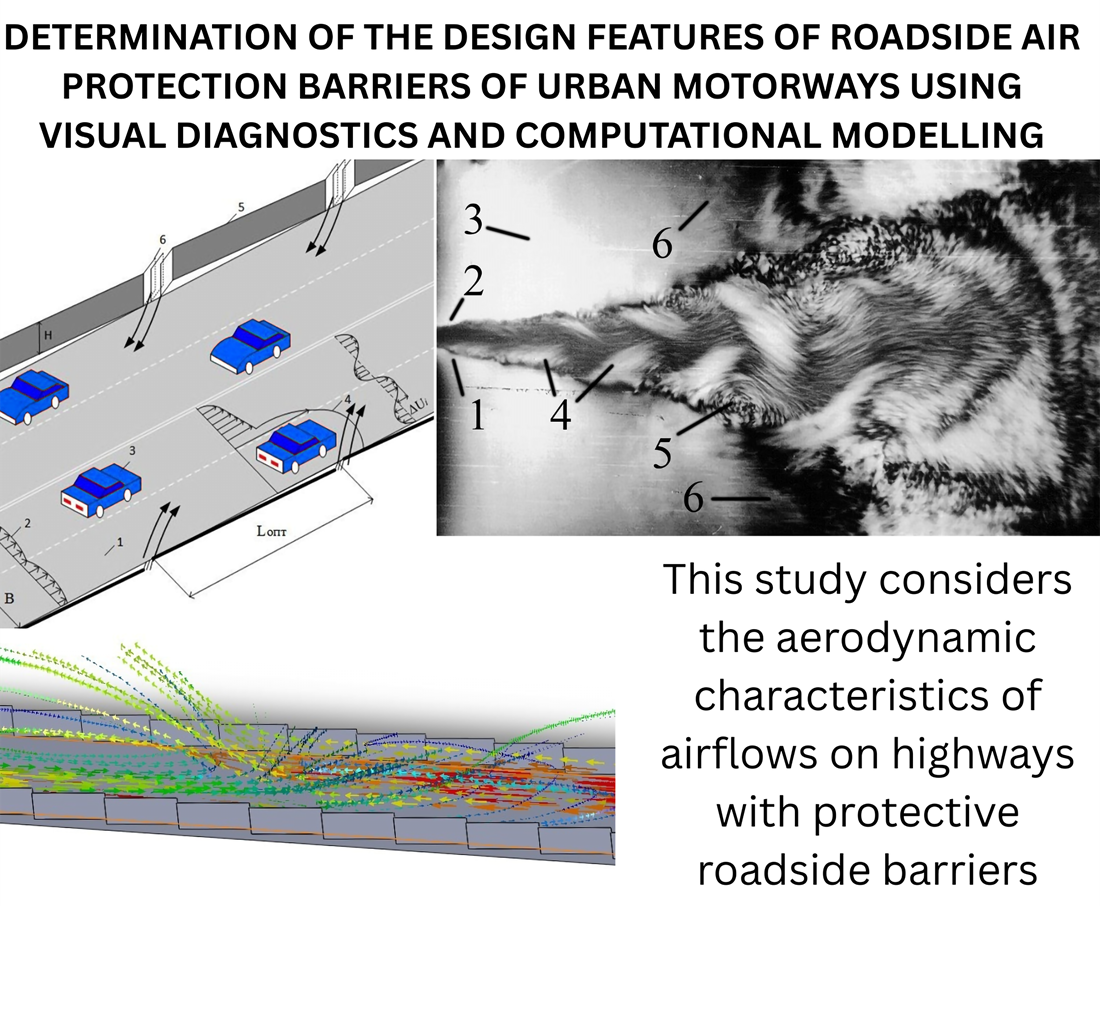
This study considers the aerodynamic characteristics of airflows on highways with protective roadside barriers. The task to optimize roadside barriers was addressed by analyzing airflow aerodynamic patterns using physical modeling and computational simulation. A flow structure visual diagnostics method (FSVD) was employed to analyze the kinematic features of airflow formation in the roadside barrier zone. It was established that the use of discrete-type barriers leads to the formation of stable air structures that enhance active flow mixing and dilution through external air entrainment. Each discrete element consists of a diffuser shield, expanding at an angle of 4° to the roadway axis, with a length equal to three lane widths. Additional elements in the form of parallel screens (confusors) are positioned between shields at an angle of 60° to the roadway axis. The combined approach, integrating FSVD and computational simulation in SOLIDWORKS Flow Simulation, provided a detailed representation of airflow behavior. It was determined that confusors between discrete shields generate an ejection effect, promoting external air entrainment and dilution within the roadway zone. This ensures unidirectional clean airflow and prevents exhaust gases from entering near-ground layers of residential areas. The applied computational model demonstrated the consistency and unidirectionality of dilution processes through ejection and dispersion via vertical flows. This enables better air circulation compared to conventional analogs, prevents stagnant zones, and reduces the impact of crosswinds and adverse atmospheric stability conditions. The devised structural solutions could be applied to design and optimize roadside barriers, particularly in residential areas
References
- Bonnici, D. (2022). It's 2024, how many cars are there in the world? Which Car. Available at: https://www.whichcar.com.au/news/how-many-cars-are-there-in-the-world
- Karner, A. A., Eisinger, D. S., Niemeier, D. A. (2010). Near-Roadway Air Quality: Synthesizing the Findings from Real-World Data. Environmental Science & Technology, 44 (14), 5334–5344. https://doi.org/10.1021/es100008x
- Han, B., Zhao, R., Zhang, N., Xu, J., Zhang, L., Yang, W. et al. (2021). Acute cardiovascular effects of traffic-related air pollution (TRAP) exposure in healthy adults: A randomized, blinded, crossover intervention study. Environmental Pollution, 288, 117583. https://doi.org/10.1016/j.envpol.2021.117583
- Tu, Y., Xu, C., Wang, W., Wang, Y., Jin, K. (2021). Investigating the impacts of driving restriction on NO2 concentration by integrating citywide scale cellular data and traffic simulation. Atmospheric Environment, 265, 118721. https://doi.org/10.1016/j.atmosenv.2021.118721
- Piracha, A., Chaudhary, M. T. (2022). Urban Air Pollution, Urban Heat Island and Human Health: A Review of the Literature. Sustainability, 14 (15), 9234. https://doi.org/10.3390/su14159234
- Vasiutynska, K., Barbashev, S. (2021). Impact assessment of the urbanization factors on the atmosphere pollution in the Ukraine regions. Transactions of Kremenchuk Mykhailo Ostrohradskyi National University, 4 (129), 83–89. https://doi.org/10.30929/1995-0519.2021.4.83-89
- Yehorova, O., Zhytska, L., Bakharev, V., Mislyuk, O., Khomenko, E. (2024). Assessing the deposition of heavy metals in edaphotopes and synantrophy vegetation under the conditions of technological pollution of the city. Eastern-European Journal of Enterprise Technologies, 1 (10 (127)), 15–26. https://doi.org/10.15587/1729-4061.2024.297718
- Xu, T., Barman, S., Levin, M. W., Chen, R., Li, T. (2022). Integrating public transit signal priority into max-pressure signal control: Methodology and simulation study on a downtown network. Transportation Research Part C: Emerging Technologies, 138, 103614. https://doi.org/10.1016/j.trc.2022.103614
- Tu, Y., Wang, W., Li, Y., Xu, C., Xu, T., Li, X. (2019). Longitudinal safety impacts of cooperative adaptive cruise control vehicle’s degradation. Journal of Safety Research, 69, 177–192. https://doi.org/10.1016/j.jsr.2019.03.002
- Abhijith, K. V., Kumar, P., Gallagher, J., McNabola, A., Baldauf, R., Pilla, F. et al. (2017). Air pollution abatement performances of green infrastructure in open road and built-up street canyon environments – A review. Atmospheric Environment, 162, 71–86. https://doi.org/10.1016/j.atmosenv.2017.05.014
- Hagler, G. S. W., Lin, M.-Y., Khlystov, A., Baldauf, R. W., Isakov, V., Faircloth, J., Jackson, L. E. (2012). Field investigation of roadside vegetative and structural barrier impact on near-road ultrafine particle concentrations under a variety of wind conditions. Science of The Total Environment, 419, 7–15. https://doi.org/10.1016/j.scitotenv.2011.12.002
- Leelőssy, Á., Molnár, F., Izsák, F., Havasi, Á., Lagzi, I., Mészáros, R. (2014). Dispersion modeling of air pollutants in the atmosphere: a review. Open Geosciences, 6 (3). https://doi.org/10.2478/s13533-012-0188-6
- Enayati Ahangar, F., Heist, D., Perry, S., Venkatram, A. (2017). Reduction of air pollution levels downwind of a road with an upwind noise barrier. Atmospheric Environment, 155, 1–10. https://doi.org/10.1016/j.atmosenv.2017.02.001
- Liang, M., Chao, Y., Tu, Y., Xu, T. (2023). Vehicle Pollutant Dispersion in the Urban Atmospheric Environment: A Review of Mechanism, Modeling, and Application. Atmosphere, 14 (2), 279. https://doi.org/10.3390/atmos14020279
- Forehead, H., Huynh, N. (2018). Review of modelling air pollution from traffic at street-level - The state of the science. Environmental Pollution, 241, 775–786. https://doi.org/10.1016/j.envpol.2018.06.019
- Hagler, G. S. W., Tang, W., Freeman, M. J., Heist, D. K., Perry, S. G., Vette, A. F. (2011). Model evaluation of roadside barrier impact on near-road air pollution. Atmospheric Environment, 45 (15), 2522–2530. https://doi.org/10.1016/j.atmosenv.2011.02.030
- Huertas, J. I., Aguirre, J. E., Lopez Mejia, O. D., Lopez, C. H. (2021). Design of Road-Side Barriers to Mitigate Air Pollution near Roads. Applied Sciences, 11 (5), 2391. https://doi.org/10.3390/app11052391
- Amini, S., Ahangar, F. E., Schulte, N., Venkatram, A. (2016). Using models to interpret the impact of roadside barriers on near-road air quality. Atmospheric Environment, 138, 55–64. https://doi.org/10.1016/j.atmosenv.2016.05.001
- Francisco, D. M., Heist, D. K., Venkatram, A., Brouwer, L. H., Perry, S. G. (2022). Observations and parameterization of the effects of barrier height and source-to-barrier distance on concentrations downwind of a roadway. Atmospheric Pollution Research, 13 (4), 101385. https://doi.org/10.1016/j.apr.2022.101385
- Hashad, K., Steffens, J. T., Baldauf, R. W., Heist, D. K., Deshmukh, P., Zhang, K. M. (2024). Resolving the effect of roadside vegetation barriers as a near-road air pollution mitigation strategy. Environmental Science: Advances, 3 (3), 411–421. https://doi.org/10.1039/d3va00220a
- Biliaiev, M., Pshinko, O., Rusakova, T., Biliaieva, V., Sładkowski, A. (2021). Computing model for simulation of the pollution dispersion near the road with solid barriers. Transport Problems, 16 (2), 73–86. https://doi.org/10.21307/tp-2021-024
- Biliaiev, M. M., Berlov, O. V., Biliaieva, V. V., Kozachyna, V. A., Yakubovska, Z. M. (2023). Investigation of the effectiveness for protective screens of various forms on air pollution reduction. Ukrainian Journal of Civil Engineering and Architecture, 4 (016), 27–33. https://doi.org/10.30838/j.bpsacea.2312.290823.27.967
- Maisotsenko, V. S., Arsiri, V. A. (1998). Pat. No. US005838587A. Method of restricted space formation for working media motion. Available at: https://patentimages.storage.googleapis.com/aa/b0/ab/183c93d862432c/US5838587.pdf
- Arsiriy, V. A., Kroshka, A. V., Ryabokon', P. M., Kravchenko, O. V. (2022). Vizualizaciya struktury potokov dlya issledovaniya gidrodinamicheskih parametrov zhidkostey i gazov. International journal Sustainable development, 2, 66–73.
- Arsiri, V., Kravchenko, O. (2018). Reconstruction of Turbomachines on the Basis of the Flow Structure Visual Diagnostics. Mechanics and Mechanical Engineering, 22 (2), 405–414. https://doi.org/10.2478/mme-2018-0032
- SOLIDWORKS Flow Simulation. Available at: https://www.solidworks.com/product/solidworks-flow-simulation
- Nikuradse, J. (1950). Laws of Flow in Rough Pipes. National Advisory Commission for Aeronautics. Washington: DC, USA, 62. Available at: https://ntrs.nasa.gov/citations/19930093938
Downloads
Published
How to Cite
Issue
Section
License
Copyright (c) 2025 Kateryna Vasiutynska, Vasyl Arsirii, Sergiy Smyk, Olena Makovetska

This work is licensed under a Creative Commons Attribution 4.0 International License.
The consolidation and conditions for the transfer of copyright (identification of authorship) is carried out in the License Agreement. In particular, the authors reserve the right to the authorship of their manuscript and transfer the first publication of this work to the journal under the terms of the Creative Commons CC BY license. At the same time, they have the right to conclude on their own additional agreements concerning the non-exclusive distribution of the work in the form in which it was published by this journal, but provided that the link to the first publication of the article in this journal is preserved.
A license agreement is a document in which the author warrants that he/she owns all copyright for the work (manuscript, article, etc.).
The authors, signing the License Agreement with TECHNOLOGY CENTER PC, have all rights to the further use of their work, provided that they link to our edition in which the work was published.
According to the terms of the License Agreement, the Publisher TECHNOLOGY CENTER PC does not take away your copyrights and receives permission from the authors to use and dissemination of the publication through the world's scientific resources (own electronic resources, scientometric databases, repositories, libraries, etc.).
In the absence of a signed License Agreement or in the absence of this agreement of identifiers allowing to identify the identity of the author, the editors have no right to work with the manuscript.
It is important to remember that there is another type of agreement between authors and publishers – when copyright is transferred from the authors to the publisher. In this case, the authors lose ownership of their work and may not use it in any way.







