Development of a methodological approach for assessing the condition of complex organizational and technical systems
DOI:
https://doi.org/10.15587/1729-4061.2025.326468Keywords:
hierarchical structures, metaheuristic algorithms, evolving artificial neural networks, destabilizing factorsAbstract
In this study, the object of research is organizational and technical systems. The primary issue addressed is the enhancement of operational efficiency in assessing the state of such systems under constraints related to data reliability, regardless of the volume of incoming data acquired from information sources. The subject of the research is the process of evaluating the condition of organizational and technical systems. The study presents the development of a methodological approach for assessing the condition of complex organizational and technical systems. The originality of the proposed approach lies in the implementation of advanced auxiliary procedures that enable the following:
– deployment of a search population of hippopotamus agents across the search plane, accounting for uncertainty in the information acquired through technical means about the organizational and technical system, by employing appropriate corrective coefficients. This enables a reduction in the time required for initial configuration of the subsystem responsible for processing heterogeneous data from extraction sources;
– additional consideration of the velocity of each agent within the hippopotamus swarm, allowing the prioritization of search tasks by each individual agent within the corresponding search space (across elements and components of the organizational and technical system);
– verification of the algorithm’s convergence to local and global optima;
– replacement of ineffective search agents by refreshing the population of hippopotamus agents;
– implementation of deep learning mechanisms for the knowledge bases of the hippopotamus agent swarm;
– estimation of the required computational resources in cases where the available computational capacity is insufficient for performing the necessary calculations.
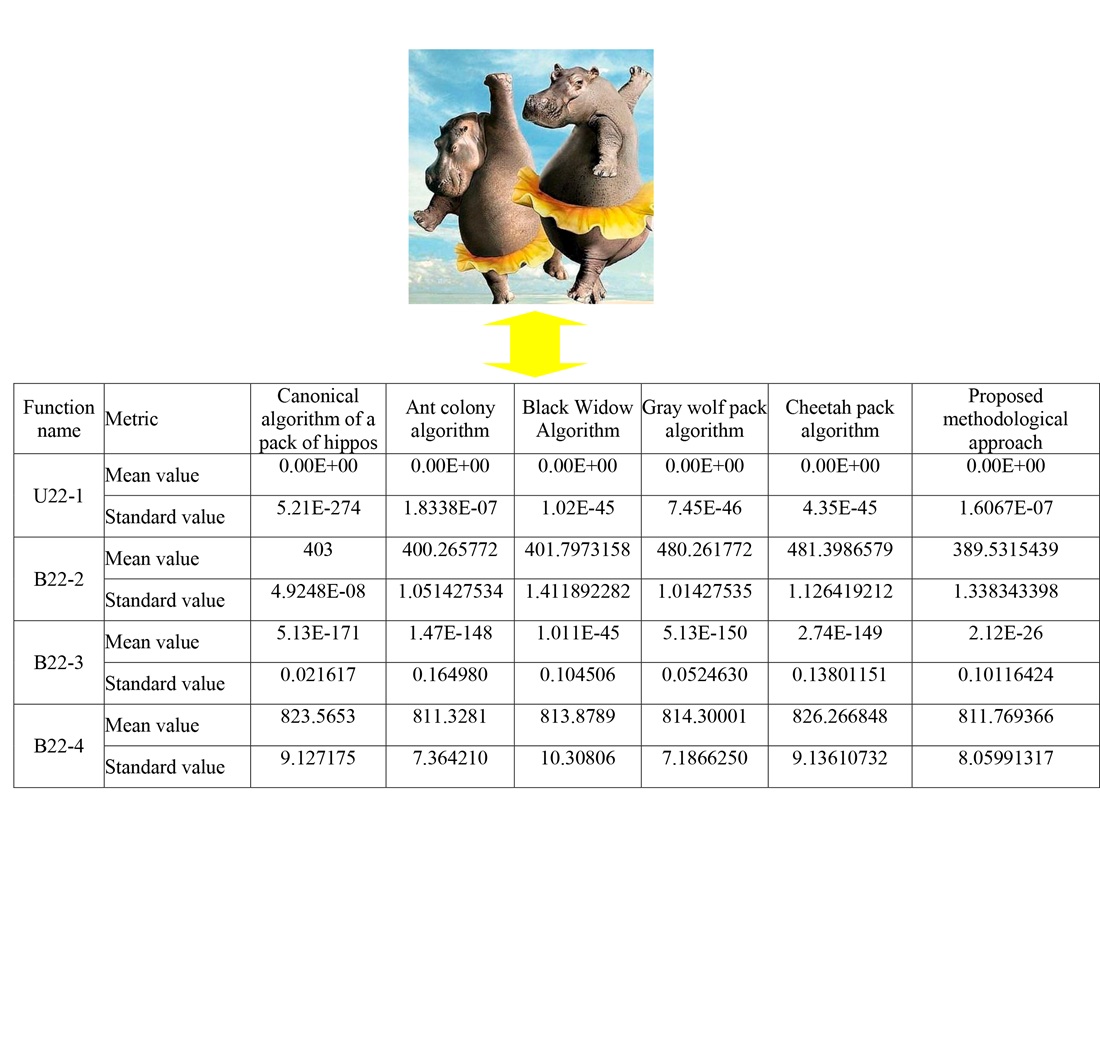
An illustrative example demonstrated a 13–16 % increase in decision-making efficiency due to the integration of additional procedures, while ensuring a decision reliability level of 0.9
References
- Bashkyrov, O. M., Kostyna, O. M., Shyshatskyi, A. V. (2015). Rozvytok intehrovanykh system zviazku ta peredachi danykh dlia potreb Zbroinykh Syl. Ozbroiennia ta viyskova tekhnika, 1, 35–39. Available at: http://nbuv.gov.ua/UJRN/ovt_2015_1_7
- Dudnyk, V., Sinenko, Y., Matsyk, M., Demchenko, Y., Zhyvotovskyi, R., Repilo, I. et al. (2020). Development of a method for training artificial neural networks for intelligent decision support systems. Eastern-European Journal of Enterprise Technologies, 3 (2 (105)), 37–47. https://doi.org/10.15587/1729-4061.2020.203301
- Sova, O., Shyshatskyi, A., Salnikova, O., Zhuk, O., Trotsko, O., Hrokholskyi, Y. (2021). Development of a method for assessment and forecasting of the radio electronic environment. EUREKA: Physics and Engineering, 4, 30–40. https://doi.org/10.21303/2461-4262.2021.001940
- Pievtsov, H., Turinskyi, O., Zhyvotovskyi, R., Sova, O., Zvieriev, O., Lanetskii, B., Shyshatskyi, A. (2020). Development of an advanced method of finding solutions for neuro-fuzzy expert systems of analysis of the radioelectronic situation. EUREKA: Physics and Engineering, 4, 78–89. https://doi.org/10.21303/2461-4262.2020.001353
- Zuiev, P., Zhyvotovskyi, R., Zvieriev, O., Hatsenko, S., Kuprii, V., Nakonechnyi, O. et al. (2020). Development of complex methodology of processing heterogeneous data in intelligent decision support systems. Eastern-European Journal of Enterprise Technologies, 4 (9 (106)), 14–23. https://doi.org/10.15587/1729-4061.2020.208554
- Shyshatskyi, A. (2020). Complex Methods of Processing Different Data in Intellectual Systems for Decision Support System. International Journal of Advanced Trends in Computer Science and Engineering, 9 (4), 5583–5590. https://doi.org/10.30534/ijatcse/2020/206942020
- Yeromina, N., Kurban, V., Mykus, S., Peredrii, O., Voloshchenko, O., Kosenko, V. et al. (2021). The Creation of the Database for Mobile Robots Navigation under the Conditions of Flexible Change of Flight Assignment. International Journal of Emerging Technology and Advanced Engineering, 11 (5), 37–44. https://doi.org/10.46338/ijetae0521_05
- Shyshatskyi, A., Stasiuk, T., Odarushchenko, E., Berezanska, K., Demianenko, H. (2023). Method of assessing the state of hierarchical objects based on bio-inspired algorithms. Advanced Information Systems, 7 (3), 44–48. https://doi.org/10.20998/2522-9052.2023.3.06
- Ko, Y.-C., Fujita, H. (2019). An evidential analytics for buried information in big data samples: Case study of semiconductor manufacturing. Information Sciences, 486, 190–203. https://doi.org/10.1016/j.ins.2019.01.079
- Ramaji, I. J., Memari, A. M. (2018). Interpretation of structural analytical models from the coordination view in building information models. Automation in Construction, 90, 117–133. https://doi.org/10.1016/j.autcon.2018.02.025
- Pérez-González, C. J., Colebrook, M., Roda-García, J. L., Rosa-Remedios, C. B. (2019). Developing a data analytics platform to support decision making in emergency and security management. Expert Systems with Applications, 120, 167–184. https://doi.org/10.1016/j.eswa.2018.11.023
- Chen, H. (2018). Evaluation of Personalized Service Level for Library Information Management Based on Fuzzy Analytic Hierarchy Process. Procedia Computer Science, 131, 952–958. https://doi.org/10.1016/j.procs.2018.04.233
- Chan, H. K., Sun, X., Chung, S.-H. (2019). When should fuzzy analytic hierarchy process be used instead of analytic hierarchy process? Decision Support Systems, 125, 113114. https://doi.org/10.1016/j.dss.2019.113114
- Osman, A. M. S. (2019). A novel big data analytics framework for smart cities. Future Generation Computer Systems, 91, 620–633. https://doi.org/10.1016/j.future.2018.06.046
- Gödri, I., Kardos, C., Pfeiffer, A., Váncza, J. (2019). Data analytics-based decision support workflow for high-mix low-volume production systems. CIRP Annals, 68 (1), 471–474. https://doi.org/10.1016/j.cirp.2019.04.001
- Harding, J. L. (2013). Data quality in the integration and analysis of data from multiple sources: some research challenges. The International Archives of the Photogrammetry, Remote Sensing and Spatial Information Sciences, XL-2/W1, 59–63. https://doi.org/10.5194/isprsarchives-xl-2-w1-59-2013
- Kosko, B. (1986). Fuzzy cognitive maps. International Journal of Man-Machine Studies, 24 (1), 65–75. https://doi.org/10.1016/s0020-7373(86)80040-2
- Koval, M., Sova, O., Shyshatskyi, A., Artabaiev, Y., Garashchuk, N., Yivzhenko, Y. et al. (2022). Improving the method for increasing the efficiency of decision-making based on bio-inspired algorithms. Eastern-European Journal of Enterprise Technologies, 6 (4 (120)), 6–13. https://doi.org/10.15587/1729-4061.2022.268621
- Kashkevich, S. (Ed.) (2025). Decision support systems: mathematical support. Kharkiv: ТЕСHNOLOGY СЕNTЕR PC, 202. https://doi.org/10.15587/978-617-8360-13-9
- Shyshatskyi, A. (Ed.) (2024). Information and control systems: modelling and optimizations. Kharkiv: ТЕСHNOLOGY СЕNTЕR PC, 180. https://doi.org/10.15587/978-617-8360-04-7
Downloads
Published
How to Cite
Issue
Section
License
Copyright (c) 2025 Basem Abdullah Mohammed, Iraida Stanovska, Svitlana Kashkevich, Andrii Lebedynskyi, Yuliia Vakulenko, Nadiia Protas, Oksana Klyuchak, Oleksandr Lastivka, Andrii Semeniuk, Oleksandr Kivshar

This work is licensed under a Creative Commons Attribution 4.0 International License.
The consolidation and conditions for the transfer of copyright (identification of authorship) is carried out in the License Agreement. In particular, the authors reserve the right to the authorship of their manuscript and transfer the first publication of this work to the journal under the terms of the Creative Commons CC BY license. At the same time, they have the right to conclude on their own additional agreements concerning the non-exclusive distribution of the work in the form in which it was published by this journal, but provided that the link to the first publication of the article in this journal is preserved.
A license agreement is a document in which the author warrants that he/she owns all copyright for the work (manuscript, article, etc.).
The authors, signing the License Agreement with TECHNOLOGY CENTER PC, have all rights to the further use of their work, provided that they link to our edition in which the work was published.
According to the terms of the License Agreement, the Publisher TECHNOLOGY CENTER PC does not take away your copyrights and receives permission from the authors to use and dissemination of the publication through the world's scientific resources (own electronic resources, scientometric databases, repositories, libraries, etc.).
In the absence of a signed License Agreement or in the absence of this agreement of identifiers allowing to identify the identity of the author, the editors have no right to work with the manuscript.
It is important to remember that there is another type of agreement between authors and publishers – when copyright is transferred from the authors to the publisher. In this case, the authors lose ownership of their work and may not use it in any way.







