Підвищення точності спектрально-кореляційного пеленгування та оцінки затримки за допомогою машинного навчання
DOI:
https://doi.org/10.15587/1729-4061.2025.327021Ключові слова:
спектрально-кореляційний аналіз, моніторинг радіосигналів, прогнозування параметрів сигналу, точність пеленгаціїАнотація
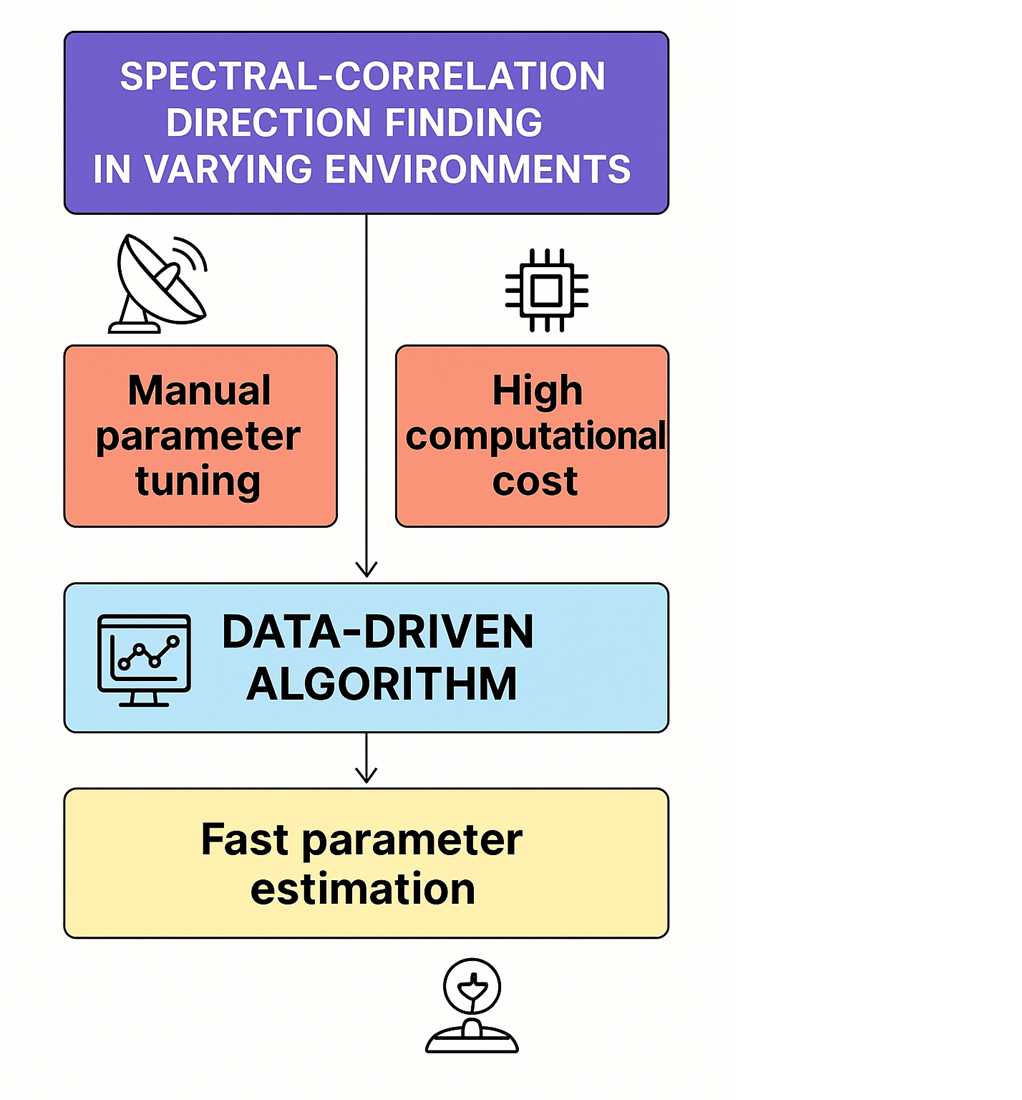
Об’єктом дослідження є процес оцінки затримки та напрямку радіосигналу за допомогою цифрового спектрально-кореляційного аналізу, посиленого машинним навчанням. Цей процес необхідний для високоточної пеленгації в системах електромагнітного моніторингу. Проблема, що розглядається, полягає в низькій адаптивності та недостатній точності традиційних методів пеленгації за умов змінного сигналу, особливо через ручний вибір параметрів і обчислювальну складність кореляційної обробки.
Суть отриманих результатів полягає в застосуванні методу прогнозування параметрів радіосигналу (затримки та кута) на основі машинного навчання, який зменшив стандартне відхилення оцінок пеленгації до 0,08–0,026° та похибку оцінки затримки до 1,5–14,8 мкс у діапазоні відношення сигнал/шум від 9 до 37 дБ. Ці результати підтверджуються усередненням понад 1000 реалізацій за допомогою моделювання Монте-Карло, що підтверджує їх стабільність під впливом шуму. Завдяки своїм відмінним особливостям запропоноване рішення вирішило проблему, забезпечивши автоматичний вибір параметрів обробки через навчену нейронну мережу, яка адаптується до нелінійних характеристик сигналу, мінімізуючи потребу в ручному налаштуванні або вичерпному пошуку.
Ці результати пояснюються здатністю моделі ідентифікувати приховані залежності між параметрами сигналу та результатами обробки, забезпечуючи адаптивну поведінку та зменшуючи відхилення. Хоча оцінка обчислювальної складності не надається, очікується, що оцінка параметрів на основі прогнозування покращить швидкість обробки в майбутніх реалізаціях. Результати можуть бути застосовані в електромагнітному моніторингу в реальному часі, радіоспостереження та оборонних додатках, особливо в умовах обмежених обчислювальних ресурсів або змінних шумових умов
Посилання
- Rembovskij, A. M. (2015). Radio monitoring – tasks, methods, means. Moscow: Hot line. Telekom, 640.
- Tsyporenko, V., Tsyporenko, V., Andreiev, O., Sabibolda, A. (2021). Digital spectral correlation method for measuring radio signal reception delay and direction finding. Technical Engineering, 2 (88), 113–121. https://doi.org/10.26642/ten-2021-2(88)-113-121
- Elbir, A. M. (2017). Direction Finding in the Presence of Direction-Dependent Mutual Coupling. IEEE Antennas and Wireless Propagation Letters, 16, 1541–1544. https://doi.org/10.1109/lawp.2017.2647983
- Tsyporenko, V. V., Tsyporenko, V. G., Nikitczuk, T. M. (2019). Optimization of direct digital method of correlative-interferometric direction finding with reconstruction of spatial analytical signal. Radio Electronics, Computer Science, Control, 3, 15–24. https://doi.org/10.15588/1607-3274-2019-3-2
- Duplouy, J., Morlaas, C., Aubert, H., Potier, P., Pouliguen, P. (2019). Wideband Vector Antenna for Dual-Polarized and Three-Dimensional Direction-Finding Applications. IEEE Antennas and Wireless Propagation Letters, 18 (8), 1572–1575. https://doi.org/10.1109/lawp.2019.2923531
- Lee, J.-H., Kim, J.-K., Ryu, H.-K., Park, Y.-J. (2018). Multiple Array Spacings for an Interferometer Direction Finder With High Direction-Finding Accuracy in a Wide Range of Frequencies. IEEE Antennas and Wireless Propagation Letters, 17 (4), 563–566. https://doi.org/10.1109/lawp.2018.2803107
- Xie, X., Xu, Z. (2018). Direction Finding of BPSK Signals Using Time-Modulated Array. IEEE Microwave and Wireless Components Letters, 28 (7), 618–620. https://doi.org/10.1109/lmwc.2018.2834523
- Cai, J., Zhou, H., Huang, W., Wen, B. (2021). Ship Detection and Direction Finding Based on Time-Frequency Analysis for Compact HF Radar. IEEE Geoscience and Remote Sensing Letters, 18 (1), 72–76. https://doi.org/10.1109/lgrs.2020.2967387
- He, C., Liang, X., Li, Z., Geng, J., Jin, R. (2015). Direction Finding by Time-Modulated Array With Harmonic Characteristic Analysis. IEEE Antennas and Wireless Propagation Letters, 14, 642–645. https://doi.org/10.1109/lawp.2014.2373432
- Rosado-Sanz, J., Jarabo-Amores, M. P., De la Mata-Moya, D., Rey-Maestre, N. (2022). Adaptive Beamforming Approaches to Improve Passive Radar Performance in Sea and Wind Farms’ Clutter. Sensors, 22 (18), 6865. https://doi.org/10.3390/s22186865
- Smailov, N., Tsyporenko, V., Sabibolda, A., Tsyporenko, V., Kabdoldina, A., Zhekambayeva, M. et al. (2023). Improving the accuracy of a digital spectral correlation-interferometric method of direction finding with analytical signal reconstruction for processing an incomplete spectrum of the signal. Eastern-European Journal of Enterprise Technologies, 5 (9 (125)), 14–25. https://doi.org/10.15587/1729-4061.2023.288397
- Sabibolda, A., Tsyporenko, V., Smailov, N., Tsyporenko, V., Abdykadyrov, A. (2024). Estimation of the Time Efficiency of a Radio Direction Finder Operating on the Basis of a Searchless Spectral Method of Dispersion-Correlation Radio Direction Finding. Advances in Asian Mechanism and Machine Science, 62–70. https://doi.org/10.1007/978-3-031-67569-0_8
- Kuttybayeva, A., Sabibolda, A., Kengesbayeva, S., Baigulbayeva, M., Amir, A., Sekenov, B. (2024). Investigation of a Fiber Optic Laser Sensor with Grating Resonator Using Mirrors. 2024 Conference of Young Researchers in Electrical and Electronic Engineering (ElCon), 709–711. https://doi.org/10.1109/elcon61730.2024.10468264
- Smailov, N., Tsyporenko, V., Sabibolda, A., Tsyporenko, V., Abdykadyrov, A., Kabdoldina, A. et al. (2024). Usprawnienie cyfrowego korelacyjno-interferometrycznego ustalania kierunku za pomocą przestrzennego sygnału analitycznego. Informatyka, Automatyka, Pomiary w Gospodarce i Ochronie Środowiska, 14 (3), 43–48. https://doi.org/10.35784/iapgos.6177
- Abdykadyrov, A., Smailov, N., Sabibolda, A., Tolen, G., Dosbayev, Z., Ualiyev, Z., Kadyrova, R. (2024). Optimization of distributed acoustic sensors based on fiber optic technologies. Eastern-European Journal of Enterprise Technologies, 5 (5 (131)), 50–59. https://doi.org/10.15587/1729-4061.2024.313455
- Marxuly, S., Abdykadyrov, A., Chezhimbayeva, K., Smailov, N. (2024). Study of the ozone control process using electronic sensors. Informatyka Automatyka Pomiary W Gospodarce I Ochronie Środowiska, 14 (4), 38–45. https://doi.org/10.35784/iapgos.6051
- Podchashynskyi, Y., Luhovykh, O., Tsyporenko, V., Tsyporenko, V. (2021). Devising a method for measuring the motion parameters of industrial equipment in the quarry using adaptive parameters of a video sequence. Eastern-European Journal of Enterprise Technologies, 6 (9 (114)), 32–46. https://doi.org/10.15587/1729-4061.2021.248624
- Zahoruiko, L., Martianova, T., Al-Hiari, M., Polovenko, L., Kovalchuk, M., Merinova, S. et al. (2024). Model matematyczny i struktura sieci neuronowej do wykrywania cyberataków na systemy teleinformatyczne i komunikacyjne. Informatyka, Automatyka, Pomiary w Gospodarce i Ochronie Środowiska, 14 (3), 49–55. https://doi.org/10.35784/iapgos.6155
- Mummaneni, S., Dodda, P., Ginjupalli, N. D. (2024). Inspirowane kojotami podejście do przewidywania tocznia rumieniowatego układowego z wykorzystaniem sieci neuronowych. Informatyka, Automatyka, Pomiary w Gospodarce i Ochronie Środowiska, 14 (2), 22–27. https://doi.org/10.35784/iapgos.6077
- Rayavarapu, S. M., Tammineni, S. P., Gottapu, S. R., & Singam, A. (2024). Przegląd generatywnych sieci przeciwstawnych dla zastosowań bezpieczeństwa. Informatyka, Automatyka, Pomiary w Gospodarce i Ochronie Środowiska, 14 (2), 66–70. https://doi.org/10.35784/iapgos.5778
- Stelmakh, N., Mandrovska, S., Galagan, R. (2024). Zastosowanie sieci neuronowych resnet-152 do analizy obrazów z uav do wykrywania pożaru. Informatyka, Automatyka, Pomiary w Gospodarce i Ochronie Środowiska, 14 (2), 77–82. https://doi.org/10.35784/iapgos.5862
- Lyfar, V., Lyfar, O., Zynchenko, V. (2024). Metody inteligentnej analizy danych z wykorzystaniem sieci neuronowych w diagnozie. Informatyka, Automatyka, Pomiary w Gospodarce i Ochronie Środowiska, 14 (2), 109–112. https://doi.org/10.35784/iapgos.5746
- Limtrakul, S., Wetweerapong, J. (2023). An enhanced differential evolution algorithm with adaptive weight bounds for efficient training of neural networks. Informatyka, Automatyka, Pomiary w Gospodarce i Ochronie Środowiska, 13 (1), 4–13. https://doi.org/10.35784/iapgos.3366
- Bilynsky, Y., Nikolskyy, A., Revenok, V., Pogorilyi, V., Smailova, S., Voloshina, O., Kumargazhanova, S. (2023). Convolutional neural networks for early computer diagnosis of child dysplasia. Informatyka, Automatyka, Pomiary w Gospodarce i Ochronie Środowiska, 13 (2), 56–63. https://doi.org/10.35784/iapgos.3499
- Michalska-Ciekańska, M. (2022). Głębokie sieci neuronowe dla diagnostyki zmian skórnych. Informatyka, Automatyka, Pomiary w Gospodarce i Ochronie Środowiska, 12 (3), 50–53. https://doi.org/10.35784/iapgos.3042
- Gęca, J. (2020). Performance comparison of machine learning algorithms for predictive maintenance. Informatyka, Automatyka, Pomiary w Gospodarce i Ochronie Środowiska, 10 (3), 32–35. https://doi.org/10.35784/iapgos.1834
- Smailov, N., Batyrgaliyev, A., Akhmediyarova, A., Seilova, N., Koshkinbayeva, M., Baigulbayeva, M. et al. (2020). Approaches to Evaluating the Quality of Masking Noise Interference. International Journal of Electronics and Telecommunications, 67 (01), 59–64. https://doi.org/10.24425/ijet.2021.135944
- Li, R., Zhao, L., Liu, C., Bi, M. (2022). Strongest Angle-of-Arrival Estimation for Hybrid Millimeter Wave Architecture with 1-Bit A/D Equipped at Transceivers. Sensors, 22 (9), 3140. https://doi.org/10.3390/s22093140
- Wang, J., Wang, P., Zhang, R., Wu, W. (2022). SDFnT-Based Parameter Estimation for OFDM Radar Systems with Intercarrier Interference. Sensors, 23 (1), 147. https://doi.org/10.3390/s23010147
- Ren, B., Wang, T. (2022). Space-Time Adaptive Processing Based on Modified Sparse Learning via Iterative Minimization for Conformal Array Radar. Sensors, 22 (18), 6917. https://doi.org/10.3390/s22186917
- Jwo, D.-J., Cho, T.-S., Demssie, B. A. (2025). Dynamic Modeling and Its Impact on Estimation Accuracy for GPS Navigation Filters. Sensors, 25 (3), 972. https://doi.org/10.3390/s25030972
- Smailov, N., Uralova, F., Kadyrova, R., Magazov, R., Sabibolda, A. (2025). Optymalizacja metod uczenia maszynowego do deanonimizacji w sieciach społecznościowych. Informatyka, Automatyka, Pomiary w Gospodarce i Ochronie Środowiska, 15 (1), 101–104. https://doi.org/10.35784/iapgos.7098
- Wang, H., Yu, Z., Wen, F. (2024). Computationally Efficient Direction Finding for Conformal MIMO Radar. Sensors, 24 (18), 6065. https://doi.org/10.3390/s24186065
##submission.downloads##
Опубліковано
Як цитувати
Номер
Розділ
Ліцензія
Авторське право (c) 2025 Nurzhigit Smailov, Vitaliy Tsyporenko, Zhomart Ualiyev, Аіnur Issova, Zhandos Dosbayev, Yerlan Tashtay, Maigul Zhekambayeva, Temirlan Alimbekov, Rashida Kadyrova, Akezhan Sabibolda

Ця робота ліцензується відповідно до Creative Commons Attribution 4.0 International License.
Закріплення та умови передачі авторських прав (ідентифікація авторства) здійснюється у Ліцензійному договорі. Зокрема, автори залишають за собою право на авторство свого рукопису та передають журналу право першої публікації цієї роботи на умовах ліцензії Creative Commons CC BY. При цьому вони мають право укладати самостійно додаткові угоди, що стосуються неексклюзивного поширення роботи у тому вигляді, в якому вона була опублікована цим журналом, але за умови збереження посилання на першу публікацію статті в цьому журналі.
Ліцензійний договір – це документ, в якому автор гарантує, що володіє усіма авторськими правами на твір (рукопис, статтю, тощо).
Автори, підписуючи Ліцензійний договір з ПП «ТЕХНОЛОГІЧНИЙ ЦЕНТР», мають усі права на подальше використання свого твору за умови посилання на наше видання, в якому твір опублікований. Відповідно до умов Ліцензійного договору, Видавець ПП «ТЕХНОЛОГІЧНИЙ ЦЕНТР» не забирає ваші авторські права та отримує від авторів дозвіл на використання та розповсюдження публікації через світові наукові ресурси (власні електронні ресурси, наукометричні бази даних, репозитарії, бібліотеки тощо).
За відсутності підписаного Ліцензійного договору або за відсутністю вказаних в цьому договорі ідентифікаторів, що дають змогу ідентифікувати особу автора, редакція не має права працювати з рукописом.
Важливо пам’ятати, що існує і інший тип угоди між авторами та видавцями – коли авторські права передаються від авторів до видавця. В такому разі автори втрачають права власності на свій твір та не можуть його використовувати в будь-який спосіб.