Optimization of marketing campaigns using a modified ID3 decision tree algorithm
DOI:
https://doi.org/10.15587/1729-4061.2025.327158Keywords:
marketing campaign, ID3, decision tree, class imbalance, accuracy, entropy modification, overfitting, data splitting, majority class, minority classAbstract
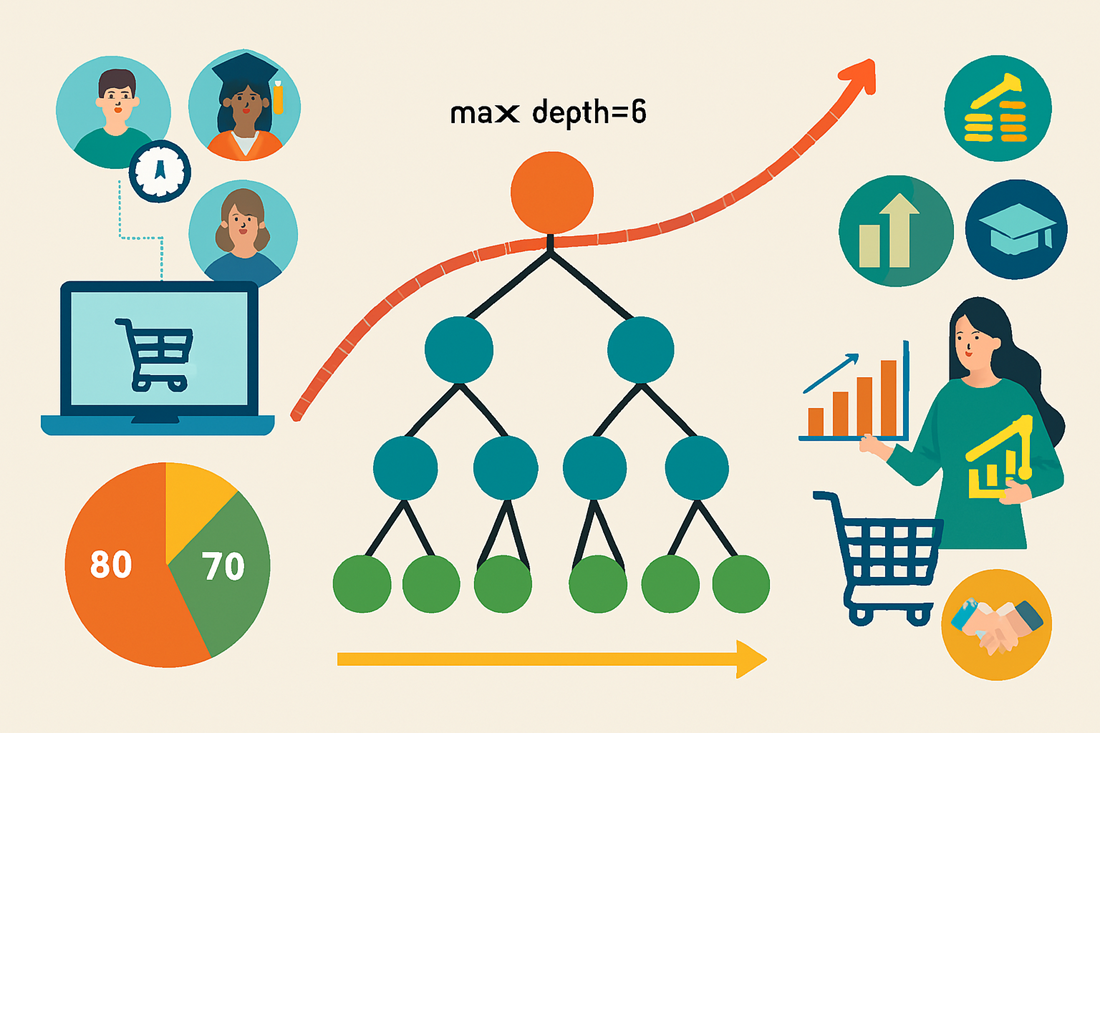
The object of this study is the strategy of online retail marketing campaigns, particularly in the context of utilizing a modified ID3 decision tree algorithm to improve predictive effectiveness regarding consumer responses. It addresses challenges in audience segmentation, campaign evaluation, and market adaptation, while also tackling technical issues such as overfitting, prediction errors, and data imbalance. These challenges often hinder businesses from accurately identifying and targeting potential customers, leading to inefficient marketing strategies and resource allocation. The dataset was split into 80:20 and 70:30 ratios, and the model was tested across decision tree depths from max_depth 1 to max_depth 20. The highest accuracy occurred at max_depth 6, ensuring optimal computational efficiency. However, increasing tree depth led to declining accuracy and rising computational costs, highlighting the risk of overfitting. Key factors influencing consumer response include income, education level, and recent company interactions. These variables help determine purchasing behavior and engagement levels, making them crucial in refining marketing strategies. Class imbalance introduces bias, affecting model performance by favoring the majority class while underrepresenting minority groups. The modified ID3 model outperforms ID3 Shannon, offering better precision for the majority class but lower recall for the minority class. Limiting campaign offers to one or two improves consumer responsiveness and prevents information overload. A data-driven marketing strategy ensures promotions align with consumer preferences and market trends. The developed model enables businesses to better target campaigns, increase conversion rates, and optimize resource allocation, ensuring an effective balance between tree depth and model accuracy
References
- Byrne, S., Hart, P. S. (2009). The Boomerang Effect A Synthesis of Findings and a Preliminary Theoretical Framework. Annals of the International Communication Association, 33 (1), 3–37. https://doi.org/10.1080/23808985.2009.11679083
- Brun, A., Castelli, C. (2008). Supply chain strategy in the fashion industry: Developing a portfolio model depending on product, retail channel and brand. International Journal of Production Economics, 116 (2), 169–181. https://doi.org/10.1016/j.ijpe.2008.09.011
- Kaiser, C., Ahuvia, A., Rauschnabel, P. A., Wimble, M. (2020). Social media monitoring: What can marketers learn from Facebook brand photos? Journal of Business Research, 117, 707–717. https://doi.org/10.1016/j.jbusres.2019.09.017
- Wettstein, D., Suggs, L. S. (2016). Is it social marketing? The benchmarks meet the social marketing indicator. Journal of Social Marketing, 6 (1), 2–17. https://doi.org/10.1108/jsocm-05-2014-0034
- Erkan, I., Evans, C. (2016). The influence of eWOM in social media on consumers’ purchase intentions: An extended approach to information adoption. Computers in Human Behavior, 61, 47–55. https://doi.org/10.1016/j.chb.2016.03.003
- Wang, X., Yu, C., Wei, Y. (2012). Social Media Peer Communication and Impacts on Purchase Intentions: A Consumer Socialization Framework. Journal of Interactive Marketing, 26 (4), 198–208. https://doi.org/10.1016/j.intmar.2011.11.004
- Gunawan, D. D., Huarng, K.-H. (2015). Viral effects of social network and media on consumers’ purchase intention. Journal of Business Research, 68 (11), 2237–2241. https://doi.org/10.1016/j.jbusres.2015.06.004
- Wandosell, G., Parra-Meroño, M. C., Alcayde, A., Baños, R. (2021). Green Packaging from Consumer and Business Perspectives. Sustainability, 13 (3), 1356. https://doi.org/10.3390/su13031356
- Pace, K., Silk, K., Nazione, S., Fournier, L., Collins-Eaglin, J. (2016). Promoting Mental Health Help-Seeking Behavior Among First-Year College Students. Health Communication, 33 (2), 102–110. https://doi.org/10.1080/10410236.2016.1250065
- Melović, B., Dabić, M., Vukčević, M., Ćirović, D., Backović, T. (2021). Strategic business decision making: the use and relevance of marketing metrics and knowledge management. Journal of Knowledge Management, 25 (11), 175–202. https://doi.org/10.1108/jkm-10-2020-0764
- López, V., Fernández, A., García, S., Palade, V., Herrera, F. (2013). An insight into classification with imbalanced data: Empirical results and current trends on using data intrinsic characteristics. Information Sciences, 250, 113–141. https://doi.org/10.1016/j.ins.2013.07.007
- Horton, S., Towell, M., Haegeli, P. (2020). Examining the operational use of avalanche problems with decision trees and model-generated weather and snowpack variables. Natural Hazards and Earth System Sciences, 20 (12), 3551–3576. https://doi.org/10.5194/nhess-20-3551-2020
- Wang, Y., Li, Y., Song, Y., Rong, X., Zhang, S. (2017). Improvement of ID3 Algorithm Based on Simplified Information Entropy and Coordination Degree. Algorithms, 10 (4), 124. https://doi.org/10.3390/a10040124
- Chen, Z., Ji, J. (2023). Analysis and Identification of the Composition of Ancient Glass Objects Based on Logistic Regression Analysis. Highlights in Science, Engineering and Technology, 41, 265–270. https://doi.org/10.54097/hset.v41i.6830
- Middleton, L., Dowdle, D., Villa, L., Gray, J., Cumming, J. (2019). Saving 20 000 Days and Beyond: a realist evaluation of two quality improvement campaigns to manage hospital demand in a New Zealand District Health Board. BMJ Open Quality, 8 (4), e000374. https://doi.org/10.1136/bmjoq-2018-000374
- Giovanis, A. N., Athanasopoulou, P. (2018). Consumer-brand relationships and brand loyalty in technology-mediated services. Journal of Retailing and Consumer Services, 40, 287–294. https://doi.org/10.1016/j.jretconser.2017.03.003
- Kranzler, E. C., Gibson, L. A., Hornik, R. C. (2017). Recall of “The Real Cost” Anti-Smoking Campaign Is Specifically Associated With Endorsement of Campaign-Targeted Beliefs. Journal of Health Communication, 22 (10), 818–828. https://doi.org/10.1080/10810730.2017.1364311
- Huang, K., Wang, T. (2024). Optimized Application of the Decision Tree ID3 Algorithm Based on Big Data in Sports Performance Management. International Journal of E-Collaboration, 20 (1), 1–20. https://doi.org/10.4018/ijec.350022
- Deniz, N. (2020). Cognitive biases in MCDM methods: an embedded filter proposal through sustainable supplier selection problem. Journal of Enterprise Information Management, 33 (5), 947–963. https://doi.org/10.1108/jeim-09-2019-0285
- Sun, H., Hu, X. (2017). Attribute selection for decision tree learning with class constraint. Chemometrics and Intelligent Laboratory Systems, 163, 16–23. https://doi.org/10.1016/j.chemolab.2017.02.004
- Quinlan, J. R. (1986). Induction of decision trees. Machine Learning, 1 (1), 81–106. https://doi.org/10.1007/bf00116251
- Narayanan, S., Das, J. R. (2021). Can the marketing innovation of purpose branding make brands meaningful and relevant? International Journal of Innovation Science, 14 (3/4), 519–536. https://doi.org/10.1108/ijis-11-2020-0272
- Kaplan, A. M., Haenlein, M. (2010). Users of the world, unite! The challenges and opportunities of Social Media. Business Horizons, 53 (1), 59–68. https://doi.org/10.1016/j.bushor.2009.09.003
- Souiden, N. (2002). Segmenting the Arab markets on the basis of marketing stimuli. International Marketing Review, 19 (6), 611–636. https://doi.org/10.1108/02651330210451944
- Chu, W., Qu, X. (2024). Severitys prediction of car accidents in PA and model comparison. Applied and Computational Engineering, 52 (1), 215–226. https://doi.org/10.54254/2755-2721/52/20241582
- Lee, S., Lee, S., Park, Y. (2007). A prediction model for success of services in e-commerce using decision tree: E-customer’s attitude towards online service. Expert Systems with Applications, 33 (3), 572–581. https://doi.org/10.1016/j.eswa.2006.06.005
- Hancock, J. T., Khoshgoftaar, T. M. (2020). CatBoost for big data: an interdisciplinary review. Journal of Big Data, 7 (1). https://doi.org/10.1186/s40537-020-00369-8
- Papadopoulou, N., Raïes, K., Mir Bernal, P., Woodside, A. G. (2019). Gifts as conduits in choice overload environments. Psychology & Marketing, 36 (7), 716–729. https://doi.org/10.1002/mar.21207
- Vins, A. D. S., Sam Emmanuel, W. R. (2021). Optimized Random Forest Algorithm with Parameter Tuning for Predicting Heart Disease. Advances in Computing and Data Sciences, 443–451. https://doi.org/10.1007/978-3-030-81462-5_40
Downloads
Published
How to Cite
Issue
Section
License
Copyright (c) 2025 Asrianda Asrianda, Herman Mawengkang, Poltak Sihombing, Mahyuddin K. M. Nasution

This work is licensed under a Creative Commons Attribution 4.0 International License.
The consolidation and conditions for the transfer of copyright (identification of authorship) is carried out in the License Agreement. In particular, the authors reserve the right to the authorship of their manuscript and transfer the first publication of this work to the journal under the terms of the Creative Commons CC BY license. At the same time, they have the right to conclude on their own additional agreements concerning the non-exclusive distribution of the work in the form in which it was published by this journal, but provided that the link to the first publication of the article in this journal is preserved.
A license agreement is a document in which the author warrants that he/she owns all copyright for the work (manuscript, article, etc.).
The authors, signing the License Agreement with TECHNOLOGY CENTER PC, have all rights to the further use of their work, provided that they link to our edition in which the work was published.
According to the terms of the License Agreement, the Publisher TECHNOLOGY CENTER PC does not take away your copyrights and receives permission from the authors to use and dissemination of the publication through the world's scientific resources (own electronic resources, scientometric databases, repositories, libraries, etc.).
In the absence of a signed License Agreement or in the absence of this agreement of identifiers allowing to identify the identity of the author, the editors have no right to work with the manuscript.
It is important to remember that there is another type of agreement between authors and publishers – when copyright is transferred from the authors to the publisher. In this case, the authors lose ownership of their work and may not use it in any way.








