Devising a method for calculating the structure of efficient cooling systems for thrust bearings and guide bearings in hydrogenerators
DOI:
https://doi.org/10.15587/1729-4061.2025.329021Keywords:
hydrogenerator, single-row thrust bearing, oil cooler, hydraulic calculations, thermal calculationsAbstract
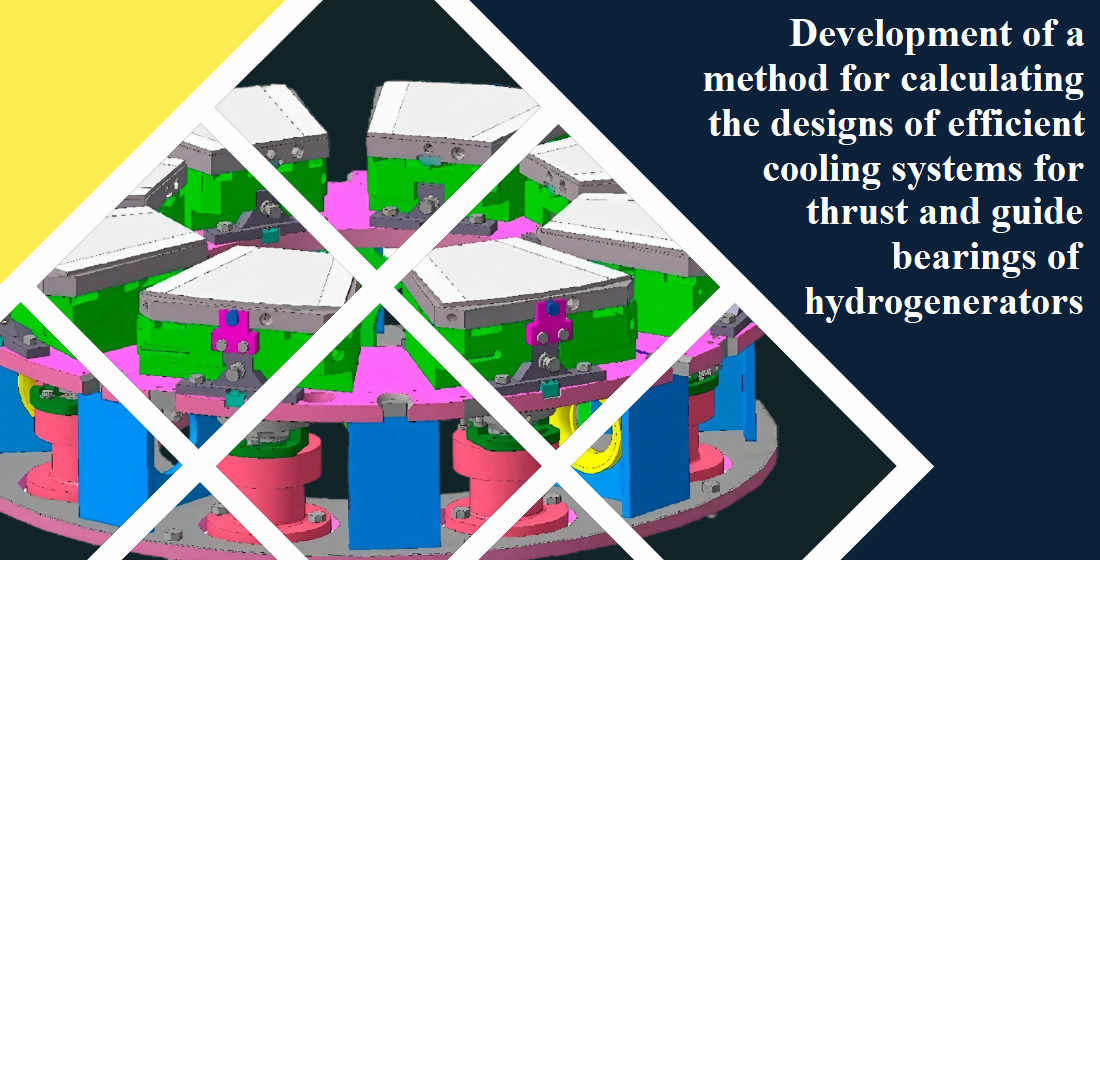
The object of this study is the thermal and hydraulic characteristics of the oil coolers in a thrust bearing and guide bearing cooling system of hydrogenerators.
The study addresses the task to improve the efficiency of the cooling system of the supporting elements of hydrogenerators while maintaining mass and dimension indicators. The main problems in this case are the unbalanced flow of oil within the typical cooling system and different stiffness of the thrust bearing segment supports.
The main result is the design of a cooling system structure that ensures effective heat removal from the oil. According to calculations, an oil cooler for a hydrogenerator with a capacity of 56 MW provides removal of 250 kW of losses with a heat transfer margin of 26.2%, for a hydrogenerator with a capacity of 96 MW – 150 kW and 31.8%, respectively.
The results are explained by the use of new antifriction materials for supporting elements (fluoroplastic-4) and a higher strength group material for the thrust bearing disk. The designed structure of the cooling system enables operation with preservation of isotropy of cooling liquids and does not have "dead" zones of these liquids flow.
A feature of the proposed method for calculating oil coolers is the addition to existing criterion equations of an experimental coefficient B, which takes into account the peculiarity of the geometry of the structure in addition to the nature of the oil flow and gas-dynamic parameters. The action of three-dimensional forces, temperatures, and pressures within the base metal and cooling liquids were comprehensively taken into account.
The proposed structures of the thrust bearing and guide bearing, as well as their cooling systems, could be implemented in the design and modernization of medium and high-power hydrogenerators
References
- Qiu, H., He, K. (2024). Research on Torque Ripple and Influencing Factors of Hydro-Generator. Recent Patents on Engineering, 18 (1). https://doi.org/10.2174/1872212117666230127152125
- Flankl, M., Tuysuz, A., Kolar, J. W. (2017). Cogging Torque Shape Optimization of an Integrated Generator for Electromechanical Energy Harvesting. IEEE Transactions on Industrial Electronics, 64 (12), 9806–9814. https://doi.org/10.1109/tie.2017.2733441
- ODobzhanskyi, O., Duniev, O., Amiri, E., Yehorov, A., Gottipati, P., Masliennikov, A., Mendrela, E. (2021). Performance Comparison of BLDC Permanent Magnet Machines with Different Topologies. 2021 IEEE 2nd KhPI Week on Advanced Technology (KhPIWeek), 346–350. https://doi.org/10.1109/khpiweek53812.2021.9569983
- Casanova Garcia, G. F., Cardona Gutierrez, A. F., Mantilla Viveros, C. A. (2020). Structural component fatigue analysis of a hydrogenerator rotor. DYNA, 87 (214), 155–164. https://doi.org/10.15446/dyna.v87n214.84678
- Sheng, Z., Zhe, H., Zhangbin, Y., Chunde, X. (2023). Simulation and Comparative study on Cooling Performance of Thrust Bearing Cooled by Heat Pipe. 2023 IEEE 6th International Electrical and Energy Conference (CIEEC), 879–884. https://doi.org/10.1109/cieec58067.2023.10167119
- Tretiak, O., Kritskiy, D., Kobzar, I., Arefieva, M., Nazarenko, V. (2022). The Methods of Three-Dimensional Modeling of the Hydrogenerator Thrust Bearing. Computation, 10 (9), 152. https://doi.org/10.3390/computation10090152
- Liao, Y., Liao, B. (2020). Finite Element Analysis and Lightweight Design of Hydro Generator Lower Bracket. Manufacturing Technology, 20 (1), 66–71. https://doi.org/10.21062/mft.2020.017
- Quaranta, E., Bergamin, R., Schleiss, A. J. (2023). How to estimate the weight of hydropower electro-mechanical equipment? Available evidence, novel equations and challenges for engineering applications. Results in Engineering, 18, 101067. https://doi.org/10.1016/j.rineng.2023.101067
- Zhang, J., Huang, X., Wang, Z. (2024). Study of Unsymmetrical Magnetic Pulling Force and Magnetic Moment in 1000 MW Hydrogenerator Based on Finite Element Analysis. Symmetry, 16 (10), 1351. https://doi.org/10.3390/sym16101351
- Doost, A. K., Majlessi, R. (2015). Heat Transfer Analysis in Cooling System of Hydropower’s Generator. Open Journal of Applied Sciences, 05 (03), 98–107. https://doi.org/10.4236/ojapps.2015.53010
- El-Zohri, E. H., Shafey, H. M., Kahoul, A. (2019). Performance evaluation of generator air coolers for the hydro-power plant of Aswan High Dam at Egypt. Energy, 179, 960–974. https://doi.org/10.1016/j.energy.2019.05.006
- Wang, Y., Cai, Y., Zhang, J., Chen, Z., Li, C., Sun, W. (2025). Investigation on heat transfer mechanism simulation and structure optimization design of hydraulic turbine bearing semi-ring cooler. Heliyon, 11 (3), e42328. https://doi.org/10.1016/j.heliyon.2025.e42328
- Nowicki, R., Morozov, N. (2017). Thrust bearing monitoring of vertical hydro-turbine-generators. Conference: 1st World Congress on Condition Monitoring. London. Available at: https://www.researchgate.net/publication/318654615_Thrust_bearing_monitoring_of_vertical_hydro-turbine-generators
- Muhsen, A., Kizilova, N. (2021). The Advanced Cooling System of Generator for Hydropower Plant. eNergetics. Available at: https://www.researchgate.net/publication/358981403_The_Advanced_Cooling_System_of_Generator_for_Hydropower_Plant
- Liming, Z., Yongyao, L., Zhengwei, W., Xin, L., Yexiang, X. (2017). A review on the large tilting pad thrust bearings in the hydropower units. Renewable and Sustainable Energy Reviews, 69, 1182–1198. https://doi.org/10.1016/j.rser.2016.09.140
- Pitchurov, G. T., Markov, D., Georgiev, E. (2023). Verification of the capacity of lubricating oil cooler system of turbine bearings. IOP Conference Series: Earth and Environmental Science, 1128 (1), 012019. https://doi.org/10.1088/1755-1315/1128/1/012019
- Adaramola, B. A., Musa, A. (2020). Modification and Performance Evaluation of Turbo Generator’s Oil Coolers for Electricity Generation. International Journal of Scientific Engineering and Applied Science (IJSEAS), 6 (11), 138–148. Available at: https://ijseas.com/volume6/v6i11/ijseas20201116.pdf
- Yehorov, A., Duniev, O., Masliennikov, A., Gouws, R., Dobzhanskyi, O., Stamann, M. (2025). Study on the Thermal State of a Transverse-Flux Motor. IEEE Access, 13, 20893–20902. https://doi.org/10.1109/access.2025.3534284
- Tretiak, O., Kritskiy, D., Kobzar, I., Arefieva, M., Selevko, V., Brega, D. et al. (2023). Stress-Strained State of the Thrust Bearing Disc of Hydrogenerator-Motor. Computation, 11 (3), 60. https://doi.org/10.3390/computation11030060
Downloads
Published
How to Cite
Issue
Section
License
Copyright (c) 2025 Oleksii Tretiak, Stanislav Kravchenko, Oleksii Mykhailychenko, Viacheslav Nazarenko, Serhii Smyk, Oleksandr Vasyliev, Mariia Arefieva, Iryna Tretiak, Serhii Serhiienko, Volodymyr Selevko

This work is licensed under a Creative Commons Attribution 4.0 International License.
The consolidation and conditions for the transfer of copyright (identification of authorship) is carried out in the License Agreement. In particular, the authors reserve the right to the authorship of their manuscript and transfer the first publication of this work to the journal under the terms of the Creative Commons CC BY license. At the same time, they have the right to conclude on their own additional agreements concerning the non-exclusive distribution of the work in the form in which it was published by this journal, but provided that the link to the first publication of the article in this journal is preserved.
A license agreement is a document in which the author warrants that he/she owns all copyright for the work (manuscript, article, etc.).
The authors, signing the License Agreement with TECHNOLOGY CENTER PC, have all rights to the further use of their work, provided that they link to our edition in which the work was published.
According to the terms of the License Agreement, the Publisher TECHNOLOGY CENTER PC does not take away your copyrights and receives permission from the authors to use and dissemination of the publication through the world's scientific resources (own electronic resources, scientometric databases, repositories, libraries, etc.).
In the absence of a signed License Agreement or in the absence of this agreement of identifiers allowing to identify the identity of the author, the editors have no right to work with the manuscript.
It is important to remember that there is another type of agreement between authors and publishers – when copyright is transferred from the authors to the publisher. In this case, the authors lose ownership of their work and may not use it in any way.







