Розробка моделі течії в соплово-заслінковому клапані насоса-регулятора НР-3 для підвищення стабільності характеристик
DOI:
https://doi.org/10.15587/1729-4061.2025.329024Ключові слова:
сопло-заслонка, чисельне моделювання, застійна зона, вихрова течіяАнотація
Об’єктом дослідження є течія в’язкої нестисливої рідини в клапані соплово-заслінкового типу, який використовується в складі вільного регулятора частоти обертання турбіни насоса-регулятора НР-3 турбовального вертолітного двигуна ТВ3-117. Виникла потреба в детальних розрахунках течії рідини через незадовільну роботу клапана в реальних умовах експлуатації. Додатковою складністю стали суперечливі дані про характеристики таких клапанів у літературі, що унеможливлювало визначення особливостей течії та напрямків удосконалення конструкції.
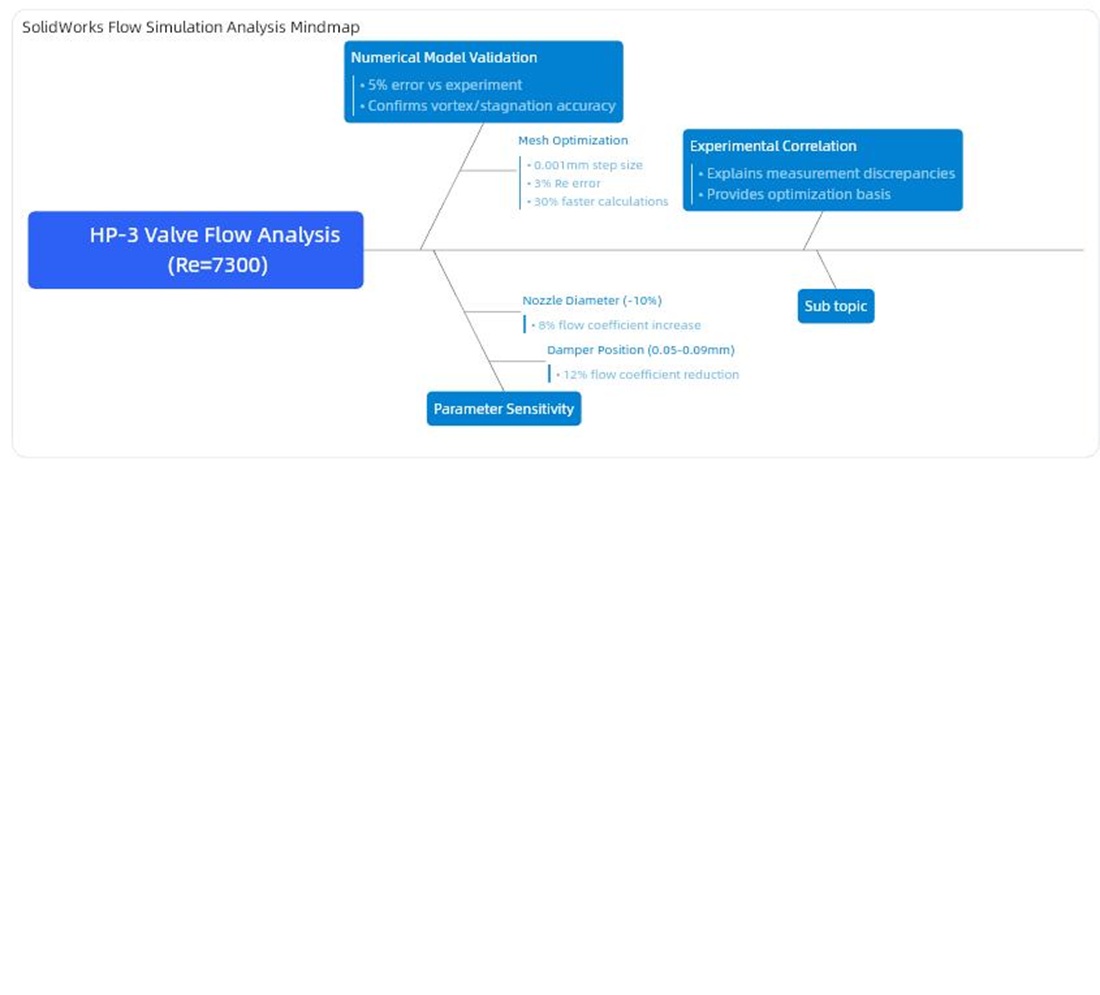
У роботі представлено результати чисельних розрахунків течії в клапані, виконаних у середовищі Solidworks Flow Simulation. Запропоновано математичну модель, яка враховує вплив розрахункової сітки на точність і витрати обчислювального часу, а також шляхи підвищення точності без значного збільшення ресурсів. Модель верифіковано шляхом порівняння з експериментальними даними виробника. Отримані результати дозволили розв’язати проблему завдяки детальній побудові моделі з урахуванням геометрії клапана та оптимізації розрахункової сітки, що забезпечило баланс між точністю і швидкістю обчислень. Результати пояснюються застосуванням сучасного програмного забезпечення для гідродинамічних розрахунків, точним налаштуванням сітки та коректною верифікацією моделі, що відображає реальні фізичні процеси в клапані. Розроблена модель дозволяє досліджувати течію в клапані та може бути застосована для аналізу впливу виробничих дефектів. Модель придатна для параметричних досліджень і модифікації клапанів у вертолітних двигунах типу ТВ3-117 чи подібних системах. Також модель може бути адаптована для інших систем, де потрібен аналіз течії в подібних клапанах
Посилання
- SOLIDWORKS Installation and Administration. Available at: https://help.solidworks.com/2022/english/Installation/install_guide/c_install_admin_overview.htm
- Tabe Jamaat, A. G., Hattori, B. Y. (2022). Development of subgrid-scale model for LES of Burgers turbulence with large filter size. Physics of Fluids, 34 (4). https://doi.org/10.1063/5.0087761
- Lytviak, O., Komar, S., Derevyanko, O., Durieiev, V. (2021). Devising quality control criteria for manufacturing control valves of the type «nozzle-flap». Eastern-European Journal of Enterprise Technologies, 1 (1 (109)), 27–34. https://doi.org/10.15587/1729-4061.2021.224918
- Lytviak, O., Loginov, V., Komar, S., Martseniuk, Y. (2021). Self-Oscillations of The Free Turbine Speed in Testing Turboshaft Engine with Hydraulic Dynamometer. Aerospace, 8 (4), 114. https://doi.org/10.3390/aerospace8040114
- Liu, Y., Ren, Y., Zhang, M., Wei, K., Hao, L. (2022). Solenoid valves quality improvement based on Six Sigma management. International Journal of Lean Six Sigma, 14 (1), 72–93. https://doi.org/10.1108/ijlss-08-2021-0140
- Jafari, B., Mashadi, B. (2022). Valve control of a hydraulically interconnected suspension system to improve vehicle handling qualities. Vehicle System Dynamics, 61 (4), 1011–1027. https://doi.org/10.1080/00423114.2022.2056490
- Fedorovich, O., Lutai, L., Trishch, R., Zabolotnyi, О., Khomiak, E., Nikitin, A. (2024). Models for Reducing the Duration and Cost of the Aviation Equipment Diagnostics Process Using the Decomposition of the Component Architecture of a Complex Product. Information Technology for Education, Science, and Technics, 108–125. https://doi.org/10.1007/978-3-031-71801-4_9
- Cheng, Y., Tang, Y., Wu, J., Jin, H., Shen, L. (2024). Numerical Simulation Study on Hydraulic Characteristics and Wear of Eccentric Semi-Ball Valve under Sediment Laden Water Flow. Sustainability, 16 (17), 7266. https://doi.org/10.3390/su16177266
- Lopes, R., Eça, L., Vaz, G. (2020). On the Numerical Behavior of RANS-Based Transition Models. Journal of Fluids Engineering, 142 (5). https://doi.org/10.1115/1.4045576
- Laima, S., Zhou, X., Jin, X., Gao, D., Li, H. (2023). DeepTRNet: Time-resolved reconstruction of flow around a circular cylinder via spatiotemporal deep neural networks. Physics of Fluids, 35 (1). https://doi.org/10.1063/5.0129049
- Kim, M., Park, J., Choi, H. (2024). Large eddy simulation of flow over a circular cylinder with a neural-network-based subgrid-scale model. Journal of Fluid Mechanics, 984. https://doi.org/10.1017/jfm.2024.154
- SolidWorks Flow Simulation. Available at: https://www.goengineer.com/solidworks/simulation/solidworks-flow-simulation-cfd
- Popa, C. (2023). An aplication for the selection and sizing of control valve for control loop. Romanian Journal of Petroleum & Gas Technology, 4 (75) (2), 109–116. https://doi.org/10.51865/jpgt.2023.02.11
- Kim, J., Kim, H., Kim, J., Lee, C. (2022). Deep reinforcement learning for large-eddy simulation modeling in wall-bounded turbulence. Physics of Fluids, 34 (10). https://doi.org/10.1063/5.0106940
- Trishch, R., Cherniak, O., Zdenek, D., Petraskevicius, V. (2024). Assessment of the occupational health and safety management system by qualimetric methods. Engineering Management in Production and Services, 16 (2), 118–127. https://doi.org/10.2478/emj-2024-0017
- Cherniak, O., Trishch, R., Ginevičius, R., Nechuiviter, O., Burdeina, V. (2024). Methodology for Assessing the Processes of the Occupational Safety Management System Using Functional Dependencies. Integrated Computer Technologies in Mechanical Engineering - 2023, 3–13. https://doi.org/10.1007/978-3-031-60549-9_1
- Khomiak, E., Burdeina, V., Cherniak, O., Olesia, N., Bubela, T. (2024). Improving the Method of Quality Control of the Fuel Element Shell in Order to Improve the Safety of a Nuclear Reactor. Integrated Computer Technologies in Mechanical Engineering - 2023, 351–360. https://doi.org/10.1007/978-3-031-61415-6_30
- Khomiak, E., Trishch, R., Zabolotnyi, O., Cherniak, О., Lutai, L., Katrich, O. (2024). Automated Mode of Improvement of the Quality Control System for Nuclear Reactor Fuel Element Shell Tightness. Information Technology for Education, Science, and Technics, 79–91. https://doi.org/10.1007/978-3-031-71801-4_7
- Wu, Q., Chen, Z., Xu, H., Cai, Y. (2024). A novel wall model for large-eddy simulation of the flow around a circular cylinder. Physics of Fluids, 36 (6). https://doi.org/10.1063/5.0209462
- Nisters, C., Bauer, F., Brocker, M. (2020). Condition monitoring systems for hydraulic accumulators – improvements in efficiency, productivity and quality. Volume 2 - Conference, 195–203. https://doi.org/10.25368/2020.83
- Tong, Z., Xin, J., Song, J., Cao, X. E. (2023). A graphics-accelerated deep neural network approach for turbomachinery flows based on large eddy simulation. Physics of Fluids, 35 (9). https://doi.org/10.1063/5.0160968
- Abekawa, A., Minamoto, Y., Osawa, K., Shimamoto, H., Tanahashi, M. (2023). Exploration of robust machine learning strategy for subgrid scale stress modeling. Physics of Fluids, 35 (1). https://doi.org/10.1063/5.0134471
- Dong, X., Hong, H., Deng, X., Zhong, W., Hu, G. (2023). Surrogate model-based deep reinforcement learning for experimental study of active flow control of circular cylinder. Physics of Fluids, 35 (10). https://doi.org/10.1063/5.0170316
- Zhan, Q., Bai, C., Ge, Y., Sun, X. (2023). Flow time history representation and reconstruction based on machine learning. Physics of Fluids, 35 (8). https://doi.org/10.1063/5.0160296
- Wang, Y.-Z., Hua, Y., Aubry, N., Chen, Z.-H., Wu, W.-T., Cui, J. (2022). Accelerating and improving deep reinforcement learning-based active flow control: Transfer training of policy network. Physics of Fluids, 34 (7). https://doi.org/10.1063/5.0099699
##submission.downloads##
Опубліковано
Як цитувати
Номер
Розділ
Ліцензія
Авторське право (c) 2025 Oleksandr Lytviak, Roman Trishch, Eduard Khomiak, Serhii Kochuk, Svitlana Khomenko, Ihor Tiupa

Ця робота ліцензується відповідно до Creative Commons Attribution 4.0 International License.
Закріплення та умови передачі авторських прав (ідентифікація авторства) здійснюється у Ліцензійному договорі. Зокрема, автори залишають за собою право на авторство свого рукопису та передають журналу право першої публікації цієї роботи на умовах ліцензії Creative Commons CC BY. При цьому вони мають право укладати самостійно додаткові угоди, що стосуються неексклюзивного поширення роботи у тому вигляді, в якому вона була опублікована цим журналом, але за умови збереження посилання на першу публікацію статті в цьому журналі.
Ліцензійний договір – це документ, в якому автор гарантує, що володіє усіма авторськими правами на твір (рукопис, статтю, тощо).
Автори, підписуючи Ліцензійний договір з ПП «ТЕХНОЛОГІЧНИЙ ЦЕНТР», мають усі права на подальше використання свого твору за умови посилання на наше видання, в якому твір опублікований. Відповідно до умов Ліцензійного договору, Видавець ПП «ТЕХНОЛОГІЧНИЙ ЦЕНТР» не забирає ваші авторські права та отримує від авторів дозвіл на використання та розповсюдження публікації через світові наукові ресурси (власні електронні ресурси, наукометричні бази даних, репозитарії, бібліотеки тощо).
За відсутності підписаного Ліцензійного договору або за відсутністю вказаних в цьому договорі ідентифікаторів, що дають змогу ідентифікувати особу автора, редакція не має права працювати з рукописом.
Важливо пам’ятати, що існує і інший тип угоди між авторами та видавцями – коли авторські права передаються від авторів до видавця. В такому разі автори втрачають права власності на свій твір та не можуть його використовувати в будь-який спосіб.