Identifying the impact of posted speed limits on vehicle travel mode on urban routes
DOI:
https://doi.org/10.15587/1729-4061.2025.329830Keywords:
speed limit, average speed, speed mode, acceleration noise, speed gradient, GPS trackAbstract
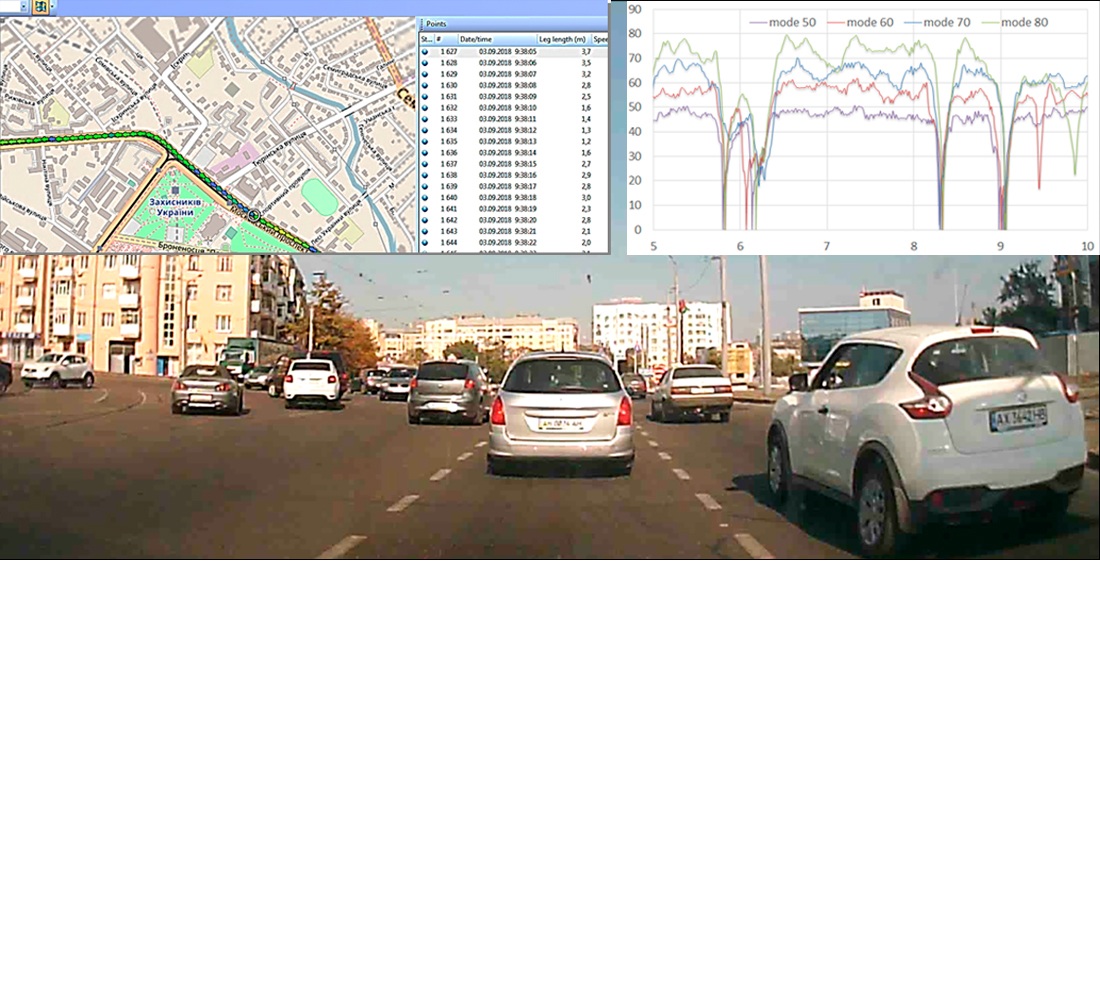
The object of the study is the vehicle driving mode and the results of trip on the road network of a large city under various speed limit conditions. The problem of quantitative assessment of the impact of speed limits on the average speed on the route, as well as on the indicators of driving mode unevenness, was solved. The values of such traffic parameters as average speed, average speed deviation, acceleration noise, speed gradient, energy gradient at different values of the posted speed limit (PSL) were obtained. Graphs of changes in the average speed and indicators of the unevenness of the speed regime were constructed and mathematical models of the dependence of the average speed on urban routes on the adopted speed limit were proposed. The results showed an increase in the average speed on the route by an average of 2.4 km/h with an increase in PSL by 10 km/h. At the same time, the dependence of the average speed on the PSL is non-linear and shows a decrease in the impact of the speed limit factor at higher PSL values (from 3.5 km/h for a PSL of 50 km/h to 1.24 km/h for a PSL of 80 km/h). Increasing the PSL does not affect the specific time in motion and leads to an increase in the specific idle time. With an increase in PSL, the acceleration noise and energy gradient increase. The increase in average speed is explained by the ability to increase speed in low-loaded sections of the route, but with an increase in PSL, the ability to realize the increased speed decreases, and the traffic mode itself becomes more uneven.
The research was carried out using the “driving laboratory” method on three different routes under the same initial conditions for speed limits from 50 to 80 km/h. The driving mode of the car was recorded in the form of GPS tracks. The results can be used to assess the impact of PSL changes on the technical and economic performance of urban road transport. The results will also be useful in conducting an information campaign and promoting a culture of compliance with the speed limits established in cities among drivers
References
- Raccagni, S., Ventura, R., Barabino, B. (2024). Impact of urban road characteristics on vehicle speed: Insights from Brescia, Italy. Heliyon, 10 (20), e39459. https://doi.org/10.1016/j.heliyon.2024.e39459
- van Eggermond, M. A. B., Schaffner, D., Studer, N., Erath, A. (2025). Quantifying the effect of road design on urban road driving speed. Transportation Research Part F: Traffic Psychology and Behaviour, 112, 148–169. https://doi.org/10.1016/j.trf.2025.04.005
- Castillo-Manzano, J. I., Castro-Nuño, M., López-Valpuesta, L., Vassallo, F. V. (2019). The complex relationship between increases to speed limits and traffic fatalities: Evidence from a meta-analysis. Safety Science, 111, 287–297. https://doi.org/10.1016/j.ssci.2018.08.030
- Gupta, N., Megat Johari, M. U., Jashami, H., Savolainen, P. (2022). How is traffic safety affected by changes in traffic speeds following speed limit increases? An evaluation with probe vehicle data. Traffic Safety Research, 3, 000017. https://doi.org/10.55329/xsjw3584
- Othman, B., De Nunzio, G., Di Domenico, D., Canudas-de-Wit, C. (2022). Analysis of the Impact of Variable Speed Limits on Environmental Sustainability and Traffic Performance in Urban Networks. IEEE Transactions on Intelligent Transportation Systems, 23 (11), 21766–21776. https://doi.org/10.1109/tits.2022.3192129
- Othman, B., Nunzio, G. D., Di Domenico, D., Canudas-de-Wit, C. (2021). Urban Road Traffic Fuel Consumption Optimization via Variable Speed Limits or Signalized Access Control: A Comparative Study. 2021 60th IEEE Conference on Decision and Control (CDC), 1929–1934. https://doi.org/10.1109/cdc45484.2021.9683194
- Al-Mosherefawi, O. J., Jwad, R. A. (2025). Evaluation of the Urban Transport System According to the Principles of the Active City: Kufa City as a Case Study. European International Journal of Multidisciplinary Research and Management Studies, 5 (1), 27–34. https://doi.org/10.55640/eijmrms-05-01-05
- van Goeverden, C. D. (2022). The value of travel speed. Transportation Research Interdisciplinary Perspectives, 13, 100530. https://doi.org/10.1016/j.trip.2021.100530
- Zheng, L., Ma, H., Wang, Z. (2024). Travel Time Estimation for Urban Arterials Based on the Multi-Source Data. Sustainability, 16 (17), 7845. https://doi.org/10.3390/su16177845
- Nian, G., Sun, J., Huang, J. (2021). Exploring the Effects of Urban Built Environment on Road Travel Speed Variability with a Spatial Panel Data Model. ISPRS International Journal of Geo-Information, 10 (12), 829. https://doi.org/10.3390/ijgi10120829
- Schweppenhäuser, M., Schrab, K., Protzmann, R., Radusch, I. (2025). Evaluating spatiotemporal speed metrics for traffic state estimation on complex urban roads. Simulation. https://doi.org/10.1177/00375497241308890
- Shi, C., Chen, B., Li, Q. (2017). Estimation of Travel Time Distributions in Urban Road Networks Using Low-Frequency Floating Car Data. ISPRS International Journal of Geo-Information, 6 (8), 253. https://doi.org/10.3390/ijgi6080253
- Salonen, M., Toivonen, T. (2013). Modelling travel time in urban networks: comparable measures for private car and public transport. Journal of Transport Geography, 31, 143–153. https://doi.org/10.1016/j.jtrangeo.2013.06.011
- Lu, Q.-L., Qurashi, M., Antoniou, C. (2023). Simulation-based policy analysis: The case of urban speed limits. Transportation Research Part A: Policy and Practice, 175, 103754. https://doi.org/10.1016/j.tra.2023.103754
- Jia, R., Li, Z., Xia, Y., Zhu, J., Ma, N., Chai, H., Liu, Z. (2020). Urban road traffic condition forecasting based on sparse ride‐hailing service data. IET Intelligent Transport Systems, 14 (7), 668–674. https://doi.org/10.1049/iet-its.2019.0338
- Pulugurtha, S., Koilada, K. (2020). Exploring Correlations between Travel Time Based Measures by Year, Day-of-the-week, Time-of-the-day, Week-of-the-Year and the Posted Speed Limit. Urban, Planning and Transport Research, 9 (1), 1–17. https://doi.org/10.1080/21650020.2020.1845230
- Jin, J., Rafferty, P. (2021). How the speed limit policy affects travel speed?: Quasi-experimental approach. Transport Policy, 103, 2–10. https://doi.org/10.1016/j.tranpol.2021.01.003
- Wei, L., Li, W., Liang, H., Luo, F. (2023). Traffic Flow Characteristics of Speed Limited Roads Based on Cellular Automata NaSch Traffic Flow Model. Advances in Intelligent Systems, Computer Science and Digital Economics IV, 629–638. https://doi.org/10.1007/978-3-031-24475-9_51
- Yang, H., Wang, X., Yin, Y. (2012). The impact of speed limits on traffic equilibrium and system performance in networks. Transportation Research Part B: Methodological, 46 (10), 1295–1307. https://doi.org/10.1016/j.trb.2012.08.002
- Li, S., Wang, T., Ren, H., Shi, B., Kong, X. (2021). Optimization Model and Method of Variable Speed Limit for Urban Expressway. Journal of Advanced Transportation, 2021, 1–13. https://doi.org/10.1155/2021/9950417
- Jang, S., Wu, S., Kim, D., Song, K.-H., Lee, S. M., Suh, W. (2022). Impact of Lowering Speed Limit on Urban Transportation Network. Applied Sciences, 12 (11), 5296. https://doi.org/10.3390/app12115296
- Bist, T. C., Tiwari, H. (2024). Assessment of Stratified Speed Characteristics and Compliance with Posted Speed Limit in an Urban Area: A Case Study of Section of Karnali Highway, Nepal. International Journal on Engineering Technology, 2 (1), 187–194. https://doi.org/10.3126/injet.v2i1.72571
- Alkaissi, Z. A., Hussain, R. Y. (2025). Travel Time Variability and Spatio-Temporal Analysis of Urban Streets Using Global Positioning System: A Review. Journal of Engineering, 31 (1), 173–188. https://doi.org/10.31026/j.eng.2025.01.10
- Alomari, A. H., Khedaywi, T. S., Marian, A. R. O., Jadah, A. A. (2022). Traffic speed prediction techniques in urban environments. Heliyon, 8 (12), e11847. https://doi.org/10.1016/j.heliyon.2022.e11847
- Babu, Y. S., Pattnaik, S. B. (1997). Acceleration noise and level of service of urban roads ‐ A case study. Journal of Advanced Transportation, 31 (3), 325–342. https://doi.org/10.1002/atr.5670310307
- Naef, M., Al-Taei, A. (2021). Evaluation of Acceleration Noise Parameter as a Traffic Flow Performance Indicator for Multi-Lane Urban Highways. Al-Rafidain Engineering Journal (AREJ), 26 (1), 44–52. https://doi.org/10.33899/rengj.2021.128127.1059
- Kadoya, Y., Watanapongvanich, S., Khan, M. S. R. (2021). How is emotion associated with driving speed? A study on taxi drivers in Japan. Transportation Research Part F: Traffic Psychology and Behaviour, 79, 205–216. https://doi.org/10.1016/j.trf.2021.04.020
- Shirazinejad, R. S., Dissanayake, S. (2020). Speed Characteristics in Relation to Speed Limit Increase and Its Influence on Driver’s Speed Selection Behavior. Sustainability, 12 (4), 1369. https://doi.org/10.3390/su12041369
- Riabushenko, O. (2023). Methodology for determining bottlenecks on the city’s street-road network by analyzing GPS track data. Automobile Transport, 52, 71–79. https://doi.org/10.30977/at.2219-8342.2023.52.0.08
- Alomari, A., Al-Omari, A., Aljizawi, W. (2022). Evaluation of travel time reliability in urban areas using mobile navigation applications in Jordan. Journal of Applied Engineering Science, 20 (3), 644–656. https://doi.org/10.5937/jaes0-35118
Downloads
Published
How to Cite
Issue
Section
License
Copyright (c) 2025 Oleksandr Riabushenko, Ivan Nahliuk, Serhii Danets, Mykola Bahlai

This work is licensed under a Creative Commons Attribution 4.0 International License.
The consolidation and conditions for the transfer of copyright (identification of authorship) is carried out in the License Agreement. In particular, the authors reserve the right to the authorship of their manuscript and transfer the first publication of this work to the journal under the terms of the Creative Commons CC BY license. At the same time, they have the right to conclude on their own additional agreements concerning the non-exclusive distribution of the work in the form in which it was published by this journal, but provided that the link to the first publication of the article in this journal is preserved.
A license agreement is a document in which the author warrants that he/she owns all copyright for the work (manuscript, article, etc.).
The authors, signing the License Agreement with TECHNOLOGY CENTER PC, have all rights to the further use of their work, provided that they link to our edition in which the work was published.
According to the terms of the License Agreement, the Publisher TECHNOLOGY CENTER PC does not take away your copyrights and receives permission from the authors to use and dissemination of the publication through the world's scientific resources (own electronic resources, scientometric databases, repositories, libraries, etc.).
In the absence of a signed License Agreement or in the absence of this agreement of identifiers allowing to identify the identity of the author, the editors have no right to work with the manuscript.
It is important to remember that there is another type of agreement between authors and publishers – when copyright is transferred from the authors to the publisher. In this case, the authors lose ownership of their work and may not use it in any way.







