Determining the influence of design features in agrivoltaics systems on tracking efficiency
DOI:
https://doi.org/10.15587/1729-4061.2025.329837Keywords:
agrivoltaics, photovoltaic module, angle of incidence of solar rays, tracking, photovoltaicsAbstract
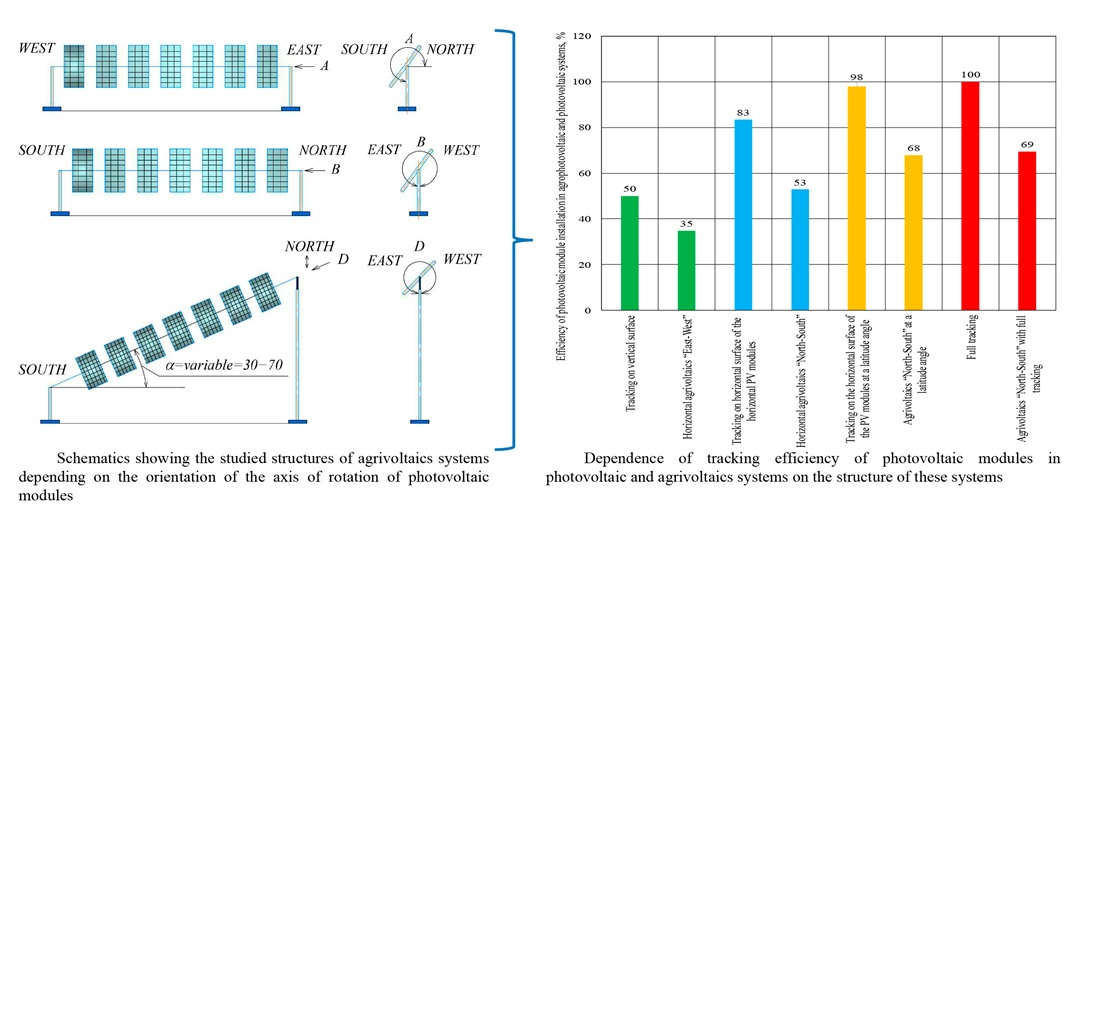
The object of this study is agrivoltaics systems. The task addressed relates to determining the tracking efficiency of agrivoltaics systems. The subject of the study is the dependence of the tracking efficiency of agrivoltaics systems on their design features and the dependence of the area coverage efficiency of photovoltaic panels on the distance between the arrays in an agrivoltaics system during the highest solar activity.
It was established that the tracking efficiency of an agrivoltaics system with a horizontal axis of rotation and the orientation of the axis of rotation "East-West" is 34.75%, and for an agrivoltaics system with an orientation "North-South" – 52.89%. The tracking efficiency of an agrivoltaics system with an orientation "North-South" and the axis of rotation set at an angle of latitude (50°) is 67.95%. At the same time, with the rotation axis set in such a way that the photovoltaic modules track the flow of sunlight also in the vertical plane, this value is 69.5%. The length of the day during the operation of the agrivoltaics system varies from 12 hours on March 21 and September 21 to 16 hours on June 21. This combination of the time of switching on and off the agrivoltaics system and the length of the day leads to the fact that the angle of inclination of the photovoltaic modules relative to the plane of their axis of rotation is 45°.
The obtained value of the angle of inclination of the photovoltaic modules relative to the plane of the axis of rotation in the agrivoltaics system has made it possible to determine the distance between agrivoltaics arrays, which was 3.79 m. If one takes into account the specified distance between the agrivoltaics arrays, the efficiency of covering the area with photovoltaic modules during the highest solar activity will be 52.8%.
The research results could be used as a basis for designing agrivoltaics system structures at different latitudes as well as assessing their economic efficiency
References
- Pourasl, H. H., Barenji, R. V., Khojastehnezhad, V. M. (2023). Solar energy status in the world: A comprehensive review. Energy Reports, 10, 3474–3493. https://doi.org/10.1016/j.egyr.2023.10.022
- Transforming our world: the 2030 Agenda for Sustainable Development. United Nations. Available at: https://sdgs.un.org/2030agenda
- Córdoba Hernández, R., Camerin, F. (2024). The application of ecosystem assessments in land use planning: A case study for supporting decisions toward ecosystem protection. Futures, 161, 103399. https://doi.org/10.1016/j.futures.2024.103399
- Anusuya, K., Vijayakumar, K., Leenus Jesu Martin, M., Manikandan, S. (2024). Agrophotovoltaics: enhancing solar land use efficiency for energy food water nexus. Renewable Energy Focus, 50, 100600. https://doi.org/10.1016/j.ref.2024.100600
- Weselek, A., Bauerle, A., Hartung, J., Zikeli, S., Lewandowski, I., Högy, P. (2021). Agrivoltaic system impacts on microclimate and yield of different crops within an organic crop rotation in a temperate climate. Agronomy for Sustainable Development, 41 (5). https://doi.org/10.1007/s13593-021-00714-y
- Zahrawi, A. A., Aly, A. M. (2024). A Review of Agrivoltaic Systems: Addressing Challenges and Enhancing Sustainability. Sustainability, 16 (18), 8271. https://doi.org/10.3390/su16188271
- Gomez-Casanovas, N., Mwebaze, P., Khanna, M., Branham, B., Time, A., DeLucia, E. H. et al. (2023). Knowns, uncertainties, and challenges in agrivoltaics to sustainably intensify energy and food production. Cell Reports Physical Science, 4 (8), 101518. https://doi.org/10.1016/j.xcrp.2023.101518
- Okonkwo, P. C., Nwokolo, S. C., Udo, S. O., Obiwulu, A. U., Onnoghen, U. N., Alarifi, S. S. et al. (2025). Solar PV systems under weather extremes: Case studies, classification, vulnerability assessment, and adaptation pathways. Energy Reports, 13, 929–959. https://doi.org/10.1016/j.egyr.2024.12.067
- Trommsdorff, M., Hopf, M., Hörnle, O., Berwind, M., Schindele, S., Wydra, K. (2023). Can synergies in agriculture through an integration of solar energy reduce the cost of agrivoltaics? An economic analysis in apple farming. Applied Energy, 350, 121619. https://doi.org/10.1016/j.apenergy.2023.121619
- Zhang, F., Li, M., Zhang, W., Liu, W., Ali Abaker Omer, A., Zhang, Z. et al. (2023). Large-scale and cost-efficient agrivoltaics system by spectral separation. IScience, 26 (11), 108129. https://doi.org/10.1016/j.isci.2023.108129
- Kumpanalaisatit, M., Setthapun, W., Sintuya, H., Pattiya, A., Jansri, S. N. (2022). Current status of agrivoltaic systems and their benefits to energy, food, environment, economy, and society. Sustainable Production and Consumption, 33, 952–963. https://doi.org/10.1016/j.spc.2022.08.013
- Reasoner, M., Ghosh, A. (2022). Agrivoltaic Engineering and Layout Optimization Approaches in the Transition to Renewable Energy Technologies: A Review. Challenges, 13 (2), 43. https://doi.org/10.3390/challe13020043
- Majewski, P., Al-shammari, W., Dudley, M., Jit, J., Lee, S.-H., Myoung-Kug, K., Sung-Jim, K. (2021). Recycling of solar PV panels- product stewardship and regulatory approaches. Energy Policy, 149, 112062. https://doi.org/10.1016/j.enpol.2020.112062
- Keil, J., Liu, Y., Kortshagen, U., Ferry, V. E. (2021). Bilayer Luminescent Solar Concentrators with Enhanced Absorption and Efficiency for Agrivoltaic Applications. ACS Applied Energy Materials, 4 (12), 14102–14110. https://doi.org/10.1021/acsaem.1c02860
- Osterthun, N., Neugebohrn, N., Gehrke, K., Vehse, M., Agert, C. (2021). Spectral engineering of ultrathin germanium solar cells for combined photovoltaic and photosynthesis. Optics Express, 29 (2), 938. https://doi.org/10.1364/oe.412101
- Dinesh, H., Pearce, J. M. (2016). The potential of agrivoltaic systems. Renewable and Sustainable Energy Reviews, 54, 299–308. https://doi.org/10.1016/j.rser.2015.10.024
- Gautam, S., Das, D. B., Saxena, A. K. (2024). Economic indicators evaluation to study the feasibility of a solar agriculture farm: A case study. Solar Compass, 10, 100074. https://doi.org/10.1016/j.solcom.2024.100074
- Bolinger, M., Bolinger, G. (2022). Land Requirements for Utility-Scale PV: An Empirical Update on Power and Energy Density. IEEE Journal of Photovoltaics, 12 (2), 589–594. https://doi.org/10.1109/jphotov.2021.3136805
- Imran, H., Riaz, M. H. (2021). Investigating the potential of east/west vertical bifacial photovoltaic farm for agrivoltaic systems. Journal of Renewable and Sustainable Energy, 13 (3). https://doi.org/10.1063/5.0054085
- Riaz, M. H., Imran, H., Younas, R., Butt, N. Z. (2021). The optimization of vertical bifacial photovoltaic farms for efficient agrivoltaic systems. Solar Energy, 230, 1004–1012. https://doi.org/10.1016/j.solener.2021.10.051
- Akbar, A., Mahmood, F. ibne, Alam, H., Aziz, F., Bashir, K., Zafar Butt, N. (2024). Field Assessment of Vertical Bifacial Agrivoltaics with Vegetable Production: A Case Study in Lahore, Pakistan. Renewable Energy, 227, 120513. https://doi.org/10.1016/j.renene.2024.120513
- Kallioğlu, M. A., Avcı, A. S., Sharma, A., Khargotra, R., Singh, T. (2024). Solar collector tilt angle optimization for agrivoltaic systems. Case Studies in Thermal Engineering, 54, 103998. https://doi.org/10.1016/j.csite.2024.103998
- Varo-Martínez, M., Fernández-Ahumada, L. M., Ramírez-Faz, J. C., Ruiz-Jiménez, R., López-Luque, R. (2024). Methodology for the estimation of cultivable space in photovoltaic installations with dual-axis trackers for their reconversion to agrivoltaic plants. Applied Energy, 361, 122952. https://doi.org/10.1016/j.apenergy.2024.122952
- Berrian, D., Chhapia, G., Linder, J. (2025). Performance of land productivity with single-axis trackers and shade-intolerant crops in agrivoltaic systems. Applied Energy, 384, 125471. https://doi.org/10.1016/j.apenergy.2025.125471
- Alam, H., Butt, N. Z. (2024). How does module tracking for agrivoltaics differ from standard photovoltaics? Food, energy, and technoeconomic implications. Renewable Energy, 235, 121151. https://doi.org/10.1016/j.renene.2024.121151
- Hussain, S. N., Ghosh, A. (2024). Evaluating tracking bifacial solar PV based agrivoltaics system across the UK. Solar Energy, 284, 113102. https://doi.org/10.1016/j.solener.2024.113102
- Willockx, B., Lavaert, C., Cappelle, J. (2023). Performance evaluation of vertical bifacial and single-axis tracked agrivoltaic systems on arable land. Renewable Energy, 217, 119181. https://doi.org/10.1016/j.renene.2023.119181
- Golub, G., Tsyvenkova, N., Yaremenko, O., Marus, O., Omarov, I., Нolubenko, A. (2023). Determining the efficiency of installing fixed solar photovoltaic modules and modules with different tracking options. Eastern-European Journal of Enterprise Technologies, 4 (8 (124)), 15–25. https://doi.org/10.15587/1729-4061.2023.286464
- Golub, G., Tsyvenkova, N., Nadykto, V., Marus, O., Yaremenko, O., Omarov, I. et al. (2024). Determining the influence of mounting angle on the average annual efficiency of fixed solar photovoltaic modules. Eastern-European Journal of Enterprise Technologies, 2 (8 (128)), 26–37. LOCKSS. https://doi.org/10.15587/1729-4061.2024.300485
- Golub, G., Blažauskas, E., Tsyvenkova, N., Šarauskis, E., Jasinskas, A., Kukharets, S. et al. (2025). Determination of the Installation Efficiency of Vertical Stationary Photovoltaic Modules with a Double-Sided “East–West”-Oriented Solar Panel. Applied Sciences, 15 (3), 1635. https://doi.org/10.3390/app15031635
Downloads
Published
How to Cite
Issue
Section
License
Copyright (c) 2025 Gennadii Golub, Nataliya Tsyvenkova, Ivan Rogovskii, Viacheslav Chuba, Volodymyr Nadykto, Ivan Omarov, Yaroslav Yarosh, Ivan Chuba

This work is licensed under a Creative Commons Attribution 4.0 International License.
The consolidation and conditions for the transfer of copyright (identification of authorship) is carried out in the License Agreement. In particular, the authors reserve the right to the authorship of their manuscript and transfer the first publication of this work to the journal under the terms of the Creative Commons CC BY license. At the same time, they have the right to conclude on their own additional agreements concerning the non-exclusive distribution of the work in the form in which it was published by this journal, but provided that the link to the first publication of the article in this journal is preserved.
A license agreement is a document in which the author warrants that he/she owns all copyright for the work (manuscript, article, etc.).
The authors, signing the License Agreement with TECHNOLOGY CENTER PC, have all rights to the further use of their work, provided that they link to our edition in which the work was published.
According to the terms of the License Agreement, the Publisher TECHNOLOGY CENTER PC does not take away your copyrights and receives permission from the authors to use and dissemination of the publication through the world's scientific resources (own electronic resources, scientometric databases, repositories, libraries, etc.).
In the absence of a signed License Agreement or in the absence of this agreement of identifiers allowing to identify the identity of the author, the editors have no right to work with the manuscript.
It is important to remember that there is another type of agreement between authors and publishers – when copyright is transferred from the authors to the publisher. In this case, the authors lose ownership of their work and may not use it in any way.








