Improving the protection of high-voltage equipment with condenser-type insulation during technical condition monitoring under operating voltage
DOI:
https://doi.org/10.15587/1729-4061.2025.330655Keywords:
condenser-type insulation, test-tap, monitoring under operating voltageAbstract
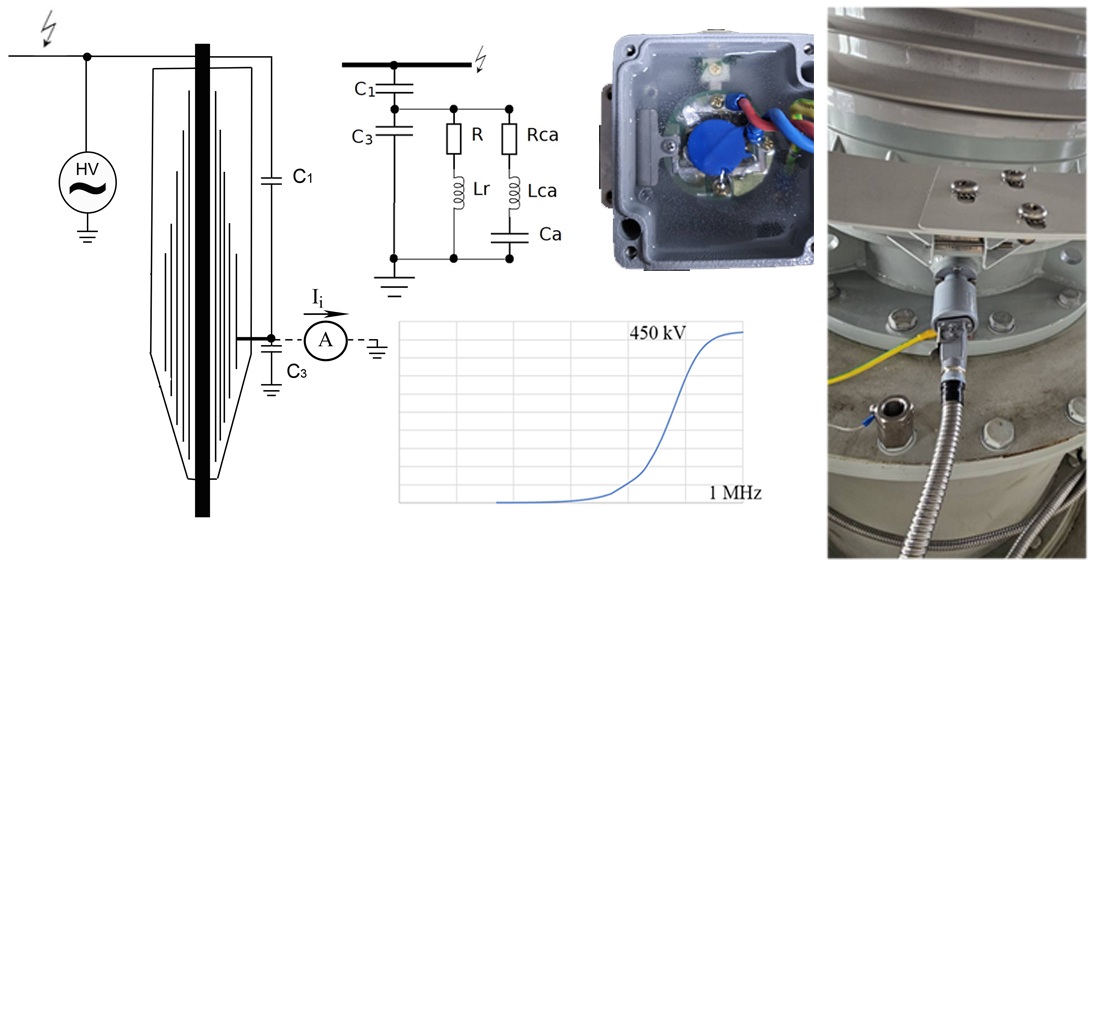
The object of this study is condenser-type insulation of high-voltage electrical equipment and elements of its overvoltage protection circuits, in the case of breaking the cable to the diagnostic device of technical condition of insulation under operating voltage.
The work reports a study on the overvoltage that can cause damage to high-voltage equipment with condenser-type insulation (bushings and instrument current transformers), equipped by hardware for monitoring the technical condition of insulation under operating voltage. Such overvoltage can occur as a result of damage of the cable from the test-tap of the device insulation and/or as a result of lightning and switching overvoltage on the buses of the switchgear.
The task relates to insufficient attention and lack of requirements of regulatory documents to the insulation protection schemes of devices with an increase in the number of implementations of devices for monitoring the condition of insulation under operating voltage in recent years. The relevance of the issue is predetermined by war in Ukraine, when electric power facilities and the system as a whole are subject of military attacks, causing both physical destruction and provoking overvoltage and short circuits that affect equipment that has not been destroyed.
The paper gives the results of modeling the overvoltage that may arise on the insulation test-tap of equipment with condenser-type insulation, when the cable to the monitoring device is damaged. The results of temperature tests of a complex protective resistor are presented. The use of a parallel resistor and a capacitor as the main protection elements has been justified. Such a scheme could limit the instantaneous overvoltage value for most devices at the level of no more than 1.6 kV, even without the use of additional protection elements, such as varistors or arresters, for example.
A methodology and recommendations for selecting protective elements and checking the compliance have been devised, both under the nominal operating mode and in the presence of high-frequency overvoltage
References
- Case Histories for Mitigating Transformer Bushing Risk (2022). INMR. Available at: https://www.inmr.com/case-histories-for-mitigating-transformer-bushing-risk/
- Test Requirements for HV Bushings (2025). INMR. Available at: https://www.inmr.com/test-requirements-hv-bushings/
- Jerbic, V., Keitoue, S., Puskaric, J., Tomic, I. (2024). Improving the Reliability of Online Bushing Monitoring. Journal of Energy - Energija, 73 (1), 18–23. https://doi.org/10.37798/2024731511
- SOU-N MPE 40.1.46.301:2006. Perevirka izoliatsiyi transformatoriv strumu 330-750 kV pid robochoiu napruhoiu. Metodychni vkazivky.
- Tostrud, M. (2017). Bushing sensors and their role in reliable on-line bushing monitoring. Transformers Magazine. Available at: https://transformers-magazine.com/magazine/4939-bushing-sensors-and-their-role-in-reliable-on-line-bushing-monitoring/
- Your Complete Online Bushings Monitoring Solution Starts Here (2024). Available at: https://www.dynamicratings.com/your-complete-online-bushings-monitoring-solution-starts-here/
- Sacerdotianu, D., Nicola, M., Lazarescu, F., Hurezeanu, I., Roman, D., Albita, A., Purcaru, D. (2021). Contributions to Monitoring the Condition and the Protection of Insulated Bushings, Pertaining to Transformer Units. 2021 9th International Conference on Modern Power Systems (MPS), 1–6. https://doi.org/10.1109/mps52805.2021.9492693
- Adapter diahnostychnoho vyvedennia vvedennia (2025). Energy Automation LLC. Available at: http://enera.com.ua/products/parts/AIV/
- Damião, L., Guimarães, J., Ferraz, G., Bortoni, E., Rossi, R., Capelini, R. et al. (2020). Online Monitoring of Partial Discharges in Power Transformers Using Capacitive Coupling in the Tap of Condenser Bushings. Energies, 13 (17), 4351. https://doi.org/10.3390/en13174351
- Koch, M., Kruger, M. (2012). A new method for on-line monitoring of bushings and partial discharges of power transformers. 2012 IEEE International Conference on Condition Monitoring and Diagnosis, 1205–1208. https://doi.org/10.1109/cmd.2012.6416378
- Suwnansri, T., Pongmanee, A., Suwanasri, C. (2014). On-line Monitoring for Bushing of Power Transformer. GMSARN International Journal, 8, 47–52. Available at: https://gmsarnjournal.com/home/wp-content/uploads/2015/08/vol8no2-3.pdf
- IEEE C57.19.100-2012. IEEE Guide for Application of Power Apparatus Bushings. Available at: https://standards.ieee.org/ieee/C57.19.100/3946/
- Messadi, A., Zouaghi, A., Ferdjallah-Kherkhachi, E., Vollaire, C., Richer, O., de Oliveira, L. F., Breard, A. (2023). High Frequency Model of Power Transformer Bushing for Very Fast Transient Studies. IEEE Access, 11, 93908–93919. https://doi.org/10.1109/access.2023.3309702
- Sakhno, O., Skrupska, L., Odiyaka, K., Vasylevskyi, V., Shylo, S. (2025). Diagnostics of the technical state of high-voltage equipment under operating voltage. Technology Audit and Production Reserves, 2 (1 (82)), 35–44. https://doi.org/10.15587/2706-5448.2025.325777
- Cristaldi, L., Faifer, M., Laurano, C., Ottoboni, R., Toscani, S. (2015). Monitoring of power transformer bushings in high voltage substations. 2015 IEEE International Workshop on Applied Measurements for Power Systems (AMPS), 1–6. https://doi.org/10.1109/amps.2015.7312741
- Kalantarov, P. L., Ceytlin, L. A. (1986). Raschet induktivnostey. Leningr: Energoatomizdat, 488.
- Film capacitors. Metallized polypropylene film capacitors (MKP) (2021). TDK. Available at: https://www.tdk-electronics.tdk.com/inf/20/20/db/fc_2009/MKP_B32674_678.pdf
- Pravyla ulashtuvannia elektroustanovok (2017). Zatverdzheno Nakaz Ministerstva enerhetyky ta vuhilnoi promyslovosti Ukrainy No. 476. 21.07.2017. Available at: https://sies.gov.ua/storage/app/sites/4/uploaded-files/Законодавство.%20Накази%20Міненерго/Nakaz%20476%20vid%2021.07.2017/stranitsy-iz-pue-skan1.pdf
Downloads
Published
How to Cite
Issue
Section
License
Copyright (c) 2025 Oleksandr Sakhno, Kostiantyn Odiyaka, Liudmyla Skrupska

This work is licensed under a Creative Commons Attribution 4.0 International License.
The consolidation and conditions for the transfer of copyright (identification of authorship) is carried out in the License Agreement. In particular, the authors reserve the right to the authorship of their manuscript and transfer the first publication of this work to the journal under the terms of the Creative Commons CC BY license. At the same time, they have the right to conclude on their own additional agreements concerning the non-exclusive distribution of the work in the form in which it was published by this journal, but provided that the link to the first publication of the article in this journal is preserved.
A license agreement is a document in which the author warrants that he/she owns all copyright for the work (manuscript, article, etc.).
The authors, signing the License Agreement with TECHNOLOGY CENTER PC, have all rights to the further use of their work, provided that they link to our edition in which the work was published.
According to the terms of the License Agreement, the Publisher TECHNOLOGY CENTER PC does not take away your copyrights and receives permission from the authors to use and dissemination of the publication through the world's scientific resources (own electronic resources, scientometric databases, repositories, libraries, etc.).
In the absence of a signed License Agreement or in the absence of this agreement of identifiers allowing to identify the identity of the author, the editors have no right to work with the manuscript.
It is important to remember that there is another type of agreement between authors and publishers – when copyright is transferred from the authors to the publisher. In this case, the authors lose ownership of their work and may not use it in any way.







