Identifying the influence of solvothermal processing on the structural and electrochemical properties of graphene-like materials for supercapacitor applications
DOI:
https://doi.org/10.15587/1729-4061.2025.330856Keywords:
graphene-like material, coconut shell biomass, solvothermal treatment, ethylene glycol, electrochemical performance, supercapacitorAbstract
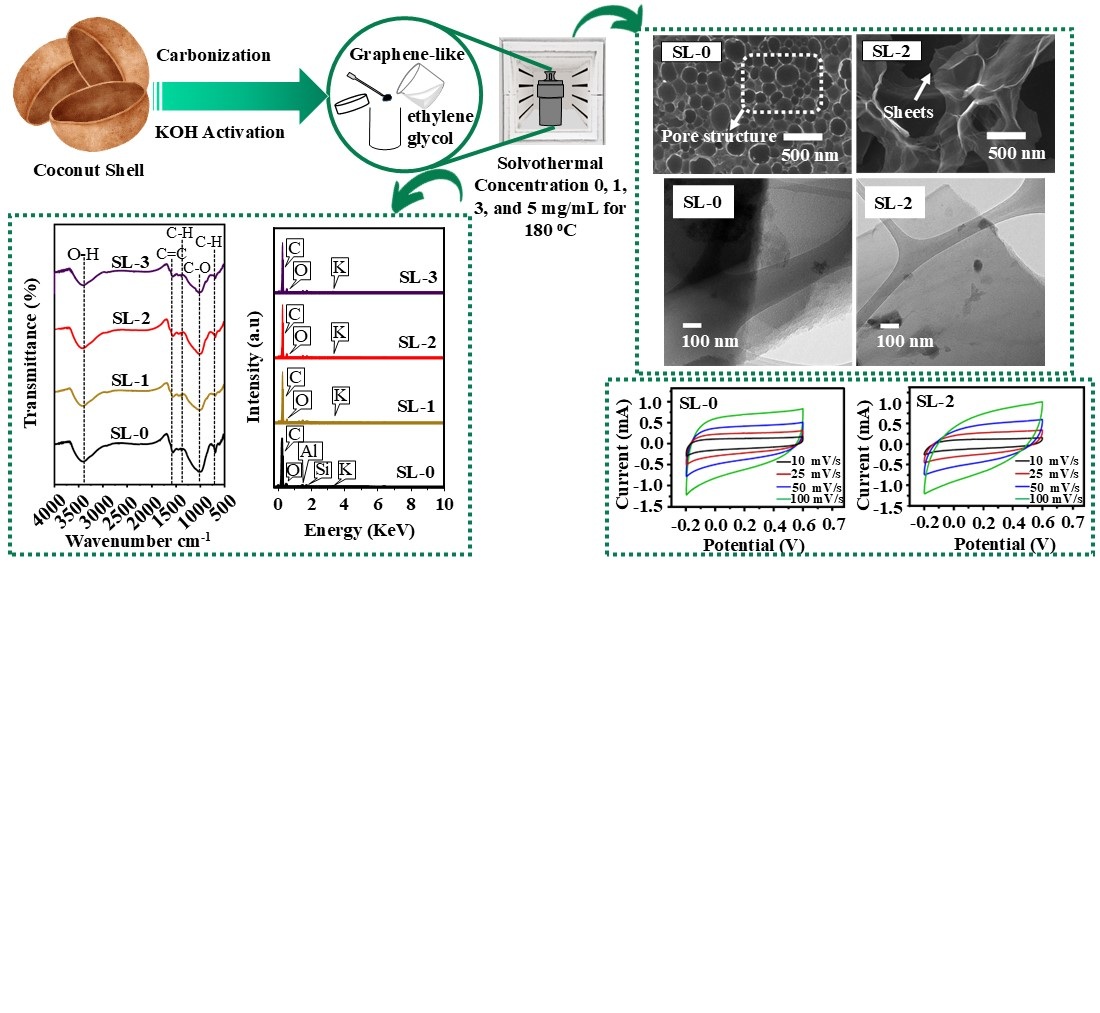
The object of this study is a graphene-like material synthesized from coconut shell biomass via a solvothermal process using ethylene glycol (98%) as the dispersing medium. Were examined are exfoliated carbon nanosheets intended for use as electrode materials in supercapacitors. The research addresses the problem of improving biomass-derived carbon materials' structural quality and electrochemical performance for energy storage. The solvothermal process was applied at varying ethylene glycol concentrations (1, 3, and 5 mg/ml), and the synthesized samples were compared with an untreated control. The results show that the sample treated with 3 mg/ml (SL-2) exhibited the most favorable characteristics, including reduced interlayer spacing (0.39 nm), formation of thin nanosheets, and decreased oxygen-containing functional groups, as evidenced by TEM, FTIR, and EDS analyses. These structural improvements are attributed to the combined effects of thermal energy and solvent-assisted exfoliation, which facilitated partial deoxygenation and reordering of carbon layers. BET analysis revealed a high specific surface area of 872.886 m2/g, contributing to enhanced ion accessibility. Electrochemical measurements demonstrated a specific capacitance of 31.50 F/g for SL-2, significantly higher than the untreated sample (6.32 F/g), along with lower internal resistance (1.87 Ω) and prolonged charge-discharge time (39.90 s), indicating improved ion transport and conductivity. These results highlight the potential of this sustainable and tunable method for producing cost-effective, eco-friendly supercapacitor electrodes
References
- Ahmad, F., Zahid, M., Jamil, H., Khan, M. A., Atiq, S., Bibi, M. et al. (2023). Advances in graphene-based electrode materials for high-performance supercapacitors: A review. Journal of Energy Storage, 72, 108731. https://doi.org/10.1016/j.est.2023.108731
- Mishra, S., Srivastava, R., Muhammad, A., Amit, A., Chiavazzo, E., Fasano, M., Asinari, P. (2023). The impact of physicochemical features of carbon electrodes on the capacitive performance of supercapacitors: a machine learning approach. Scientific Reports, 13 (1). https://doi.org/10.1038/s41598-023-33524-1
- Aimon, A. H., Rahmawati, D., Sutarto, R., Marsudi, M. A., Wibowo, A., Iskandar, F. (2024). Simple and Harmless Fabrication of Reduced Graphene Oxide-Based Transparent Conductive Film Using L-Ascorbic Acid as Reducing Agent. Arabian Journal for Science and Engineering, 49 (7), 10181–10191. https://doi.org/10.1007/s13369-024-09045-y
- Pei, S., Cheng, H.-M. (2012). The reduction of graphene oxide. Carbon, 50 (9), 3210–3228. https://doi.org/10.1016/j.carbon.2011.11.010
- Widanarto, W., Wulandari, R., Rahmawati, D., Cahyanto, W. T., Sari, K., Effendi, M. et al. (2024). Microwave irradiation-induced yield enhancement of coconut shell biomass-derived graphene-like material. Physica Scripta, 99 (6), 065949. https://doi.org/10.1088/1402-4896/ad4691
- Rahman, M. O., Nor, N. B. M., Sawaran Singh, N. S., Sikiru, S., Dennis, J. O., Shukur, M. F. bin Abd. et al. (2023). One-Step Solvothermal Synthesis by Ethylene Glycol to Produce N-rGO for Supercapacitor Applications. Nanomaterials, 13 (4), 666. https://doi.org/10.3390/nano13040666
- Pham, P. V., Mai, T.-H., Dash, S. P., Biju, V., Chueh, Y.-L., Jariwala, D., Tung, V. (2024). Transfer of 2D Films: From Imperfection to Perfection. ACS Nano, 18 (23), 14841–14876. https://doi.org/10.1021/acsnano.4c00590
- Novoselov, K. S., Geim, A. K., Morozov, S. V., Jiang, D., Zhang, Y., Dubonos, S. V. et al. (2004). Electric Field Effect in Atomically Thin Carbon Films. Science, 306 (5696), 666–669. https://doi.org/10.1126/science.1102896
- Dreyer, D. R., Park, S., Bielawski, C. W., Ruoff, R. S. (2010). The chemistry of graphene oxide. Chem. Soc. Rev., 39 (1), 228–240. https://doi.org/10.1039/b917103g
- Wang, Y., Duan, Y., Liang, X., Tang, L., Sun, L., Wang, R. et al. (2023). Hierarchical Porous Activated Carbon Derived from Coconut Shell for Ultrahigh-Performance Supercapacitors. Molecules, 28 (20), 7187. https://doi.org/10.3390/molecules28207187
- Widanarto, W., Solehudin, H., Rahmawati, D., Byennardsi, S. D., Effendi, M., Ghoshal, S. K., Kurniawan, C. (2025). Lanthanum-doped rGO from biomass: a sustainable electrode material for enhanced supercapacitor performance. Engineering Research Express, 7 (2), 025004. https://doi.org/10.1088/2631-8695/adca8b
- Huo, Y., Xiu, S., Meng, L.-Y., Quan, B. (2023). Solvothermal synthesis and applications of micro/nano carbons: A review. Chemical Engineering Journal, 451, 138572. https://doi.org/10.1016/j.cej.2022.138572
- Mahmun, A., Deoghare, A. B. (2024). A comparative study on coconut shell-derived graphene oxide and reduced graphene oxide. Current Applied Physics, 62, 12–21. https://doi.org/10.1016/j.cap.2024.03.009
- Gupta, B., Kumar, N., Panda, K., Kanan, V., Joshi, S., Visoly-Fisher, I. (2017). Role of oxygen functional groups in reduced graphene oxide for lubrication. Scientific Reports, 7 (1). https://doi.org/10.1038/srep45030
- Shams, M., Guiney, L. M., Huang, L., Ramesh, M., Yang, X., Hersam, M. C., Chowdhury, I. (2019). Influence of functional groups on the degradation of graphene oxide nanomaterials. Environmental Science: Nano, 6 (7), 2203–2214. https://doi.org/10.1039/c9en00355j
- Carrera, C., Galán-González, A., Maser, W. K., Benito, A. M. (2025). Multifaceted role of H2O2 in the solvothermal synthesis of green-emitting nitrogen-doped graphene quantum dots. Chemical Science, 16 (8), 3662–3670. https://doi.org/10.1039/d4sc07896a
- Popov, I. A., Bozhenko, K. V., Boldyrev, A. I. (2011). Is graphene aromatic? Nano Research, 5 (2), 117–123. https://doi.org/10.1007/s12274-011-0192-z
- Yu, W., Sisi, L., Haiyan, Y., Jie, L. (2020). Progress in the functional modification of graphene/graphene oxide: a review. RSC Advances, 10 (26), 15328–15345. https://doi.org/10.1039/d0ra01068e
- Nethravathi, C., Rajamathi, M. (2008). Chemically modified graphene sheets produced by the solvothermal reduction of colloidal dispersions of graphite oxide. Carbon, 46 (14), 1994–1998. https://doi.org/10.1016/j.carbon.2008.08.013
- Sankar, S., Lee, H., Jung, H., Kim, A., Ahmed, A. T. A., Inamdar, A. I. et al. (2017). Ultrathin graphene nanosheets derived from rice husks for sustainable supercapacitor electrodes. New Journal of Chemistry, 41 (22), 13792–13797. https://doi.org/10.1039/c7nj03136j
Downloads
Published
How to Cite
Issue
Section
License
Copyright (c) 2025 Wahyu Widanarto, Dedi Setiawan, Mukhtar Effendi, Wahyu Tri Cahyanto, Retno Supriyanti, Muhammad Syaiful Aliim, Dina Rahmawati, Candra Kurniawan

This work is licensed under a Creative Commons Attribution 4.0 International License.
The consolidation and conditions for the transfer of copyright (identification of authorship) is carried out in the License Agreement. In particular, the authors reserve the right to the authorship of their manuscript and transfer the first publication of this work to the journal under the terms of the Creative Commons CC BY license. At the same time, they have the right to conclude on their own additional agreements concerning the non-exclusive distribution of the work in the form in which it was published by this journal, but provided that the link to the first publication of the article in this journal is preserved.
A license agreement is a document in which the author warrants that he/she owns all copyright for the work (manuscript, article, etc.).
The authors, signing the License Agreement with TECHNOLOGY CENTER PC, have all rights to the further use of their work, provided that they link to our edition in which the work was published.
According to the terms of the License Agreement, the Publisher TECHNOLOGY CENTER PC does not take away your copyrights and receives permission from the authors to use and dissemination of the publication through the world's scientific resources (own electronic resources, scientometric databases, repositories, libraries, etc.).
In the absence of a signed License Agreement or in the absence of this agreement of identifiers allowing to identify the identity of the author, the editors have no right to work with the manuscript.
It is important to remember that there is another type of agreement between authors and publishers – when copyright is transferred from the authors to the publisher. In this case, the authors lose ownership of their work and may not use it in any way.







