Devising a method for receiving a multidimensional signal using high-order phase difference modulation in next-generation mobile networks
DOI:
https://doi.org/10.15587/1729-4061.2025.331201Keywords:
phase difference modulation, 32-position, 3D AFM-32, multidimensional, OFDM, noise immunity, coherent algorithm, energy efficiency, 5G/6GAbstract
The object of this study is the process of receiving multidimensional signals formed on the basis of high-order phase-difference modulation of the data transmission system.
The development of mobile networks of the next generations is accompanied by increased requirements for the speed, reliability, and noise immunity of information transmission. Existing modulation methods provide an increase in the speed of information transmission by reducing noise immunity and increasing the spectral width of the signal. The general unsolved problem is the lack of an effective method for forming a multidimensional signal of the nth multiplicity and receiving it based on high-order phase-difference modulation, capable of improving the efficiency of these parameters.
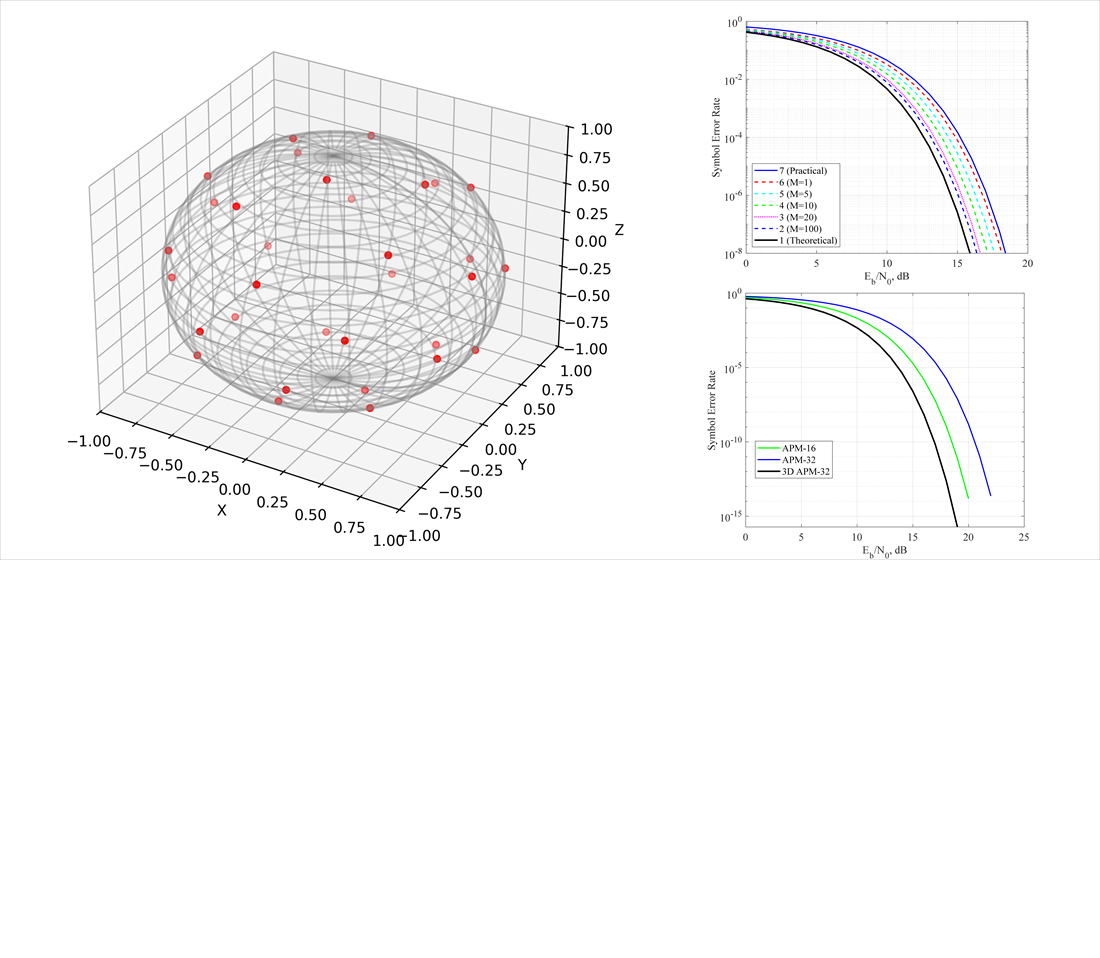
The work proposes a method that makes it possible to form a three-dimensional multi-position signal 3D AFM-32, which uses three independent parameters – amplitude, phase, and time. A feature of the result is that noise immunity is ensured without increasing the spectral width of the signal, but due to three-dimensional formatting, which increases the distance between signal points by 50%.
A coherent reception algorithm has been developed that provides accurate signal recovery even in the presence of phase or frequency disturbances. It is shown that the reception efficiency is achieved at an averaging interval of not less than M = 20, at which the system demonstrates an error probability at the level of SER≈10⁻8 at Eb/N0 ≈ 17.4 dB. This makes it possible to obtain an energy gain of 2–3 dB compared to QAM-32 and classical AFM.
The proposed approach is invariant to phase shifts due to the first and second order phase differences, which eliminates ambiguities during reception. 3D AFM-32 demonstrated higher noise immunity compared to QAM-16/32 and AFM-16/32 under the same conditions. The results could be used in 5G/6G networks, in particular in adaptive OFDM systems, autonomous transport, and telemetry
References
- Rappaport, T. S., MacCartney, G. R., Samimi, M. K., Sun, S. (2015). Wideband Millimeter-Wave Propagation Measurements and Channel Models for Future Wireless Communication System Design. IEEE Transactions on Communications, 63 (9), 3029–3056. https://doi.org/10.1109/tcomm.2015.2434384
- Shoaib, M., Husnain, G., Sayed, N., Lim, S. (2024). Unveiling the 5G Frontier: Navigating Challenges, Applications, and Measurements in Channel Models and Implementations. IEEE Access, 12, 59533–59560. https://doi.org/10.1109/access.2024.3392761
- Banelli, P., Buzzi, S., Colavolpe, G., Modenini, A., Rusek, F., Ugolini, A. (2014). Modulation Formats and Waveforms for 5G Networks: Who Will Be the Heir of OFDM?: An overview of alternative modulation schemes for improved spectral efficiency. IEEE Signal Processing Magazine, 31 (6), 80–93. https://doi.org/10.1109/msp.2014.2337391
- Pyatin, I., Boiko, J., Eromenko, O., Parkhomey, I. (2023). Implementation and analysis of 5G network identification operations at low signal-to-noise ratio. TELKOMNIKA (Telecommunication Computing Electronics and Control), 21 (3), 496. https://doi.org/10.12928/telkomnika.v21i3.22893
- Makarenko, A., Qasim, N., Turovsky, O., Rudenko, N., Polonskyi, K., Govorun, O. (2023). Reducing the impact of interchannel interference on the efficiency of signal transmission in telecommunication systems of data transmission based on the ofdm signal. Eastern-European Journal of Enterprise Technologies, 1 (9 (121)), 82–93. https://doi.org/10.15587/1729-4061.2023.274501
- Klymash, M., Berkman, L., Otrokh, S., Pilinsky, V., Chumak, O., Hryshchenko, O. (2021). Increasing the multi-position signals noise immunity of mobile communication systems based on high-order phase modulation. Selected Papers of the XXI International Scientific and Practical Conference "Information Technologies and Security" (ITS 2021), 147–157. Available at: https://ceur-ws.org/Vol-3241/paper14.pdf
- Dogan Tusha, S., Tusha, A., Basar, E., Arslan, H. (2021). Multidimensional Index Modulation for 5G and Beyond Wireless Networks. Proceedings of the IEEE, 109 (2), 170–199. https://doi.org/10.1109/jproc.2020.3040589
- Cai, Y., Qin, Z., Cui, F., Li, G. Y., McCann, J. A. (2018). Modulation and Multiple Access for 5G Networks. IEEE Communications Surveys & Tutorials, 20 (1), 629–646. https://doi.org/10.1109/comst.2017.2766698
- Bicais, S., Dore, J.-B. (2020). Design of Digital Communications for Strong Phase Noise Channels. IEEE Open Journal of Vehicular Technology, 1, 227–243. https://doi.org/10.1109/ojvt.2020.2994626
- Shamasundar, B., Bhat, S., Jacob, S., Chockalingam, A. (2018). Multidimensional Index Modulation in Wireless Communications. IEEE Access, 6, 589–604. https://doi.org/10.1109/access.2017.2772018
- Peng, M., Wang, X., Yang, X., Wang, D. (2024). A simple two-stage carrier-phase estimation algorithm for 32-QAM coherent optical communication systems. Frontiers in Physics, 12. https://doi.org/10.3389/fphy.2024.1452087
- Zhang, G., Yang, P., Cai, Y., Hu, Q., Yu, G. (2024). From Analog to Digital: Multi-Order Digital Joint Coding-Modulation for Semantic Communication. IEEE Transactions on Communications, 1–1. https://doi.org/10.1109/tcomm.2024.3511949
- Bian, Y., Cheng, X., Wen, M., Yang, L., Poor, H. V., Jiao, B. (2014). Differential Spatial Modulation. IEEE Transactions on Vehicular Technology. https://doi.org/10.1109/tvt.2014.2348791
- Taylor, M. G. (2009). Phase Estimation Methods for Optical Coherent Detection Using Digital Signal Processing. Journal of Lightwave Technology, 27 (7), 901–914. https://doi.org/10.1109/jlt.2008.927778
- Mostofi, Y., Cox, D. C. (2006). Mathematical analysis of the impact of timing synchronization errors on the performance of an OFDM system. IEEE Transactions on Communications, 54 (2), 226–230. https://doi.org/10.1109/tcomm.2005.861675
- Elahi, A., Gul, N., Khan, S. U. (2021). EigenSpace-Based Generalized Sidelobe Canceler Applied for Sidelobe Suppression in Cognitive Radio Systems. Wireless Personal Communications, 121 (4), 3009–3028. https://doi.org/10.1007/s11277-021-08861-x
Downloads
Published
How to Cite
Issue
Section
License
Copyright (c) 2025 Nataliia Halahan, Liubov Berkman, Oleksandr Drobyk, Anatoliy Makarenko, Vladyslav Zavatskyi

This work is licensed under a Creative Commons Attribution 4.0 International License.
The consolidation and conditions for the transfer of copyright (identification of authorship) is carried out in the License Agreement. In particular, the authors reserve the right to the authorship of their manuscript and transfer the first publication of this work to the journal under the terms of the Creative Commons CC BY license. At the same time, they have the right to conclude on their own additional agreements concerning the non-exclusive distribution of the work in the form in which it was published by this journal, but provided that the link to the first publication of the article in this journal is preserved.
A license agreement is a document in which the author warrants that he/she owns all copyright for the work (manuscript, article, etc.).
The authors, signing the License Agreement with TECHNOLOGY CENTER PC, have all rights to the further use of their work, provided that they link to our edition in which the work was published.
According to the terms of the License Agreement, the Publisher TECHNOLOGY CENTER PC does not take away your copyrights and receives permission from the authors to use and dissemination of the publication through the world's scientific resources (own electronic resources, scientometric databases, repositories, libraries, etc.).
In the absence of a signed License Agreement or in the absence of this agreement of identifiers allowing to identify the identity of the author, the editors have no right to work with the manuscript.
It is important to remember that there is another type of agreement between authors and publishers – when copyright is transferred from the authors to the publisher. In this case, the authors lose ownership of their work and may not use it in any way.