Гібридна багатомасштабна згорткова нейрона мережа з особливостями уваги та текстури для покращеної класифікації зображень
DOI:
https://doi.org/10.15587/1729-4061.2025.331524Ключові слова:
багатомасштабне ядро, механізми уваги, CIFAR-10, GLCM, LBP, фільтри ГабораАнотація
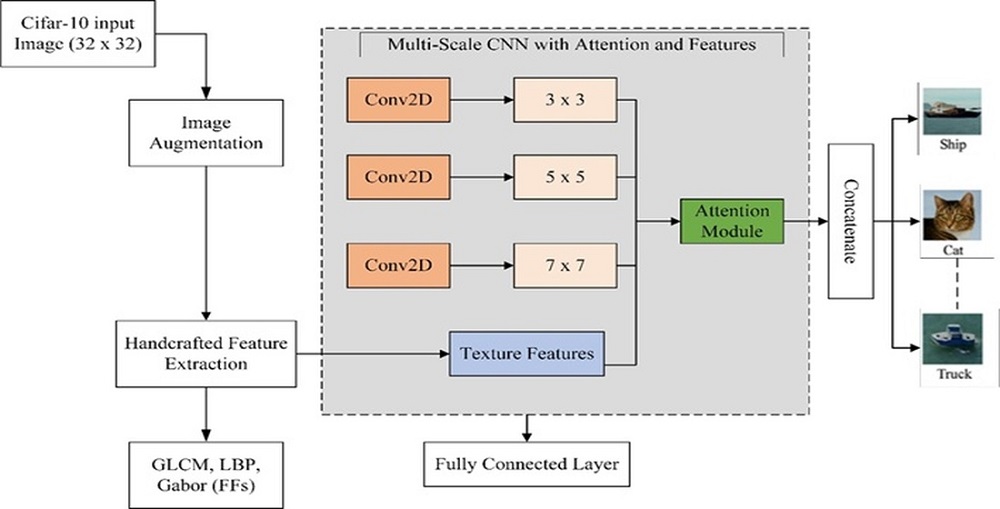
Об'єктом цього дослідження є класифікація зображень з низькою роздільною здатністю та з кількома класами, представлених за допомогою еталонного набору даних CIFAR-10. Точна класифікація зображень з низькою роздільною здатністю та з кількома класами є складною, оскільки традиційні згорткові нейронні мережі (CIFAR-10) зазвичай мають проблеми з ідентифікацією як глобальних, так і складних текстурних візерунків. Щоб вирішити цю проблему, у цьому дослідженні використовується набір даних CIFAR-10 як репрезентативний еталон для реальних сценаріїв, де якість зображення обмежена, наприклад, у недорогих медичних системах візуалізації, дистанційному зондуванні та системах відеоспостереження. Обмежена розрізнювальність традиційних CNF у цих ситуаціях є основною проблемою, яку розглядають. Запропонований метод використовує три паралельні згорткові потоки з різними розмірами ядра (3 × 3, 5 × 5 та 7 × 7) для захоплення ієрархічних просторових візерунків, а потім інтегрує два механізми уваги – стискання та збудження та згортковий блочний модуль уваги – які адаптивно підкреслюють найбільш релевантну просторову та канальну інформацію. Крім того, дескриптори структурної текстури, такі як матриця спільної появи рівнів сірого, локальний бінарний шаблон та фільтри Габора, обчислюються незалежно, а потім об'єднуються з глибокими представленнями для збагачення простору ознак. Експерименти проводилися на наборі даних CIFAR-10 з різними рівнями складності класів: 10, 5 та 3 категорії. Результати показують, що гібридний підхід значно покращує точність, повноту та F1-оцінку у всіх сценаріях, з найвищою точністю 90,87%, отриманою, коли задіяні лише три класи. Ці покращення пояснюються взаємодоповнюючою природою глибоких та ручних ознак, які разом дозволяють моделі вивчати як глобальну семантику, так і дрібнозернисті локальні текстури, що може досягти вищої точності класифікації, підвищеної надійності та зменшення помилок класифікації, що зрештою підвищує ефективність застосувань, починаючи від підтримки медичних рішень до інтелектуального спостереження.
Посилання
- Talebi, K., Torabi, Z., Daneshpour, N. (2024). Ensemble models based on CNN and LSTM for dropout prediction in MOOC. Expert Systems with Applications, 235, 121187. https://doi.org/10.1016/j.eswa.2023.121187
- Harumy, T. H. F., Zarlis, M., Lydia, M. S., Efendi, S. (2023). A novel approach to the development of neural network architecture based on metaheuristic protis approach. Eastern-European Journal of Enterprise Technologies, 4 (4 (124)), 46–59. https://doi.org/10.15587/1729-4061.2023.281986
- Rao, K. N., Khalaf, O. I., Krishnasree, V., Kumar, A. S., Alsekait, D. M., Priyanka, S. S. et al. (2024). An efficient brain tumor detection and classification using pre-trained convolutional neural network models. Heliyon, 10 (17), e36773. https://doi.org/10.1016/j.heliyon.2024.e36773
- Krizhevsky, A., Sutskever, I., Hinton, G. E. (2017). ImageNet classification with deep convolutional neural networks. Communications of the ACM, 60 (6), 84–90. https://doi.org/10.1145/3065386
- Wei, D., Zhou, B., Torrabla, A., Freeman, W. (2015). Understanding Intra-Class Knowledge Inside CNN. arXiv. https://doi.org/10.48550/arXiv.1507.02379
- Zhou, F., Wang, J. (2024). Heartbeat classification method combining multi-branch convolutional neural networks and transformer. IScience, 27 (3), 109307. https://doi.org/10.1016/j.isci.2024.109307
- Harumy, T. H. F., Br Ginting, D. S., Manik, F. Y., Alkhowarizmi, A. (2024). Developing an early detection model for skin diseases using a hybrid deep neural network to enhance health independence in coastal communities. Eastern-European Journal of Enterprise Technologies, 6 (9 (132)), 71–85. https://doi.org/10.15587/1729-4061.2024.313983
- Zeng, G., He, Y., Yu, Z., Yang, X., Yang, R., Zhang, L. (2015). Preparation of novel high copper ions removal membranes by embedding organosilane-functionalized multi-walled carbon nanotube. Journal of Chemical Technology & Biotechnology, 91 (8), 2322–2330. https://doi.org/10.1002/jctb.4820
- Sengupta, A., Ye, Y., Wang, R., Liu, C., Roy, K. (2019). Going Deeper in Spiking Neural Networks: VGG and Residual Architectures. Frontiers in Neuroscience, 13. https://doi.org/10.3389/fnins.2019.00095
- Tan, M., Le, Q. V. (2019). EfficientNet: Rethinking Model Scaling for Convolutional Neural Networks Mingxing. International Conference on Machine Learning. https://doi.org/10.48550/arXiv.1905.11946
- Hu, J., Shen, L., Sun, G. (2018). Squeeze-and-Excitation Networks. 2018 IEEE/CVF Conference on Computer Vision and Pattern Recognition. https://doi.org/10.1109/cvpr.2018.00745
- Woo, S., Park, J., Lee, J.-Y., Kweon, I. S. (2018). CBAM: Convolutional Block Attention Module. Computer Vision – ECCV 2018, 3–19. https://doi.org/10.1007/978-3-030-01234-2_1
- Chen, S.-H., Wu, Y.-L., Pan, C.-Y., Lian, L.-Y., Su, Q.-C. (2023). Breast ultrasound image classification and physiological assessment based on GoogLeNet. Journal of Radiation Research and Applied Sciences, 16 (3), 100628. https://doi.org/10.1016/j.jrras.2023.100628
- Zhang, C., Pan, X., Li, H., Gardiner, A., Sargent, I., Hare, J., Atkinson, P. M. (2018). A hybrid MLP-CNN classifier for very fine resolution remotely sensed image classification. ISPRS Journal of Photogrammetry and Remote Sensing, 140, 133–144. https://doi.org/10.1016/j.isprsjprs.2017.07.014
- Shafiq, M. A., Wang, Z., Amin, A., Hegazy, T., Deriche, M., AlRegib, G. (2015). Detection of Salt-dome Boundary Surfaces in Migrated Seismic Volumes Using Gradient of Textures. SEG Technical Program Expanded Abstracts 2015, 1811–1815. https://doi.org/10.1190/segam2015-5927230.1
- Ojala, T., Pietikäinen, M., Harwood, D. (1996). A comparative study of texture measures with classification based on featured distributions. Pattern Recognition, 29 (1), 51–59. https://doi.org/10.1016/0031-3203(95)00067-4
- Althnian, A., Aloboud, N., Alkharashi, N., Alduwaish, F., Alrshoud, M., Kurdi, H. (2020). Face Gender Recognition in the Wild: An Extensive Performance Comparison of Deep-Learned, Hand-Crafted, and Fused Features with Deep and Traditional Models. Applied Sciences, 11 (1), 89. https://doi.org/10.3390/app11010089
- Guo, J., Yuan, H., Shi, B., Zheng, X., Zhang, Z., Li, H., Sato, Y. (2024). A novel breast cancer image classification model based on multiscale texture feature analysis and dynamic learning. Scientific Reports, 14 (1). https://doi.org/10.1038/s41598-024-57891-5
- Liao, N., Guan, J. (2024). Multi-scale Convolutional Feature Fusion Network Based on Attention Mechanism for IoT Traffic Classification. International Journal of Computational Intelligence Systems, 17 (1). https://doi.org/10.1007/s44196-024-00421-y
- Yazdan, S. A., Ahmad, R., Iqbal, N., Rizwan, A., Khan, A. N., Kim, D.-H. (2022). An Efficient Multi-Scale Convolutional Neural Network Based Multi-Class Brain MRI Classification for SaMD. Tomography, 8 (4), 1905–1927. https://doi.org/10.3390/tomography8040161
- Ishengoma, F. S., Lyimo, N. N. (2024). Ensemble model for grape leaf disease detection using CNN feature extractors and random forest classifier. Heliyon, 10 (12), e33377. https://doi.org/10.1016/j.heliyon.2024.e33377
- Xu, Z., Guo, X., Wang, J. (2024). Enhancing skin lesion segmentation with a fusion of convolutional neural networks and transformer models. Heliyon, 10 (10), e31395. https://doi.org/10.1016/j.heliyon.2024.e31395
- Liu, X., Hu, L., Tie, L., Jun, L., Wang, X., Liu, X. (2024). Integration of Convolutional Neural Network and Vision Transformer for gesture recognition using sEMG. Biomedical Signal Processing and Control, 98, 106686. https://doi.org/10.1016/j.bspc.2024.106686
- Zhang, L., Zeng, W., Zhou, P., Deng, X., Wu, J., Wen, H. (2025). A fast and lightweight train image fault detection model based on convolutional neural networks. Image and Vision Computing, 154, 105380. https://doi.org/10.1016/j.imavis.2024.105380
- Krizhevsky, A. (2009). Learning Multiple Layers of Features from Tiny Images. University of Toronto. Available at: https://www.cs.utoronto.ca/~kriz/learning-features-2009-TR.pdf
##submission.downloads##
Опубліковано
Як цитувати
Номер
Розділ
Ліцензія
Авторське право (c) 2025 Irpan Adiputra Pardosi, Tengku Henny Febriana Harumy, Syahril Efendi

Ця робота ліцензується відповідно до Creative Commons Attribution 4.0 International License.
Закріплення та умови передачі авторських прав (ідентифікація авторства) здійснюється у Ліцензійному договорі. Зокрема, автори залишають за собою право на авторство свого рукопису та передають журналу право першої публікації цієї роботи на умовах ліцензії Creative Commons CC BY. При цьому вони мають право укладати самостійно додаткові угоди, що стосуються неексклюзивного поширення роботи у тому вигляді, в якому вона була опублікована цим журналом, але за умови збереження посилання на першу публікацію статті в цьому журналі.
Ліцензійний договір – це документ, в якому автор гарантує, що володіє усіма авторськими правами на твір (рукопис, статтю, тощо).
Автори, підписуючи Ліцензійний договір з ПП «ТЕХНОЛОГІЧНИЙ ЦЕНТР», мають усі права на подальше використання свого твору за умови посилання на наше видання, в якому твір опублікований. Відповідно до умов Ліцензійного договору, Видавець ПП «ТЕХНОЛОГІЧНИЙ ЦЕНТР» не забирає ваші авторські права та отримує від авторів дозвіл на використання та розповсюдження публікації через світові наукові ресурси (власні електронні ресурси, наукометричні бази даних, репозитарії, бібліотеки тощо).
За відсутності підписаного Ліцензійного договору або за відсутністю вказаних в цьому договорі ідентифікаторів, що дають змогу ідентифікувати особу автора, редакція не має права працювати з рукописом.
Важливо пам’ятати, що існує і інший тип угоди між авторами та видавцями – коли авторські права передаються від авторів до видавця. В такому разі автори втрачають права власності на свій твір та не можуть його використовувати в будь-який спосіб.