Здійснення нелінійної дефазифікації лінгвістичних індикаторів переваг в методі аналізу ієрархій Сааті
DOI:
https://doi.org/10.15587/1729-4061.2025.332092Ключові слова:
метод аналізу ієрархій, рівні переваг, лінгвістичні індикатори, нормовані вагові коефіцієнтиАнотація
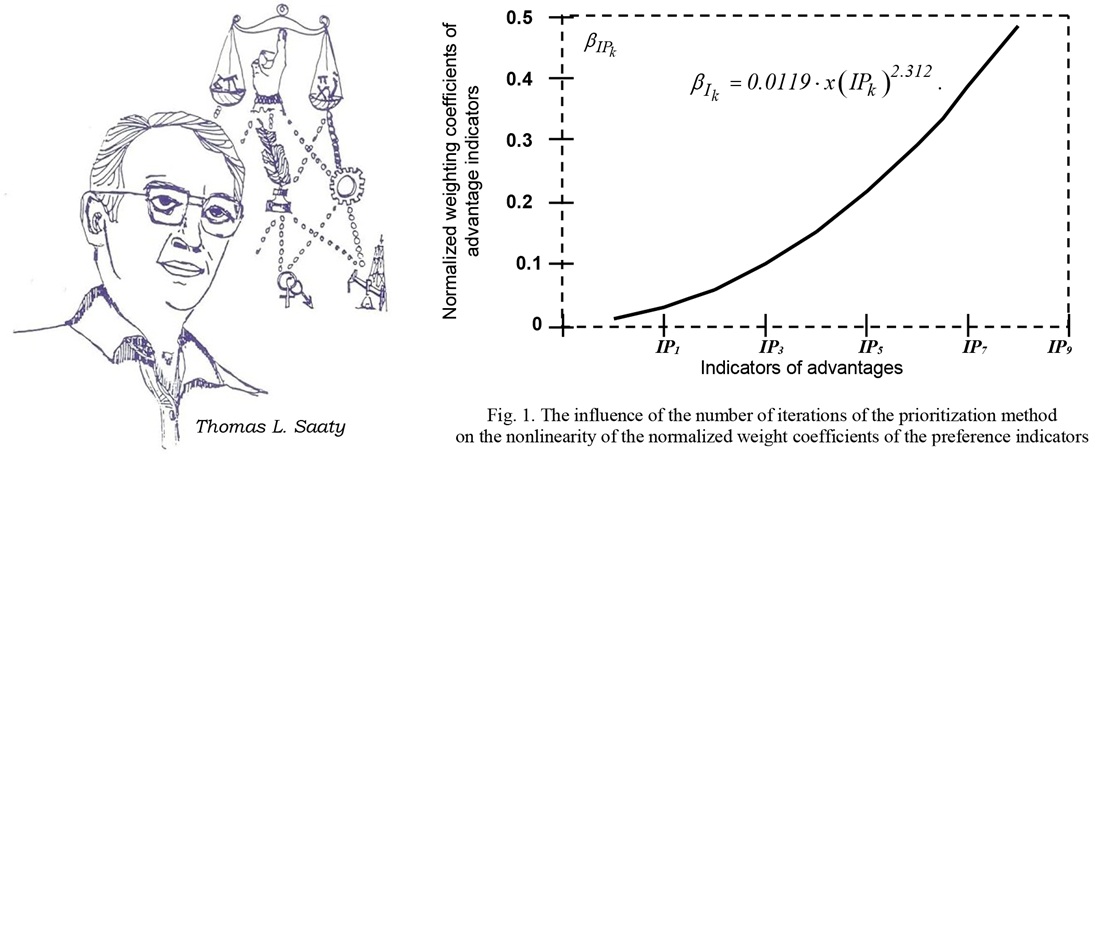
Об’єктом дослідження є метод аналізу ієрархій, як більш застосовуваний для вирішення мультикритеріальних задач прийняття рішень (ПР). Предметом – шкала рівнів переваг Сааті та методи встановлення нормованих вагових коефіцієнтів (НВК). Проблема полягає у підвищенні точності мультикритеріальних рішень, де лінійна дефазифікація лінгвістичних індикаторів переваг (ІП), застосовувана для формування матриць попарних порівнянь (МПП), не відповідає особливостям людського мислення. Суть результатів – для базових ІП (IР9, IР7, IР5, IР3, IР1) НВК встановлені математичним методом розстановки пріоритетів (МРП), адаптованим для потреб досліджень, для проміжних (IР8, IР6, IР4, IР2) – мультиплікативною агрегацією НВК сусідніх ІП. Особливість – встановлено прийнятним застосування результатів ІІ ітерації МРП з ХІІ, що є нелінійними, формують ступеневу шкалу, забезпечують належну точність вимірів пріоритетів. Кількісний показник чутливості до виміру лінгвістичних переваг зріс 4,5 рази порівняно з лінійною шкалою. Однак середній показник кількісної оцінки встановлення помилкового ІП в нелінійній шкалі виявився у 1,84 рази більшим, ніж у лінійній. що висуває додаткові вимоги до компетентності експертів, а також необхідності контролю їх уважності під час формування МПП.
Відносний кількісний показник, що відповідає збільшенню НВК термів шкали Сааті, утвореним за допомогою модифікатора «дуже» шляхом здійснення нечіткої операції «концентрація», зріс майже удвічі, «подвійної концентрацї» – на третину. Це більшою мірою відповідає кількісно-якісній логіці співвідношення зазначених термів. Практичне використання отриманих результатів сприятиме запобіганню негативному явищу реверсу рангів у мультикритеріальних задачах ПР
Посилання
- Rotshtein, O. P., Shtovba, S. D., Kozachko, O. M. (2007). Modeliuvannia ta optymizatsiya nadiynosti bahatovymirnykh alhorytmichnykh protsesiv. Vinnytsia: UNIVERSUM–Vinnytsia, 211.
- Kovalchuk, V. M. (2010) Osoblyvosti rozvʼyazannia bahatokryterialnykh zadach pryiniattia rishen u nechitkomu seredovyshchi. Finansova systema Ukrainy. Naukovi zapysky. Seriya “Ekonomika”, 14, 447–456. Available at: https://eprints.oa.edu.ua/id/eprint/6803/
- Reva, O. M., Kamyshyn, V. V., Borsuk, S. P., Yarotskyi, S. V., Sahanovska, L. A. (2023). Metodolohiya systemno-informatsiynoi kvalimetriyi investytsiynoi pryvablyvosti obiektiv ekspertyzy. Kyiv: UkrINTEI, 150.
- Taherdoost, H., Madanchian, M. (2023). Multi-Criteria Decision Making (MCDM) Methods and Concepts. Encyclopedia, 3 (1), 77–87. https://doi.org/10.3390/encyclopedia3010006
- Metody vyrishennia zadach bahatokryterialnoi optymizatsiyi (2024). Odesa: Odes. nats. un-t im. I.I. Mech-nykova, 50. Available at: https://dspace.onu.edu.ua/items/0a0bbbbe-81da-45e2-9703-fed7261b3a11
- Saaty, T. L. (2009). Mathematical Principles of Decision Making (Principia Mathematica Decernendi). Pittsburgh: RWS.
- Millar, L. A., McCallum, J., Burston, L. M. (2010). Use of the conjoint value hierarchy approach to measure the value of the national continence management strategy. The Australian and New Zealand Continence Journal, 16 (3), 81–86.
- Khan, A. U., Ali, Y. (2020). Analytical hierarchy process (AHP) and analytic network process methods and their applications: a twenty year review from 2000-2019. International Journal of the Analytic Hierarchy Process, 12 (3). https://doi.org/10.13033/ijahp.v12i3.822
- Ivanova, N., Ganzha, O., Podkovyrov, I. (2020). The use of the Analytic Hierarchy Process in Determination of the Design Solution for Vertical Gardening. Journal of Physics: Conference Series, 1614 (1), 012035. https://doi.org/10.1088/1742-6596/1614/1/012035
- Krenicky, T., Hrebenyk, L., Chernobrovchenko, V. (2022). Application of Concepts of the Analytic Hierarchy Process in Decision-Making. Management Systems in Production Engineering, 30 (4), 304–310. https://doi.org/10.2478/mspe-2022-0039
- Oleniacz, G., Skrzypczak, I., Leń, P. (2019). Decision-making models using the Analytical Hierarchy Process in the urgency of land consolidation works. Journal of Water and Land Development, 43 (1), 144–150. https://doi.org/10.2478/jwld-2019-0072
- Vartanyan, V. M., Shteinbrekher, D. A. (2019). Application of the hierarchy analysis technique for the design of high-technological projects knowledge management strategy. Radioelectronic and Computer Systems, 2 (90), 118–126. https://doi.org/10.32620/reks.2019.2.11
- Nisfoian, S., Sysolina, N., Savelenko, H. (2020). Improving the Efficiency of Investment Project Selection Mechanisms at the Enterprise. Central Ukrainian Scientific Bulletin. Economic Sciences, 5 (38), 228–237. https://doi.org/10.32515/2663-1636.2020.5(38).228-237
- Alshaibi, A., Kahraman, G. D., Qasim, A. (2016). Analytic Hierarchy Process (AHP) as criteria in business decision making and their implementation in practice. International Journal of Management and Business Studies, 6 (2), 209–220. Available at: https://www.internationalscholarsjournals.com/abstract/analytic-hierarchy-process-ahp-as-criteria-in-business-decision-making-and-their-implementation-in-practice-61841.html
- Taherdoost, H. (2017). Decision Making Using the Analytic Hierarchy Process (AHP); A Step by Step Approach. International Journal of Economics and Management System, 2, 244–246. Available at: https://hal.science/hal-02557320
- Tavana, M., Soltanifar, M., Santos-Arteaga, F. J. (2021). Analytical hierarchy process: revolution and evolution. Annals of Operations Research, 326 (2), 879–907. https://doi.org/10.1007/s10479-021-04432-2
- Koo, M., Yang, S.-W. (2025). Likert-Type Scale. Encyclopedia, 5 (1), 18. https://doi.org/10.3390/encyclopedia5010018
- Mahmoudi, A., Deng, X., Javed, S. A., Zhang, N. (2020). Sustainable Supplier Selection in Megaprojects: Grey Ordinal Priority Approach. Business Strategy and the Environment, 30 (1), 318–339. https://doi.org/10.1002/bse.2623
- Reva, O., Kamyshyn, V., Borsuk, S., Nevynitsyn, A. (2022). α-Method of Air Traffic Controllers’ Preference System Specification Over Typical Mistakes Severities. ICT with Intelligent Applications, 679–685. https://doi.org/10.1007/978-981-16-4177-0_68
##submission.downloads##
Опубліковано
Як цитувати
Номер
Розділ
Ліцензія
Авторське право (c) 2025 Оleksii Reva, Volodymyr Kamyshyn, Sergii Borsuk, Pavlo Mamenko, Kostiantyn Кyrychenko, Larysa Sahanovska

Ця робота ліцензується відповідно до Creative Commons Attribution 4.0 International License.
Закріплення та умови передачі авторських прав (ідентифікація авторства) здійснюється у Ліцензійному договорі. Зокрема, автори залишають за собою право на авторство свого рукопису та передають журналу право першої публікації цієї роботи на умовах ліцензії Creative Commons CC BY. При цьому вони мають право укладати самостійно додаткові угоди, що стосуються неексклюзивного поширення роботи у тому вигляді, в якому вона була опублікована цим журналом, але за умови збереження посилання на першу публікацію статті в цьому журналі.
Ліцензійний договір – це документ, в якому автор гарантує, що володіє усіма авторськими правами на твір (рукопис, статтю, тощо).
Автори, підписуючи Ліцензійний договір з ПП «ТЕХНОЛОГІЧНИЙ ЦЕНТР», мають усі права на подальше використання свого твору за умови посилання на наше видання, в якому твір опублікований. Відповідно до умов Ліцензійного договору, Видавець ПП «ТЕХНОЛОГІЧНИЙ ЦЕНТР» не забирає ваші авторські права та отримує від авторів дозвіл на використання та розповсюдження публікації через світові наукові ресурси (власні електронні ресурси, наукометричні бази даних, репозитарії, бібліотеки тощо).
За відсутності підписаного Ліцензійного договору або за відсутністю вказаних в цьому договорі ідентифікаторів, що дають змогу ідентифікувати особу автора, редакція не має права працювати з рукописом.
Важливо пам’ятати, що існує і інший тип угоди між авторами та видавцями – коли авторські права передаються від авторів до видавця. В такому разі автори втрачають права власності на свій твір та не можуть його використовувати в будь-який спосіб.