Визначення найкращих моделей класифікації жестів алфавіту BISINDO для підтримки комунікативних потреб спільноти глухих
DOI:
https://doi.org/10.15587/1729-4061.2025.332096Ключові слова:
BISINDO, жести алфавіту, продуктивність, CNN, VGG-19, MobileNetV2, ResNet-50, Inception-V3Анотація
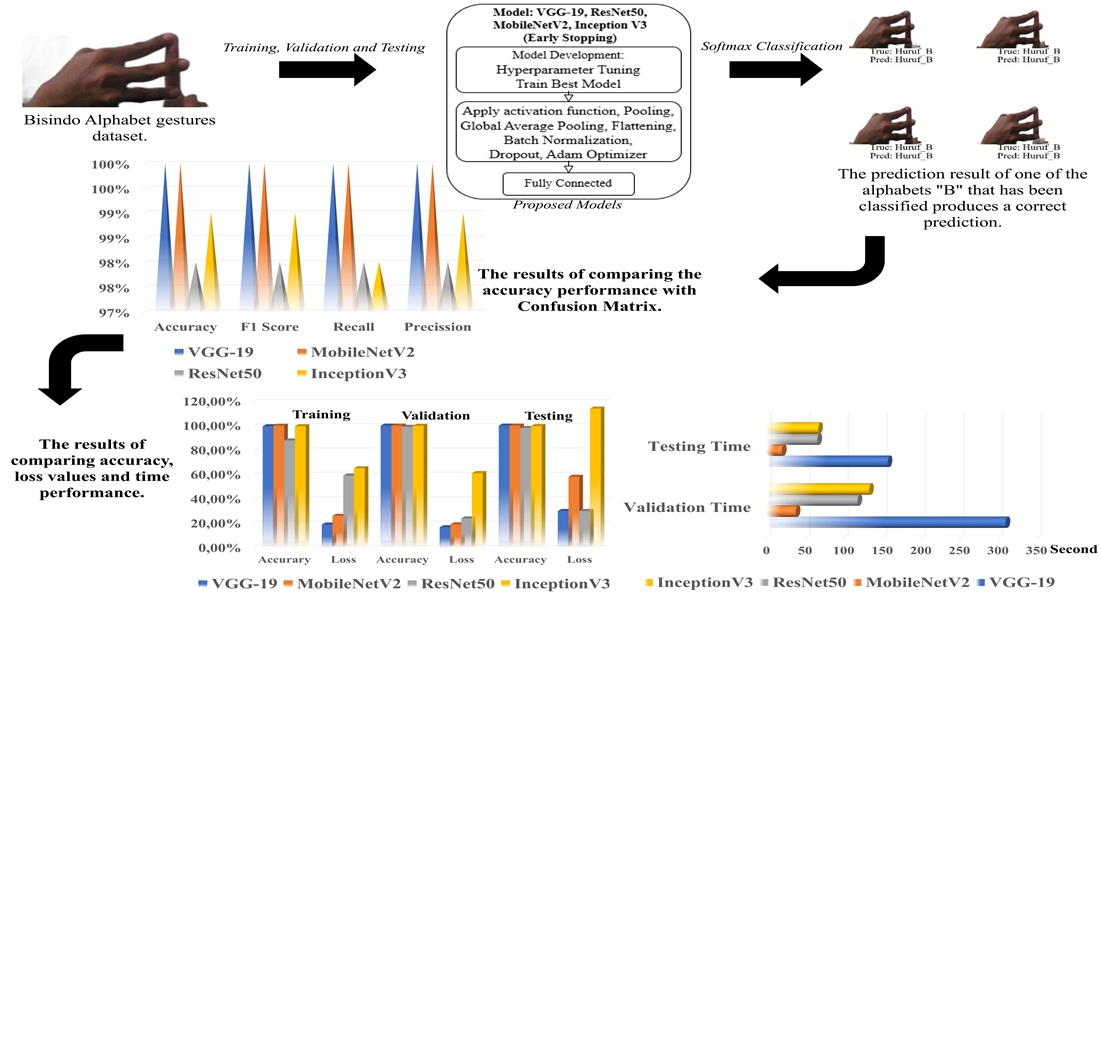
Об’єктом цього дослідження є жести алфавіту BISINDO, які являють собою статичні рухи рук, що використовуються глухими людьми в Індонезії для спілкування, причому кожна літера має унікальний візерунок руки, на який впливають культура та регіональні особливості. Вирішена проблема полягає в точності та продуктивності класифікації жестів рук BISINDO, яка є неоптимальною через складні варіації жестів та обчислювальні обмеження на легких пристроях.
У цьому дослідженні розглядається продуктивність класифікації жестів алфавіту BISINDO за допомогою моделей глибокого навчання з 4 архітектурами: VGG-19, ResNet-50, MobileNetV2 та Inception-V3. Цей об’єкт являє собою колекцію зображень, що використовуються як набір даних, що складається з 10 400 зображень (7 280 навчальних, 2 080 валідаційних та 1 040 тестових). Результати показують, що архітектури MobileNetV2 та VGG-19 досягають найвищої точності 100%, далі йдуть Inception-V3 (99%) та ResNet-50 (98%). Результати цього дослідження показують, що чудова продуктивність MobileNetV2 зумовлена його ефективною згортковою архітектурою з роздільною глибиною, тоді як перевага VGG-19 полягає в його дуже глибокій архітектурі та використанні малих згорткових фільтрів для захоплення дуже детальних ієрархічних характеристик жестів. Тим часом Inception-V3 перевершує інших завдяки модулю inception, який захоплює характеристики жестів у різних масштабах. Результати цього порівняння продуктивності показують, що MobileNetV2 є найвищим завдяки своїй обчислювальній ефективності, яка забезпечує високу продуктивність, а також адаптацію до складних варіацій жестів алфавіту BISINDO. Результати цього дослідження також можуть бути застосовані в сферах освіти та комунікації для глухих, особливо у вбудованих додатках, що забезпечує доступність жестової мови в режимі реального часу.
Посилання
- Types of Hearing Loss. American Speech-Language-Hearing Association. Available at: https://www.asha.org/public/hearing/Types-of-Hearing-Loss
- Altiarika, E., Sari, W. P. (2023). Pengembangan Deteksi Realtime untuk Bahasa Isyarat Indonesia dengan Menggunakan Metode Deep Learning Long Short Term Memory dan Convolutional Neural Network. Jurnal Teknologi Informatika Dan Komputer, 9 (1), 1–13. https://doi.org/10.37012/jtik.v9i1.1272
- Caraka, R. E., Supardi, K., Kurniawan, R., Kim, Y., Gio, P. U., Yuniarto, B., Mubarok, F. Z., Pardamean, B. (2024). Empowering deaf communication: a novel LSTM model for recognizing Indonesian sign language. Universal Access in the Information Society, 24 (1), 771–783. https://doi.org/10.1007/s10209-024-01095-1
- Aziz, A. N. (2021). Image Recognition Alfabet Bahasa Isyarat Indonesia (Bisindo) Menggunakan Metode Convolutional Neural Network. Yogyakarta. Available at: https://dspace.uii.ac.id/handle/123456789/32137
- Shams, M. Y., Hassan, E., Gamil, S., Ibrahim, A., Gabr, E., Gamal, S. et al. (2025). Skin Disease Classification: A Comparison of ResNet50, MobileNet, and Efficient-B0. Journal of Current Multidisciplinary Research, 1 (1), 1–7. https://doi.org/10.21608/jcmr.2025.327880.1002
- Reka, S. S., Murthy Voona, V. D., Sai Nithish, P. V., Paavan Kumar, D. S., Venugopal, P., Ravi, V. (2023). Performance Analysis of Deep Convolutional Network Architectures for Classification of Over-Volume Vehicles. Applied Sciences, 13 (4), 2549. https://doi.org/10.3390/app13042549
- Younis, H., Obaid, M. (2024). Performance Comparison of Pretrained Deep Learning Models for Landfill Waste Classification. International Journal of Advanced Computer Science and Applications, 15 (11). https://doi.org/10.14569/ijacsa.2024.0151166
- Sanjaya, S. A., Faustine Ilone, H. (2023). BISINDO Sign Language Recognition: A Systematic Literature Review of Deep Learning Techniques for Image Processing. Indonesian Journal of Computer Science, 12 (6). https://doi.org/10.33022/ijcs.v12i6.3539
- Aryananda, I. G. A. O., Samopa, F. (2024). Comparison of the Accuracy of The Bahasa Isyarat Indonesia (BISINDO) Detection System Using CNN and RNN Algorithm for Implementation on Android. MALCOM: Indonesian Journal of Machine Learning and Computer Science, 4 (3), 1111–1119. https://doi.org/10.57152/malcom.v4i3.1465
- Pin, K., Ho Chang, J., Nam, Y. (2022). Comparative Study of Transfer Learning Models for Retinal Disease Diagnosis from Fundus Images. Computers, Materials & Continua, 70 (3), 5821–5834. https://doi.org/10.32604/cmc.2022.021943
- Cui, S., Su, Y. L., Duan, K., Liu, Y. (2022). Maize leaf disease classification using CBAM and lightweight Autoencoder network. Journal of Ambient Intelligence and Humanized Computing, 14 (6), 7297–7307. https://doi.org/10.1007/s12652-022-04438-z
- Kumar, J. S., Anuar, S., Hassan, N. H. (2022). Transfer Learning based Performance Comparison of the Pre-Trained Deep Neural Networks. International Journal of Advanced Computer Science and Applications, 13 (1). https://doi.org/10.14569/ijacsa.2022.0130193
- Mendes, J., Lima, J., Costa, L., Rodrigues, N., Pereira, A. I. (2024). Deep learning networks for olive cultivar identification: A comprehensive analysis of convolutional neural networks. Smart Agricultural Technology, 8, 100470. https://doi.org/10.1016/j.atech.2024.100470
- Wahyuningsih, W., Nugraha, G. S., Dwiyansaputra, R. (2024). Classification Of Dental Caries Disease In Tooth Images Using A Comparison Of Efficientnet-B0, Mobilenetv2, Resnet-50, Inceptionv3 Architectures. Jurnal Teknik Informatika (Jutif), 5 (4), 177–185. https://doi.org/10.52436/1.jutif.2024.5.4.2187
- Candra, A., Rosmalinda, Intan, T. K., Purnamasari, F., Liyanto, H., Nugraha, A. T., Ewaldo. (2024). Development of machine learning-based sign language translator for Bahasa Isyarat Indonesia (BISINDO). Proceedings Of The 6th International Conference On Computing And Applied Informatics 2022, 2987, 020070. https://doi.org/10.1063/5.0199747
- Harumy, T. H. F., Br Ginting, D. S., Manik, F. Y., Alkhowarizmi, A. (2024). Developing an early detection model for skin diseases using a hybrid deep neural network to enhance health independence in coastal communities. Eastern-European Journal of Enterprise Technologies, 6 (9 (132)), 71–85. https://doi.org/10.15587/1729-4061.2024.313983
- Díaz-Gaxiola, E., Morales-Casas, Z. E., Castro-López, O., Beltrán-Gutiérrez, G., Vega-López, I. F., Yee-Rendón, A. (2019). Estudio comparativo de arquitecturas de CNNs en hojas de Pimiento Morrón infectadas con virus PHYVV o PEPGMV. Research in Computing Science, 148 (7), 289–303. https://doi.org/10.13053/rcs-148-7-22
- Kunjachan, S., Remya, R., Kumar, S., Asish, G. R., Sheela, K., Kala, S. (2023). Comparative study of convolutional neural networks for leaf classification in Ayurveda. IET Conference Proceedings, 2023 (11), 18–23. https://doi.org/10.1049/icp.2023.1756
- Iparraguirre-Villanueva, O., Guevara-Ponce, V., Paredes, O. R., Sierra-Liñan, F., Zapata-Paulini, J., Cabanillas-Carbonell, M. (2022). Convolutional Neural Networks with Transfer Learning for Pneumonia Detection. International Journal of Advanced Computer Science and Applications, 13 (9). https://doi.org/10.14569/ijacsa.2022.0130963
- Panthakkan, A., Anzar, S. M., Al Mansoori, S., Mansoor, W., Al Ahmad, H. (2022). A systematic comparison of transfer learning models for COVID-19 prediction. Intelligent Decision Technologies, 16 (3), 557–574. https://doi.org/10.3233/idt-220017
- Ahmed, N., Rahman, M., Ishrak, F., Joy, I. K., Sabuj, S. H., Rahman, S. (2024). Comparative Performance Analysis of Transformer-Based Pre-Trained Models for Detecting Keratoconus Disease. arXiv. https://doi.org/10.48550/arXiv.2408.09005
- Ahmad, N., Wijaya, E. S., Tjoaquinn, C., Lucky, H., Iswanto, I. A. (2023). Transforming Sign Language using CNN Approach based on BISINDO Dataset. 2023 International Conference on Informatics, Multimedia, Cyber and Informations System (ICIMCIS), 543–548. https://doi.org/10.1109/icimcis60089.2023.10349011
- Hossain, Md. B., Iqbal, S. M. H. S., Islam, Md. M., Akhtar, Md. N., Sarker, I. H. (2022). Transfer learning with fine-tuned deep CNN ResNet50 model for classifying COVID-19 from chest X-ray images. Informatics in Medicine Unlocked, 30, 100916. https://doi.org/10.1016/j.imu.2022.100916
- Agarwal, C., Vishwakarma, V. P. (2022). Comparison of Different Deep CNN Models for Leukemia Diagnosis. Proceedings of the International Conference on Cognitive and Intelligent Computing, 659–672. https://doi.org/10.1007/978-981-19-2350-0_63
- Gulzar, Y. (2023). Fruit Image Classification Model Based on MobileNetV2 with Deep Transfer Learning Technique. Sustainability, 15 (3), 1906. https://doi.org/10.3390/su15031906
- Indraswari, R., Rokhana, R., Herulambang, W. (2022). Melanoma image classification based on MobileNetV2 network. Procedia Computer Science, 197, 198–207. https://doi.org/10.1016/j.procs.2021.12.132
- Theckedath, D., Sedamkar, R. R. (2020). Detecting Affect States Using VGG16, ResNet50 and SE-ResNet50 Networks. SN Computer Science, 1 (2). https://doi.org/10.1007/s42979-020-0114-9
- Cai, W., Li, M., Jin, G., Liu, Q., Lu, C. (2024). Comparison of Residual Network and Other Classical Models for Classification of Interlayer Distresses in Pavement. Applied Sciences, 14 (15), 6568. https://doi.org/10.3390/app14156568
- Patra, P., Singh, T. (2022). Diabetic Retinopathy Detection using an Improved ResNet 50-InceptionV3 and hybrid DiabRetNet Structures. 2022 OITS International Conference on Information Technology (OCIT), 140–145. https://doi.org/10.1109/ocit56763.2022.00036
- Wang, C., Chen, D., Hao, L., Liu, X., Zeng, Y., Chen, J., Zhang, G. (2019). Pulmonary Image Classification Based on Inception-v3 Transfer Learning Model. IEEE Access, 7, 146533–146541. https://doi.org/10.1109/access.2019.2946000
- Wang, X., Li, J., Tao, J., Wu, L., Mou, C., Bai, W. et al. (2022). A Recognition Method of Ancient Architectures Based on the Improved Inception V3 Model. Symmetry, 14 (12), 2679. https://doi.org/10.3390/sym14122679
- Harumy, T. H. F., Zarlis, M., Lydia, M. S., Efendi, S. (2024). Image classification of diseases in rice using deep neural neural network and incevtion V3. Proceedings Of The 6th International Conference On Computing And Applied Informatics 2022, 2987, 020046. https://doi.org/10.1063/5.0200203
##submission.downloads##
Опубліковано
Як цитувати
Номер
Розділ
Ліцензія
Авторське право (c) 2025 Ilka Zufria, Tengku Henny Febriana Harumy, Syahril Efendi

Ця робота ліцензується відповідно до Creative Commons Attribution 4.0 International License.
Закріплення та умови передачі авторських прав (ідентифікація авторства) здійснюється у Ліцензійному договорі. Зокрема, автори залишають за собою право на авторство свого рукопису та передають журналу право першої публікації цієї роботи на умовах ліцензії Creative Commons CC BY. При цьому вони мають право укладати самостійно додаткові угоди, що стосуються неексклюзивного поширення роботи у тому вигляді, в якому вона була опублікована цим журналом, але за умови збереження посилання на першу публікацію статті в цьому журналі.
Ліцензійний договір – це документ, в якому автор гарантує, що володіє усіма авторськими правами на твір (рукопис, статтю, тощо).
Автори, підписуючи Ліцензійний договір з ПП «ТЕХНОЛОГІЧНИЙ ЦЕНТР», мають усі права на подальше використання свого твору за умови посилання на наше видання, в якому твір опублікований. Відповідно до умов Ліцензійного договору, Видавець ПП «ТЕХНОЛОГІЧНИЙ ЦЕНТР» не забирає ваші авторські права та отримує від авторів дозвіл на використання та розповсюдження публікації через світові наукові ресурси (власні електронні ресурси, наукометричні бази даних, репозитарії, бібліотеки тощо).
За відсутності підписаного Ліцензійного договору або за відсутністю вказаних в цьому договорі ідентифікаторів, що дають змогу ідентифікувати особу автора, редакція не має права працювати з рукописом.
Важливо пам’ятати, що існує і інший тип угоди між авторами та видавцями – коли авторські права передаються від авторів до видавця. В такому разі автори втрачають права власності на свій твір та не можуть його використовувати в будь-який спосіб.