Розробка методики оцінки рівня інформаційного потенціалу енергопідприємств в умовах цифрової когерентності
DOI:
https://doi.org/10.15587/1729-4061.2025.332324Ключові слова:
інформаційний потенціал, енергопідприємства, інтегральний показник, цифрова когерентність, оцінка інформаційного потенціалаАнотація
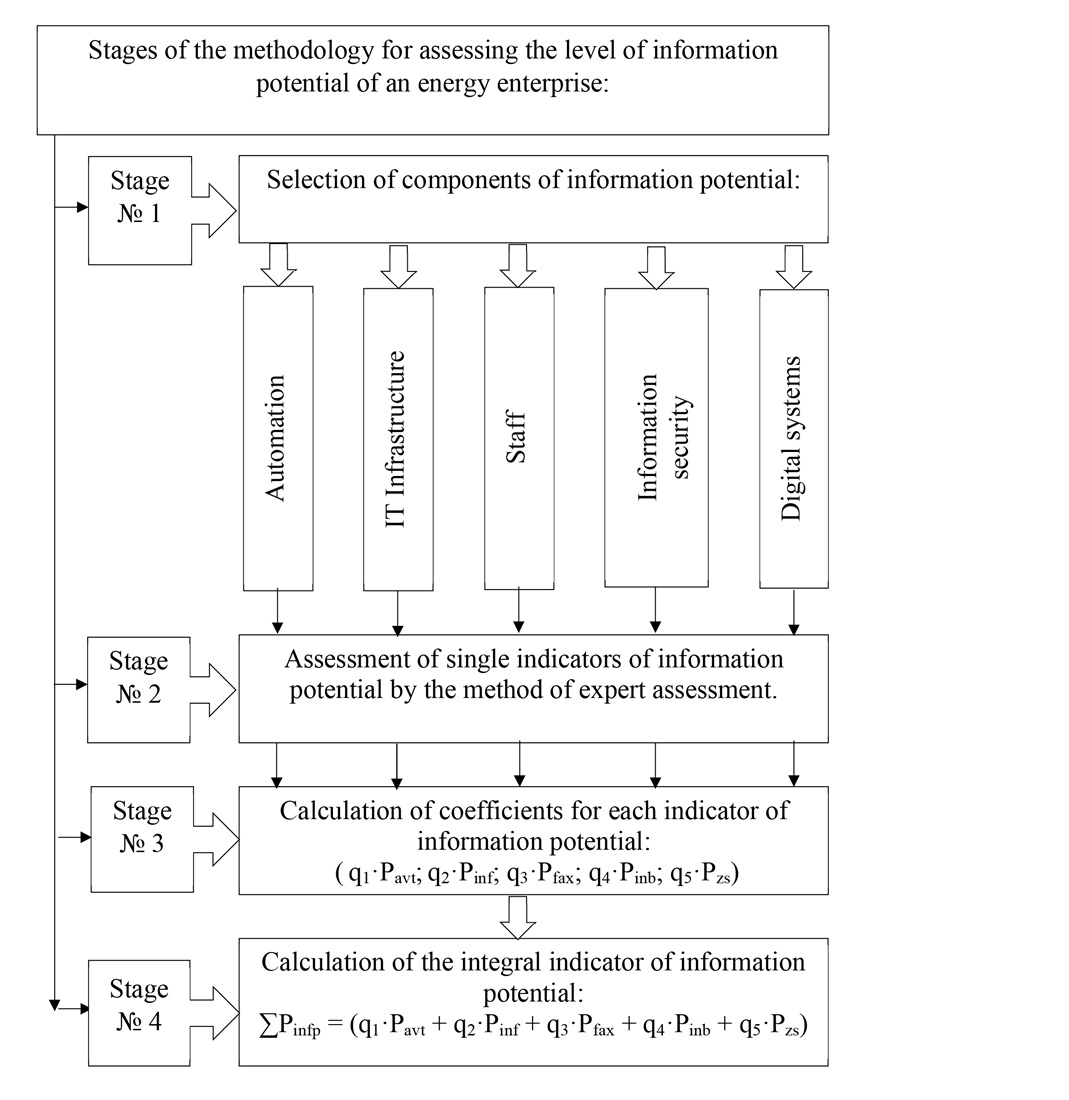
Об'єктом дослідження є процес оцінки рівня інформаційного потенціалу енергопідприємств в умовах цифрової когерентності. Вирішено проблему ефективного управління інформаційним потенціалом енергопідприємств на основі розробки методики оцінки рівня інформаційного потенціалу енергопідприємств в умовах цифрової когерентності з урахуванням сучасних викликів, пов’язаних із інтеграцією цифрових систем. Методика дозволяє забезпечити точність аналізу, оперативного прийняття рішень та адаптації до динамічних умов цифрової трансформації. Розроблена методика базується на взаємопов’язаних етапах, що включають інтеграцію показників, оцінку взаємодії компонентів системи та моніторинг змін показників інформаційного потенціалу енергопідприємств. Основними етапами методики є: вибір компонентів інформаційного потенціалу, таких як рівень автоматизації, ІТ-інфраструктури, кадрового складу, інформаційної безпеки та цифрових систем; аналіз їх взаємодії; моніторинг та управління ризиками в реальному часі. Визначено, що застосування методики дозволяє ідентифікувати слабкі місця інформаційної системи підприємства та адаптувати її до нових викликів, включаючи кіберзагрози та необхідність технологічних оновлень. Основною особливістю є здатність методики аналізувати взаємозв'язки між компонентами інфраструктури, враховуючи цифрову когерентність, що дозволяє підвищити точність оцінки ризиків та ефективність управління інформаційним потенціалом енергопідприємства. На основі отриманих даних можна оцінити критичне зниження рівня інформаційного потенціалу Запорізької електростанції з 0,5790 до 0,3710 ум. од. та його можливі наслідки для ефективності підприємства
Посилання
- Walter, L., Denter, N. M., Kebel, J. (2022). A review on digitalization trends in patent information databases and interrogation tools. World Patent Information, 69, 102107. https://doi.org/10.1016/j.wpi.2022.102107
- Berdik, D., Otoum, S., Schmidt, N., Porter, D., Jararweh, Y. (2021). A Survey on Blockchain for Information Systems Management and Security. Information Processing & Management, 58 (1), 102397. https://doi.org/10.1016/j.ipm.2020.102397
- Maddikunta, P. K. R., Pham, Q.-V., B, P., Deepa, N., Dev, K., Gadekallu, T. R., Ruby, R., Liyanage, M. (2022). Industry 5.0: A survey on enabling technologies and potential applications. Journal of Industrial Information Integration, 26, 100257. https://doi.org/10.1016/j.jii.2021.100257
- Hughes, L., Dwivedi, Y. K., Misra, S. K., Rana, N. P., Raghavan, V., Akella, V. (2019). Blockchain research, practice and policy: Applications, benefits, limitations, emerging research themes and research agenda. International Journal of Information Management, 49, 114–129. https://doi.org/10.1016/j.ijinfomgt.2019.02.005
- Fedushko, S., Benova, E. (2019). Semantic analysis for information and communication threats detection of online service users. Procedia Computer Science, 160, 254–259. https://doi.org/10.1016/j.procs.2019.09.465
- Gunduz, M. Z., Das, R. (2020). Cyber-security on smart grid: Threats and potential solutions. Computer Networks, 169, 107094. https://doi.org/10.1016/j.comnet.2019.107094
- Tolah, A., Furnell, S. M., Papadaki, M. (2021). An empirical analysis of the information security culture key factors framework. Computers & Security, 108, 102354. https://doi.org/10.1016/j.cose.2021.102354
- Andersson, A., Hedström, K., Karlsson, F. (2022). Standardizing information security – a structurational analysis. Information & Management, 59(3), 103623. https://doi.org/10.1016/j.im.2022.103623
- Hadlington, L., Binder, J., Stanulewicz, N. (2021). Exploring role of moral disengagement and counterproductive work behaviours in information security awareness. Computers in Human Behavior, 114, 106557. https://doi.org/10.1016/j.chb.2020.106557
- Xu, L. D., Duan, L. (2018). Big data for cyber physical systems in industry 4.0: a survey. Enterprise Information Systems, 13 (2), 148–169. https://doi.org/10.1080/17517575.2018.1442934
- Nishant, R., Kennedy, M., Corbett, J. (2020). Artificial intelligence for sustainability: Challenges, opportunities, and a research agenda. International Journal of Information Management, 53, 102104. https://doi.org/10.1016/j.ijinfomgt.2020.102104
- Diachkov, D. V. (2014). Estimation of information potential of industrial enterprises. Ekonomika. Menedzhment. Pidpryiemnytstvo, 26 (1), 75–84. Available at: http://nbuv.gov.ua/UJRN/ecmepi_2014_26(1)__11
- Diachkov, D. V. (2012). Metodychni pidkhody do otsinky informatsiynoho potentsialu pidpryiemstva. Naukovyi visnyk Poltavskoho universytetu ekonomiky i torhivl, 4 (55), 131–135. Available at: http://nbuv.gov.ua/UJRN/Nvpusk_2012_4_27
- Prokhorova, V., Protsenko, V., Bezuglaya, Y., Us, J. (2018). The optimization algorithm for the directions of influence of risk factors on the system that manages the potential of machine-building enterprises. Eastern-European Journal of Enterprise Technologies, 4 (1 (94)), 6–13. https://doi.org/10.15587/1729-4061.2018.139513
- Shibaeva, N., Baban, T., Prokhorova, V., Karlova, O., Girzheva, O., Krutko, M. (2019). Methodological bases of estimating the efficiency of organizational and economic mechanism of regulatory policy in agriculture. Global Journal of Environmental Science and Management, 5, 160–171. https://doi.org/10.22034/gjesm.2019.05.SI.18
- Babenko, V., Baksalova, O., Prokhorova, V., Dykan, V., Ovchynnikova, V., Chobitok, V. (2021). Information And Consulting Service Using In The Organization Of Personnel Management. Studies of Applied Economics, 38 (4). https://doi.org/10.25115/eea.v38i4.3999
- Iarmosh, O., Prokhorova, V., Shcherbyna, I., Kashaba, O., Slastianykova, K. (2021). Innovativeness of the creative economy as a component of the Ukrainian and the world sustainable development strategy. IOP Conference Series: Earth and Environmental Science, 628 (1), 012035. https://doi.org/10.1088/1755-1315/628/1/012035
- MEK 62443-2-1. Promyslovi komunikatsiyni merezhi – Informatsiyna bezpeka merezhi ta systemy – Chastyna 2-1: Stvorennia prohramy informatsiynoi bezpeky systemy promyslovoi avtomatyzatsiyi. Available at: https://tk185.appau.org.ua/downloads/IEC_62443_2_1_ukr_draft.pdf
- Prokhorova, V., Budanov, M., Budanov, P., Zaitseva, A., Slastianykova, A. (2025). Devising a comprehensive methodology for estimating the economic efficiency of implementing an investment project for ensuring energy security of enterprises: organizational-economic aspect. Eastern-European Journal of Enterprise Technologies, 1 (13 (133)), 59–68. https://doi.org/10.15587/1729-4061.2025.321965
- Prokhorova, V., Budanov, O., Budanov, P., Slastianykova, K. (2025). Comprehensive methodology for estimating information safety at enterprises of electroenergy system under the conditions of digital coherence. Eastern-European Journal of Enterprise Technologies, 2 (13 (134)), 27–37. https://doi.org/10.15587/1729-4061.2025.327159
##submission.downloads##
Опубліковано
Як цитувати
Номер
Розділ
Ліцензія
Авторське право (c) 2025 Viktoriia Prokhorova, Oleksandr Budanov, Pavlo Budanov, Krystyna Slastianykova

Ця робота ліцензується відповідно до Creative Commons Attribution 4.0 International License.
Закріплення та умови передачі авторських прав (ідентифікація авторства) здійснюється у Ліцензійному договорі. Зокрема, автори залишають за собою право на авторство свого рукопису та передають журналу право першої публікації цієї роботи на умовах ліцензії Creative Commons CC BY. При цьому вони мають право укладати самостійно додаткові угоди, що стосуються неексклюзивного поширення роботи у тому вигляді, в якому вона була опублікована цим журналом, але за умови збереження посилання на першу публікацію статті в цьому журналі.
Ліцензійний договір – це документ, в якому автор гарантує, що володіє усіма авторськими правами на твір (рукопис, статтю, тощо).
Автори, підписуючи Ліцензійний договір з ПП «ТЕХНОЛОГІЧНИЙ ЦЕНТР», мають усі права на подальше використання свого твору за умови посилання на наше видання, в якому твір опублікований. Відповідно до умов Ліцензійного договору, Видавець ПП «ТЕХНОЛОГІЧНИЙ ЦЕНТР» не забирає ваші авторські права та отримує від авторів дозвіл на використання та розповсюдження публікації через світові наукові ресурси (власні електронні ресурси, наукометричні бази даних, репозитарії, бібліотеки тощо).
За відсутності підписаного Ліцензійного договору або за відсутністю вказаних в цьому договорі ідентифікаторів, що дають змогу ідентифікувати особу автора, редакція не має права працювати з рукописом.
Важливо пам’ятати, що існує і інший тип угоди між авторами та видавцями – коли авторські права передаються від авторів до видавця. В такому разі автори втрачають права власності на свій твір та не можуть його використовувати в будь-який спосіб.