Встановлення закономірностей вогнезахисту деревини композитним покриттям з біополімером
DOI:
https://doi.org/10.15587/1729-4061.2025.332443Ключові слова:
вогнезахисна композиція, біополімери, оброблення поверхні деревини, поверхневий натяг, спучення покриттяАнотація
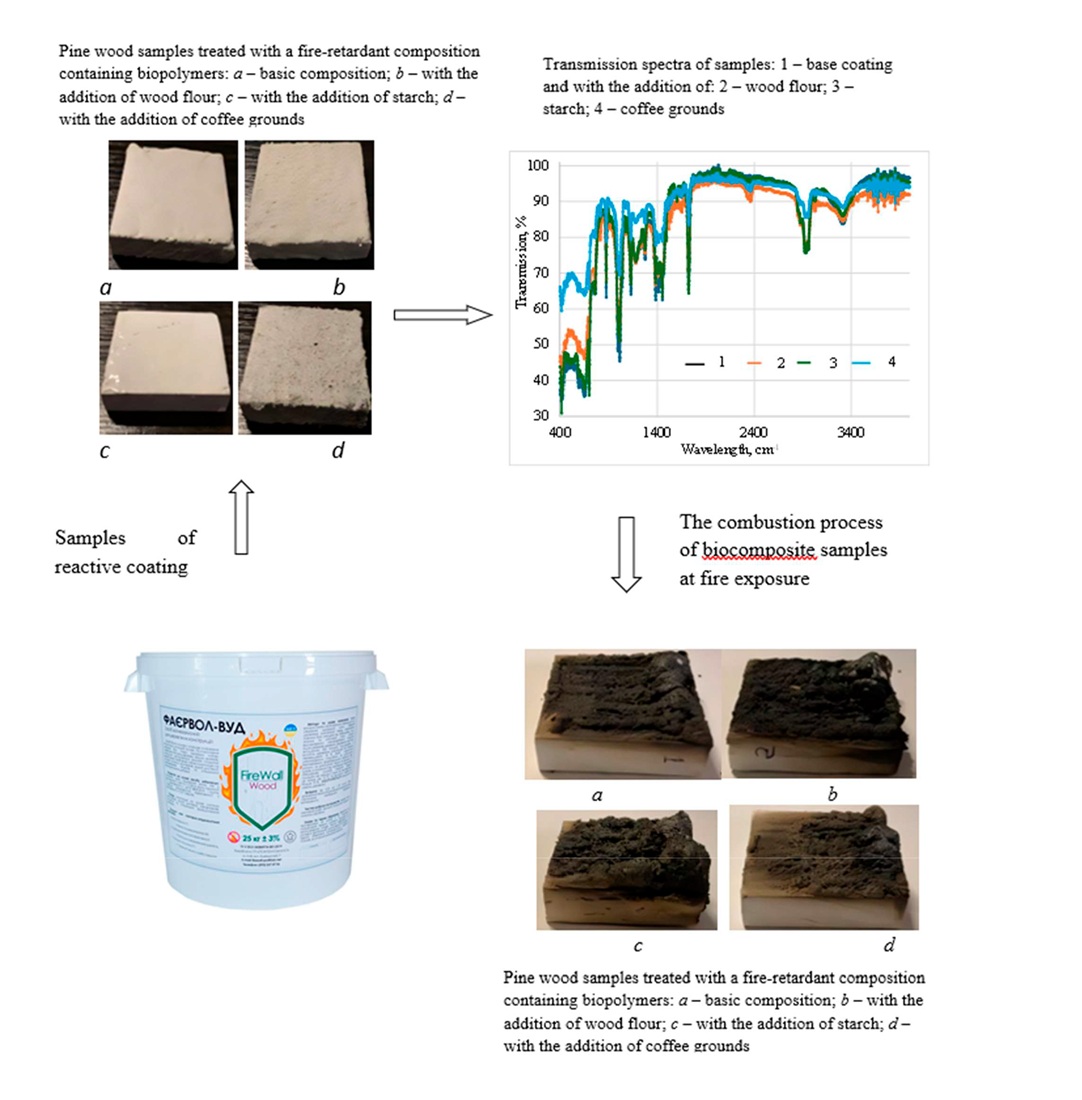
Об’єктом досліджень є зміни поверхневих властивостей деревини під час її оброблення вогнезахисним композиційним покриттям з наявністю біополімерів. Проблема, спрямована на виробництво екологічно-чистих композицій, отриманих з природних та відновлюваних джерел для вогнезахисту деревини та технологією нанесення, полягає у забезпечені стійкості до дії високотемпературного полум’я. Доведено, що вогнезахисна композиція з наявністю біополімерів є нагромадженням біологічних речовин з азотно-фосфорними антипіренами, вуглеводами та газоутворюючими речовинами, облямованих полімерним в’яжучим. Під впливом термічної дії розпочинаються хімічні реакції у вогнезахисній композиції, поліфосфат амонію розкладоється і виділяє фосфорну кислоту. Це, у свою чергу, впливає на деструкцію біополімеру та дегидрацію пентаерітриту з утворенням великої кількості вуглеводнів, а меламін проваджує виділення негорючих газів, що спонукають утворювати пінококс. Проведено дослідження поверхневих енергетичних характеристик вогнезахисної композиції з наявністю біополімерів та встановлено, що полярність вогнезахисної композиції з наявністю біополімерів перевищує значення необробленої деревини у 3,5 рази, що дає ефективне оброблення поверхні деревини. За результатами термічного впливу на зразки встановлено, шо при дії радіаційної панелі відбулося спучення вогнезахисної композиції, при додаванні біополімерів, таких як деревне борошно і крохмаль, висота коксу підвищилась понад 15 мм, а кратність піни підвищилась в 1,2 рази. Практичне значення полягає у тому, що отримані результати було враховано під час розроблення реактивного покриття для деревини. Таким чином, є підстави стверджувати про можливість ефективного захисту деревини вогнезахисною композицією з наявністю біополімерів
Посилання
- Pantaleoni, A., Marrocchi, A., Russo, P., Malucelli, G., Altamura, D., Nardelli, F. et al. (2025). Advanced flame-retardant biocomposites: Polylactic acid reinforced with green gallic acid‑iron‑phosphorus coated flax fibers. International Journal of Biological Macromolecules, 300, 140215. https://doi.org/10.1016/j.ijbiomac.2025.140215
- Li, M., Li, X., Xu, K., Qin, A., Yan, C., Xu, Y. et al. (2024). Construction and mechanism analysis of flame-retardant, energy-storage and transparent bio-based composites based on natural cellulose template. International Journal of Biological Macromolecules, 263, 130317. https://doi.org/10.1016/j.ijbiomac.2024.130317
- Melati, A., Settar, A., Alfano, A., Faucault, L., Chetehouna, K. (2023). Effect of Fire-Retardant Coating and SiC Powder Filler on Thermal Properties of Green-Poxy Bio-Based Composites. Advances in Thermal Science and Energy, 130–139. https://doi.org/10.1007/978-3-031-43934-6_14
- Li, S., Zhao, F., Wang, X., Liu, Z., Guo, J., Li, Y. et al. (2024). A green flame retardant coating based on one-step aqueous complexation of phytic acid and urea for fabrication of lightweight and high toughness flame retardant EPS insulation board. Polymer Degradation and Stability, 219, 110597. https://doi.org/10.1016/j.polymdegradstab.2023.110597
- Aghmih, K., Boukhriss, A., El Bouchti, M., Ait Chaoui, M., Majid, S., Gmouh, S. (2022). Introduction of Ionic Liquids as Highly Efficient Plasticizers and Flame Retardants of Cellulose Triacetate Films. Journal of Polymers and the Environment, 30 (7), 2905–2918. https://doi.org/10.1007/s10924-022-02407-3
- Madyaratri, E., Ridho, M., Aristri, M., Lubis, M., Iswanto, A., Nawawi, D. et al. (2022). Recent Advances in the Development of Fire-Resistant Biocomposites—A Review. Polymers, 14 (3), 362. https://doi.org/10.3390/polym14030362
- Rajendran, M., Nagarajan, C. kavitha. (2021). Experimental Investigation on bio-Composite Using Jute and Banana Fiber as a Potential Substitute of Solid Wood Based Materials. Journal of Natural Fibers, 19 (12), 4557–4566. https://doi.org/10.1080/15440478.2020.1867943
- Hanken, R. B. L., Arimatéia, R. R., Farias, G. M. G., Agrawal, P., Santana, L. N. L., Freitas, D. M. G., de Mélo, T. J. A. (2019). Effect of natural and expanded vermiculite clays on the properties of eco-friendly biopolyethylene-vermiculite clay biocomposites. Composites Part B: Engineering, 175, 107184. https://doi.org/10.1016/j.compositesb.2019.107184
- Giancaspro, J., Papakonstantinou, C., Balaguru, P. (2009). Mechanical behavior of fire-resistant biocomposite. Composites Part B: Engineering, 40 (3), 206–211. https://doi.org/10.1016/j.compositesb.2008.11.008
- Gómez, C., Torres, F. G., Nakamatsu, J., Arroyo, O. H. (2006). Thermal and Structural Analysis of Natural Fiber Reinforced Starch-Based Biocomposites. International Journal of Polymeric Materials and Polymeric Biomaterials, 55 (11), 893–907. https://doi.org/10.1080/00914030500522547
- Pettersen, R. C. (1984). The Chemical Composition of Wood. The Chemistry of Solid Wood, 57–126. https://doi.org/10.1021/ba-1984-0207.ch002
- Broido, A. (1969). A simple, sensitive graphical method of treating thermogravimetric analysis data. Journal of Polymer Science Part A-2: Polymer Physics, 7 (10), 1761–1773. https://doi.org/10.1002/pol.1969.160071012
- Traciak, J., Fal, J., Żyła, G. (2021). 3D printed measuring device for the determination the surface tension of nanofluids. Applied Surface Science, 561, 149878. https://doi.org/10.1016/j.apsusc.2021.149878
- Rekiel, E., Zdziennicka, A., Jańczuk, B. (2021). Mutual influence of ethanol and surfactin on their wetting and adhesion properties. Colloids and Surfaces A: Physicochemical and Engineering Aspects, 627, 127161. https://doi.org/10.1016/j.colsurfa.2021.127161
- Tsapko, Y., Tkachenko, T., Tsapko, А., Likhnyovskyi, R., Sukhanevych, M., Bereznutska, Y. et al. (2024). Defining patterns in the fire protection of wood with reactive coating. Eastern-European Journal of Enterprise Technologies, 6 (10 (132)), 55–63. https://doi.org/10.15587/1729-4061.2024.317334
- Tsapko, J., Tsapko, А. (2017). Simulation of the phase transformation front advancement during the swelling of fire retardant coatings. Eastern-European Journal of Enterprise Technologies, 2 (11 (86)), 50–55. https://doi.org/10.15587/1729-4061.2017.73542
- Tsapko, Y., Tsapko, А., Bondarenko, O. (2019). Effect of a flameretardant coating on the burning parameters of wood samples. Eastern-European Journal of Enterprise Technologies, 2 (10 (98)), 49–54. https://doi.org/10.15587/1729-4061.2019.163591
- Tsapko, Y., Tsapko, А., Bondarenko, O. (2020). Modeling the process of moisture diffusion by a flame-retardant coating for wood. Eastern-European Journal of Enterprise Technologies, 1 (10 (103)), 14–19. https://doi.org/10.15587/1729-4061.2020.192687
- Tsapko, Y. V., Tsapko, A., Bondarenko, O. P., Sukhanevych, M. V., Kobryn, M. V. (2019). Research of the process of spread of fire on beams of wood of fire-protected intumescent coatings. IOP Conference Series: Materials Science and Engineering, 708 (1), 012112. https://doi.org/10.1088/1757-899x/708/1/012112
##submission.downloads##
Опубліковано
Як цитувати
Номер
Розділ
Ліцензія
Авторське право (c) 2025 Yuriy Tsapko, Аleksii Tsapko, Ruslan Likhnyovskyi, Kseniia Bielikova, Oksana Berdnyk, Andrii Gavryliuk, Anna Borysova, Oleksandr Dotsenko, Maksym Haiduk, Viacheslav Nesterenko

Ця робота ліцензується відповідно до Creative Commons Attribution 4.0 International License.
Закріплення та умови передачі авторських прав (ідентифікація авторства) здійснюється у Ліцензійному договорі. Зокрема, автори залишають за собою право на авторство свого рукопису та передають журналу право першої публікації цієї роботи на умовах ліцензії Creative Commons CC BY. При цьому вони мають право укладати самостійно додаткові угоди, що стосуються неексклюзивного поширення роботи у тому вигляді, в якому вона була опублікована цим журналом, але за умови збереження посилання на першу публікацію статті в цьому журналі.
Ліцензійний договір – це документ, в якому автор гарантує, що володіє усіма авторськими правами на твір (рукопис, статтю, тощо).
Автори, підписуючи Ліцензійний договір з ПП «ТЕХНОЛОГІЧНИЙ ЦЕНТР», мають усі права на подальше використання свого твору за умови посилання на наше видання, в якому твір опублікований. Відповідно до умов Ліцензійного договору, Видавець ПП «ТЕХНОЛОГІЧНИЙ ЦЕНТР» не забирає ваші авторські права та отримує від авторів дозвіл на використання та розповсюдження публікації через світові наукові ресурси (власні електронні ресурси, наукометричні бази даних, репозитарії, бібліотеки тощо).
За відсутності підписаного Ліцензійного договору або за відсутністю вказаних в цьому договорі ідентифікаторів, що дають змогу ідентифікувати особу автора, редакція не має права працювати з рукописом.
Важливо пам’ятати, що існує і інший тип угоди між авторами та видавцями – коли авторські права передаються від авторів до видавця. В такому разі автори втрачають права власності на свій твір та не можуть його використовувати в будь-який спосіб.