Design of a complex dual-axis solar tracker with an integrated solar PV monitoring system
DOI:
https://doi.org/10.15587/1729-4061.2025.332548Keywords:
dual-axis solar tracker, online monitoring system, web interface, solar cell, clean energyAbstract
The object of this study is two-axis tracker systems for tracking the position of the Sun and monitoring the parameters of photovoltaic panels. The task addressed is the optimization of photovoltaic panel positioning to improve their efficiency and maximize electricity generation, specifically selecting the optimal tracking algorithm while accounting for implementation cost and payback period under variable climatic conditions.
The essence of the results is the design and deployment of a system that controls panel tilt and azimuth angles according to the chosen tracking algorithm, while performing online monitoring of key photovoltaic converter operating parameters and meteorological data. By accurately calculating the Sun’s trajectory and employing dual-axis tracking, the number of unnecessary movements is reduced, which lowers the tracker’s energy consumption and drive wear, thereby improving system reliability and reducing operational costs.
These findings are associated with the use of dual-axis algorithms with precise solar-position calculations, as well as by the implementation of a web interface and an integrated database for collecting statistical data on tracking performance. The system provides real-time data collection and analysis, allowing the tracking algorithm to be changed and its effectiveness to be evaluated for a specific location or climatic zone. The user-friendly web interface enables users to access information in the form of plots and sensor readings.
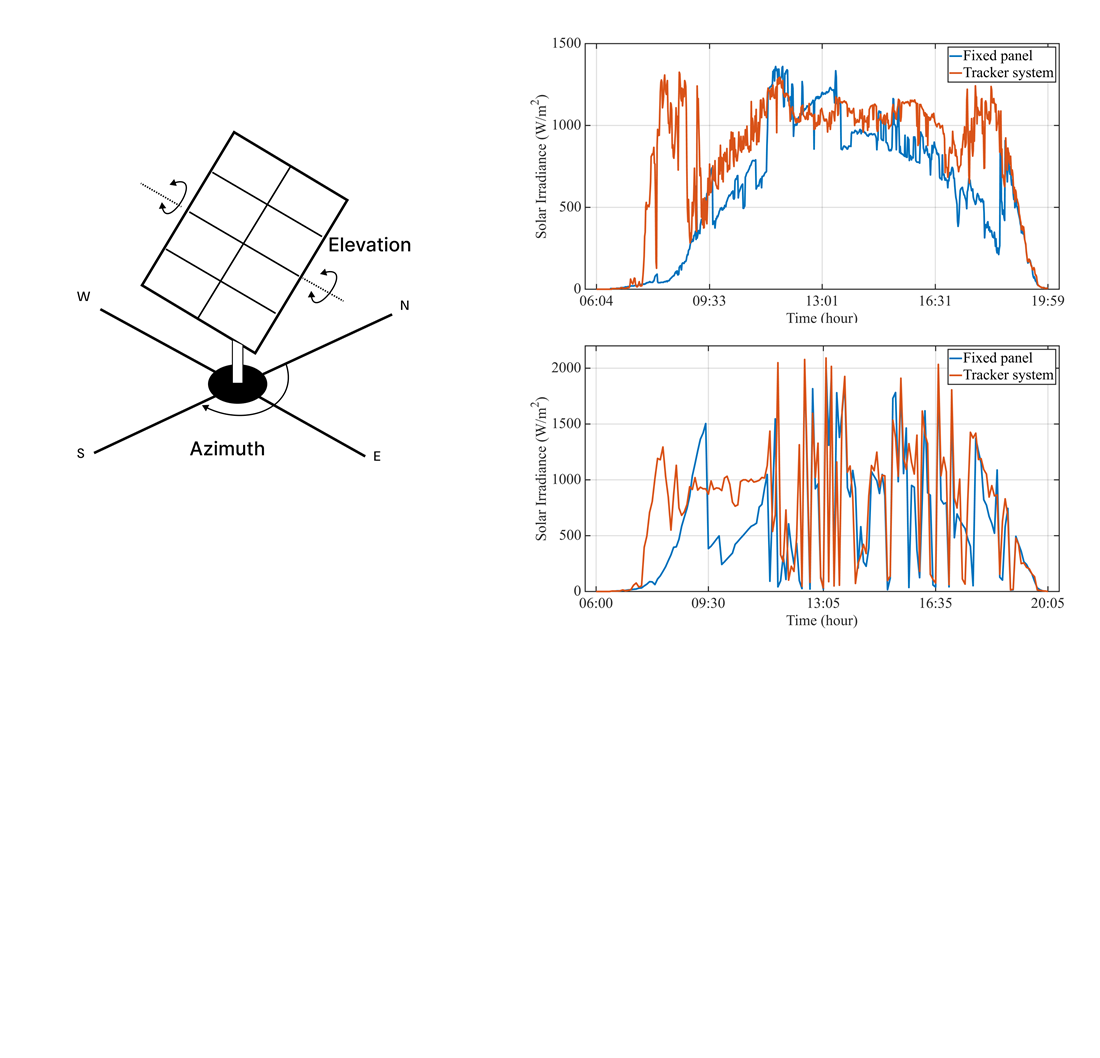
In practice, the designed system can be used for long-term monitoring of tracking efficiency, to analyze return on investment, as well as plan operational expenditures. Experimental studies showed that the dual-axis tracker with a precise solar-position calculation algorithm increases energy generation efficiency on a spring sunny day in the western region of Ukraine by more than 25%
References
- Dambhare, M. V., Butey, B., Moharil, S. V. (2021). Solar photovoltaic technology: A review of different types of solar cells and its future trends. Journal of Physics: Conference Series, 1913 (1), 012053. https://doi.org/10.1088/1742-6596/1913/1/012053
- Ruvinskii, M. A., Kostyuk, O. B., Dzundza, B. S., Yaremiy, I. P., Mokhnatskyi, M. L., Yavorskyy, Ya. S. (2017). Kinetic Phenomena and Thermoelectric Properties of Polycrystalline Thin Films Based on PbSnAgTe Compounds. Journal of Nano- and Electronic Physics, 9 (5), 05004-1-05004–05006. https://doi.org/10.21272/jnep.9(5).05004
- Kostyuk, O. B., Dzundza, B. S., Yavorsky, Ya. S., Dashevsky, Z. M. (2021). Development of Thermal Detector Based on Flexible Film Thermoelectric Module. Physics and Chemistry of Solid State, 22 (1), 45–52. https://doi.org/10.15330/pcss.22.1.45-52
- Dashevsky, Z., Mamykin, S., Dzundza, B., Auslender, M., Shneck, R. Z. (2023). A Review of Nanocrystalline Film Thermoelectrics on Lead Chalcogenide Semiconductors: Progress and Application. Energies, 16 (9), 3774. https://doi.org/10.3390/en16093774
- Izam, N. S. M. N., Itam, Z., Sing, W. L., Syamsir, A. (2022). Sustainable Development Perspectives of Solar Energy Technologies with Focus on Solar Photovoltaic—A Review. Energies, 15 (8), 2790. https://doi.org/10.3390/en15082790
- Renewable capacity statistics 2025 (2025). IRENA. Available at: https://www.irena.org/-/media/Files/IRENA/Agency/Publication/2025/Mar/IRENA_DAT_RE_Capacity_Statistics_2025.pdf
- Champion Photovoltaic Module Efficiency Chart. NREL. Available at: https://www.nrel.gov/pv/module-efficiency
- Barrios-Sánchez, J. M., Tlapanco-Ríos, E. I. (2025). Dual-Axis Solar Tracking System for Enhanced Photovoltaic Efficiency in Tropical Climates. Sustainability, 17 (3), 1117. https://doi.org/10.3390/su17031117
- Shang, H., Shen, W. (2023). Design and Implementation of a Dual-Axis Solar Tracking System. Energies, 16 (17), 6330. https://doi.org/10.3390/en16176330
- Hammoumi, A. E., Motahhir, S., Ghzizal, A. E., Chalh, A., Derouich, A. (2018). A simple and low‐cost active dual‐axis solar tracker. Energy Science & Engineering, 6 (5), 607–620. https://doi.org/10.1002/ese3.236
- Jamroen, C., Fongkerd, C., Krongpha, W., Komkum, P., Pirayawaraporn, A., Chindakham, N. (2021). A novel UV sensor-based dual-axis solar tracking system: Implementation and performance analysis. Applied Energy, 299, 117295. https://doi.org/10.1016/j.apenergy.2021.117295
- Pratama, A. Y., Fauzy, A., Effendi, H. (2019). Performance Enhancement of Solar Panel Using Dual Axis Solar Tracker. 2019 International Conference on Electrical Engineering and Informatics (ICEEI), 444–447. https://doi.org/10.1109/iceei47359.2019.8988902
- Amadi, H. N., Gutierrez, S. (2019). Design and Performance Evaluation of a Dual-Axis Solar Tracking System for Rural Applications. European Journal of Electrical Engineering and Computer Science, 3 (1). https://doi.org/10.24018/ejece.2019.3.1.52
- Holota, V. I., Kogut, I., Druzhinin, A., Khoverko, Y. (2013). High Sensitive Active MOS Photo Detector on the Local 3D SOI-Structure. Advanced Materials Research, 854, 45–47. https://doi.org/10.4028/www.scientific.net/amr.854.45
- Kogut, I. T., Holota, V. I., Druzhinin, A., Dovhij, V. V. (2016). The Device-Technological Simulation of Local 3D SOI-Structures. Journal of Nano Research, 39, 228–234. https://doi.org/10.4028/www.scientific.net/jnanor.39.228
- Sunrise/Sunset calculations. NOAA. Available at: https://gml.noaa.gov/grad/solcalc/solareqns.PDF
- Sun Angle Calculator. Available at: https://www.omnicalculator.com/physics/sun-angle
Downloads
Published
How to Cite
Issue
Section
License
Copyright (c) 2025 Vitalii Fedenko, Bogdan Dzundza, Myroslav Pavlyuk, Omelian Poplavskyi

This work is licensed under a Creative Commons Attribution 4.0 International License.
The consolidation and conditions for the transfer of copyright (identification of authorship) is carried out in the License Agreement. In particular, the authors reserve the right to the authorship of their manuscript and transfer the first publication of this work to the journal under the terms of the Creative Commons CC BY license. At the same time, they have the right to conclude on their own additional agreements concerning the non-exclusive distribution of the work in the form in which it was published by this journal, but provided that the link to the first publication of the article in this journal is preserved.
A license agreement is a document in which the author warrants that he/she owns all copyright for the work (manuscript, article, etc.).
The authors, signing the License Agreement with TECHNOLOGY CENTER PC, have all rights to the further use of their work, provided that they link to our edition in which the work was published.
According to the terms of the License Agreement, the Publisher TECHNOLOGY CENTER PC does not take away your copyrights and receives permission from the authors to use and dissemination of the publication through the world's scientific resources (own electronic resources, scientometric databases, repositories, libraries, etc.).
In the absence of a signed License Agreement or in the absence of this agreement of identifiers allowing to identify the identity of the author, the editors have no right to work with the manuscript.
It is important to remember that there is another type of agreement between authors and publishers – when copyright is transferred from the authors to the publisher. In this case, the authors lose ownership of their work and may not use it in any way.







