Identifying the influence of various factors on the composition of juices and wines obtained from the autonomous Bayan Shirey grape variety
DOI:
https://doi.org/10.15587/1729-4061.2025.332592Keywords:
autochthonous, maceration, phenolic compounds, suspended particles, absorbed oxygen, lilac, gallicAbstract
The object of the study is juice, wine, pulp obtained from the autochthonous Bayan Shirey grape variety. There are a number of studies on the autochthonous Bayan Shirey grape variety, but the influence of extraction methods and tools on the composition and quality of juice samples, as well as the origin of wine, maceration time and treatment with a fining agent on the compositional parameters has not been studied.
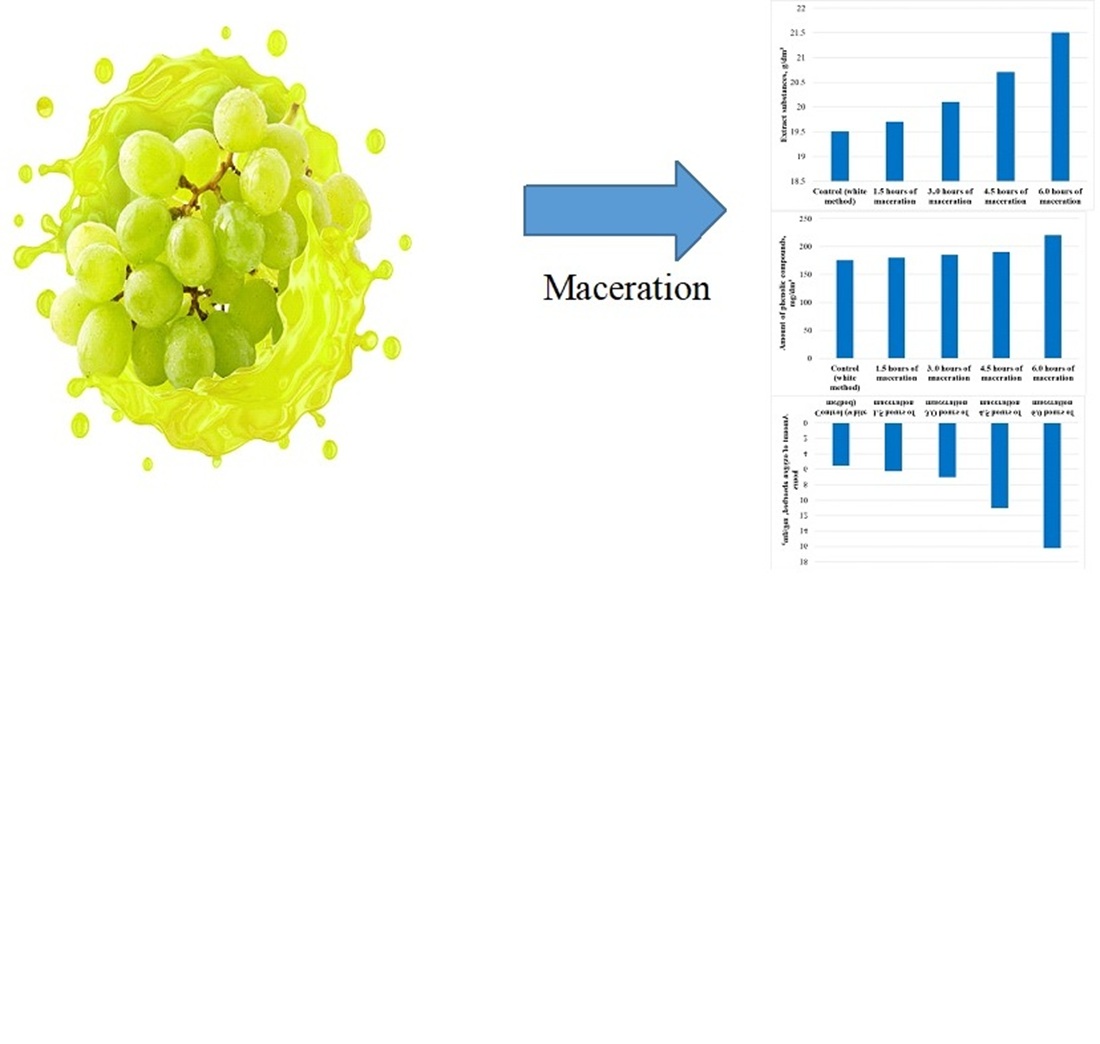
A comparative analysis of the physicochemical composition of wine samples prepared using the same technological method from Bayan Shirey grapes of different origin was carried out. The results showed that the acidity of wine samples from the Goygol region, which has a relatively cold climate, was 0.4–0.6 g/dm3 higher than that of the sample taken from the arid Samukh region with a warm climate, and the highest. The largest amount of extracted extract was in the Samukh sample, then in descending order in the samples Ganja, Shamkir and Goygol. With maceration time, the amount of turbidity-forming compounds and absorbed oxygen in wine samples increases. Therefore, it is more effective to carry out maceration for 1.5–3.0 hours. Processing samples of long maceration with optimal doses of adhesives allowed to minimize the content of suspended particles and the NTU index.
The studies substantiate the correct choice of technological methods, means and modes that minimize oxidation for the preparation of exquisite table and champagne wines. The appearance, composition and quality of the future wine are optimized depending on the growing conditions of the grapes, the reasons for the increase in suspended particles causing oxidation and methods for their elimination.
These studies are important in production for determining the of methods and means on the composition and quality of juice, as well as for studying the origin of wine, maceration time, time and treatment with solvents to change physicochemical composition. The obtained results can be used at factories and wineries
References
- Jara-Palacios, M. J., Hernanz, D., González-Manzano, S., Santos-Buelga, C., Escudero-Gilete, M. L., Heredia, F. J. (2014). Detailed phenolic composition of white grape by-products by RRLC/MS and measurement of the antioxidant activity. Talanta, 125, 51–57. https://doi.org/10.1016/j.talanta.2014.02.065
- Guler, A. (2023). Effects of different maceration techniques on the colour, polyphenols and antioxidant capacity of grape juice. Food Chemistry, 404, 134603. https://doi.org/10.1016/j.foodchem.2022.134603
- Baron, M., Kumsta, M., Sumczynski, D., Mlcek, J., Jurikova, T., Sochor, J. (2018). Einfluss der Dauer der Mazeration auf den Gehalt von Antioxidantien im Traubensaft. Erwerbs-Obstbau, 60 (S1), 37–45. https://doi.org/10.1007/s10341-018-0385-7
- Puzovic, A., Mikulic-Petkovsek, M. (2024). Comparative Evaluation of Conventional and Emerging Maceration Techniques for Enhancing Bioactive Compounds in Aronia Juice. Foods, 13 (20), 3255. https://doi.org/10.3390/foods13203255
- Puzovic, A., Pelacci, M., Simkova, K., Hudina, M., Rusjan, D., Veberic, R., Mikulic-Petkovsek, M. (2024). Effect of Heat Pasteurization and Enzymatic Maceration on Yield, Color, Sugars, Organic Acids, and Phenolic Content in the ‘Merlot Kanthus’ Grape Juice. Beverages, 10 (3), 66. https://doi.org/10.3390/beverages10030066
- Rahimov, N., Kazimova, İ., Yusifova, M., Nasrullayeva, G. (2023). Development of improved technology for the production of strong wines of marsala type on the basis of enzymatic catalysis. Eastern-European Journal of Enterprise Technologies, 2 (11 (122)), 63–73. https://doi.org/10.15587/1729-4061.2023.277838
- Błaszak, M., Lachowicz-Wiśniewska, S., Kapusta, I., Szewczuk, M., Ochmian, I. (2025). Enhanced Extraction of Polyphenols, Physicochemical Properties, and Microbial Control in Vitis vinifera L. Juice Using Ultrasound-Assisted Maceration. Molecules, 30 (3), 587. https://doi.org/10.3390/molecules30030587
- Gu, X., Liu, Y., Suo, R., Yu, Q., Xue, C., Wang, J. et al. (2025). Effects of different low-temperature maceration times on the chemical and sensory characteristics of Syrah wine. Food Chemistry, 463, 141230. https://doi.org/10.1016/j.foodchem.2024.141230
- Wojdyło, A., Samoticha, J., Chmielewska, J. (2021). Effect of different pre-treatment maceration techniques on the content of phenolic compounds and color of Dornfelder wines elaborated in cold climate. Food Chemistry, 339, 127888. https://doi.org/10.1016/j.foodchem.2020.127888
- Mallard, J., Valentin, D., Ballester, J. (2025). Oxidation in white wine: The point of view of winemakers from areas with different oenological practices. Food Research International, 199, 115341. https://doi.org/10.1016/j.foodres.2024.115341
- Benucci, I., Cerreti, M., Esti, M. (2024). Dosing oxygen from the early stages of white winemaking: Effect on oxidation–reduction potential, browning stability, volatile composition, and sensory properties. Food Chemistry, 432, 137243. https://doi.org/10.1016/j.foodchem.2023.137243
- Ailer, Š., Jakabová, S., Benešová, L., Ivanova-Petropulos, V. (2022). Wine Faults: State of Knowledge in Reductive Aromas, Oxidation and Atypical Aging, Prevention, and Correction Methods. Molecules, 27 (11), 3535. https://doi.org/10.3390/molecules27113535
- Mercanti, N., Macaluso, M., Pieracci, Y., Brazzarola, F., Palla, F., Verdini, P. G., Zinnai, A. (2024). Enhancing wine shelf-life: Insights into factors influencing oxidation and preservation. Heliyon, 10 (15), e35688. https://doi.org/10.1016/j.heliyon.2024.e35688
- Fia, G., Bucalossi, G., Proserpio, C., Vincenzi, S. (2021). Unripe grapes: an overview of the composition, traditional and innovative applications, and extraction methods of a promising waste of viticulture. Australian Journal of Grape and Wine Research, 28 (1), 8–26. https://doi.org/10.1111/ajgw.12522
- Olejar, K. J., Ricci, A., Swift, S., Zujovic, Z., Gordon, K. C., Fedrizzi, B. et al. (2019). Characterization of an Antioxidant and Antimicrobial Extract from Cool Climate, White Grape Marc. Antioxidants, 8 (7), 232. https://doi.org/10.3390/antiox8070232
- Ferreira, R. M., Costa, A. M., Pinto, C. A., Silva, A. M. S., Saraiva, J. A., Cardoso, S. M. (2023). Impact of Fermentation and Pasteurization on the Physico-Chemical and Phytochemical Composition of Opuntia ficus-indica Juices. Foods, 12 (11), 2096. https://doi.org/10.3390/foods12112096
- Fataliyev, H., Malikov, A., Lezgiyev, Y., Gadimova, N., Musayev, T., Aliyeva, G. (2024). Identifying of the wine-making potential of the autochthon madrasa grape variety of different colors and quality. Eastern-European Journal of Enterprise Technologies, 2 (11 (128)), 56–63. https://doi.org/10.15587/1729-4061.2024.302971
- Fataliyev, H., Malikov, A., Lazgiyev, Y., Haydarov, E., Agayeva, S., Baloghlanova, K. et al. (2023). Effect of maceration regime on phenolic compound quantity and color quality of madrasa wine samples. Food Science and Technology, 17 (4). https://doi.org/10.15673/fst.v17i4.2784
- Fataliyev, H., Lezgiyev, Y., Aghazade, Y., Gadimova, N., Heydarov, E., Ismailov, M. (2024). Identifying the influence of various technological techniques on the indicators of the composition of bunches and wine samples of the madras grape variety. Eastern-European Journal of Enterprise Technologies, 6 (11 (132)), 50–62. https://doi.org/10.15587/1729-4061.2024.318532
- Fataliyev, H., Aghazade, Y., Heydarov, E., Gadimova, N., Ismayilov, M., Imanova, K. (2025). Identifying the factors affecting the production of juice and wine from the autochthonous Bayanshira grape variety. Eastern-European Journal of Enterprise Technologies, 1 (11 (133)), 38–50. https://doi.org/10.15587/1729-4061.2025.323382
- Fataliyev, H., Gadimova, N., Huseynova, S., Isgandarova, S., Heydarov, E., Mammadova, S. (2024). Enrichment of functional drinks using grape pomace extracts, analysis of physicochemical indicators. Eastern-European Journal of Enterprise Technologies, 3 (11 (129)), 37–45. https://doi.org/10.15587/1729-4061.2024.307039
- Fataliyev, H., Isgandarova, S., Gadimova, N., Mammadova, A., Ismailov, M., Mammadzade, M. (2024). Identification of the effect of ripening conditions on the yield of rose hips and their processed products. Eastern-European Journal of Enterprise Technologies, 4 (11 (130)), 26–35. https://doi.org/10.15587/1729-4061.2024.309597
- Fataliyev, H., Mammadzade, M., Ismayılov, M., Gadimova, N., Mammadova, N., Musayev, T. (2025). Identifying the factors affecting the preparation of wine material from cherry fruits. Eastern-European Journal of Enterprise Technologies, 2 (11 (134)), 77–88. https://doi.org/10.15587/1729-4061.2025.326471
- Nabiyev, A. (2010). Chemistry of Wine. Baku, 472.
- Fataliyev, H. K. (2013). Winemaking practicum. Baku, 328. Available at: http://anl.az/el/Kitab/2013/Azf-272480.pdf
- Mikayilov, V. (2012). Food products tasting. Baku, 384.
- Maharramov, M. A., Maharramova, M. H., Kazimova, I. H., Maharramova, S. I. (2018). Safety of raw materials and food products. Baku, 147.
- Sheskin, D. J. (2020). Handbook of Parametric and Nonparametric Statistical Procedures. Chapman and Hall/CRC. https://doi.org/10.1201/9780429186196
- Gadimova, N., Fataliyev, H., Heydarov, E., Lezgiyev, Y., Isgandarova, S. (2023). Development of a model and optimization of the interaction of factors in the grain malting process and its application in the production of functional beverages. Eastern-European Journal of Enterprise Technologies, 5 (11 (125)), 43–56. https://doi.org/10.15587/1729-4061.2023.289421
- Gadimova, N., Fataliyev, H., Allahverdiyeva, Z., Musayev, T., Akhundova, N., Babashli, A. (2022). Obtaining and investigation of the chemical composition of powdered malt and polymalt extracts for application in the production of non-alcoholic functional beverages. Eastern-European Journal of Enterprise Technologies, 5 (11 (119)), 66–74. https://doi.org/10.15587/1729-4061.2022.265762
Downloads
Published
How to Cite
Issue
Section
License
Copyright (c) 2025 Hasil Fataliyev, Yahya Aghazade, Vugar Mikayilov, Elnur Heydarov, Natavan Gadimova, Konul Imanova, Shabnam Fataliyeva

This work is licensed under a Creative Commons Attribution 4.0 International License.
The consolidation and conditions for the transfer of copyright (identification of authorship) is carried out in the License Agreement. In particular, the authors reserve the right to the authorship of their manuscript and transfer the first publication of this work to the journal under the terms of the Creative Commons CC BY license. At the same time, they have the right to conclude on their own additional agreements concerning the non-exclusive distribution of the work in the form in which it was published by this journal, but provided that the link to the first publication of the article in this journal is preserved.
A license agreement is a document in which the author warrants that he/she owns all copyright for the work (manuscript, article, etc.).
The authors, signing the License Agreement with TECHNOLOGY CENTER PC, have all rights to the further use of their work, provided that they link to our edition in which the work was published.
According to the terms of the License Agreement, the Publisher TECHNOLOGY CENTER PC does not take away your copyrights and receives permission from the authors to use and dissemination of the publication through the world's scientific resources (own electronic resources, scientometric databases, repositories, libraries, etc.).
In the absence of a signed License Agreement or in the absence of this agreement of identifiers allowing to identify the identity of the author, the editors have no right to work with the manuscript.
It is important to remember that there is another type of agreement between authors and publishers – when copyright is transferred from the authors to the publisher. In this case, the authors lose ownership of their work and may not use it in any way.







