Виявлення несправностей обертових машин у нафтохімічній промисловості з використанням підходу, основаного на глибокому навчанні: TabNet – WGAN
DOI:
https://doi.org/10.15587/1729-4061.2025.332597Ключові слова:
обертові машини, виявлення несправностей, глибоке навчання, WGAN, TabNet, SHAP, прогнозне обслуговуванняАнотація
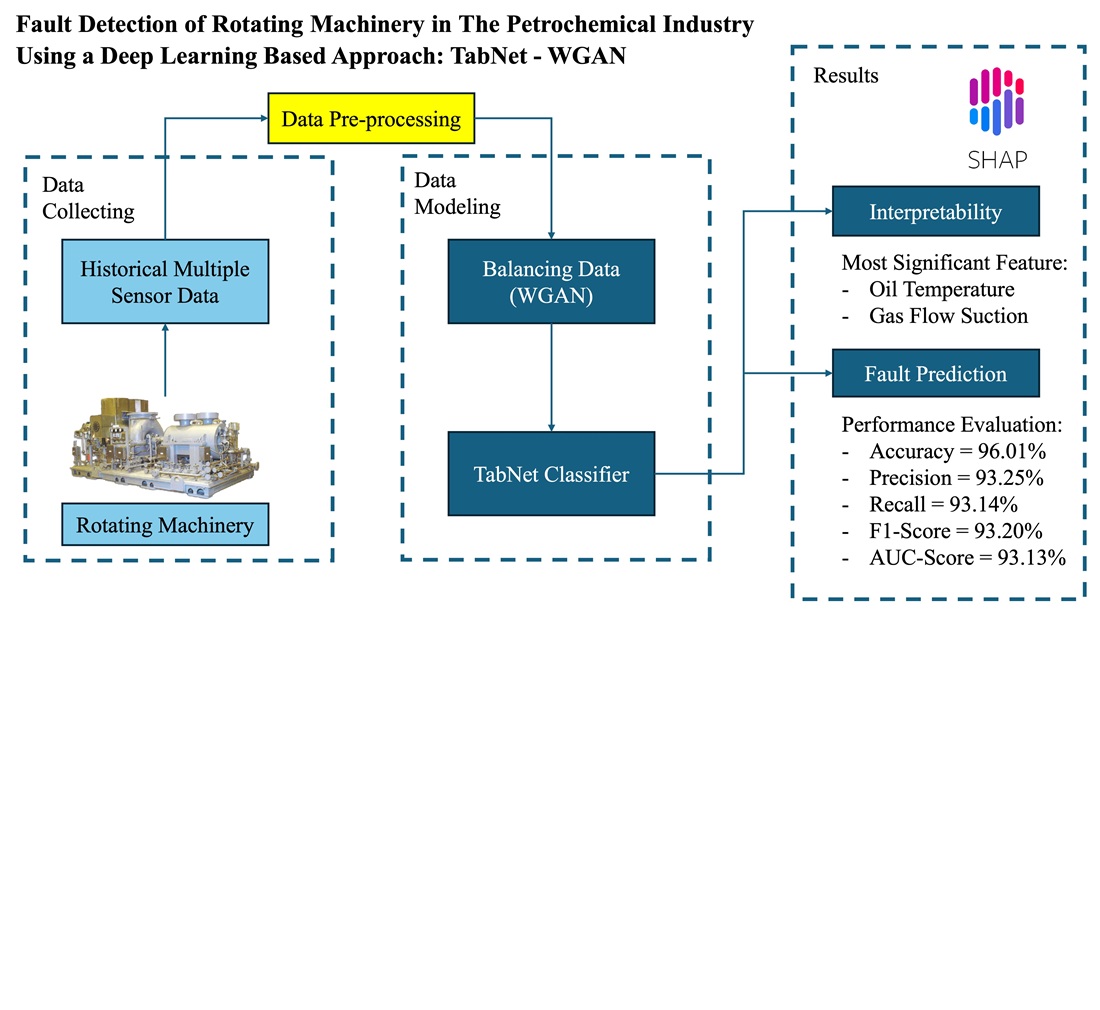
Об’єктом дослідження є процес виявлення несправностей у критично важливих обертових машинах, зокрема парових турбінах та компресорах, що працюють у нафтохімічному виробничому середовищі. Традиційні методи виявлення несправностей, хоча й перевірені та економічно ефективні, навряд чи справляються з сучасними промисловими проблемами, такими як зростаюча складність даних датчиків, дисбаланс класів у записах про відмови та потреба в інтерпретації в режимі реального часу. Нещодавні досягнення в глибокому навчанні пропонують перспективні рішення цих обмежень. У цьому дослідженні пропонується інтегрована структура, яка поєднує генеративно-змагальну мережу Вассерштейна (WGAN) для балансування даних та TabNet, інтерпретовану модель глибокого навчання, оптимізовану для табличних даних датчиків. Метою є підвищення точності та інтерпретованості виявлення несправностей у незбалансованих, багатовимірних промислових наборах даних. Використовуючи історичні дані з нафтохімічного заводу (2015–2024), модель WGAN-TabNet продемонструвала вищу продуктивність порівняно з традиційними класифікаторами (логістична регресія, SVM, XGBoost), досягнувши точності 96,01%, прецизійності 93,25%, повноти 93,14%, F1-оцінки 93,20% та AUC-оцінки 93,13%. Інтерпретованість, забезпечена комбінацією TabNet та SHAP-аналізу, додатково визначила ключові операційні змінні, що впливають на відмову, такі як температура оливи та швидкість потоку газу, пропонуючи практичні висновки для прогнозного обслуговування. Результати підкреслюють, що інтеграція глибокого навчання з надійним балансуванням даних значно покращує виявлення несправностей там, де традиційні методи не спрацьовують, підтримуючи практичне впровадження в сучасних системах прогнозного обслуговування
Посилання
- Mobley, R. K. (2002). An Introduction to Predictive Maintenance. Butterworth-Heinemann. https://doi.org/10.1016/b978-0-7506-7531-4.x5000-3
- Borgnakke, C., Sonntag, R. E. (2013). Fundamentals of Thermodynamics. Wiley, 912.
- Giampaolo, T. (2010). Compressor Handbook: Principles and Practice. The Fairmont Press, 376.
- Mobley, R. K. (2001). Plant Engineer’s Handbook. Butterworth-Heinemann.
- Moubray, J. (1997). Reliability-Centered Maintenance. Butterworth-Heinemann.
- Nunes, P., Santos, J., Rocha, E. (2023). Challenges in predictive maintenance – A review. CIRP Journal of Manufacturing Science and Technology, 40, 53–67. https://doi.org/10.1016/j.cirpj.2022.11.004
- Zhou, H., Pan, H., Zheng, K., Wu, Z., Xiang, Q. (2025). A novel oversampling method based on Wasserstein CGAN for imbalanced classification. Cybersecurity, 8 (1). https://doi.org/10.1186/s42400-024-00290-0
- Jardine, A. K. S., Lin, D., Banjevic, D. (2006). A review on machinery diagnostics and prognostics implementing condition-based maintenance. Mechanical Systems and Signal Processing, 20 (7), 1483–1510. https://doi.org/10.1016/j.ymssp.2005.09.012
- Zhang, W., Yang, D., Wang, H. (2019). Data-Driven Methods for Predictive Maintenance of Industrial Equipment: A Survey. IEEE Systems Journal, 13 (3), 2213–2227. https://doi.org/10.1109/jsyst.2019.2905565
- Goodfellow, I., Bengio, Y., Courville, A. (2016). Deep Learning. The MIT Press, 800.
- Liu, R., Yang, B., Zio, E., Chen, X. (2018). Artificial intelligence for fault diagnosis of rotating machinery: A review. Mechanical Systems and Signal Processing, 108, 33–47. https://doi.org/10.1016/j.ymssp.2018.02.016
- Chen, T., Guestrin, C. (2016). XGBoost. Proceedings of the 22nd ACM SIGKDD International Conference on Knowledge Discovery and Data Mining, 785–794. https://doi.org/10.1145/2939672.2939785
- Tarekegn, A. N., Giacobini, M., Michalak, K. (2021). A review of methods for imbalanced multi-label classification. Pattern Recognition, 118, 107965. https://doi.org/10.1016/j.patcog.2021.107965
- Chawla, N. V., Bowyer, K. W., Hall, L. O., Kegelmeyer, W. P. (2002). SMOTE: Synthetic Minority Over-sampling Technique. Journal of Artificial Intelligence Research, 16, 321–357. https://doi.org/10.1613/jair.953
- Blagus, R., Lusa, L. (2013). SMOTE for high-dimensional class-imbalanced data. BMC Bioinformatics, 14 (1). https://doi.org/10.1186/1471-2105-14-106
- Goodfellow, I., Pouget-Abadie, J., Mirza, M., Xu, B., Warde-Farley, D., Ozair, S. et al. (2014). Generative Adversarial Networks. Advances in Neural Information Processing Systems (NeurIPS). arXiv. https://doi.org/10.48550/arXiv.1406.2661
- Arjovsky, M., Chintala, S., Bottou, L. (2017). Wasserstein GAN. International Conference on Machine Learning (ICML). arXiv. https://doi.org/10.48550/arXiv.1701.07875
- Arik, S. Ö., Pfister, T. (2021). TabNet: Attentive interpretable tabular learning. Proceedings of the AAAI Conference on Artificial Intelligence. arXiv. https://doi.org/10.48550/arXiv.1908.07442
- Fares, I. A., Abd Elaziz, M. (2025). Explainable TabNet Transformer-based on Google Vizier Optimizer for Anomaly Intrusion Detection System. Knowledge-Based Systems, 316, 113351. https://doi.org/10.1016/j.knosys.2025.113351
- Fan, J., Yuan, X., Miao, Z., Sun, Z., Mei, X., Zhou, F. (2022). Full Attention Wasserstein GAN With Gradient Normalization for Fault Diagnosis Under Imbalanced Data. IEEE Transactions on Instrumentation and Measurement, 71, 1–16. https://doi.org/10.1109/tim.2022.3190525
##submission.downloads##
Опубліковано
Як цитувати
Номер
Розділ
Ліцензія
Авторське право (c) 2025 Muhammad Ikhsan Anshori, Arian Dhini

Ця робота ліцензується відповідно до Creative Commons Attribution 4.0 International License.
Закріплення та умови передачі авторських прав (ідентифікація авторства) здійснюється у Ліцензійному договорі. Зокрема, автори залишають за собою право на авторство свого рукопису та передають журналу право першої публікації цієї роботи на умовах ліцензії Creative Commons CC BY. При цьому вони мають право укладати самостійно додаткові угоди, що стосуються неексклюзивного поширення роботи у тому вигляді, в якому вона була опублікована цим журналом, але за умови збереження посилання на першу публікацію статті в цьому журналі.
Ліцензійний договір – це документ, в якому автор гарантує, що володіє усіма авторськими правами на твір (рукопис, статтю, тощо).
Автори, підписуючи Ліцензійний договір з ПП «ТЕХНОЛОГІЧНИЙ ЦЕНТР», мають усі права на подальше використання свого твору за умови посилання на наше видання, в якому твір опублікований. Відповідно до умов Ліцензійного договору, Видавець ПП «ТЕХНОЛОГІЧНИЙ ЦЕНТР» не забирає ваші авторські права та отримує від авторів дозвіл на використання та розповсюдження публікації через світові наукові ресурси (власні електронні ресурси, наукометричні бази даних, репозитарії, бібліотеки тощо).
За відсутності підписаного Ліцензійного договору або за відсутністю вказаних в цьому договорі ідентифікаторів, що дають змогу ідентифікувати особу автора, редакція не має права працювати з рукописом.
Важливо пам’ятати, що існує і інший тип угоди між авторами та видавцями – коли авторські права передаються від авторів до видавця. В такому разі автори втрачають права власності на свій твір та не можуть його використовувати в будь-який спосіб.