Реалізація моделі глибокого навчання з увагою та теорії планованої поведінки для прогнозування використання системи бортового трекеру на Boeing 737-900ER
DOI:
https://doi.org/10.15587/1729-4061.2025.332938Ключові слова:
розширене глибоке навчання, рівень уваги, теорія запланованої поведінки, політ, прогнозуванняАнотація
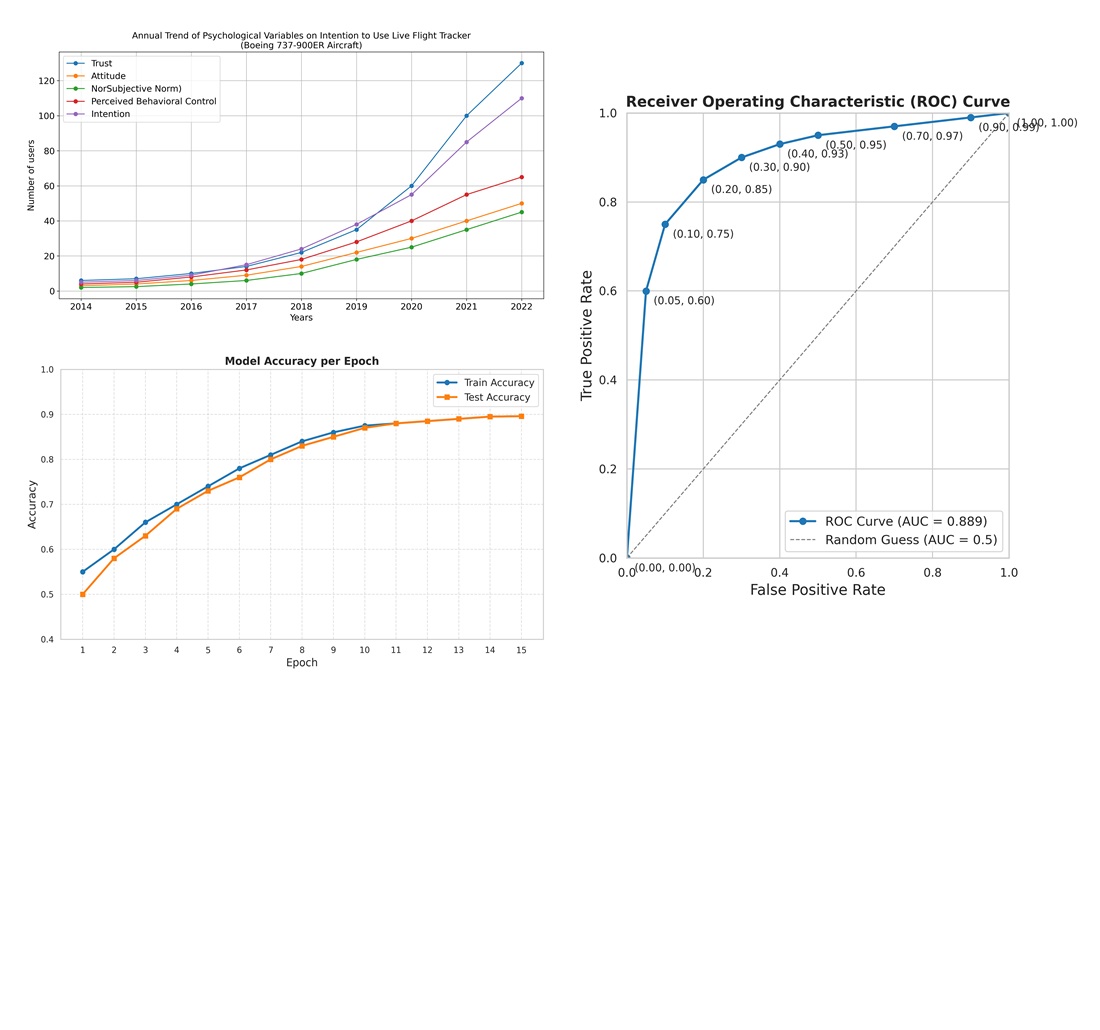
Об’єктом дослідження є система прогнозування для використання технології відстеження польотів у реальному часі на літаку Boeing 737-900ER. Вирішувана проблема пов’язана з низькою точністю системи прогнозування, яка спирається лише на технічні дані без врахування аспектів поведінки користувача, а також з обмеженнями інтерпретованості в традиційних моделях глибокого навчання, що перешкоджають перевірці рішень у критичних та чутливих умовах польоту. Суть отриманих результатів полягає в розробці моделі прогнозування на основі двонаправленої довготривалої короткочасної пам’яті, поєднаної з шаром уваги та психологічними елементами з теорії планованої поведінки. Ця модель здатна підвищити точність прогнозування до 91,2%, що значно вище, ніж у традиційних моделей з точністю близько 78%, та демонструє високі показники F1 та AUC, що вказує на баланс між точністю та чутливістю. Завдяки своїм особливостям та характерним відмінностям, а саме інтеграції двонаправленого послідовного навчання, зосередженню на найбільш релевантних вхідних ознаках через механізм уваги та психологічній контекстуалізації через теорію планованої поведінки, ці результати дозволяють ефективно вирішувати проблеми низької точності та відсутності інтерпретованості при прогнозуванні використання відстежувача польотів. Ці результати пояснюються здатністю моделі виділяти ключові змінні, такі як час використання, умови польоту та попередні моделі взаємодії, що корелюють з намірами та поведінкою користувачів. Теорія структури запланованої поведінки забезпечує основу для інтерпретації системних рішень на основі ставлення, соціальних норм та сприйнятого користувачами контролю над використовуваною технологією. У практичних умовах результати цього дослідження можуть бути впроваджені в систему навчання пілотів на основі моделювання, метою якої є визначення оптимальних моделей взаємодії за допомогою технології відстеження польотів
Посилання
- Vasigh, B., Azadian, F. (2022). Aircraft Financial and Operational Efficiencies. Aircraft Valuation in Volatile Market Conditions, 113–163. https://doi.org/10.1007/978-3-030-82450-1_3
- Bakır, M., Itani, N. (2024). Modelling Behavioural Factors Affecting Consumers’ Intention to Adopt Electric Aircraft: A Multi-Method Investigation. Sustainability, 16 (19), 8467. https://doi.org/10.3390/su16198467
- Healy, C. G. (2025). Flying Into the Future: Exploring Commercial Airline Pilots’ Perceptions of AI Implementation in Cockpit Operations. University of Arizona Global Campus.
- Bağcı, B., Kartal, M. (2024). A combined multi criteria model for aircraft selection problem in airlines. Journal of Air Transport Management, 116, 102566. https://doi.org/10.1016/j.jairtraman.2024.102566
- Genc, O. F., Capar, N., Ahmed, Z. U. (2024). Turkish Airlines: A New Era After the Pandemic. Emerging Economies Cases Journal, 6 (2), 100–116. https://doi.org/10.1177/25166042241245515
- Borkers, P. (2024). Measuring Service Quality During and After In-Flight Incidents: A Case Study of Alaska Airlines Flight 1282. University of Hamburg.
- Zheng, Y., Jiang, W., Zhou, A., Hung, N. Q. V., Zhan, C., Chen, T. (2024). Epidemiology-informed Graph Neural Network for Heterogeneity-aware Epidemic Forecasting. arXiv. https://doi.org/10.48550/arXiv.2411.17372
- Karunarathna, I., Gunasena, P., Hapuarachchi, T., Gunathilake, S. (2024). The crucial role of data collection in research: Techniques, challenges, and best practices. Uva Clin. Res.
- Kabashkin, I., Perekrestov, V. (2024). Ecosystem of Aviation Maintenance: Transition from Aircraft Health Monitoring to Health Management Based on IoT and AI Synergy. Applied Sciences, 14 (11), 4394. https://doi.org/10.3390/app14114394
- Zhou, P., Shi, W., Tian, J., Qi, Z., Li, B., Hao, H., Xu, B. (2016). Attention-Based Bidirectional Long Short-Term Memory Networks for Relation Classification. Proceedings of the 54th Annual Meeting of the Association for Computational Linguistics (Volume 2: Short Papers). https://doi.org/10.18653/v1/p16-2034
- Wang, Z., Yang, B. (2020). Attention-based Bidirectional Long Short-Term Memory Networks for Relation Classification Using Knowledge Distillation from BERT. 2020 IEEE Intl Conf on Dependable, Autonomic and Secure Computing, Intl Conf on Pervasive Intelligence and Computing, Intl Conf on Cloud and Big Data Computing, Intl Conf on Cyber Science and Technology Congress (DASC/PiCom/CBDCom/CyberSciTech), 562–568. https://doi.org/10.1109/dasc-picom-cbdcom-cyberscitech49142.2020.00100
- Calvet, L. (2024). Towards Environmentally Sustainable Aviation: A Review on Operational Optimization. Future Transportation, 4 (2), 518–547. https://doi.org/10.3390/futuretransp4020025
- Meyer, T. R. (2024). Purpose, Performance, and Process Influence on Airline Pilot Trust in Automation Technology: A Quantitative Study. Liberty University.
- De Cerqueira, J. S., Kemell, K.-K., Rousi, R., Xi, N., Hamari, J., Abrahamsson, P. (2025). Mapping Trustworthiness in Large Language Models: A Bibliometric Analysis Bridging Theory to Practice. arXiv. http://dx.doi.org/10.48550/arXiv.2503.04785
- Moura Lopes, N., Aparicio, M., Trindade Neves, F. (2024). Determinants of Pilots’ Performance: Investigating Technology Trust and Situation Awareness. Journal of Aerospace Information Systems, 21 (8), 651–660. https://doi.org/10.2514/1.i011373
- Boyacı, T., Canyakmaz, C., de Véricourt, F. (2024). Human and Machine: The Impact of Machine Input on Decision Making Under Cognitive Limitations. Management Science, 70 (2), 1258–1275. https://doi.org/10.1287/mnsc.2023.4744
- Liu, G., Guo, J. (2019). Bidirectional LSTM with attention mechanism and convolutional layer for text classification. Neurocomputing, 337, 325–338. https://doi.org/10.1016/j.neucom.2019.01.078
- Shen, J., Shafiq, M. O. (2019). Learning Mobile Application Usage - A Deep Learning Approach. 2019 18th IEEE International Conference On Machine Learning And Applications (ICMLA), 287–292. https://doi.org/10.1109/icmla.2019.00054
- Luong, T., Pham, H., Manning, C. D. (2015). Effective Approaches to Attention-based Neural Machine Translation. Proceedings of the 2015 Conference on Empirical Methods in Natural Language Processing. https://doi.org/10.18653/v1/d15-1166
- Islam, M. R. (2024). Explainable Artificial Intelligence for Enhancing Transparency in Decision Support Systems. Malardalen University.
- Chaurasia, S., Bharti, K. K., Gupta, A. (2024). A multi-model attention based CNN-BiLSTM model for personality traits prediction based on user behavior on social media. Knowledge-Based Systems, 300, 112252. https://doi.org/10.1016/j.knosys.2024.112252
- Al-Emran, M., Abu-Hijleh, B., Alsewari, A. A. (2024). Exploring the Effect of Generative AI on Social Sustainability Through Integrating AI Attributes, TPB, and T-EESST: A Deep Learning-Based Hybrid SEM-ANN Approach. IEEE Transactions on Engineering Management, 71, 14512–14524. https://doi.org/10.1109/tem.2024.3454169
- Zhang, N., Hwang, B.-G., Lu, Y., Ngo, J. (2022). A Behavior theory integrated ANN analytical approach for understanding households adoption decisions of residential photovoltaic (RPV) system. Technology in Society, 70, 102062. https://doi.org/10.1016/j.techsoc.2022.102062
- Li, Y., Qi, Y., Shi, Y., Chen, Q., Cao, N., Chen, S. (2022). Diverse Interaction Recommendation for Public Users Exploring Multi-view Visualization using Deep Learning. IEEE Transactions on Visualization and Computer Graphics, 1–11. https://doi.org/10.1109/tvcg.2022.3209461
- Tan, G. W.-H., Ooi, K.-B., Leong, L.-Y., Lin, B. (2014). Predicting the drivers of behavioral intention to use mobile learning: A hybrid SEM-Neural Networks approach. Computers in Human Behavior, 36, 198–213. https://doi.org/10.1016/j.chb.2014.03.052
- Chaganti, R., Ravi, V., Pham, T. D. (2023). A multi-view feature fusion approach for effective malware classification using Deep Learning. Journal of Information Security and Applications, 72, 103402. https://doi.org/10.1016/j.jisa.2022.103402
##submission.downloads##
Опубліковано
Як цитувати
Номер
Розділ
Ліцензія
Авторське право (c) 2025 Daniel Dewantoro Rumani, Miko Andi Wardana, Ahmad Mubarok

Ця робота ліцензується відповідно до Creative Commons Attribution 4.0 International License.
Закріплення та умови передачі авторських прав (ідентифікація авторства) здійснюється у Ліцензійному договорі. Зокрема, автори залишають за собою право на авторство свого рукопису та передають журналу право першої публікації цієї роботи на умовах ліцензії Creative Commons CC BY. При цьому вони мають право укладати самостійно додаткові угоди, що стосуються неексклюзивного поширення роботи у тому вигляді, в якому вона була опублікована цим журналом, але за умови збереження посилання на першу публікацію статті в цьому журналі.
Ліцензійний договір – це документ, в якому автор гарантує, що володіє усіма авторськими правами на твір (рукопис, статтю, тощо).
Автори, підписуючи Ліцензійний договір з ПП «ТЕХНОЛОГІЧНИЙ ЦЕНТР», мають усі права на подальше використання свого твору за умови посилання на наше видання, в якому твір опублікований. Відповідно до умов Ліцензійного договору, Видавець ПП «ТЕХНОЛОГІЧНИЙ ЦЕНТР» не забирає ваші авторські права та отримує від авторів дозвіл на використання та розповсюдження публікації через світові наукові ресурси (власні електронні ресурси, наукометричні бази даних, репозитарії, бібліотеки тощо).
За відсутності підписаного Ліцензійного договору або за відсутністю вказаних в цьому договорі ідентифікаторів, що дають змогу ідентифікувати особу автора, редакція не має права працювати з рукописом.
Важливо пам’ятати, що існує і інший тип угоди між авторами та видавцями – коли авторські права передаються від авторів до видавця. В такому разі автори втрачають права власності на свій твір та не можуть його використовувати в будь-який спосіб.