Development and experimental evaluation of bio-inspired pile surface asperities for enhanced load transfer in sandy soils
DOI:
https://doi.org/10.15587/1729-4061.2025.334186Keywords:
axial load capacity, caudal asperity, cranial asperity, experimental validation, L / H ratioAbstract
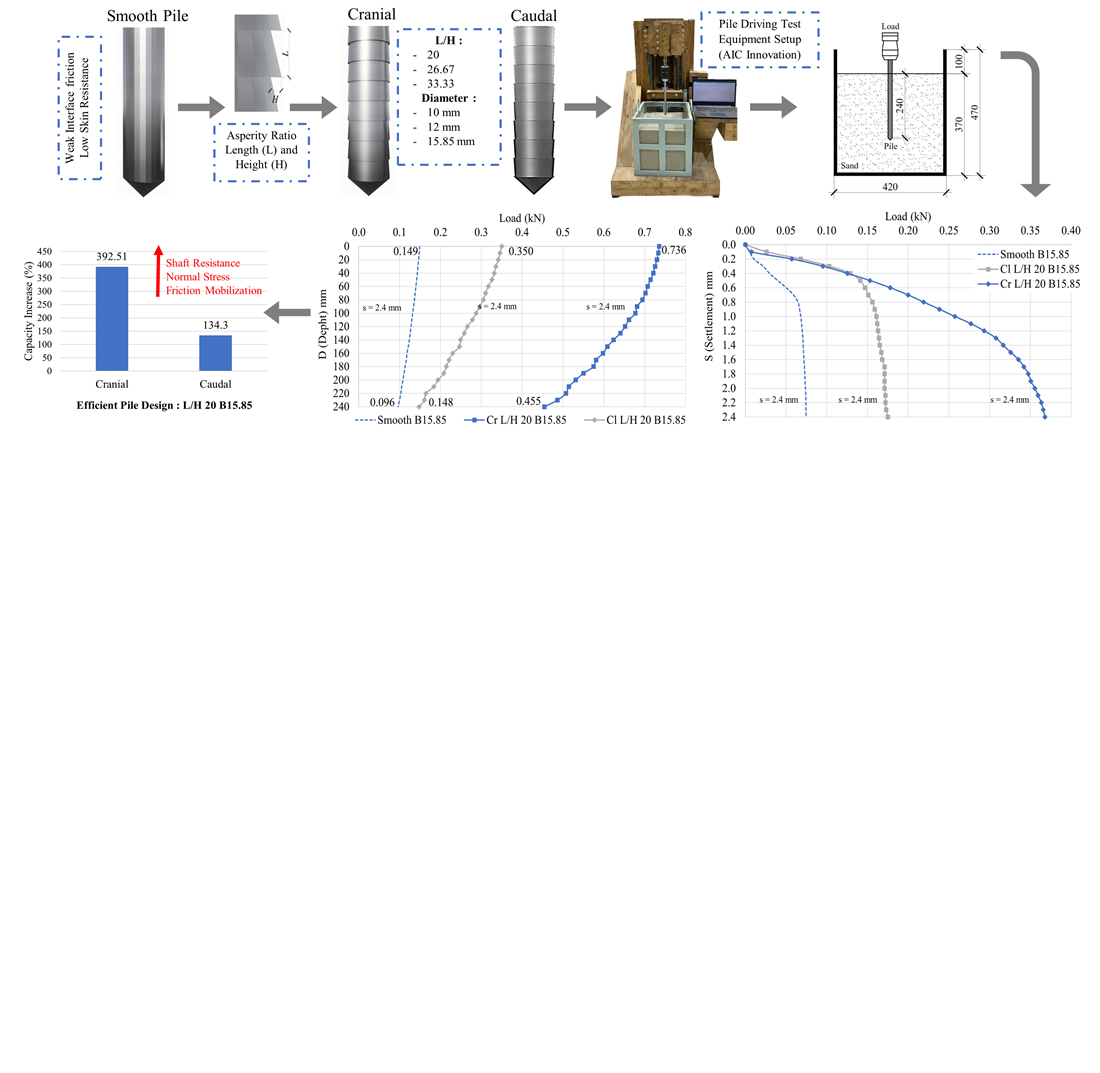
In sandy soils, skin resistance efficiency is critical, as it governs load capacity, settlement, and foundation cost. This study investigates pile foundations with directional surface asperities embedded in uniform sand to clarify the limited knowledge of how asperity orientation (cranial vs. caudal), geometric ratio (L / H), and pile diameter affect axial load transfer. Experimental tests were conducted on steel piles with diameters of 10, 12, and 15.85 mm under smooth, cranial, and caudal conditions with L / H ratios of 20, 26.67, and 33.33. Axial compression tests following ASTM D1143-20 in controlled dry sand provided ultimate load and shaft resistance data, validated by one-way ANOVA. The results show that cranial asperities consistently outperformed other surfaces, with the Cr L / H 20 configuration on the 15.85 mm pile reaching 0.368 kN, a 392.51% increase over smooth piles, while caudal asperities achieved only 134.30%. Cranial asperities also mobilized shaft resistance more uniformly along the pile, reducing end-bearing reliance. This performance is explained by stronger passive interaction at the pile-soil interface, which raises normal stress and friction mobilization. The distinctive feature of this research is the identification of the L / H ratio as a measurable design parameter, with L / H = 20 found to be optimal, in contrast to previous studies that described roughness only qualitatively. The findings demonstrate practical potential for applying cranial asperity designs in pile foundations for light- to medium-scale infrastructure on sandy soils, such as bridges, wharves, and transmission towers, enabling shorter or fewer piles without compromising safety while improving cost efficiency and geotechnical performance
References
- Lee, S.-H., Nawaz, M. N., Chong, S.-H. (2023). Estimation of interface frictional anisotropy between sand and snakeskin-inspired surfaces. Scientific Reports, 13 (1). https://doi.org/10.1038/s41598-023-31047-3
- Tramsen, H. T., Gorb, S. N., Zhang, H., Manoonpong, P., Dai, Z., Heepe, L. (2018). Inversion of friction anisotropy in a bio-inspired asymmetrically structured surface. Journal of The Royal Society Interface, 15 (138), 20170629. https://doi.org/10.1098/rsif.2017.0629
- Martinez, A., Palumbo, S., Todd, B. D. (2019). Bioinspiration for Anisotropic Load Transfer at Soil–Structure Interfaces. Journal of Geotechnical and Geoenvironmental Engineering, 145 (10). https://doi.org/10.1061/(asce)gt.1943-5606.0002138
- Martinez, A., Frost, J. D. (2018). Undrained Behavior of Sand–Structure Interfaces Subjected to Cyclic Torsional Shearing. Journal of Geotechnical and Geoenvironmental Engineering, 144 (9). https://doi.org/10.1061/(asce)gt.1943-5606.0001942
- Krengel, D., Jiang, H., Chen, J., Matsushima, T. (2025). The combined effect of particle angularity and inter-particle friction on micro- and macroscopic properties of granular assemblies. Computers and Geotechnics, 177, 106850. https://doi.org/10.1016/j.compgeo.2024.106850
- Zhang, T., Wang, Y., Zhang, C., Wang, S. (2024). DEM investigation of particle gradation effect on the stress-dilatancy behavior of granular soil. Advanced Powder Technology, 35 (11), 104692. https://doi.org/10.1016/j.apt.2024.104692
- Zhong, W., Liu, H., Wang, Q., Zhang, W., Li, Y., Ding, X., Chen, L. (2021). Investigation of the penetration characteristics of snake skin-inspired pile using DEM. Acta Geotechnica, 16 (6), 1849–1865. https://doi.org/10.1007/s11440-020-01132-2
- Martinez, A., Frost, J. D. (2017). The influence of surface roughness form on the strength of sand–structure interfaces. Géotechnique Letters, 7 (1), 104–111. https://doi.org/10.1680/jgele.16.00169
- Gayathri, V. L., Vangla, P., Riya, A. (2022). Effect of snakeskin-inspired patterns on the shear response of soil - continuum interfaces. International Journal of Geotechnical Engineering, 16 (6), 759–775. https://doi.org/10.1080/19386362.2022.2066049
- O’Hara, K. B., Martinez, A. (2020). Monotonic and Cyclic Frictional Resistance Directionality in Snakeskin-Inspired Surfaces and Piles. Journal of Geotechnical and Geoenvironmental Engineering, 146 (11). https://doi.org/10.1061/(asce)gt.1943-5606.0002368
- Stutz, H. H., Martinez, A., Heepe, L., Tram Tramsen, H., Gorb, S. N. (2019). Strength anisotropy at soil-structure interfaces with snake skin inspired structural surfaces. E3S Web of Conferences, 92, 13008. https://doi.org/10.1051/e3sconf/20199213008
- Martinez, A., Palumbo, S. (2018). Anisotropic Shear Behavior of Soil-Structure Interfaces: Bio-Inspiration from Snake Skin. IFCEE 2018, 94–104. https://doi.org/10.1061/9780784481592.010
- Nawaz, M. N., Lee, S.-H., Chong, S.-H., Ku, T. (2024). Interface frictional anisotropy of dilative sand. Scientific Reports, 14 (1). https://doi.org/10.1038/s41598-024-56621-1
- Moon, J.-S., Lee, S. (2016). Static skin friction behavior of a single micropile in sand. KSCE Journal of Civil Engineering, 20 (5), 1793–1805. https://doi.org/10.1007/s12205-016-0918-2
- Kodicherla, S. P. K., Gong, G., Yang, Z. X., Krabbenhoft, K., Fan, L., Moy, C. K. S., Wilkinson, S. (2019). The influence of particle elongations on direct shear behaviour of granular materials using DEM. Granular Matter, 21 (4). https://doi.org/10.1007/s10035-019-0947-x
- Huang, L., Martinez, A. (2020). Study of Interface Frictional Anisotropy at Bioinspired Soil-Structure Interfaces with Compliant Asperities. Geo-Congress 2020, 253–261. https://doi.org/10.1061/9780784482834.028
- Vangla, P., Wala, B. A., Gayathri, V. L., Frost, J. D. (2022). Snakeskin-inspired patterns for frictional anisotropic behaviour of split set rock bolts. Géotechnique Letters, 12 (2), 95–100. https://doi.org/10.1680/jgele.21.00076
- Han, F., Ganju, E., Salgado, R., Prezzi, M. (2018). Effects of Interface Roughness, Particle Geometry, and Gradation on the Sand–Steel Interface Friction Angle. Journal of Geotechnical and Geoenvironmental Engineering, 144 (12). https://doi.org/10.1061/(asce)gt.1943-5606.0001990
- Liu, R., Lou, S., Li, X., Han, G., Jiang, Y. (2020). Anisotropic surface roughness and shear behaviors of rough-walled plaster joints under constant normal load and constant normal stiffness conditions. Journal of Rock Mechanics and Geotechnical Engineering, 12 (2), 338–352. https://doi.org/10.1016/j.jrmge.2019.07.007
- Liu, Y., Liu, X., Hu, W. (2022). Competition mechanism between dilation and interlocking in granular soils: DEM simulation and constitutive modeling. Acta Geotechnica, 18 (1), 149–169. https://doi.org/10.1007/s11440-022-01552-2
- Vesic, A. B. (1963). Bearing capacity of deep foundations in sand. Highway Research Record. Available at: https://trid.trb.org/View/126654
- Yang, Q., Hong, S., Shen, Q., Xiao, S., Zhu, H. (2025). An Investigation of the Influence of Concrete Tubular Piles at the Pit Bottom During Excavation on Bearing Behavior. Buildings, 15 (14), 2437. https://doi.org/10.3390/buildings15142437
- O’Hara, K. B., Martinez, A. (2022). Load Transfer Directionality of Snakeskin-Inspired Piles during Installation and Pullout in Sands. Journal of Geotechnical and Geoenvironmental Engineering, 148 (12). https://doi.org/10.1061/(asce)gt.1943-5606.0002929
- Aleali, S. A., Bandini, P., Newtson, C. M. (2020). Multifaceted Bioinspiration for Improving the Shaft Resistance of Deep Foundations. Journal of Bionic Engineering, 17 (5), 1059–1074. https://doi.org/10.1007/s42235-020-0076-6
Downloads
Published
How to Cite
Issue
Section
License
Copyright (c) 2025 Agata Iwan Candra, As`ad Munawir, Yulvi Zaika, Eko Andi Suryo

This work is licensed under a Creative Commons Attribution 4.0 International License.
The consolidation and conditions for the transfer of copyright (identification of authorship) is carried out in the License Agreement. In particular, the authors reserve the right to the authorship of their manuscript and transfer the first publication of this work to the journal under the terms of the Creative Commons CC BY license. At the same time, they have the right to conclude on their own additional agreements concerning the non-exclusive distribution of the work in the form in which it was published by this journal, but provided that the link to the first publication of the article in this journal is preserved.
A license agreement is a document in which the author warrants that he/she owns all copyright for the work (manuscript, article, etc.).
The authors, signing the License Agreement with TECHNOLOGY CENTER PC, have all rights to the further use of their work, provided that they link to our edition in which the work was published.
According to the terms of the License Agreement, the Publisher TECHNOLOGY CENTER PC does not take away your copyrights and receives permission from the authors to use and dissemination of the publication through the world's scientific resources (own electronic resources, scientometric databases, repositories, libraries, etc.).
In the absence of a signed License Agreement or in the absence of this agreement of identifiers allowing to identify the identity of the author, the editors have no right to work with the manuscript.
It is important to remember that there is another type of agreement between authors and publishers – when copyright is transferred from the authors to the publisher. In this case, the authors lose ownership of their work and may not use it in any way.







