Визначення закономірностей тепло- і масообміну в проміжному ківші сортової машини безперервного лиття заготовок
DOI:
https://doi.org/10.15587/1729-4061.2025.336057Ключові слова:
проміжний ківш, безперервне лиття заготовок, футерівка, CFD-моделювання, SHAP-аналіз, машинне навчанняАнотація
Об’єкт дослідження – тепловий стан проміжного ковша сортової машини безперервного лиття заготовок, для підвищення тривалості серії плавок.
У роботі виконано чисельне моделювання процесів тепло- і масообміну в проміжному ківші сортової машини безперервного лиття заготовок (МБЛЗ). Модель враховує гідродинаміку рідкої сталі, розподіл температур у багатошаровій футерівці та кожусі промковша, та дає змогу прогнозувати локальний знос футерівки на основі аналізу технологічних параметрів процесу і хімічного складу сталі. Особливу увагу приділено дослідженню температурних і турбулентних характеристик потоку, часу перебування сталі в ківші та впливу її складу на інтенсивність руйнування шарів футерівки.
Отримані результати дозволяють локалізувати критичні ділянки термічного та механічного перенавантаження футерівки ковша, зокрема зони контакту струменя рідкої сталі та пристінні області поблизу турбостопів, де фіксуються: зсувне напруження до 275 Па, турбулентна кінетична енергія понад 0,14 м2/с2 і температура металу до 1830 K.
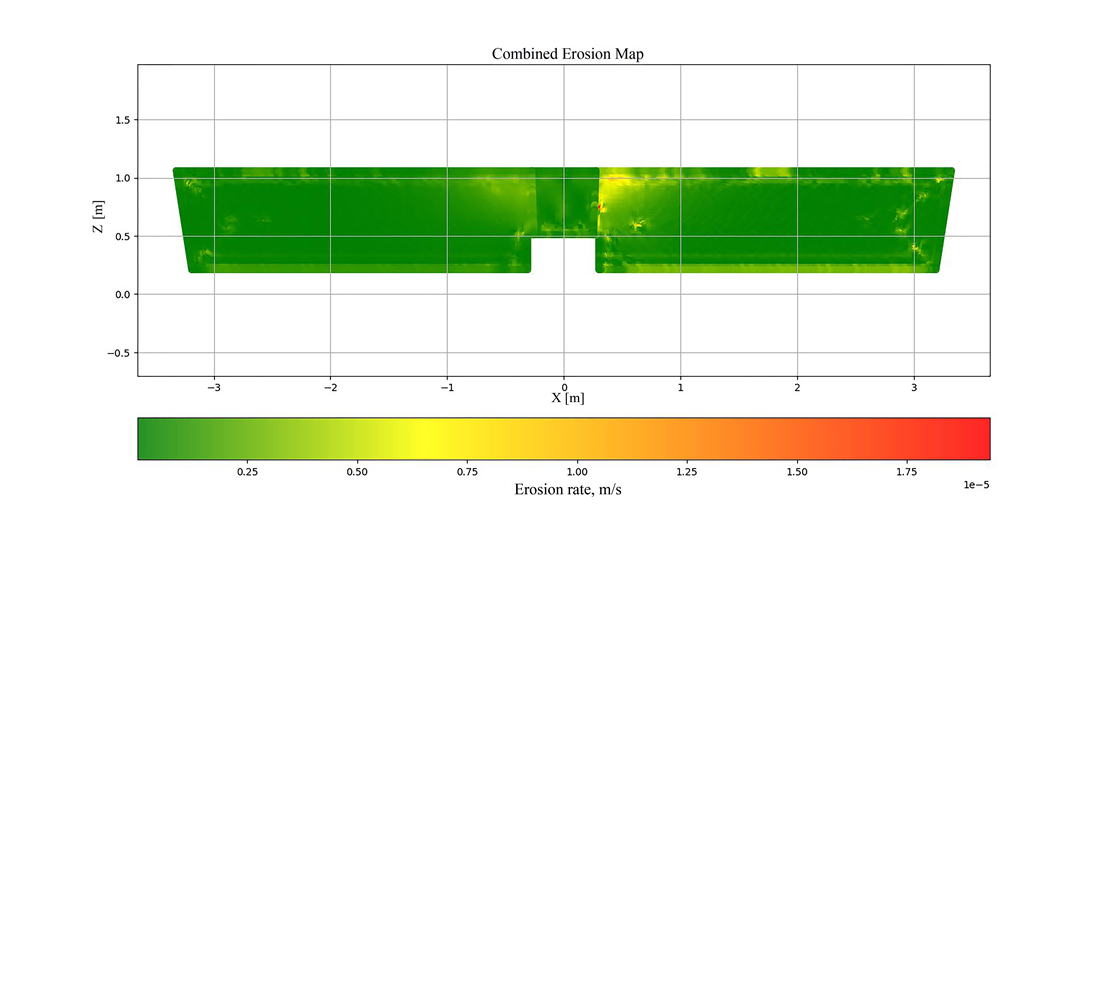
Розроблена карта локального зносу показує розподіл швидкості ерозії футерівки в межах 2,4–4,3 мм/год залежно від гідродинамічних і хімічних умов. Прогностична модель поєднує CFD-параметри, хімічний склад сталі і швидкість розливання, яка показала високу точність, що підтверджується коефіцієнтом детермінації R2 = 0.99937.
Особливістю отриманого результату є комплексне поєднання локальних умов течії та складу сталі з ерозійною моделлю, що дало змогу дати інженерно обґрунтовані рекомендації щодо оптимізації режимів роботи ковша.
Розроблена прогностична модель швидкості зносу футерівки може бути використана для моніторингу її стану, вдосконалення режимів роботи ковша та підвищення надійності процесу безперервного лиття.
Посилання
- Wang, Q., Tan, C., Huang, A., Yan, W., Gu, H., He, Z. et al. (2021). Numerical Simulation on Refractory Wear and Inclusion Formation in Continuous Casting Tundish. Metallurgical and Materials Transactions B, 52 (3), 1344–1356. https://doi.org/10.1007/s11663-021-02097-7
- Wang, Q., Tan, C., Huang, A., Yan, W., Gu, H., He, Z. et al. (2021). Quantitative Characterization of Flow-Induced Erosion of Tundish Refractory Lining via Water Model Experiment and Numerical Simulation. Metallurgical and Materials Transactions B, 52 (5), 3265–3275. https://doi.org/10.1007/s11663-021-02254-y
- Zhang, J., Qin, B., Liu, Y., Li, Q., Zuo, X., Wang, C. et al. (2023). Multiphase flow inside a four-strand continuous casting tundish using three types of ladle shrouds. Journal of Iron and Steel Research International, 30 (6), 1171–1181. https://doi.org/10.1007/s42243-023-00982-w
- Dong, B., Lv, W., Xie, Z. (2024). Research on temperature prediction model of molten steel of tundish in continuous casting. Scientific Reports, 14 (1). https://doi.org/10.1038/s41598-024-78611-z
- Box, G. E. P., Hunter, J. S., Hunter, W. G. (2005). Statistics for Experimenters: Design, Innovation, and Discovery. Wiley, 672.
- Wang, T., Wang, J., Chen, C., Chen, L., Geng, M., Song, J. et al. (2024). Physical and Numerical Study on Right Side and Front Side Gas Blowing at Walls in a Single‐Strand Tundish. Steel Research International, 95 (9). https://doi.org/10.1002/srin.202400037
- Zhou, H., Li, H., Deng, X., Liu, B., Ji, C., Chen, B. et al. (2024). Optimization of Vortex Slag Entrainment during Ladle Teeming Process in the Continuous Casting of Automobile Outer Panel. Steel Research International, 95 (10). https://doi.org/10.1002/srin.202400322
- Cramb, A. W. (Ed.) (2018). Making, Shaping and Treating of Steel: Continuous Casting. Pittsburgh: AIST.
- Bathe, K.-J. (2006). Finite Element Procedures. Klaus-Jurgen Bathe, 1037.
- Synehin, Ye. V., Sukhovetskyi, S. V. (2022). Analytical studies and characteristics of steel refining methods in the CCM tundish. Teoriia i praktyka metalurhii, 4, 25–29. Available at: https://crust.ust.edu.ua/items/d0c7753a-eb06-4b78-9df0-82f88c18f80b
- Smirnov, O. M., Kuberskyi, S. V., Shtepan, Ye. V. (2011). Bezperervne rozlyvannia stali. Alchevsk: DonDTU, 518.
- Sigarev, E. N., Chernyatevich, A. G., Chubina, E. A. (2007). Thermodynamic andgas-dynamic aspects of the guniting of converter linings. Steel in Translation, 37 (2), 92–98. https://doi.org/10.3103/s0967091207020039
- Zovnishnia torhivlia Ukrainy tovaramy u 2021 rotsi (2022). Derzhavna sluzhba statystyky Ukrainy. Available at: https://www.ukrstat.gov.ua/express/expr2022/02/14.pdf
- Vnesok HMK v ekonomiku Ukrainy 2024 (2025). GMK Center.Available at: https://gmk.center/wp-content/uploads/2025/04/ukr_2025_Econ_Steel-impact.pdf
- Ruban, V., Stoianov, O., Niziaiev, K., Synehin, Y. (2021). Determining changes in the temperature field of a graphitized hollow electrode during metal processing periods in ladle-furnace. Eastern-European Journal of Enterprise Technologies, 2 (1 (110)), 109–115. https://doi.org/10.15587/1729-4061.2021.230002
- Launder, B. E. (1972). Lectures in mathematical models of turbulence. London: Academic Press, 169.
##submission.downloads##
Опубліковано
Як цитувати
Номер
Розділ
Ліцензія
Авторське право (c) 2025 Volodymyr Ruban, Dmytro Terekhov, Oleksandr Stoianov

Ця робота ліцензується відповідно до Creative Commons Attribution 4.0 International License.
Закріплення та умови передачі авторських прав (ідентифікація авторства) здійснюється у Ліцензійному договорі. Зокрема, автори залишають за собою право на авторство свого рукопису та передають журналу право першої публікації цієї роботи на умовах ліцензії Creative Commons CC BY. При цьому вони мають право укладати самостійно додаткові угоди, що стосуються неексклюзивного поширення роботи у тому вигляді, в якому вона була опублікована цим журналом, але за умови збереження посилання на першу публікацію статті в цьому журналі.
Ліцензійний договір – це документ, в якому автор гарантує, що володіє усіма авторськими правами на твір (рукопис, статтю, тощо).
Автори, підписуючи Ліцензійний договір з ПП «ТЕХНОЛОГІЧНИЙ ЦЕНТР», мають усі права на подальше використання свого твору за умови посилання на наше видання, в якому твір опублікований. Відповідно до умов Ліцензійного договору, Видавець ПП «ТЕХНОЛОГІЧНИЙ ЦЕНТР» не забирає ваші авторські права та отримує від авторів дозвіл на використання та розповсюдження публікації через світові наукові ресурси (власні електронні ресурси, наукометричні бази даних, репозитарії, бібліотеки тощо).
За відсутності підписаного Ліцензійного договору або за відсутністю вказаних в цьому договорі ідентифікаторів, що дають змогу ідентифікувати особу автора, редакція не має права працювати з рукописом.
Важливо пам’ятати, що існує і інший тип угоди між авторами та видавцями – коли авторські права передаються від авторів до видавця. В такому разі автори втрачають права власності на свій твір та не можуть його використовувати в будь-який спосіб.