Оцінка показників якості та складу напівкопченої ковбаси з рослинного замінника м'яса, збагаченої кров’ю забитих тварин
DOI:
https://doi.org/10.15587/1729-4061.2025.336087Ключові слова:
напівкопчена ковбаса, замінник м'яса, кров забитих тварин, фізико-хімічний складАнотація
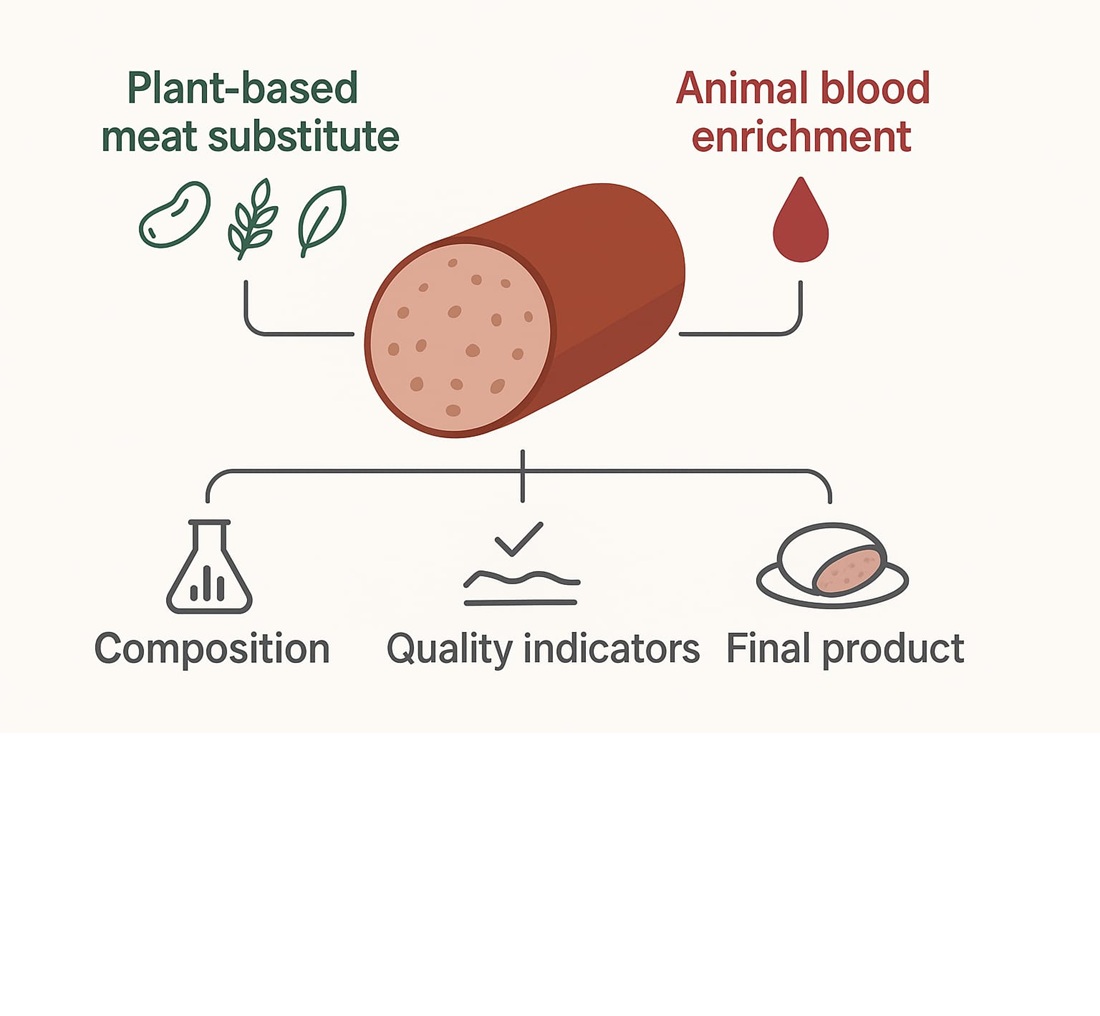
Об'єктом дослідження є напівкопчена ковбаса з рослинного замінника м'яса, збагачена кров'ю забитих тварин у різних пропорціях.
Проблема, яку необхідно вирішити, полягає в тому, що кров сільськогосподарських тварин, будучи цінним джерелом білка, викидається тоннами як відходи, і посилюється виникаючими серйозними проблемами забруднення навколишнього середовища. Але в багатьох країнах більшість білків крові використовуються як сполучні речовини, натуральні підсилювачі кольору, емульгатори, замінники жиру та агенти для засолювання м'яса.
У статті представлені результати дослідження органолептичної оцінки, мінерального та фізико-хімічного складу напівкопченої ковбаси з рослинного замінника м'яса, збагаченої кров'ю забитих тварин. Як рослинну сировину були обрані сої та нут у співвідношенні 70:30. За результатами органолептичної оцінки було встановлено, що додавання крові забитих тварин до рецептури досліджуваного продукту в кількості 2% покращує смак та колір готового продукту. У процесі дослідження було доведено, що при додаванні 2% сухої крові забитих тварин до напівкопченої ковбаси з рослинного замінника м'яса кількість білка збільшується на 2,26% порівняно з контрольним зразком. Також підвищений вміст жиру в дослідних зразках напівкопченої ковбаси показав, що кров забитих тварин може бути використана як замінник жиру. На основі досліджень мінерального складу напівкопченої ковбаси з рослинних замінників м'яса доведено, що додавання 2–6% крові забитих тварин збільшує вміст мінеральних речовин порівняно з контрольним зразком. Дослідження показали, що додавання 2%, 4%, 6% крові забитих тварин до напівкопченої ковбаси з рослинного замінника м'яса збільшує вміст незамінних та замінних амінокислот порівняно з контрольним зразком. Було виявлено, що в дослідних зразках з додаванням 2%, 4%, 6% крові забитих тварин вміст насичених та поліненасичених жирних кислот збільшується порівняно з контрольним зразком. Тим самим збагачуючи та підвищуючи біологічну та харчову цінність готового продукту
Посилання
- Zheleuova, Z. S., Uzakov, Y. M., Shingisov, A. U., Alibekov, R. S., Khamitova, B. M. (2020). Development of halal cooked smoked beef and turkey sausage using a combined plant extracts. Journal of Food Processing and Preservation, 45 (1). https://doi.org/10.1111/jfpp.15028
- Cha, S.-H., Shin, K.-O., Han, K.-S. (2020). A study on the physicochemical properties of sausage analogue made with mixed bean protein concentrate. Korean journal of Food science and Technology, 52 (6), 641–648. https://doi.org/10.9721/KJFST.2020.52.6.641
- Joshi, V., Kumar, S. (2015). Meat Analogues: Plant based alternatives to meat products- A review. International Journal of Food and Fermentation Technology, 5 (2), 107. https://doi.org/10.5958/2277-9396.2016.00001.5
- Zheleuova, Z., Shingisov, A., Berdenbetova, A., Balabekova, A., Imanbayev, A. (2025). Developing a sausage product which have increased nutritional value and improved amino acid properties. Eastern-European Journal of Enterprise Technologies, 2 (11 (134)), 96–103. https://doi.org/10.15587/1729-4061.2025.327439
- Padha, N., Salve, R. V., Gaurav, D. (2024). Legume-Based Meat Analog Products: A Comprehensive Analysis of Nutritional and Technological Aspects. Bioscene, 21 (02), 1117–1132. Available at: https://explorebioscene.com/assets/uploads/doc/ae7e6-1116-1132.10000173.pdf
- Kurek, M. A., Onopiuk, A., Pogorzelska-Nowicka, E., Szpicer, A., Zalewska, M., Półtorak, A. (2022). Novel Protein Sources for Applications in Meat-Alternative Products – Insight and Challenges. Foods, 11 (7), 957. https://doi.org/10.3390/foods11070957
- Mazumder, Md., Sujintonniti, N., Chaum, P., Ketnawa, S., Rawdkuen, S. (2023). Developments of Plant-Based Emulsion-Type Sausage by Using Grey Oyster Mushrooms and Chickpeas. Foods, 12 (8), 1564. https://doi.org/10.3390/foods12081564
- Boukid, F. (2021). Chickpea (Cicer arietinum L.) protein as a prospective plant‐based ingredient: a review. International Journal of Food Science & Technology, 56 (11), 5435–5444. https://doi.org/10.1111/ijfs.15046
- Appiah, J., Peggy, Y.-H. (2012). The Use of Blood and Derived Products as Food Additives. Food Additive. https://doi.org/10.5772/32374
- Bohrer, B. M. (2023). Blood and Blood Constituents for Meat Processing. Current Food Science and Technology Reports, 2 (1), 17–25. https://doi.org/10.1007/s43555-023-00015-3
- Rodriguez Furlán, L. T., Padilla, A. P., Campderrós, M. E. (2014). Development of reduced fat minced meats using inulin and bovine plasma proteins as fat replacers. Meat Science, 96 (2), 762–768. https://doi.org/10.1016/j.meatsci.2013.09.015
- Kumari, S., Pandey, A., Soni, A., Sarkar, S., Kumar, A. (2024). Effect of plasma protein hydrolysates on fatty acids, colour, texture and oxidation stability of mutton sausage during refrigeration storage. Indian Journal of Small Ruminants (The), 30 (1), 129–137. https://doi.org/10.5958/0973-9718.2024.00030.8
- Oro, C. E. D., Rigo, D., Gaio, I., Valduga, E., Paliga, M., Silva, M. F. et al. (2018). Formulation of chicken sausages with broiler blood proteins and dye. Journal of Food Science and Technology, 55 (11), 4694–4699. https://doi.org/10.1007/s13197-018-3403-8
- Goemaere, O., Glorieux, S., Govaert, M., Steen, L., Fraeye, I. (2021). Phosphate Elimination in Emulsified Meat Products: Impact of Protein-Based Ingredients on Quality Characteristics. Foods, 10 (4), 882. https://doi.org/10.3390/foods10040882
- Cofrades, S., Guerra, M. A., Carballo, J., Fernández‐Martín, F., Colmenero, F. J. (2000). Plasma Protein and Soy Fiber Content Effect on Bologna Sausage Properties as Influenced by Fat Level. Journal of Food Science, 65 (2), 281–287. https://doi.org/10.1111/j.1365-2621.2000.tb15994.x
- Furlán, L. T. R., Padilla, A. P., Campderrós, M. E. (2010). Functional and physical properties of bovine plasma proteins as a function of processing and pH, application in a food formulation. Advance Journal of Food Science and Technology, 2 (5), 256–267. Available at: https://maxwellsci.com/print/ajfst/v2-256-267.pdf
- Lennon, A. M., McDonald, K., Moon, S. S., Ward, P., Kenny, T. A. (2010). Performance of cold-set binding agents in re-formed beef steaks. Meat Science, 85 (4), 620–624. https://doi.org/10.1016/j.meatsci.2010.03.014
- Bah, C. S., Bekhit, A. E. A., Carne, A., McConnell, M. A. (2015). Composition and biological activities of slaughterhouse blood from red deer, sheep, pig and cattle. Journal of the Science of Food and Agriculture, 96 (1), 79–89. https://doi.org/10.1002/jsfa.7062
- Bah, C. S. F., Bekhit, A. E. A., Carne, A., McConnell, M. A. (2013). Slaughterhouse Blood: An Emerging Source of Bioactive Compounds. Comprehensive Reviews in Food Science and Food Safety, 12 (3), 314–331. https://doi.org/10.1111/1541-4337.12013
- ISO 12966-1:2014. Animal and vegetable fats and oils — Gas chromatography of fatty acid methyl esters — Part 1: Guidelines on modern gas chromatography of fatty acid methyl esters (2014). Geneva: International Organization for Standardization, 17.
- AOAC Official Method 994.12: Amino Acids in Feeds — Ion-exchange chromatography method. Chap. 45 (2000). Gaithersburg, MD: AOAC International.
- Mathi, P. (2016). Development of beef sausages through bovine blood utilization as fat replacer to reduce slaughterhouse by-product losses. University of Nairobi, 100.
##submission.downloads##
Опубліковано
Як цитувати
Номер
Розділ
Ліцензія
Авторське право (c) 2025 Aibala Taspoltaeva, Zhazira Zheleuova, Elmira Kanseitova, Viktoriia Yevlash

Ця робота ліцензується відповідно до Creative Commons Attribution 4.0 International License.
Закріплення та умови передачі авторських прав (ідентифікація авторства) здійснюється у Ліцензійному договорі. Зокрема, автори залишають за собою право на авторство свого рукопису та передають журналу право першої публікації цієї роботи на умовах ліцензії Creative Commons CC BY. При цьому вони мають право укладати самостійно додаткові угоди, що стосуються неексклюзивного поширення роботи у тому вигляді, в якому вона була опублікована цим журналом, але за умови збереження посилання на першу публікацію статті в цьому журналі.
Ліцензійний договір – це документ, в якому автор гарантує, що володіє усіма авторськими правами на твір (рукопис, статтю, тощо).
Автори, підписуючи Ліцензійний договір з ПП «ТЕХНОЛОГІЧНИЙ ЦЕНТР», мають усі права на подальше використання свого твору за умови посилання на наше видання, в якому твір опублікований. Відповідно до умов Ліцензійного договору, Видавець ПП «ТЕХНОЛОГІЧНИЙ ЦЕНТР» не забирає ваші авторські права та отримує від авторів дозвіл на використання та розповсюдження публікації через світові наукові ресурси (власні електронні ресурси, наукометричні бази даних, репозитарії, бібліотеки тощо).
За відсутності підписаного Ліцензійного договору або за відсутністю вказаних в цьому договорі ідентифікаторів, що дають змогу ідентифікувати особу автора, редакція не має права працювати з рукописом.
Важливо пам’ятати, що існує і інший тип угоди між авторами та видавцями – коли авторські права передаються від авторів до видавця. В такому разі автори втрачають права власності на свій твір та не можуть його використовувати в будь-який спосіб.