Devising a method for energy-efficient control over a data transmission process across the mobile high-density internet of things
DOI:
https://doi.org/10.15587/1729-4061.2025.336111Keywords:
Internet of Things transactions, energy resource, fog gateway, Pareto-optimal solution, boundary computationsAbstract
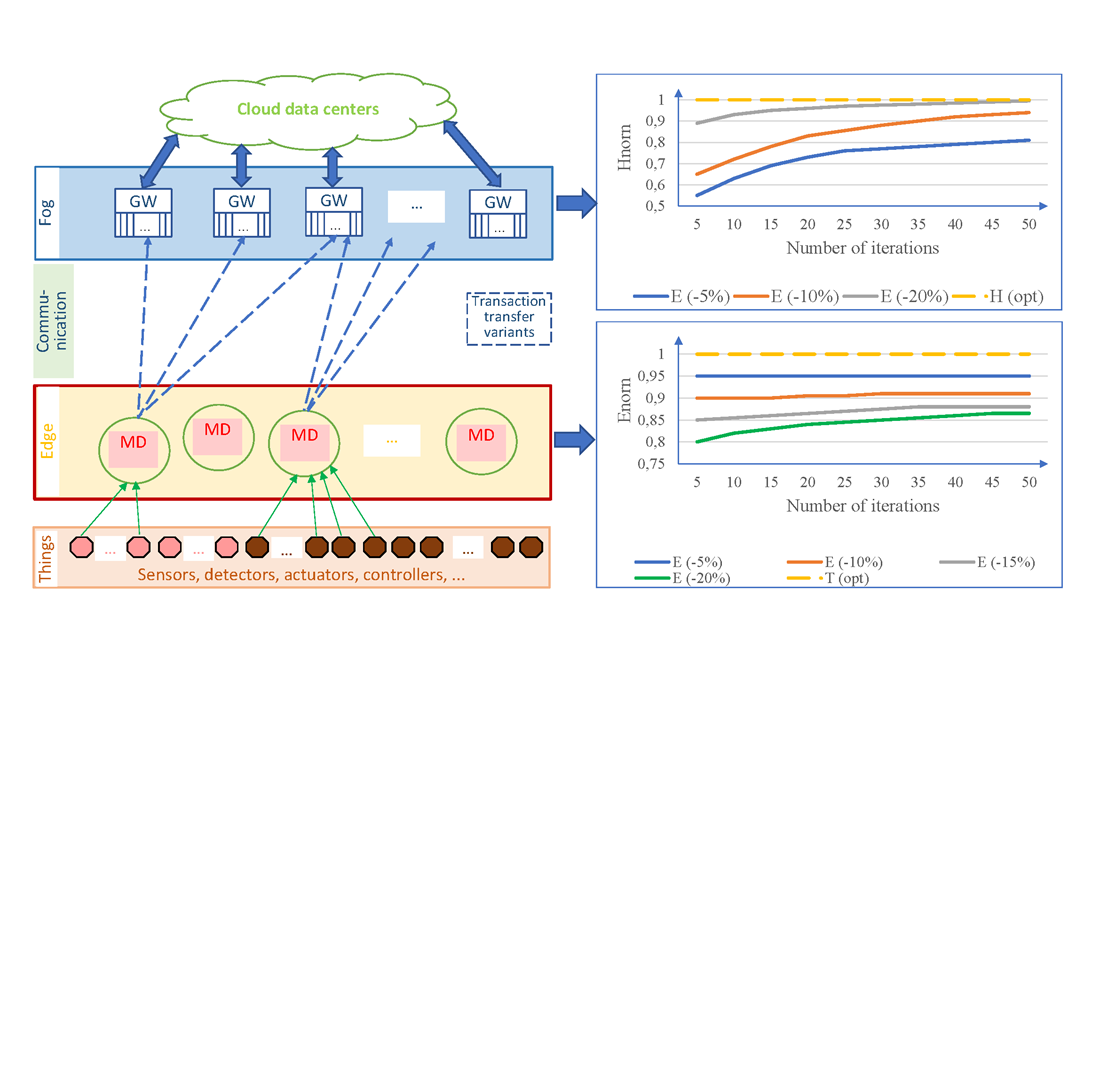
This study’s object is the process that controls data transmission across the mobile high-density Internet of Things. The task addressed is to reduce energy consumption when transmitting mobile IoT transactions to fog gateways was by devising a method for energy-efficient data transmission control.
To this end, it was proposed to optimize the distribution of active mobile devices across the fog layer gateways. In the process of research, the architecture of the data transmission subsystem between the boundary and fog layers of the Internet of Things was formed. During the development, an intermediate level of support infrastructure was selected – Communication Layer. That has made it possible to build a mathematical model of the data transmission process control process. The main difference of this model from existing ones is a significant acceleration of calculations when finding a Pareto-optimal solution. To this end, the method of successive concessions was used. It has made it possible to solve a three-criteria optimization problem with objective functions ordered by significance.
The mathematical model has made it possible to devise a method for energy-efficient control over the data transmission process across the mobile high-density Internet of Things. The main difference of this method from existing ones is the optimization of the process simultaneously according to three criteria: energy efficiency, priority, and time. In this case, preference is given to the criterion of energy efficiency of data transmission by mobile IoT devices. That has made it possible to significantly reduce the time of searching for a Pareto-optimal solution when transmitting transactions to a cloud data processing center.
The research results are attributed to the application of the successive concessions method together with the ant colony algorithm with a limited number of iterations. The method proves effective when concessions on the energy resource of mobile devices are from 5 to 15%.
References
- Kaur, G., Balyan, V., Gupta, S. H. (2025). Nature inspired optimization of IoT network for delay resistant and energy efficient applications. Scientific Reports, 15 (1). https://doi.org/10.1038/s41598-025-95138-z
- Vaiyapuri, T., Parvathy, V. S., Manikandan, V., Krishnaraj, N., Gupta, D., Shankar, K. (2021). A Novel Hybrid Optimization for Cluster‐Based Routing Protocol in Information-Centric Wireless Sensor Networks for IoT Based Mobile Edge Computing. Wireless Personal Communications, 127 (1), 39–62. https://doi.org/10.1007/s11277-021-08088-w
- Muñoz, L. A., Berná Martínez, J. V., Asensi, C. C., Pastor, D. S. (2024). RESEARCH NOTES: Design of a Distributed and Highly Scalable Fog Architecture for Heterogeneous IoT Infrastructures. International Journal of Software Engineering and Knowledge Engineering, 35 (02), 195–215. https://doi.org/10.1142/s0218194025430016
- Alqasimi, A., Al Marzouqi, K., Alhammadi, A., Aljasmi, A., Alnabulsi, A., Al-Ali, A. R. (2025). An IoT-Based Mobile Air Pollution Monitoring System. Proceedings of IEMTRONICS 2024, 221–233. https://doi.org/10.1007/978-981-97-4784-9_16
- Kuchuk, N., Kashkevich, S., Radchenko, V., Andrusenko, Y., Kuchuk, H. (2024). Applying edge computing in the execution IoT operative transactions. Advanced Information Systems, 8 (4), 49–59. https://doi.org/10.20998/2522-9052.2024.4.07
- Tzeng, S.-S., Lin, Y.-J., Wang, S.-W. (2025). Age of Information in IoT Devices With Integrated Heterogeneous Sensors Under Slotted ALOHA. IEEE Sensors Journal, 25 (11), 20842–20853. https://doi.org/10.1109/jsen.2025.3563452
- Sobchuk, V., Pykhnivskyi, R., Barabash, O., Korotin, S., Omarov, S. (2024). Sequential intrusion detection system for zero-trust cyber defense of IOT/IIOT networks. Advanced Information Systems, 8 (3), 92–99. https://doi.org/10.20998/2522-9052.2024.3.11
- Cui, Y., Shi, G., Xu, L., Ji, J. (2023). Average dwell time based networked predictive control for switched linear systems with data transmission time-varying delays. IMA Journal of Mathematical Control and Information, 40 (2), 210–231. https://doi.org/10.1093/imamci/dnad007
- Kuchuk, H., Malokhvii, E. (2024). Integration of IoT with cloud, fog, and edge computing: a review. Advanced Information Systems, 8 (2), 65–78. https://doi.org/10.20998/2522-9052.2024.2.08
- Kuchuk, H., Mozhaiev, O., Tiulieniev, S., Mozhaiev, M., Kuchuk, N., Tymoshchyk, L. et al. (2025). Devising a method for stabilizing control over a load on a cluster gateway in the internet of things edge layer. Eastern-European Journal of Enterprise Technologies, 2 (9 (134)), 24–32. https://doi.org/10.15587/1729-4061.2025.326040
- Kuchuk, H., Mozhaiev, O., Kuchuk, N., Tiulieniev, S., Mozhaiev, M., Gnusov, Y. et al. (2024). Devising a method for the virtual clustering of the Internet of Things edge environment. Eastern-European Journal of Enterprise Technologies, 1 (9 (127)), 60–71. https://doi.org/10.15587/1729-4061.2024.298431
- Lee, B. M. (2025). Efficient Resource Management for Massive MIMO in High-Density Massive IoT Networks. IEEE Transactions on Mobile Computing, 24 (3), 1963–1980. https://doi.org/10.1109/tmc.2024.3486712
- Yu, J., Hou, K., Zhang, H., Kostic, B., Yang, M., Nazif, H. (2025). A new energy-aware resources scheduling method for mobile internet of things using a hybrid optimisation algorithm. International Journal of Mobile Communications, 25 (2), 176–207. https://doi.org/10.1504/ijmc.2025.144192
- Kuchuk, H., Mozhaiev, O., Tiulieniev, S., Mozhaiev, M., Kuchuk, N., Tymoshchyk, L. et al. (2025). Devising a method for forming a stable mobile cluster of the internet of things fog layer. Eastern-European Journal of Enterprise Technologies, 1 (4 (133)), 6–14. https://doi.org/10.15587/1729-4061.2025.322263
- Kuchuk, H., Kalinin, Y., Dotsenko, N., Chumachenko, I., Pakhomov, Y. (2024). Decomposition Of Integrated High-Density IoT Data Flow. Advanced Information Systems, 8 (3), 77–84. https://doi.org/10.20998/2522-9052.2024.3.09
- Yu, J., Yu, G., Chen, Z. (2024). RAllo: Region Attention-based Edge Resource Allocation in Mobile Internet of Things. GLOBECOM 2024 - 2024 IEEE Global Communications Conference, 3413–3418. https://doi.org/10.1109/globecom52923.2024.10901347
- Zheng, Z., Nazif, H. (2023). An Energy-aware Technique for Resource Allocation in Mobile Internet of Thing (MIoT) Using Selfish Node Ranking and an Optimization Algorithm. IETE Journal of Research, 70 (4), 3546–3571. https://doi.org/10.1080/03772063.2023.2202163
- Zheng, K., Luo, R., Liu, X., Qiu, J., Liu, J. (2024). Distributed DDPG-Based Resource Allocation for Age of Information Minimization in Mobile Wireless-Powered Internet of Things. IEEE Internet of Things Journal, 11 (17), 29102–29115. https://doi.org/10.1109/jiot.2024.3406044
- Liu, J., Wei, X., Fan, J. (2019). Tolerable Data Transmission of Mobile Edge Computing Under Internet of Things. IEEE Access, 7, 71859–71871. https://doi.org/10.1109/access.2019.2920442
- Liu, Q., Mo, R., Xu, X., Ma, X. (2020). Multi-objective resource allocation in mobile edge computing using PAES for Internet of Things. Wireless Networks, 30 (5), 3533–3545. https://doi.org/10.1007/s11276-020-02409-w
- Kang, S., Li, K., Wang, R. (2024). A survey on pareto front learning for multi-objective optimization. Journal of Membrane Computing, 7 (2), 128–134. https://doi.org/10.1007/s41965-024-00170-z
- Hu, Y., Qu, Y., Li, W., Huang, Y. (2025). A Pareto Front searching algorithm based on reinforcement learning for constrained multiobjective optimization. Information Sciences, 705, 121985. https://doi.org/10.1016/j.ins.2025.121985
- Pardalos, P. M., Steponavičė, I., Z̆ilinskas, A. (2011). Pareto set approximation by the method of adjustable weights and successive lexicographic goal programming. Optimization Letters, 6 (4), 665–678. https://doi.org/10.1007/s11590-011-0291-5
- Śliwiński, T. (2024). Efficient Approximation Methods for Lexicographic Max-Min Optimization. Journal of Telecommunications and Information Technology, 1, 46–53. https://doi.org/10.26636/jtit.2024.1.1421
- Zhang, J., Xu, M., Wang, L. (2025). Research on Link Selection and Allocation for IoT Localization Systems Based on an Improved Ant Colony Algorithm. Cyber Security Intelligence and Analytics, 140–150. https://doi.org/10.1007/978-3-031-88287-6_13
- Zhang, N., Shang, F., Li, X., Zhu, W. (2022). Research on Test Data Generation Method of IOT Management Platform Based on Ant Colony Algorithm. 2022 11th International Conference of Information and Communication Technology (ICTech)), 175–178. https://doi.org/10.1109/ictech55460.2022.00042
- Zhao, H.-Y., Wang, J.-C., Guan, X., Wang, Z.-H., He, Y.-H., Xie, H.-L. (2019). Ant Colony System for Energy Consumption Optimization in Mobile IoT Networks. Journal of Circuits, Systems and Computers, 29 (09), 2050150. https://doi.org/10.1142/s0218126620501509
- Petrovska, I., Kuchuk, H., Kuchuk, N., Mozhaiev, O., Pochebut, M., Onishchenko, Y. (2023). Sequential Series-Based Prediction Model in Adaptive Cloud Resource Allocation for Data Processing and Security. 2023 13th International Conference on Dependable Systems, Services and Technologies (DESSERT), 1–6. https://doi.org/10.1109/dessert61349.2023.10416496
- Kuchuk, H., Husieva, Y., Novoselov, S., Lysytsia, D., Krykhovetskyi, H. (2025). Load Balancing Of The Layers IoT Fog-Cloud Support Network. Advanced Information Systems, 9 (1), 91–98. https://doi.org/10.20998/2522-9052.2025.1.11
- Kuchuk, H., Mozhaiev, O., Tiulieniev, S., Mozhaiev, M., Kuchuk, N., Tymoshchyk, L. et al. (2025). Devising a method for increasing data transmission speed in monitoring systems based on the mobile high-density internet of things. Eastern-European Journal of Enterprise Technologies, 3 (4 (135)), 52–61. https://doi.org/10.15587/1729-4061.2025.330644
- Bhajantri, L. B., Gangadharaiah, S. (2022). Heuristic-Based Resource Allocation for Internet of Things in Gateway Centric Multi-layer Fog Computing. ICT Systems and Sustainability, 567–579. https://doi.org/10.1007/978-981-19-5221-0_54
- Datsenko, S., Kuchuk, H. (2023). Biometric authentication utilizing convolutional neural networks. Advanced Information Systems, 7 (2), 87–91. https://doi.org/10.20998/2522-9052.2023.2.12
- Singh, S. P., Singh, P., Diwakar, M., Kumar, P. (2024). Improving quality of service for Internet of Things(IoT) in real life application: A novel adaptation based Hybrid Evolutionary Algorithm. Internet of Things, 27, 101323. https://doi.org/10.1016/j.iot.2024.101323
- Zhou, Y., Liu, X., Hu, S., Wang, Y., Yin, M. (2022). Combining max–min ant system with effective local search for solving the maximum set k-covering problem. Knowledge-Based Systems, 239, 108000. https://doi.org/10.1016/j.knosys.2021.108000
Downloads
Published
How to Cite
Issue
Section
License
Copyright (c) 2025 Heorhii Kuchuk, Oleksandr Mozhaiev, Serhii Tiulieniev, Mykhailo Mozhaiev, Nina Kuchuk, Andrii Lubentsov, Yurii Onishchenko, Yurii Gnusov, Olha Brendel, Viktoriia Roh

This work is licensed under a Creative Commons Attribution 4.0 International License.
The consolidation and conditions for the transfer of copyright (identification of authorship) is carried out in the License Agreement. In particular, the authors reserve the right to the authorship of their manuscript and transfer the first publication of this work to the journal under the terms of the Creative Commons CC BY license. At the same time, they have the right to conclude on their own additional agreements concerning the non-exclusive distribution of the work in the form in which it was published by this journal, but provided that the link to the first publication of the article in this journal is preserved.
A license agreement is a document in which the author warrants that he/she owns all copyright for the work (manuscript, article, etc.).
The authors, signing the License Agreement with TECHNOLOGY CENTER PC, have all rights to the further use of their work, provided that they link to our edition in which the work was published.
According to the terms of the License Agreement, the Publisher TECHNOLOGY CENTER PC does not take away your copyrights and receives permission from the authors to use and dissemination of the publication through the world's scientific resources (own electronic resources, scientometric databases, repositories, libraries, etc.).
In the absence of a signed License Agreement or in the absence of this agreement of identifiers allowing to identify the identity of the author, the editors have no right to work with the manuscript.
It is important to remember that there is another type of agreement between authors and publishers – when copyright is transferred from the authors to the publisher. In this case, the authors lose ownership of their work and may not use it in any way.





