Застосування методу аналізу розмірностей у реалізації газогідратної технології транспортування і зберігання природного газу
DOI:
https://doi.org/10.15587/1729-4061.2025.336905Ключові слова:
газогідратна технологія зберігання природного газу, математичне моделювання, метод аналізу розмірностейАнотація
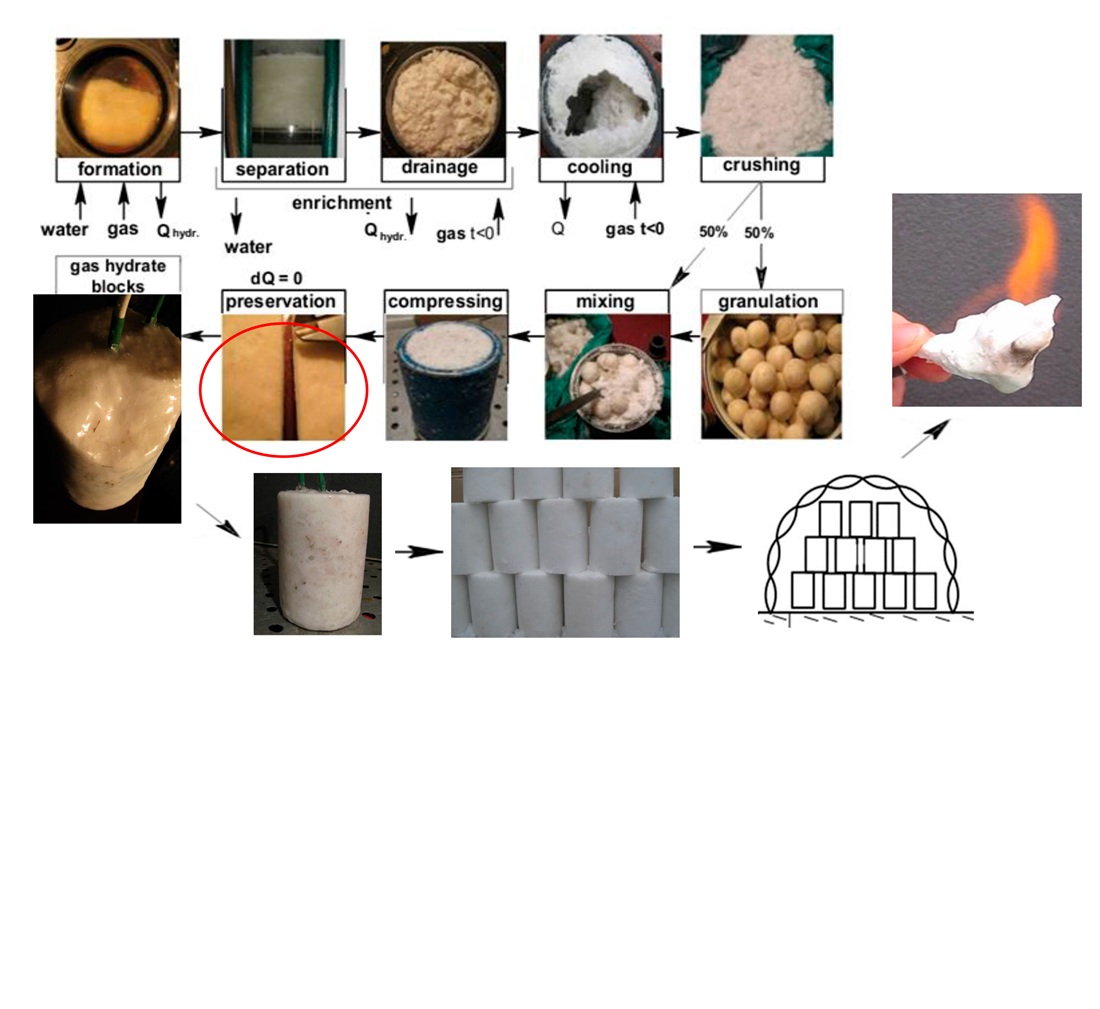
Об’єктом дослідження були параметри процесу примусової консервації газогідрату шаром льоду для забезпечення його стабільності в нерівноважних умовах. Такими умовами є атмосферний тиск і незначна від’ємна температура. Однак нанесеня води в фазі рідини і подальша її кристалізація, з виділенням відповідної кількості енергії процесу, супроводжується дисоціаціацією поверхневого шару газогідрату, а отже втратою газу. Зниження рівня плавлення газогідрату можна досягти підвищенням рівня охолодження газогідратних структу. Однак це підвищує операційні витрати технології. В роботі запропоновано варіант обгрунтвання параметрів процесу примусової консервації структур гідрату природного газу.
Для цього, використовуючи метод аналізу розмірностей, встановлено безрозмірні комплекси: критерій Фур’є (Fo); критерій, що характеризує відносну теплопровідність тіл (Kε), критерій Косовича (Ко), критерій безрозмірної температури q1/q0 та критеріальне рівняння. Експериментально визначено коефіцієнт і ступені безрозмірних комплексів у критеріальному рівнянні. Вони дозволяють описати процес примусової консервації газогідратних структур незалежно від розміру і фоми.
Застосування безрозмірних залежностей та критеріального рівняння дозволить у спрощеному вигляді визначати параметри технологічного процесу промислового виробництва газогідратних структур з необхідними властивостями (стабільністю при транспортуванні і зберігані за нерівноважних термобаричних умов без втрат газу).
На основі експериментальних досліджень встановлено межі застосовуваних параметрів стабільності газогідратних структур за нерівноважних умов. Для них критерій безрозмірної температури q1/q0 лежить у межах 0,02–0,04
Посилання
- Khan, M. I., Yasmin, T., Shakoor, A. (2015). Technical overview of compressed natural gas (CNG) as a transportation fuel. Renewable and Sustainable Energy Reviews, 51, 785–797. https://doi.org/10.1016/j.rser.2015.06.053
- Mokhatab, S., Mak, J., Valappil, J., Wood, D. (2014). Handbook of Liquefied Natural Gas. Gulf Professional Publishing. https://doi.org/10.1016/c2011-0-07476-8
- Sloan Jr., E. D., Koh, C. A., Koh, C. A. (2007). Clathrate Hydrates of Natural Gases. CRC Press. https://doi.org/10.1201/9781420008494
- Kim, K., Kang, H., Kim, Y. (2015). Risk Assessment for Natural Gas Hydrate Carriers: A Hazard Identification (HAZID) Study. Energies, 8 (4), 3142–3164. https://doi.org/10.3390/en8043142
- Takaoki, T. (2008). Natural gas transportation in form of hydrate. Journal of the Japanese Association for Petroleum Technology, 73 (2), 158–163. https://doi.org/10.3720/japt.73.158
- Veluswamy, H. P., Kumar, A., Seo, Y., Lee, J. D., Linga, P. (2018). A review of solidified natural gas (SNG) technology for gas storage via clathrate hydrates. Applied Energy, 216, 262–285. https://doi.org/10.1016/j.apenergy.2018.02.059
- Javanmardi, J., Nasrifar, Kh., Najibi, S. H., Moshfeghian, M. (2005). Economic evaluation of natural gas hydrate as an alternative for natural gas transportation. Applied Thermal Engineering, 25 (11-12), 1708–1723. https://doi.org/10.1016/j.applthermaleng.2004.10.009
- Durcansky, P., Hecko, D., Malcho, M. (2019). Primary energy accumulation through advanced gas hydrates system. International Journal of Research -GRANTHAALAYAH, 7 (5), 278–283. https://doi.org/10.29121/granthaalayah.v7.i5.2019.846
- Bondarenko, V., Svietkina, O., Sai, K., Petlovanyi, M. (2020). Research into thermobaric processes of methane gas hydrates formation. ARPN Journal of Engineering and Applied Sciences, 15 (22), 2688–2697. Available at: https://www.arpnjournals.org/jeas/research_papers/rp_2020/jeas_1120_8406.pdf
- Chen, J., Zeng, Y.-S., Yu, X.-Y., Yuan, Q., Wang, T., Deng, B. et al. (2022). A covering liquid method to intensify self-preservation effect for safety of methane hydrate storage and transportation. Petroleum Science, 19 (3), 1411–1419. https://doi.org/10.1016/j.petsci.2021.11.007
- Mimachi, H., Takahashi, M., Takeya, S., Gotoh, Y., Yoneyama, A., Hyodo, K. et al. (2015). Effect of Long-Term Storage and Thermal History on the Gas Content of Natural Gas Hydrate Pellets under Ambient Pressure. Energy & Fuels, 29 (8), 4827–4834. https://doi.org/10.1021/acs.energyfuels.5b00832
- Pallipurath, M., Mohammed, A., Rahman, N. (2024). Innovative Gas Hydrate Transport: A Pathway to Renewable Energy and Sustainable Development in India. International conference on futuristic technologies in control systems & renewable energy – 2024 (ICFCR). Available at: https://www.researchgate.net/publication/381037423
- Bhattacharjee, G., Veluswamy, H. P., Kumar, A., Linga, P. (2021). Stability analysis of methane hydrates for gas storage application. Chemical Engineering Journal, 415, 128927. https://doi.org/10.1016/j.cej.2021.128927
- Zhong, J.-R., Zeng, X.-Y., Zhou, F.-H., Ran, Q.-D., Sun, C.-Y., Zhong, R.-Q. et al. (2016). Self-preservation and structural transition of gas hydrates during dissociation below the ice point: an in situ study using Raman spectroscopy. Scientific Reports, 6 (1). https://doi.org/10.1038/srep38855
- Takeya, S., Ripmeester, J. A. (2010). Anomalous Preservation of CH4 Hydrate and its Dependence on the Morphology of Hexagonal Ice. ChemPhysChem, 11 (1), 70–73. https://doi.org/10.1002/cphc.200900731
- Misyura, S. Y. (2016). The influence of porosity and structural parameters on different kinds of gas hydrate dissociation. Scientific Reports, 6 (1). https://doi.org/10.1038/srep30324
- Majid, A. A. A., Koh, C. A. (2021). Self-preservation phenomenon in gas hydrates and its application for energy storage. Intra- and Intermolecular Interactions Between Non-Covalently Bonded Species, 267–285. https://doi.org/10.1016/b978-0-12-817586-6.00008-6
- Pedchenko, M., Pedchenko, L. (2016). Technological complex for production, transportation and storage of gas from the offshore gas and gas hydrates fields. Mining of Mineral Deposits, 10 (3), 20–30. https://doi.org/10.15407/mining10.03.020
- Pedchenko, L., Pedchenko, M. (2014). The forcibly preservation of gas hydrate blocks by layer of ice. Mining of Mineral Deposits, 8 (3), 277–286. https://doi.org/10.15407/mining08.03.277
- Marín, E., Calderón, A., Delgado-Vasallo, O. (2009). Similarity theory and dimensionless numbers in heat transfer. European Journal of Physics, 30 (3), 439–445. https://doi.org/10.1088/0143-0807/30/3/001
- Gorshenin, A. S., Krasnova, N. P., Rakhimova, J. I. (2021). Determination of heat transfer criterial equation when cooling aluminum ingots. Journal of Physics: Conference Series, 2088 (1), 012017. https://doi.org/10.1088/1742-6596/2088/1/012017
- Kepych, T. Yu., Kutsenko, O. H. (2004). Osnovy teoriyi podibnosti ta analizu rozmirnostei ta yikh zastosuvannia v zadachakh mekhaniky. Kyiv, 101. Available at: https://mechmat.knu.ua/wp-content/uploads/2018/03/otparm.pdf
##submission.downloads##
Опубліковано
Як цитувати
Номер
Розділ
Ліцензія
Авторське право (c) 2025 Larysa Pedchenko, Nazar Pedchenko, Mykhailo Pedchenko

Ця робота ліцензується відповідно до Creative Commons Attribution 4.0 International License.
Закріплення та умови передачі авторських прав (ідентифікація авторства) здійснюється у Ліцензійному договорі. Зокрема, автори залишають за собою право на авторство свого рукопису та передають журналу право першої публікації цієї роботи на умовах ліцензії Creative Commons CC BY. При цьому вони мають право укладати самостійно додаткові угоди, що стосуються неексклюзивного поширення роботи у тому вигляді, в якому вона була опублікована цим журналом, але за умови збереження посилання на першу публікацію статті в цьому журналі.
Ліцензійний договір – це документ, в якому автор гарантує, що володіє усіма авторськими правами на твір (рукопис, статтю, тощо).
Автори, підписуючи Ліцензійний договір з ПП «ТЕХНОЛОГІЧНИЙ ЦЕНТР», мають усі права на подальше використання свого твору за умови посилання на наше видання, в якому твір опублікований. Відповідно до умов Ліцензійного договору, Видавець ПП «ТЕХНОЛОГІЧНИЙ ЦЕНТР» не забирає ваші авторські права та отримує від авторів дозвіл на використання та розповсюдження публікації через світові наукові ресурси (власні електронні ресурси, наукометричні бази даних, репозитарії, бібліотеки тощо).
За відсутності підписаного Ліцензійного договору або за відсутністю вказаних в цьому договорі ідентифікаторів, що дають змогу ідентифікувати особу автора, редакція не має права працювати з рукописом.
Важливо пам’ятати, що існує і інший тип угоди між авторами та видавцями – коли авторські права передаються від авторів до видавця. В такому разі автори втрачають права власності на свій твір та не можуть його використовувати в будь-який спосіб.