Визначення механічних властивостей та морфології поверхні волоконних біокомпозитів artocarpus elasticus внаслідок впливу обробки лугами для автомобільного застосування
DOI:
https://doi.org/10.15587/1729-4061.2025.337175Ключові слова:
Artocarpus elasticus, біокомпозити, ручне укладання, механічні властивості, морфологія, гідроксид натріюАнотація
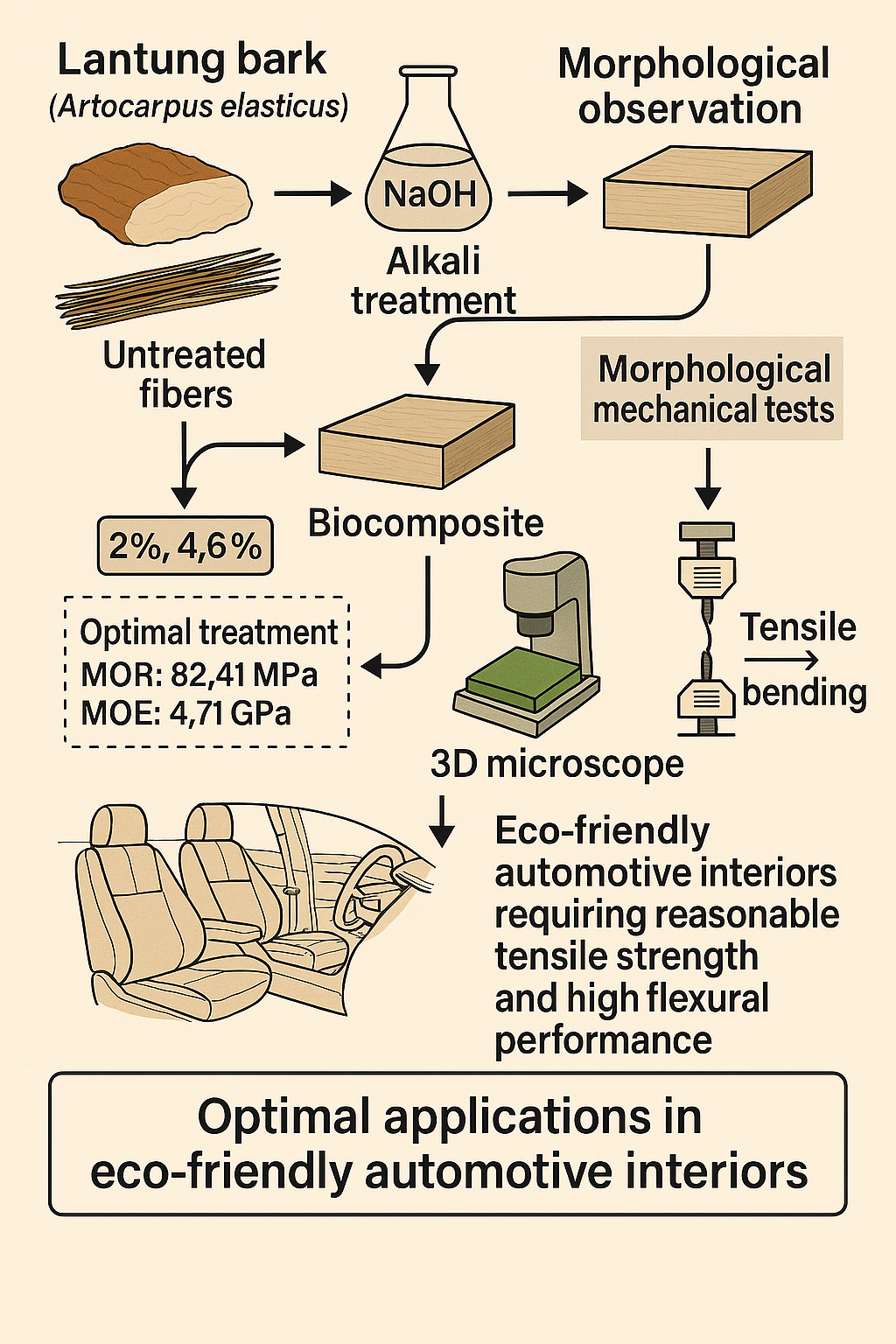
Кору лантунга (Artocarpus elasticus), натуральне волокно, поширене в Бенгкулу та інших регіонах Індонезії, було досліджено як армуючий матеріал у біокомпозитах на основі поліестеру. Зростаючий попит на екологічно чисті матеріали стимулював розробку біокомпозитів на основі натуральних волокон як альтернативи синтетичним матеріалам. Основною проблемою, яку було вирішено, є слабкий міжфазний зв'язок між необробленими волокнами лантунга та полімерними матрицями, що знижує механічні характеристики композиту. Щоб подолати цю проблему, волокна обробляли розчинами гідроксиду натрію (NaOH) у концентраціях 2%, 4% та 6% протягом 2 годин для покращення морфології поверхні та хімічної реакційної здатності. Після сушіння оброблені волокна були перетворені на біокомпозити методом ручного пресування. Тестування включало морфологічне спостереження за допомогою 3D-мікроскопії та механічну оцінку за допомогою випробувань на розтяг та вигин відповідно до стандартів ASTM. Результати показали, що обробка 2% NaOH забезпечила найкращі механічні властивості біокомпозиту з модулем розриву (MOR) 82,41 МПа та модулем пружності (MOE) 4,71 ГПа. Ці покращення пояснюються ефективним видаленням поверхневих домішок без значного пошкодження волокон, що покращує адгезію волокна до матриці. Відмінною особливістю цього дослідження є визначення оптимальної концентрації лугу, яка підтримує цілісність волокон, водночас значно покращуючи механічні характеристики. Розроблені біокомпозити лантунга мають потенційне застосування як екологічно чисті компоненти інтер'єру або неструктурні автомобільні компоненти, що потребують помірної міцності на розтяг та високої міцності на згин
Посилання
- Yogesh, M., Hari, R. A. N. (2017). Study on Pineapple Leaves Fibre and its Polymer based Composite: A Review. International Journal of Science and Research (IJSR), 6 (1), 799–807. https://doi.org/10.21275/art20164188
- Melyna, E., Afridana, A. P. (2023). The Effect of Coffee Husk Waste Addition with Alkalisation Treatment on the Mechanical Properties of Polypropylene Composites. Equilibrium Journal of Chemical Engineering, 7 (1), 14. https://doi.org/10.20961/equilibrium.v7i1.68556
- Zin, M. H., Abdan, K., Mazlan, N., Zainudin, E. S., Liew, K. E. (2018). The effects of alkali treatment on the mechanical and chemical properties of pineapple leaf fibres (PALF) and adhesion to epoxy resin. IOP Conference Series: Materials Science and Engineering, 368, 012035. https://doi.org/10.1088/1757-899x/368/1/012035
- Khan, M., Rahamathbaba, S., Mateen, M., Ravi Shankar, D., Manzoor Hussain, M. (2019). Effect of NaOH treatment on mechanical strength of banana/epoxy laminates. Polymers from Renewable Resources, 10 (1-3), 19–26. https://doi.org/10.1177/2041247919863626
- Peng, X., Zhong, L., Ren, J., Sun, R. (2010). Laccase and alkali treatments of cellulose fibre: Surface lignin and its influences on fibre surface properties and interfacial behaviour of sisal fibre/phenolic resin composites. Composites Part A: Applied Science and Manufacturing, 41 (12), 1848–1856. https://doi.org/10.1016/j.compositesa.2010.09.004
- Gundara, G., Nurzein, A. S., Wagiman, A., Ramadhan, A. R. (2023). Effect of Alkalized Pineapple Leaf Fiber Direction Variations on Tensile Strength and Bending of Polyester Matrix Composites. Formosa Journal of Sustainable Research, 2 (1), 87–96. https://doi.org/10.55927/fjsr.v2i1.2703
- Aravindh, M., Sathish, S., Ranga Raj, R., Karthick, A., Mohanavel, V., Patil, P. P. et al. (2022). A Review on the Effect of Various Chemical Treatments on the Mechanical Properties of Renewable Fiber-Reinforced Composites. Advances in Materials Science and Engineering, 2022, 1–24. https://doi.org/10.1155/2022/2009691
- Annamalai, K., Soundararajan, S., Kalidas, S., Marialueedass, N. (2024). Explorations into the mechanical properties of composites reinforced with sisal and abaca natural fibers. Matéria (Rio Janeiro). https://doi.org/10.1590/1517-7076-rmat-2024-0585
- Kabir, M. M., Alhaik, M. Y., Aldajah, S. H., Lau, K. T., Wang, H., Islam, M. M. (2021). Effect of Hemp Fibre Surface Treatment on the Fibre‐Matrix Interface and the Influence of Cellulose, Hemicellulose, and Lignin Contents on Composite Strength Properties. Advances in Materials Science and Engineering, 2021 (1). https://doi.org/10.1155/2021/9753779
- Setswalo, K., Molaletsa, N., Oladijo, O. P., Akinlabi, E. T., Sanjay, M. R., Siengchin, S. (2021). The Influence of Fiber Processing and Alkaline Treatment on the Properties of Natural Fiber-reinforced Composites: A Review. Applied Science and Engineering Progress. https://doi.org/10.14416/j.asep.2021.08.005
- Torres, G. B., Hiranobe, C. T., da Silva, E. A., Cardim, G. P., Cardim, H. P., Cabrera, F. C. et al. (2023). Eco-Friendly Natural Rubber–Jute Composites for the Footwear Industry. Polymers, 15 (20), 4183. https://doi.org/10.3390/polym15204183
- Osman, Z., Elamin, M., Ghorbel, E., Charrier, B. (2025). Influence of Alkaline Treatment and Fiber Morphology on the Mechanical, Physical, and Thermal Properties of Polypropylene and Polylactic Acid Biocomposites Reinforced with Kenaf, Bagasse, Hemp Fibers and Softwood. Polymers, 17 (7), 844. https://doi.org/10.3390/polym17070844
- Atmakuri, A., Palevicius, A., Janusas, G., Eimontas, J. (2022). Investigation of Hemp and Flax Fiber-Reinforced EcoPoxy Matrix Biocomposites: Morphological, Mechanical, and Hydrophilic Properties. Polymers, 14 (21), 4530. https://doi.org/10.3390/polym14214530
- Hestiawan, H., Zuliantoni, Supardi, N. I., Sudibyo (2025). Characteristics of Lantung Fiber and the Effect of Alkali Treatment and Water Absorption on the Mechanical Properties of Lantung Fiber Reinforced Composites. Jordan Journal of Mechanical and Industrial Engineering, 19 (02), 469–478. https://doi.org/10.59038/jjmie/190217
- Abraha, K. G., Debeli, D. K., Ghani, M. U., Tesfahunegn, A. A., Guo, J. (2023). Enset Fiber-Reinforced Polylactic Acid-Based Biocomposites for High-Performance Application. Journal of Composites Science, 7 (10), 407. https://doi.org/10.3390/jcs7100407
- Fadhillah, A. R., Hermawan, D., Wardhani, A. R. (2020). Pengaruh prosentase larutan NaOH pada proses alkalisasi serat kulit pohon waru (hibiscus tiliaceus) sebagai reinforcement komposit terhadap kekuatan tarik serat tunggal. Turbo : Jurnal Program Studi Teknik Mesin, 8 (2). https://doi.org/10.24127/trb.v8i2.1159
- Karthikeyan, A., Balamurugan, K., Kalpana, A. (2014). The effect of sodium hydroxide treatment and fiber length on the tensile property of coir fiber-reinforced epoxy composites. Science and Engineering of Composite Materials, 21 (3). https://doi.org/10.1515/secm-2013-0130
- ASTM D3039/D3039M-17. Test Method for Tensile Properties of Polymer Matrix Composite Materials. https://doi.org/10.1520/d3039_d3039m-17
- Saba, N., Paridah, M. T., Abdan, K., Ibrahim, N. A. (2016). Effect of oil palm nano filler on mechanical and morphological properties of kenaf reinforced epoxy composites. Construction and Building Materials, 123, 15–26. https://doi.org/10.1016/j.conbuildmat.2016.06.131
- Malalli, C. S., Ramji, B. R. (2022). Mechanical characterization of natural fiber reinforced polymer composites and their application in Prosthesis: A review. Materials Today: Proceedings, 62, 3435–3443. https://doi.org/10.1016/j.matpr.2022.04.276
- Firda, M. (2025). Image of The Morphology Test Results of Lantung Bark (Artocarpus Elasticus). Research Center for Biomass and Bioproduct, National Research and Innovation Agency. Available at: https://drive.google.com/file/d/199r4myKg5-j3zEMVN9jDEx1m71-P1_t1/view?usp=drive_link
- Firda, M. (2025). Tensile Test Results of Artocarpus Elasticus Fibers Treated with Sodium Hydroxide (NaOH). Research Center for Biomass and Bioproduct, National Research and Innovation Agency. Available at: https://drive.google.com/file/d/1PWZMPA8r4U8qj6fsFwvehHM0RYkz3S6y/view?usp=drive_link
- Firda, M. (2025). Bending Test Results of Artocarpus Elasticus Fibers Treated with Sodium Hydroxide (NaOH). Research Center for Biomass and Bioproduct, National Research and Innovation Agency. Available at: https://drive.google.com/file/d/1AmL4tgckzHtOttyHhqFuQXhGf9abBNly/view?usp=drive_link
- Fitri, M., Mahzan, S., Anggara, F. (2021). The Mechanical Properties Requirement for Polymer Composite Automotive Parts - A Review. International Journal of Advanced Technology in Mechanical, Mechatronics and Materials, 1 (3), 125–133. https://doi.org/10.37869/ijatec.v1i3.38
- Kumar, R. S., Muralidharan, N., Sathyamurthy, R. (2020). Optimization of Alkali Treatment Process Parameters for Kenaf Fiber: Experiments Design. Journal of Natural Fibers, 19 (11), 4276–4285. https://doi.org/10.1080/15440478.2020.1856276
- Simamora, P., Simanjuntak, J., Sinulingga, K., Laksono, A. D. (2023). Mechanical Properties of Polypropylene Composites with different Reinforced Natural Fibers – A Comparative Study. Journal of Ecological Engineering, 24 (7), 311–317. https://doi.org/10.12911/22998993/164757
##submission.downloads##
Опубліковано
Як цитувати
Номер
Розділ
Ліцензія
Авторське право (c) 2025 Tri Mulyanto, Firda Aulya Syamani, Ismadi Ismadi, Deni Purnomo, Mona Nurjanah, Iman Setyadi, Abdul Azis Abdillah, Sulaksana Permana

Ця робота ліцензується відповідно до Creative Commons Attribution 4.0 International License.
Закріплення та умови передачі авторських прав (ідентифікація авторства) здійснюється у Ліцензійному договорі. Зокрема, автори залишають за собою право на авторство свого рукопису та передають журналу право першої публікації цієї роботи на умовах ліцензії Creative Commons CC BY. При цьому вони мають право укладати самостійно додаткові угоди, що стосуються неексклюзивного поширення роботи у тому вигляді, в якому вона була опублікована цим журналом, але за умови збереження посилання на першу публікацію статті в цьому журналі.
Ліцензійний договір – це документ, в якому автор гарантує, що володіє усіма авторськими правами на твір (рукопис, статтю, тощо).
Автори, підписуючи Ліцензійний договір з ПП «ТЕХНОЛОГІЧНИЙ ЦЕНТР», мають усі права на подальше використання свого твору за умови посилання на наше видання, в якому твір опублікований. Відповідно до умов Ліцензійного договору, Видавець ПП «ТЕХНОЛОГІЧНИЙ ЦЕНТР» не забирає ваші авторські права та отримує від авторів дозвіл на використання та розповсюдження публікації через світові наукові ресурси (власні електронні ресурси, наукометричні бази даних, репозитарії, бібліотеки тощо).
За відсутності підписаного Ліцензійного договору або за відсутністю вказаних в цьому договорі ідентифікаторів, що дають змогу ідентифікувати особу автора, редакція не має права працювати з рукописом.
Важливо пам’ятати, що існує і інший тип угоди між авторами та видавцями – коли авторські права передаються від авторів до видавця. В такому разі автори втрачають права власності на свій твір та не можуть його використовувати в будь-який спосіб.