Design of a magnetic activator to prevent scale formation on the surface of tubular electric water heaters
DOI:
https://doi.org/10.15587/1729-4061.2025.338091Keywords:
magnetic field, hardness salts, energy efficiency, water treatment, electric heater, magnets, calcium, magnesiumAbstract
The object of this study is the processes of scale formation in electric water heating systems when using water of increased hardness.
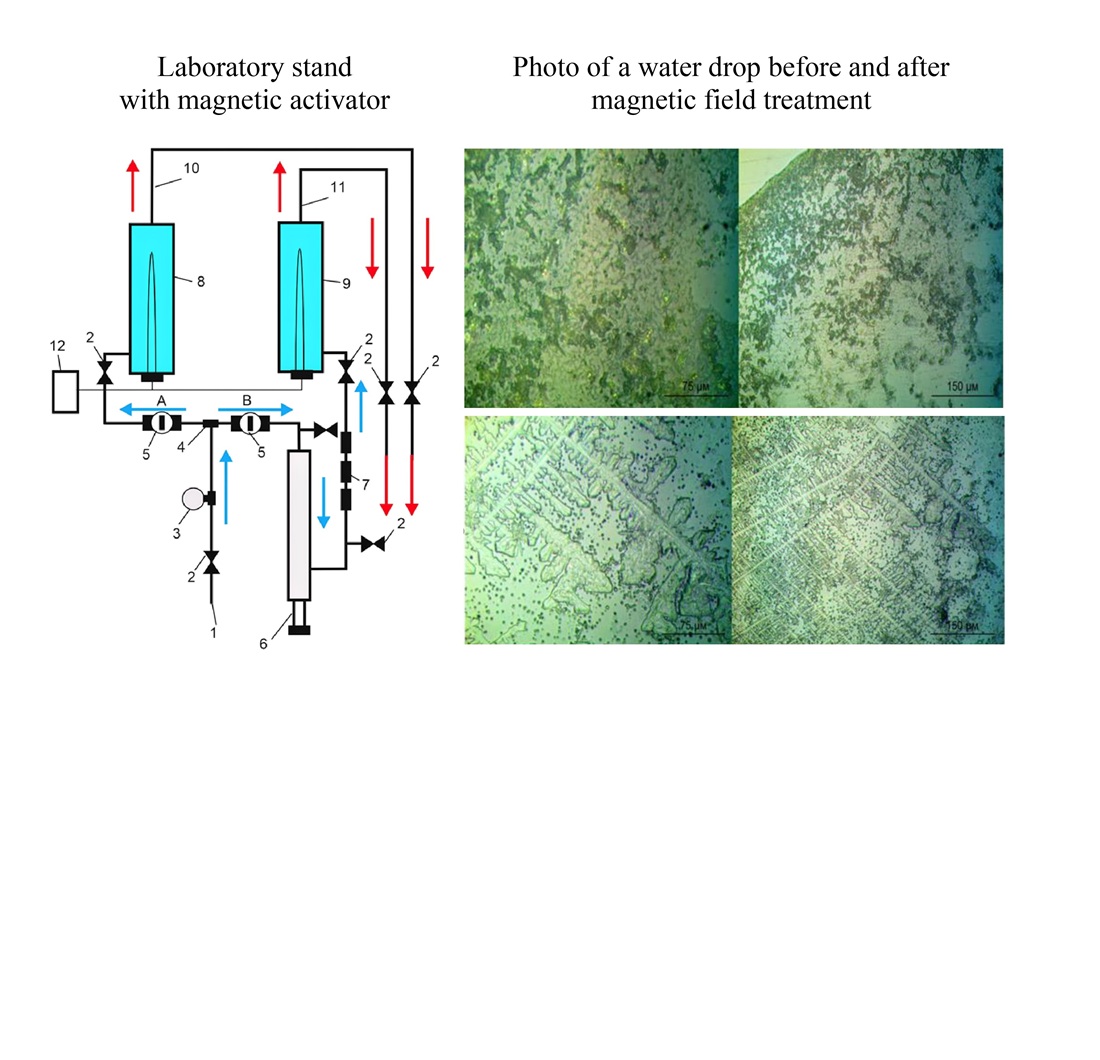
The paper reports the design and testing of a magnetic activator to prevent scale formation on tubular electric heaters under hard water conditions without the use of chemical reagents. The device with neodymium magnets is installed on the supply pipeline of the water heater and solves the problem of scale formation without the use of chemical reagents.
The experiment was conducted for 90 days on a laboratory bench simulating the operation of a domestic water heater. Magnetic treatment of water reduces the overall hardness by 15–20%, the content of Ca2⁺ and Mg2⁺ ions by 35–50% and forms predominantly an aragonite modification of calcium carbonate, which is less prone to strong adhesion to the heating surface. The thickness of the scale layer on the heating element is about 0.5 mm versus 2 mm in the control sample, which reduced additional energy costs from 13% to 3%.
The effect is attributed to the action of magnetic field on the hydrate shells of hardness ions, which contributes to the formation of a less durable aragonite modification of calcium carbonate and disruption of the conditions for the crystallization of durable calcite on the heating surface.
A unique feature of the device is a combination of internal and external magnetic activators based on neodymium magnets that generate a stable magnetic field with high induction, as well as the presence of a sump and design solutions that prevent contact of the magnets with water. This enables a long-term and targeted effect of the field on the water flow, which improves the efficiency of treatment. The magnetic activator is effective in domestic and industrial water heating systems with hard water; it increases the service life of the equipment, reduces energy consumption, and decreases the need for chemical reagents
References
- Lin, L., Jiang, W., Xu, X., Xu, P. (2020). A critical review of the application of electromagnetic fields for scaling control in water systems: mechanisms, characterization, and operation. Npj Clean Water, 3 (1). https://doi.org/10.1038/s41545-020-0071-9
- Alabi, A., Chiesa, M., Garlisi, C., Palmisano, G. (2015). Advances in anti-scale magnetic water treatment. Environmental Science: Water Research & Technology, 1 (4), 408–425. https://doi.org/10.1039/c5ew00052a
- Naderi, M., Past, V., Mahvi, A. H. (2024). Magnetic treatment as a suppressive method for CaCO3 scale deposition in hard waters in the presence of air bubbles. Desalination and Water Treatment, 318, 100249. https://doi.org/10.1016/j.dwt.2024.100249
- Alimi, F. (2024). Influence of Magnetic Field on Calcium Carbonate Precipitation: A Critical Review. Magnetochemistry, 10 (11), 83. https://doi.org/10.3390/magnetochemistry10110083
- Martínez Moya, S., Boluda Botella, N. (2021). Review of Techniques to Reduce and Prevent Carbonate Scale. Prospecting in Water Treatment by Magnetism and Electromagnetism. Water, 13 (17), 2365. https://doi.org/10.3390/w13172365
- Lin, L., Xu, X., Papelis, C., Xu, P. (2017). Innovative use of drinking water treatment solids for heavy metals removal from desalination concentrate: Synergistic effect of salts and natural organic matter. Chemical Engineering Research and Design, 120, 231–239. https://doi.org/10.1016/j.cherd.2017.02.009
- Padilla González, P., Bautista-Capetillo, C., Ruiz-Canales, A., González-Trinidad, J. et al. (2022). Characterization of Scale Deposits in a Drinking Water Network in a Semi-Arid Region. International Journal of Environmental Research and Public Health, 19 (6), 3257. https://doi.org/10.3390/ijerph19063257
- Poirier, K., Lotfi, M., Garg, K., Patchigolla, K., Anthony, E. J., Faisal, N. H. et al. (2023). A comprehensive review of pre- and post-treatment approaches to achieve sustainable desalination for different water streams. Desalination, 566, 116944. https://doi.org/10.1016/j.desal.2023.116944
- Kozisek, F. (2020). Regulations for calcium, magnesium or hardness in drinking water in the European Union member states. Regulatory Toxicology and Pharmacology, 112, 104589. https://doi.org/10.1016/j.yrtph.2020.104589
- Naderi, M., Nasseri, S., Mahvi, A. H., Mesdaghinia, A., Naddafi, K. (2021). Mechanical trajectory control of water mineral impurities in the electrochemical-magnetic reactor. Desalination and Water Treatment, 238, 67–81. https://doi.org/10.5004/dwt.2021.27756
- Miranzadeh, M. B., Naderi, M., Past, V. (2021). The interaction effect of magnetism on arsenic and iron ions in water. Desalination and Water Treatment, 213, 343–347. https://doi.org/10.5004/dwt.2021.26712
- Gholami, S., Naderi, M., Yousefi, M., Arjmand, M. M. (2019). The electrochemical removal of bacteria from drinking water. Desalination and Water Treatment, 160, 110–115. https://doi.org/10.5004/dwt.2019.24181
- Myśliwiec, D., Szcześ, A., Chibowski, S. (2016). Influence of static magnetic field on the kinetics of calcium carbonate formation. Journal of Industrial and Engineering Chemistry, 35, 400–407. https://doi.org/10.1016/j.jiec.2016.01.026
- Wang, J., Zhang, J., Liang, Y., Xu, Y. (2024). Application of excitation current to characterize the state of calcium carbonate fouling on heat transfer surface under alternating magnetic field. International Journal of Heat and Mass Transfer, 224, 125304. https://doi.org/10.1016/j.ijheatmasstransfer.2024.125304
- Amer, L., Ouhenia, S., Chateigner, D., Gascoin, S., Belabbas, I. (2021). The effect of a magnetic field on the precipitation of calcium carbonate. Applied Physics A, 127 (9). https://doi.org/10.1007/s00339-021-04860-8
- Loureiro, J. B. R., Martins, A. L., Gonçalves, A. S., Souza, B. G. B., Schluter, H. E. P., Santos, H. F. L. et al. (2022). Large-Scale Pipe Flow Experiments for the Evaluation of Nonchemical Solutions for Calcium Carbonate Scaling Inhibition and Control. SPE Journal, 28 (1), 201–214. https://doi.org/10.2118/209476-pa
- Roi, I., Vaskina, I., Jozwiakowski, K., Vaskin, R., Kozii, I. (2020). Influence of the Magnetic Field Gradient on the Efficiency of Magnetic Water Treatment. Advances in Design, Simulation and Manufacturing III. Springer, 387–395. https://doi.org/10.1007/978-3-030-50491-5_37
- Ghernaout, D., Elboughdiri, N. (2020). Magnetic Field Application: An Underappreciated Outstanding Technology. OALib, 7 (1), 1–12. https://doi.org/10.4236/oalib.1106000
- ElMassalami, M., Teixeira, M. S., Elzubair, A. (2025). Investigating the Antiscale Magnetic Treatment Controversy: Insights from the Model Calcium Carbonate Scalant. Scientific Reports, 15 (1). https://doi.org/10.1038/s41598-024-82048-9
- Hamdi, R., Tlili, M. M. (2023). Influence of Foreign Salts and Antiscalants on Calcium Carbonate Crystallization. Crystals, 13 (3), 516. https://doi.org/10.3390/cryst13030516
- Matsuura, T., Okazaki, T., Sazawa, K., Hosoki, A., Ueda, A., Kuramitz, H. (2024). Fiber Optic-Based Portable Sensor for Rapid Evaluation and In Situ Real-Time Sensing of Scale Formation in Geothermal Water. Chemosensors, 12 (9), 171. https://doi.org/10.3390/chemosensors12090171
- Tang, C., Godskesen, B., Aktor, H., Rijn, M. van, Kristensen, J. B., Rosshaug, P. S. et al. (2020). Procedure for Calculating the Calcium Carbonate Precipitation Potential (CCPP) in Drinking Water Supply: Importance of Temperature, Ionic Species and Open/Closed System. Water, 13 (1), 42. https://doi.org/10.3390/w13010042
- Zhang, Z., Jia, Y., Zhao, J. (2020). Effect of Magnesium Ion Concentration on the Scale Inhibition of Heat Exchanger in Circulating Cooling Water under Alternating Electric Field. Applied Sciences, 10 (16), 5491. https://doi.org/10.3390/app10165491
- Van, H. T., Nguyen, L. H., Nguyen, V. D., Nguyen, X. H., Nguyen, T. H., Nguyen, T. V. et al. (2019). Characteristics and mechanisms of cadmium adsorption onto biogenic aragonite shells-derived biosorbent: Batch and column studies. Journal of Environmental Management, 241, 535–548. https://doi.org/10.1016/j.jenvman.2018.09.079
- Chang, B., Li, G., Guo, F., Lu, S., Peng, Y., Hou, J. (2024). Research on Carbon Dioxide-Assisted Electrocoagulation Technology for Treatment of Divalent Cations in Water. Water, 16 (12), 1715. https://doi.org/10.3390/w16121715
- Mekhtiyev, A. D., Sarsikeyev, Ye. Zh., Аtyaksheva, А. V., Аtyaksheva, А. D., Gerassimenko, T. S., Alkina, A. D. (. Method of pre-venting deposits on the inner surface of circulating water pipelines of ferroalloy electric furnace cooling systems. Metalurgija 60 (2021) 3-4, 321-324. https://hrcak.srce.hr/256098
- Mekhtiyev, A., Sarsikeyev, Y., Gerassimenko, T., Alkina, A., Mekhtiyev, R., Neshina, Y., Kirichenko, L. (2024). Development of a magnetic activator to protect an electric water heater against scale formation. Eastern-European Journal of Enterprise Technologies, 6 (1 (132)), 95–102. https://doi.org/10.15587/1729-4061.2024.314957
Downloads
Published
How to Cite
Issue
Section
License
Copyright (c) 2025 Aliya Alkina, Ali Mekhtiyev, Yelena Neshina, Yermek Sarsikeyev, Tatyana Gerassimenko, Ruslan Mekhtiyev, Oxana Aldoshina

This work is licensed under a Creative Commons Attribution 4.0 International License.
The consolidation and conditions for the transfer of copyright (identification of authorship) is carried out in the License Agreement. In particular, the authors reserve the right to the authorship of their manuscript and transfer the first publication of this work to the journal under the terms of the Creative Commons CC BY license. At the same time, they have the right to conclude on their own additional agreements concerning the non-exclusive distribution of the work in the form in which it was published by this journal, but provided that the link to the first publication of the article in this journal is preserved.
A license agreement is a document in which the author warrants that he/she owns all copyright for the work (manuscript, article, etc.).
The authors, signing the License Agreement with TECHNOLOGY CENTER PC, have all rights to the further use of their work, provided that they link to our edition in which the work was published.
According to the terms of the License Agreement, the Publisher TECHNOLOGY CENTER PC does not take away your copyrights and receives permission from the authors to use and dissemination of the publication through the world's scientific resources (own electronic resources, scientometric databases, repositories, libraries, etc.).
In the absence of a signed License Agreement or in the absence of this agreement of identifiers allowing to identify the identity of the author, the editors have no right to work with the manuscript.
It is important to remember that there is another type of agreement between authors and publishers – when copyright is transferred from the authors to the publisher. In this case, the authors lose ownership of their work and may not use it in any way.







