Applying mathematical modeling to determine the efficiency of reinforcing brick columns in the built-in civil defense structures with steel cages
DOI:
https://doi.org/10.15587/1729-4061.2024.338165Keywords:
protective structures, brick columns, frost damage, reinforcement, modeling, finite elementsAbstract
This study’s object is brick structures for multi-story residential construction. In such buildings it is necessary to arrange built-in protective structures for civil defense. As a result of prolonged temperature and humidity exposure, wetting and destruction of brickwork may occur. Solving this problem requires devising measures to isolate brickwork from external influences, as well as, if necessary, options for strengthening damaged structures.
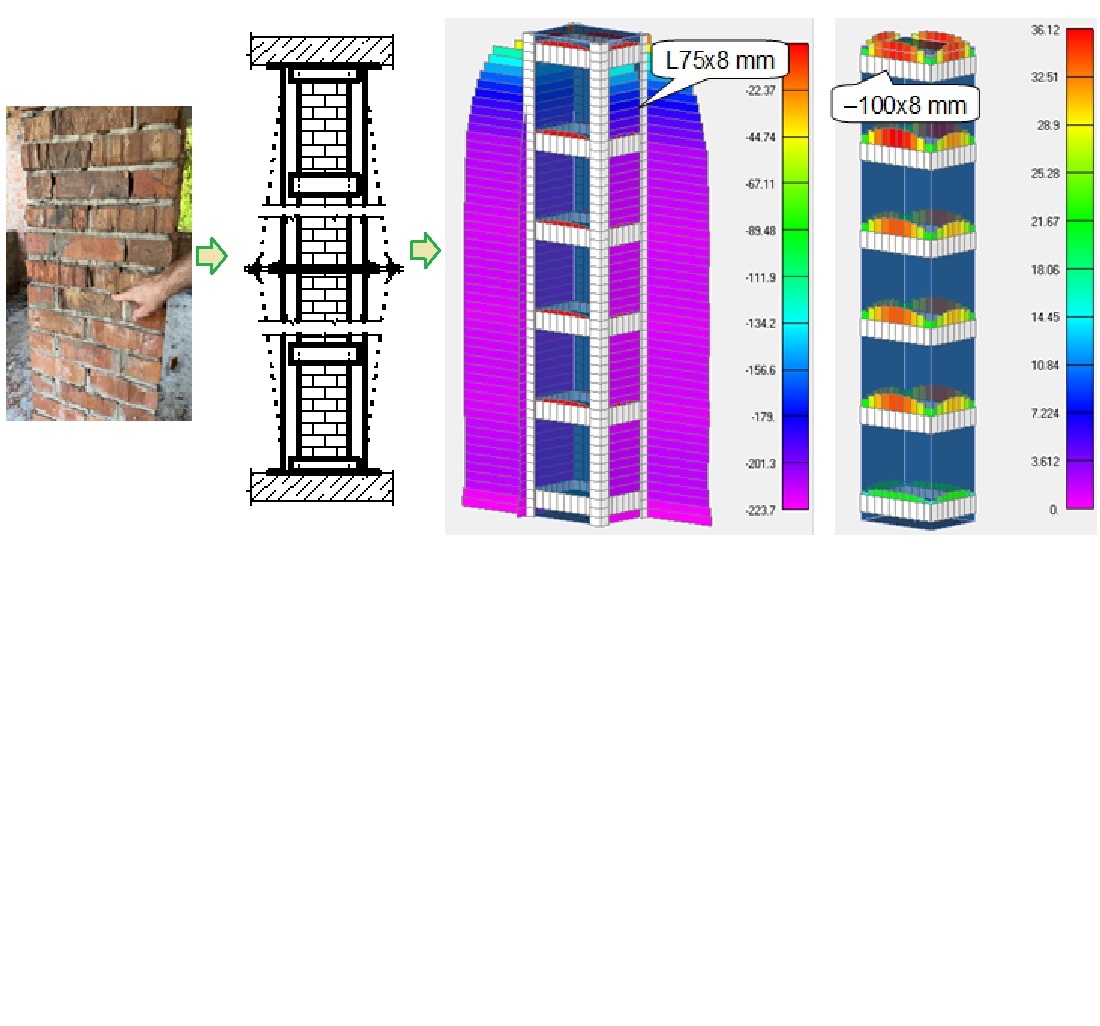
One of the results of this work is the identification of principal damage based on analysis of the consequences of prolonged temperature and humidity exposure to complexly loaded brick structures (walls, partitions, columns) of a public facility. This is frost-related damage up to 40% of the initial cross-section, which is mainly associated with different porosity of the brick and the influence of atmospheric precipitation.
The next result of the work is proposals for increasing the bearing capacity of damaged brickwork using tie clips from rolled steel elements. A qualitative feature of the proposal is the recommendations for installing these clips, which allow them to be included in joint work with existing brick elements. This qualitative distinctive feature was confirmed by mathematical numerical modeling of the increase in the bearing capacity of reinforcement brick structures.
From a scientific perspective, different initial stress-strain states of brick structures and steel elements at the time of ensuring their joint operation were taken into account. After the installation of steel clips, the maximum compressive stresses in the brickwork decreased by 28.6%. The results could be applied when installing reinforcements with steel clips for damaged compressed brick structures
References
- Kristinayanti, W. S., Zaika, Y., Devia, Y. P., Solimun, S., Wibowo, M. A. (2024). Enhancing sustainable performance with green construction based on local wisdom through implementation strategy as a mediating variable. Eastern-European Journal of Enterprise Technologies, 6 (13 (132)), 19–29. https://doi.org/10.15587/1729-4061.2024.312522
- Usenko, D., Dovzhenko, O., Pohribnyi, V., Zyma, O. (2020). Masonry strengthening under the combined action of vertical and horizontal forces. Proceedings of the 2020 session of the 13th fib International PhD Symposium in Civil Engineering, 193–199. Available at: https://phdsymp2020.sciencesconf.org/data/pages/Proceedings_phdsymp_2021.pdf
- Yao, X., Liang, B., Zhang, H., Zhang, Z., He, Z. (2021). Typical brick masonry walls reinforced with high-strength mortar and steel bars in the horizontal joints. Advances in Structural Engineering, 24 (12), 2767–2779. https://doi.org/10.1177/13694332211012238
- Usenko, V., Chernikov, O., Usenko, D., Pinchuk, N., Usenko, I., Byba, V. (2025). Safety parameters analysis for assessing the stone structures’ strength. IOP Conference Series: Earth and Environmental Science, 1499 (1), 012028. https://doi.org/10.1088/1755-1315/1499/1/012028
- Gupta, A., Singhal, V. (2020). Strengthening of Confined Masonry Structures for In-plane Loads: a Review. IOP Conference Series: Materials Science and Engineering, 936 (1), 012031. https://doi.org/10.1088/1757-899x/936/1/012031
- Semko, O., Hasenko, A. (2021). Classification of Self-stressed Steel-Concrete Composite Structures. Proceedings of the 3rd International Conference on Building Innovations, 367–374. https://doi.org/10.1007/978-3-030-85043-2_34
- Ospanov, A., Timurbekova, A., Zhalelov, D. (2024). Mathematical modeling of the melt flow in the cone-ring channel of the extruder matrix. Eastern-European Journal of Enterprise Technologies, 1 (7 (127)), 83–98. https://doi.org/10.15587/1729-4061.2024.290692
- Widyianto, A., Arrozi, W., Sampurno, Y. G., Paryanto, P., Widowati, A., Aminatun, T., Sunarta, S. (2025). Development of a mobile hydraulic press machine using finite element analysis. Eastern-European Journal of Enterprise Technologies, 1 (7 (133)), 76–89. https://doi.org/10.15587/1729-4061.2025.316584
- Sidnei, S., Berezovskyi, A., Kasiarum, S., Lytvynenko, O., Chastokolenko, I. (2023). Revealing patterns in the behavior of a reinforced concrete slab in fire based on determining its stressed and deformed state. Eastern-European Journal of Enterprise Technologies, 5 (7 (125)), 43–49. https://doi.org/10.15587/1729-4061.2023.289930
- Sidnei, S., Gonchar, S., Zhuravskij, M., Matsyk, I., Nozhko, I., Petukhova, O. et al. (2024). Defining a pattern in the loss of integrity by ribbed plates under fire conditions. Eastern-European Journal of Enterprise Technologies, 5 (7 (131)), 15–24. https://doi.org/10.15587/1729-4061.2024.313935
- Yurchenko, V., Peleshko, I., Rusyn, P. (2024). Optimization of cross-sectional dimensions of castellated beams with hexagonal openings. Eastern-European Journal of Enterprise Technologies, 3 (7 (129)), 6–16. https://doi.org/10.15587/1729-4061.2024.304803
- Galinska, T., Ovsii, D., Ovsii, A. (2021). Flexural Strength of Steel-Reinforced Concrete Composite Structural Span Elements. Proceedings of the 3rd International Conference on Building Innovations, 131–145. https://doi.org/10.1007/978-3-030-85043-2_13
Downloads
Published
How to Cite
Issue
Section
License
Copyright (c) 2025 Anton Hasenko, Dmytro Usenko, Pavlo Semko, Dmytro Ovsii

This work is licensed under a Creative Commons Attribution 4.0 International License.
The consolidation and conditions for the transfer of copyright (identification of authorship) is carried out in the License Agreement. In particular, the authors reserve the right to the authorship of their manuscript and transfer the first publication of this work to the journal under the terms of the Creative Commons CC BY license. At the same time, they have the right to conclude on their own additional agreements concerning the non-exclusive distribution of the work in the form in which it was published by this journal, but provided that the link to the first publication of the article in this journal is preserved.
A license agreement is a document in which the author warrants that he/she owns all copyright for the work (manuscript, article, etc.).
The authors, signing the License Agreement with TECHNOLOGY CENTER PC, have all rights to the further use of their work, provided that they link to our edition in which the work was published.
According to the terms of the License Agreement, the Publisher TECHNOLOGY CENTER PC does not take away your copyrights and receives permission from the authors to use and dissemination of the publication through the world's scientific resources (own electronic resources, scientometric databases, repositories, libraries, etc.).
In the absence of a signed License Agreement or in the absence of this agreement of identifiers allowing to identify the identity of the author, the editors have no right to work with the manuscript.
It is important to remember that there is another type of agreement between authors and publishers – when copyright is transferred from the authors to the publisher. In this case, the authors lose ownership of their work and may not use it in any way.





