Визначення умов формування затримок у транзитних пунктах інтермодального ланцюга постачання зернових
DOI:
https://doi.org/10.15587/1729-4061.2025.338166Ключові слова:
агентна симуляція, інтермодальні перевезення, надлишкова вантажна маса, оптимальний робочій паркАнотація
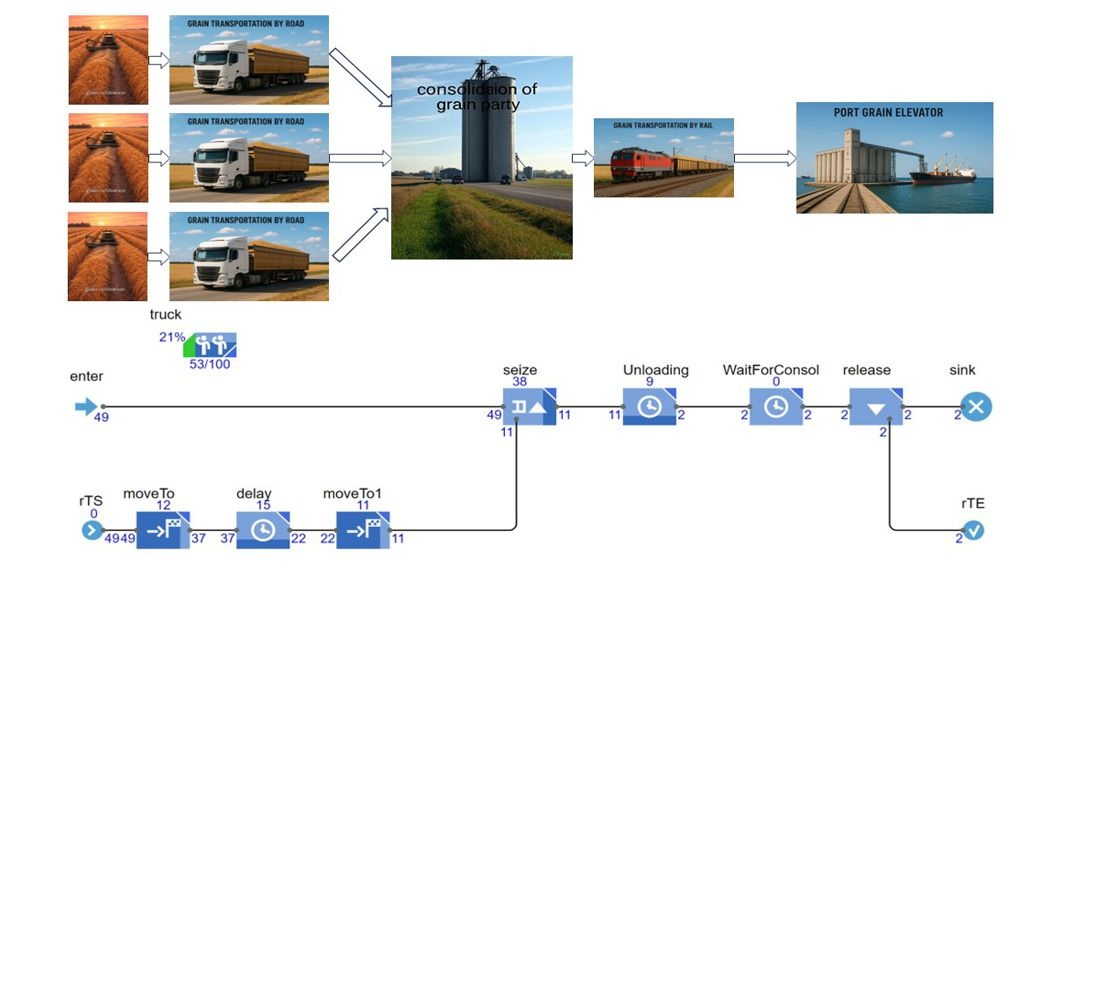
Об’єктом дослідження є транспортно-технологічна система постачання зернових у міжнародному сполученні. Вирішувалась проблема виникнення надлишкової вантажної маси у пунктах стикування різних видів транспорту. Дослідження проведено на основі розробленої імітаційної моделі, створеної за агентним та дискретно-подієвим принципами. Воно охоплює як максимальні обсяги перевезень 2021 року однієї з областей України (880 тис. тонн), так і прогнозовані показники (1–1,5 млн тонн на рік). Застосування моделі дозволило визначити оптимальні параметри парку транспортних засобів у ланцюзі постачання, керуючись системним критерієм – мінімізацією середнього часу доставки однієї тонни зерна. Встановлено, що для перевезення 1 млн тонн зернових на рік оптимальний склад транспортного парку має включати 92 вантажні автомобілі та чотири залізничні маршрути. Також визначено закономірності утворення надлишкової вантажної маси залежно від розрахункового складу транспортних засобів. При запланованій інтенсивності перевезень у 1 млн тонн на рік скорочення кількості вантажних автомобілів на 12 одиниць призведе до накопичення 237 тис. тонн вантажної маси у транзитних пунктах. Зменшення кількості залізничних маршрутів на одну одиницю спричинить накопичення 544 тис. тонн вантажної маси, що відповідає $106 млн. Запропонована модель дозволяє оцінювати наслідки затримок у постачанні, а також формування надлишкової вантажної маси, на транзитних логістичних терміналах і зернових елеваторах
Посилання
- Namazov, M., Matsiuk, V., Bulgakova, I., Nikolaienko, I., Vernyhora, R. (2023). Agent-based simulation model of multimodal iron ore concentrate transportation. Naukovij Žurnal «Tehnìka Ta Energetika», 14 (1). https://doi.org/10.31548/machinery/1.2023.46
- Zhang, T., Feng, Q. (2024). Multidimensional Risk Assessment of China’s Grain Supply Chain with Entropy Weight TOPSIS Method. Procedia Computer Science, 242, 853–858. https://doi.org/10.1016/j.procs.2024.08.213
- Anufriyeva, T., Matsiuk, V., Shramenko, N., Ilchenko, N., Pryimuk, O., Lebid, V. (2023). Construction of a simulation model for the transportation of perishable goods along variable routes. Eastern-European Journal of Enterprise Technologies, 2 (4 (122)), 42–51. https://doi.org/10.15587/1729-4061.2023.277948
- Matsiuk, V., Galan, O., Prokhorchenko, A., Tverdomed, V. (2021). An Agent-Based Simulation for Optimizing the Parameters of a Railway Transport System. Proceedings of the 17th International Conference on ICT in Education, Research and Industrial Applications. Integration, Harmonization and Knowledge Transfer. Volume I: Main Conference, PhD Symposium, and Posters. Available at: https://ceur-ws.org/Vol-3013/20210121.pdf
- Samsonkin, V., Goretskyi, O., Matsiuk, V., Myronenko, V., Boynik, A., Merkulov, V. (2019). Development of an approach for operative control over railway transport technological safety based on the identification of risks in the indicators of its operation. Eastern-European Journal of Enterprise Technologies, 6 (3 (102)), 6–14. https://doi.org/10.15587/1729-4061.2019.184162
- Alam, M. F. B., Tushar, S. R., Ahmed, T., Karmaker, C. L., Bari, A. B. M. M., de Jesus Pacheco, D. A. et al. (2024). Analysis of the enablers to deal with the ripple effect in food grain supply chains under disruption: Implications for food security and sustainability. International Journal of Production Economics, 270, 109179. https://doi.org/10.1016/j.ijpe.2024.109179
- Ekleme, G., Yercan, F. (2025). Assessment of the Black Sea Grain Initiative: Crisis Management via Maritime Transportation. Transport Policy, 163, 199–218. https://doi.org/10.1016/j.tranpol.2024.12.011
- Orozonova, A., Gapurbaeva, S., Kydykov, A., Prokopenko, O., Prause, G., Lytvynenko, S. (2022). Application of smart logistics technologies in the organization of multimodal cargo delivery. Transportation Research Procedia, 63, 1192–1198. https://doi.org/10.1016/j.trpro.2022.06.124
- Zagurskiy, O., Savchenko, L., Makhmudov, I., Matsiuk, V. (2022). Assessment of socio-ecological efficiency of transport and logistics activity. 21st International Scientific Conference Engineering for Rural Development Proceedings. https://doi.org/10.22616/erdev.2022.21.tf182
- Lv, B., Yang, B., Zhu, X., Li, J. (2019). Operational optimization of transit consolidation in multimodal transport. Computers & Industrial Engineering, 129, 454–464. https://doi.org/10.1016/j.cie.2019.02.001
- Owens, T. D., Seedah, D. P. K., Harrison, R. (2013). Modeling Rail Operating Costs for Multimodal Corridor Planning. Transportation Research Record: Journal of the Transportation Research Board, 2374 (1), 93–101. https://doi.org/10.3141/2374-11
- Rahmani, S., Park, T.-H., Dishman, A. F., Lahann, J. (2013). Multimodal delivery of irinotecan from microparticles with two distinct compartments. Journal of Controlled Release, 172 (1), 239–245. https://doi.org/10.1016/j.jconrel.2013.08.017
- Butko, T., Prokhorchenko, A., Golovko, T., Prokhorchenko, G. (2018). Development of the method for modeling the propagation of delays in noncyclic train scheduling on the railroads with mixed traffic. Eastern-European Journal of Enterprise Technologies, 1 (3 (91)), 30–39. https://doi.org/10.15587/1729-4061.2018.123141
- de Faria, C. H. F., Almeida, J. F. F., Pinto, L. R. (2024). Simulation–optimisation approach for sustainable planning of intermodal logistics in the Brazilian grain export industry. Decision Analytics Journal, 10, 100388. https://doi.org/10.1016/j.dajour.2023.100388
- Turpak, S., Gritsay, S., Ostroglyad, E. (2014). Development of micrologistics system of delivery of finished products of metallurgical enterprises by rail transport. Eastern-European Journal of Enterprise Technologies, 5 (3 (71)), 10–18. https://doi.org/10.15587/1729-4061.2014.28033
- Pavlenko, O., Shramenko, N., Muzylyov, D. (2020). Logistics Optimization of Agricultural Products Supply to the European Union Based on Modeling by Petri Nets. New Technologies, Development and Application III, 596–604. https://doi.org/10.1007/978-3-030-46817-0_69
- Muzylyov, D., Shramenko, N. (2020). Mathematical Model of Reverse Loading Advisability for Trucks Considering Idle Times. New Technologies, Development and Application III, 612–620. https://doi.org/10.1007/978-3-030-46817-0_71
- Khomenko, Y., Matsiuk, V., Okorokov, A., Gorobchenko, O. (2024). Development of a simulation model of grain delivery in global supply chains. Scientific Reports of the National University of Life and Environmental Sciences of Ukraine, 20 (5), 21–35. https://doi.org/10.31548/dopovidi/5.2024.21
- Holmgren, J., Davidsson, P., Persson, J. A., Ramstedt, L. (2012). TAPAS: A multi-agent-based model for simulation of transport chains. Simulation Modelling Practice and Theory, 23, 1–18. https://doi.org/10.1016/j.simpat.2011.12.011
- González-Cancelas, N., Vaca-Cabrero, J., Camarero-Orive, A. (2025). Multi-Agent System for Smart Roll-on/Roll-off Terminal Management: Orchestration and Communication Strategies for AI-Driven Optimization. Applied Sciences, 15 (11), 6079. https://doi.org/10.3390/app15116079
- Matsiuk, V., Ilchenko, N., Pryimuk, O., Kochubei, D., Prokhorchenko, A. (2022). Risk assessment of transport processes by agent-based simulation. AIP Conference Proceedings. https://doi.org/10.1063/5.0105913
- Archetti, C., Peirano, L., Speranza, M. G. (2022). Optimization in multimodal freight transportation problems: A Survey. European Journal of Operational Research, 299 (1), 1–20. https://doi.org/10.1016/j.ejor.2021.07.031
- Medvediev, I., Muzylyov, D., Montewka, J. (2024). A model for agribusiness supply chain risk management using fuzzy logic. Case study: Grain route from Ukraine to Poland. Transportation Research Part E: Logistics and Transportation Review, 190, 103691. https://doi.org/10.1016/j.tre.2024.103691
- Maiyar, L. M., Thakkar, J. J. (2019). Modelling and analysis of intermodal food grain transportation under hub disruption towards sustainability. International Journal of Production Economics, 217, 281–297. https://doi.org/10.1016/j.ijpe.2018.07.021
##submission.downloads##
Опубліковано
Як цитувати
Номер
Розділ
Ліцензія
Авторське право (c) 2025 Yurii Khomenko, Andrii Okorokov, Viacheslav Matsiuk, Iryna Zhuravel, Olena Pavlenko

Ця робота ліцензується відповідно до Creative Commons Attribution 4.0 International License.
Закріплення та умови передачі авторських прав (ідентифікація авторства) здійснюється у Ліцензійному договорі. Зокрема, автори залишають за собою право на авторство свого рукопису та передають журналу право першої публікації цієї роботи на умовах ліцензії Creative Commons CC BY. При цьому вони мають право укладати самостійно додаткові угоди, що стосуються неексклюзивного поширення роботи у тому вигляді, в якому вона була опублікована цим журналом, але за умови збереження посилання на першу публікацію статті в цьому журналі.
Ліцензійний договір – це документ, в якому автор гарантує, що володіє усіма авторськими правами на твір (рукопис, статтю, тощо).
Автори, підписуючи Ліцензійний договір з ПП «ТЕХНОЛОГІЧНИЙ ЦЕНТР», мають усі права на подальше використання свого твору за умови посилання на наше видання, в якому твір опублікований. Відповідно до умов Ліцензійного договору, Видавець ПП «ТЕХНОЛОГІЧНИЙ ЦЕНТР» не забирає ваші авторські права та отримує від авторів дозвіл на використання та розповсюдження публікації через світові наукові ресурси (власні електронні ресурси, наукометричні бази даних, репозитарії, бібліотеки тощо).
За відсутності підписаного Ліцензійного договору або за відсутністю вказаних в цьому договорі ідентифікаторів, що дають змогу ідентифікувати особу автора, редакція не має права працювати з рукописом.
Важливо пам’ятати, що існує і інший тип угоди між авторами та видавцями – коли авторські права передаються від авторів до видавця. В такому разі автори втрачають права власності на свій твір та не можуть його використовувати в будь-який спосіб.