Визначення витрат енергії на швидкість зняття матеріалу в процесі абразивного різання з використанням тонкого шліфувального круга
DOI:
https://doi.org/10.15587/1729-4061.2025.338832Ключові слова:
споживання енергії, абразивне різання, відрізне шліфування, енергія різання, швидкість видалення матеріалу, тонкий шліфувальний кругАнотація
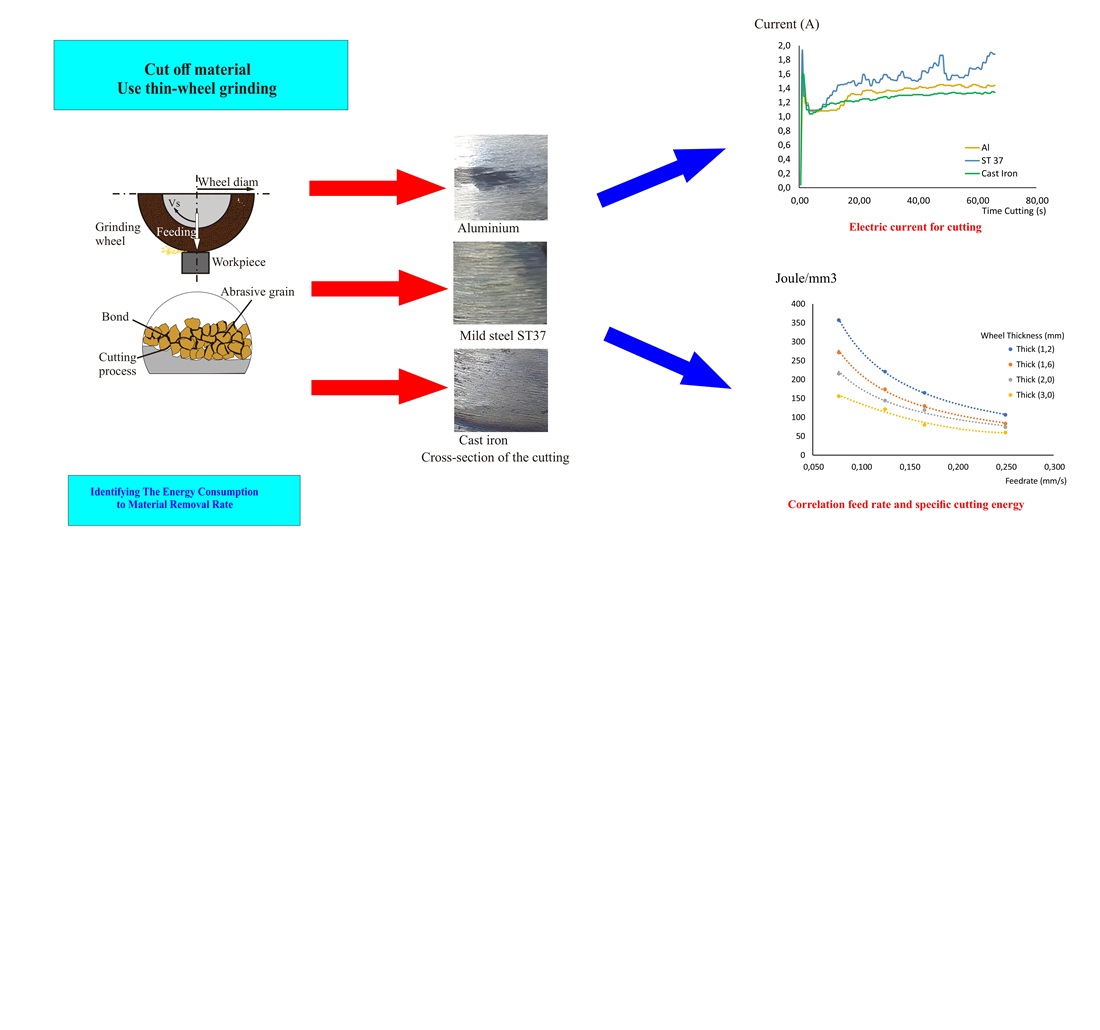
Об’єктом дослідження є процес абразивного різання з використанням тонких шліфувальних кругів, який застосовується для різання матеріалів з різними механічними властивостями. Проблема, яку необхідно вирішити, полягає у визначенні характеристик споживання енергії в цьому процесі шляхом контролю параметрів різання, таких як товщина шліфувального круга та швидкість подачі. Був проведений експеримент з використанням шліфувальних кругів товщиною 1,2, 1,6, 2,0 та 3,0 мм для різання металів. Різні швидкості подачі використовувалися для різання Al, ST37 та чавуну, які є пластичними, пластично-твердими та крихкими матеріалами. Результати експерименту показують обернену експоненціальну залежність між швидкістю подачі та питомою енергією. Шліфувальний круг діаметром 1,2 мм споживає до 10% менше енергії, ніж круг діаметром 3,0 мм при низьких швидкостях подачі. Відображення цих характеристик дозволяє вибрати рекомендовані параметри. Для досягнення стабільності під час процесу різання пластичних матеріалів використовується шліфувальний круг діаметром 1,6 мм, що працює зі швидкістю подачі 0,166 мм/с. Жорсткість круга визначає стабільність обертання, яка залежить від товщини шліфувального круга. Товщина шліфувального круга визначає швидкість видалення матеріалу під час абразивного процесу. Пластичні матеріали, такі як ST37, потребують більше енергії, оскільки абразивні частинки повинні бути здатні порушувати властивості матеріалу для ерозії його поверхні. Пластичні матеріали, як правило, викликають високе тертя та виділяють тепло, плавлячи матеріал. Простір між абразивними частинками може бути заповнений рідким матеріалом, що призводить до покриття ріжучої кромки абразивних частинок абразивним розчином. Застосування результатів спрямоване на механічну обробку як наукову основу для контролю енергії у виробничому процесі
Посилання
- World Energy Outlook 2024. IEA. Available at: https://iea.blob.core.windows.net/assets/140a0470-5b90-4922-a0e9-838b3ac6918c/WorldEnergyOutlook2024.pdf
- Lesinskyi, V., Yemelyanov, O., Zarytska, O., Petrushka, T., Myroshchenko, N. (2022). Designing a toolset for assessing the organizational and technological inertia of energy consumption processes at enterprises. Eastern-European Journal of Enterprise Technologies, 6 (13 (120)), 29–40. https://doi.org/10.15587/1729-4061.2022.267231
- Chen, X., Li, C., Tang, Y., Li, L., Li, H. (2021). Energy efficient cutting parameter optimization. Frontiers of Mechanical Engineering, 16 (2), 221–248. https://doi.org/10.1007/s11465-020-0627-x
- Triebe, M. J., Mendis, G. P., Zhao, F., Sutherland, J. W. (2018). Understanding Energy Consumption in a Machine Tool through Energy Mapping. Procedia CIRP, 69, 259–264. https://doi.org/10.1016/j.procir.2017.11.041
- Saputra, L. D., Yudiyanto, E. (2025). Toolpath Motion Strategy and Feed Rate in CNC Milling on Energy Consumption of Machining Process. Journal of Mechanical Engineering Science and Technology (JMEST), 9 (1), 114. https://doi.org/10.17977/um016v9i12025p114
- He, Y., Liu, F., Wu, T., Zhong, F.-P., Peng, B. (2011). Analysis and estimation of energy consumption for numerical control machining. Proceedings of the Institution of Mechanical Engineers, Part B: Journal of Engineering Manufacture, 226 (2), 255–266. https://doi.org/10.1177/0954405411417673
- Zare Banadkouki, M. R. (2023). Selection of strategies to improve energy efficiency in industry: A hybrid approach using entropy weight method and fuzzy TOPSIS. Energy, 279, 128070. https://doi.org/10.1016/j.energy.2023.128070
- Hacksteiner, M., Peherstorfer, H., Bleicher, F. (2018). Energy efficiency of state-of-the-art grinding processes. Procedia Manufacturing, 21, 717–724. https://doi.org/10.1016/j.promfg.2018.02.176
- Wang, M., Song, Y., Wang, P., Chen, Y., Sun, T. (2022). Grinding/Cutting Technology and Equipment of Multi-scale Casting Parts. Chinese Journal of Mechanical Engineering, 35 (1). https://doi.org/10.1186/s10033-022-00780-7
- Awan, M. R., Rojas, H. A. G., Benavides, J. I. P., Hameed, S. (2021). Experimental technique to analyze the influence of cutting conditions on specific energy consumption during abrasive metal cutting with thin discs. Advances in Manufacturing, 10 (2), 260–271. https://doi.org/10.1007/s40436-021-00361-2
- Awan, M. R., González Rojas, H. A., Hameed, S., Riaz, F., Hamid, S., Hussain, A. (2022). Machine Learning-Based Prediction of Specific Energy Consumption for Cut-Off Grinding. Sensors, 22 (19), 7152. https://doi.org/10.3390/s22197152
- Rahimifard, S., Seow, Y., Childs, T. (2010). Minimising Embodied Product Energy to support energy efficient manufacturing. CIRP Annals, 59 (1), 25–28. https://doi.org/10.1016/j.cirp.2010.03.048
- Yuan, C., Zhai, Q., Dornfeld, D. (2012). A three dimensional system approach for environmentally sustainable manufacturing. CIRP Annals, 61 (1), 39–42. https://doi.org/10.1016/j.cirp.2012.03.105
- Pawanr, S., Gupta, K. (2024). A Review on Recent Advances in the Energy Efficiency of Machining Processes for Sustainability. Energies, 17 (15), 3659. https://doi.org/10.3390/en17153659
- Awan, M. R., González Rojas, H. A., Perat Benavides, J. I., Hameed, S., Hussain, A., Sánchez Egea, A. J. (2022). Specific energy modeling of abrasive cut off operation based on sliding, plowing, and cutting. Journal of Materials Research and Technology, 18, 3302–3310. https://doi.org/10.1016/j.jmrt.2022.03.185
- Kryukov, S. A., Kryukova, A. S. (2017). Determining the Parameters of Grinding Wheels Working Surface Profile. Procedia Engineering, 206, 204–209. https://doi.org/10.1016/j.proeng.2017.10.461
- Wang, Y.-L., Zhang, Y.-B., Cui, X., Liang, X.-L., Li, R.-Z., Wang, R.-X. et al. (2024). High-speed grinding: from mechanism to machine tool. Advances in Manufacturing, 13 (1), 105–154. https://doi.org/10.1007/s40436-024-00508-x
- Gershikov, I. V. (2012). The general approach to the analysis of the temperature grinding. Eastern-European Journal of Enterprise Technologies, 5 (1 (59)), 19–22. Available at: https://journals.uran.ua/eejet/article/view/5865
- Pombo, I., Sánchez, J. A., Martin, E., Godino, L., Álvarez, J. (2024). Accurate Measurement of Temperatures in Industrial Grinding Operations with Steep Gradients. Sensors, 24 (6), 1741. https://doi.org/10.3390/s24061741
- Jedamski, R., Kuhlmann, G., Rößler, M., Karpuschewski, B., Dix, M., Epp, J. (2024). Towards developing a control of grinding processes using a combination of grinding power evaluation and Barkhausen noise analysis. Production Engineering, 18 (2), 339–351. https://doi.org/10.1007/s11740-023-01247-x
##submission.downloads##
Опубліковано
Як цитувати
Номер
Розділ
Ліцензія
Авторське право (c) 2025 Eko Yudiyanto, Satworo Adiwidodo, Sugeng Hadi Susilo, Bayu Pranoto

Ця робота ліцензується відповідно до Creative Commons Attribution 4.0 International License.
Закріплення та умови передачі авторських прав (ідентифікація авторства) здійснюється у Ліцензійному договорі. Зокрема, автори залишають за собою право на авторство свого рукопису та передають журналу право першої публікації цієї роботи на умовах ліцензії Creative Commons CC BY. При цьому вони мають право укладати самостійно додаткові угоди, що стосуються неексклюзивного поширення роботи у тому вигляді, в якому вона була опублікована цим журналом, але за умови збереження посилання на першу публікацію статті в цьому журналі.
Ліцензійний договір – це документ, в якому автор гарантує, що володіє усіма авторськими правами на твір (рукопис, статтю, тощо).
Автори, підписуючи Ліцензійний договір з ПП «ТЕХНОЛОГІЧНИЙ ЦЕНТР», мають усі права на подальше використання свого твору за умови посилання на наше видання, в якому твір опублікований. Відповідно до умов Ліцензійного договору, Видавець ПП «ТЕХНОЛОГІЧНИЙ ЦЕНТР» не забирає ваші авторські права та отримує від авторів дозвіл на використання та розповсюдження публікації через світові наукові ресурси (власні електронні ресурси, наукометричні бази даних, репозитарії, бібліотеки тощо).
За відсутності підписаного Ліцензійного договору або за відсутністю вказаних в цьому договорі ідентифікаторів, що дають змогу ідентифікувати особу автора, редакція не має права працювати з рукописом.
Важливо пам’ятати, що існує і інший тип угоди між авторами та видавцями – коли авторські права передаються від авторів до видавця. В такому разі автори втрачають права власності на свій твір та не можуть його використовувати в будь-який спосіб.