Визначення впливу нанофільтрації на поживну та біологічну цінність молочної сироватки
DOI:
https://doi.org/10.15587/1729-4061.2025.339914Ключові слова:
сироватка, мембранні технології, нанофільтрація, біологічна цінність, амінокислоти, безвідходні технологіїАнотація
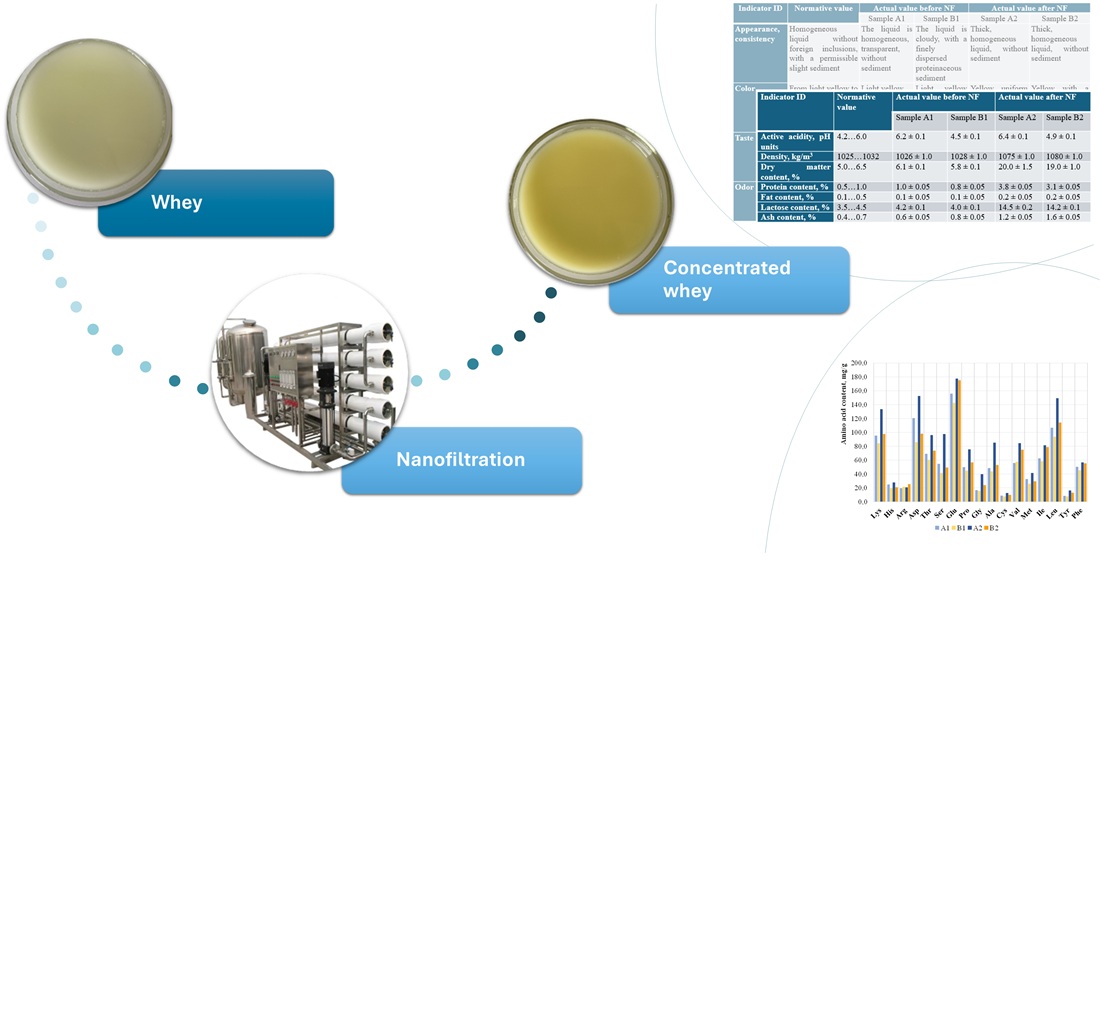
Об’єктом дослідження є поживна та біологічна цінність молочної сироватки, що піддається нанофільтраційній обробці. Проблема полягала у недостатній ефективності традиційних способів переробки сироватки для підвищення її поживної та біологічної цінності без втрати корисних компонентів. У проведеному досліджені встановлено, що застосування нанофільтрації суттєво впливає на консистенцію сироватки, яка стає більш густою і в’язкою. Смак і запах змінюється від кисломолочного до солодкого, з приємними сироватковими нотками. Нанофільтрація призводить до концентрації сухих речовин у 3,3 рази, білка ‒ у 3,8 рази, мінеральних речовин ‒ у 2 рази. Також підвищується активна кислотність, що свідчить про зміни кислотно-лужного балансу. Аналіз амінокислотного складу показав усереднене збільшення як незамінних (треоніну +31,24%, лейцину +31,13%, метіоніну +24,12%, лізину +28,65%), так і замінних амінокислот (серину +69,08%, гліцину +54,43%, аланіну +67,36% та аспарагінової кислоти +21,46%). Амінокислотний скор більшості незамінних амінокислот перевищував 110%, а коефіцієнт розбіжності знизився, що вказує на більш збалансований склад. Збільшення біологічної цінності сироватки до 60,4% свідчить про її підвищену харчову цінність та потенціал як функціонального інгредієнта харчових продуктів. Отримані результати пояснюються вибірковою проникністю мембран нанофільтрації. Зокрема, які затримують білкові речовини та пропускають воду і низькомолекулярні компоненти. Отримані результати мають практичне значення, оскільки здатність нанофільтрації до селективного розділення речовин забезпечує ефективну переробку молочної сироватки, зберігаючи при цьому її поживні та біологічні властивості
Посилання
- Achaw, O.-W., Danso-Boateng, E. (2021). Milk and Dairy Products Manufacture. Chemical and Process Industries, 293–374. https://doi.org/10.1007/978-3-030-79139-1_11
- Yiğit, A., Bielska, P., Cais-Sokolińska, D., Samur, G. (2023). Whey proteins as a functional food: Health effects, functional properties, and applications in food. Journal of the American Nutrition Association, 42 (8), 758–768. https://doi.org/10.1080/27697061.2023.2169208
- Tsermoula, P., Khakimov, B., Nielsen, J. H., Engelsen, S. B. (2021). WHEY - The waste-stream that became more valuable than the food product. Trends in Food Science & Technology, 118, 230–241. https://doi.org/10.1016/j.tifs.2021.08.025
- Reig, M., Vecino, X., Cortina, J. L. (2021). Use of Membrane Technologies in Dairy Industry: An Overview. Foods, 10 (11), 2768. https://doi.org/10.3390/foods10112768
- El‐Aidie, S. A. M., Khalifa, G. S. A. (2024). Innovative applications of whey protein for sustainable dairy industry: Environmental and technological perspectives – A comprehensive review. Comprehensive Reviews in Food Science and Food Safety, 23 (2). https://doi.org/10.1111/1541-4337.13319
- Buchanan, D., Martindale, W., Romeih, E., Hebishy, E. (2023). Recent advances in whey processing and valorisation: Technological and environmental perspectives. International Journal of Dairy Technology, 76 (2), 291–312. https://doi.org/10.1111/1471-0307.12935
- Pires, A. F., Marnotes, N. G., Rubio, O. D., Garcia, A. C., Pereira, C. D. (2021). Dairy By-Products: A Review on the Valorization of Whey and Second Cheese Whey. Foods, 10 (5), 1067. https://doi.org/10.3390/foods10051067
- O’Donoghue, L. T., Murphy, E. G. (2023). Nondairy food applications of whey and milk permeates: Direct and indirect uses. Comprehensive Reviews in Food Science and Food Safety, 22 (4), 2652–2677. https://doi.org/10.1111/1541-4337.13157
- Uribarrena, M., Rovira-Cal, E., Urbina, L., Suárez, M. J., Aymerich, E., Guerrero, P. et al. (2024). Valorization of cheese whey: closing the loop from protein extraction to whey protein film composting. Green Chemistry, 26 (7), 4103–4111. https://doi.org/10.1039/d3gc04304e
- Rocha-Mendoza, D., Kosmerl, E., Krentz, A., Zhang, L., Badiger, S., Miyagusuku-Cruzado, G. et al. (2021). Invited review: Acid whey trends and health benefits. Journal of Dairy Science, 104 (2), 1262–1275. https://doi.org/10.3168/jds.2020-19038
- Abish, Z. A., Alibekov, R. S., Tarapoulouzi, M., Bakhtybekova, A. R., Kobzhasarova, Z. I. (2024). Review in deep processing of whey. Cogent Food & Agriculture, 10 (1). https://doi.org/10.1080/23311932.2024.2415380
- Beldie, A. A., Moraru, C. I. (2021). Forward osmosis concentration of milk: Product quality and processing considerations. Journal of Dairy Science, 104 (7), 7522–7533. https://doi.org/10.3168/jds.2020-20019
- Merkel, A., Voropaeva, D., Ondrušek, M. (2021). The impact of integrated nanofiltration and electrodialytic processes on the chemical composition of sweet and acid whey streams. Journal of Food Engineering, 298, 110500. https://doi.org/10.1016/j.jfoodeng.2021.110500
- Shahgodari, S., Labanda, J., Llorens, J. (2023). Experimental and Modeling Study of the Nanofiltration of Alcohol-Based Molecules and Amino Acids by Commercial Membranes. Membranes, 13 (7), 631. https://doi.org/10.3390/membranes13070631
- Sayel, M. F., Khalid, N. T., Rashid, K. T. (2023). Comparative Study of Nanofiltration and Evaporation Technologies on the Milk Concentration. IOP Conference Series: Earth and Environmental Science, 1158 (11), 112022. https://doi.org/10.1088/1755-1315/1158/11/112022
- Castro-Muñoz, R., Gontarek, E. (2020). Nanofiltration in the food industry. Handbook of Food Nanotechnology, 73–106. https://doi.org/10.1016/b978-0-12-815866-1.00003-0
- Ratnaningsih, E., Reynard, R., Khoiruddin, K., Wenten, I. G., Boopathy, R. (2021). Recent Advancements of UF-Based Separation for Selective Enrichment of Proteins and Bioactive Peptides – A Review. Applied Sciences, 11 (3), 1078. https://doi.org/10.3390/app11031078
- Ghalamara, S., Coscueta, E. R., Silva, S., Brazinha, C., Pereira, C. D., Pintado, M. E. (2022). Integrated ultrafiltration, nanofiltration, and reverse osmosis pilot process to produce bioactive protein/peptide fractions from sardine cooking effluent. Journal of Environmental Management, 317, 115344. https://doi.org/10.1016/j.jenvman.2022.115344
- Sathya, R., Singh, A., Rasane, P., Poonia, A., Singh, J., Kaur, S. et al. (2023). Recent Trends in Membrane Processing of Whey. Whey Valorization, 323–353. https://doi.org/10.1007/978-981-99-5459-9_16
- Chen, G. Q., Qu, Y., Gras, S. L., Kentish, S. E. (2023). Separation Technologies for Whey Protein Fractionation. Food Engineering Reviews, 15 (3), 438–465. https://doi.org/10.1007/s12393-022-09330-2
##submission.downloads##
Опубліковано
Як цитувати
Номер
Розділ
Ліцензія
Авторське право (c) 2025 Ivan Puryhin, Yuliya Nazarenko, Tetiana Synenko, Nataliia Bolhova, Yevheniia Demydova

Ця робота ліцензується відповідно до Creative Commons Attribution 4.0 International License.
Закріплення та умови передачі авторських прав (ідентифікація авторства) здійснюється у Ліцензійному договорі. Зокрема, автори залишають за собою право на авторство свого рукопису та передають журналу право першої публікації цієї роботи на умовах ліцензії Creative Commons CC BY. При цьому вони мають право укладати самостійно додаткові угоди, що стосуються неексклюзивного поширення роботи у тому вигляді, в якому вона була опублікована цим журналом, але за умови збереження посилання на першу публікацію статті в цьому журналі.
Ліцензійний договір – це документ, в якому автор гарантує, що володіє усіма авторськими правами на твір (рукопис, статтю, тощо).
Автори, підписуючи Ліцензійний договір з ПП «ТЕХНОЛОГІЧНИЙ ЦЕНТР», мають усі права на подальше використання свого твору за умови посилання на наше видання, в якому твір опублікований. Відповідно до умов Ліцензійного договору, Видавець ПП «ТЕХНОЛОГІЧНИЙ ЦЕНТР» не забирає ваші авторські права та отримує від авторів дозвіл на використання та розповсюдження публікації через світові наукові ресурси (власні електронні ресурси, наукометричні бази даних, репозитарії, бібліотеки тощо).
За відсутності підписаного Ліцензійного договору або за відсутністю вказаних в цьому договорі ідентифікаторів, що дають змогу ідентифікувати особу автора, редакція не має права працювати з рукописом.
Важливо пам’ятати, що існує і інший тип угоди між авторами та видавцями – коли авторські права передаються від авторів до видавця. В такому разі автори втрачають права власності на свій твір та не можуть його використовувати в будь-який спосіб.