Resilience model development for multi-depot vehicle routing problems with probability constraints under disturbance conditions
DOI:
https://doi.org/10.15587/1729-4061.2025.340200Keywords:
resilience, vehicle routing, chance constraints, stochastic programming, Tabu search, logisticsAbstract
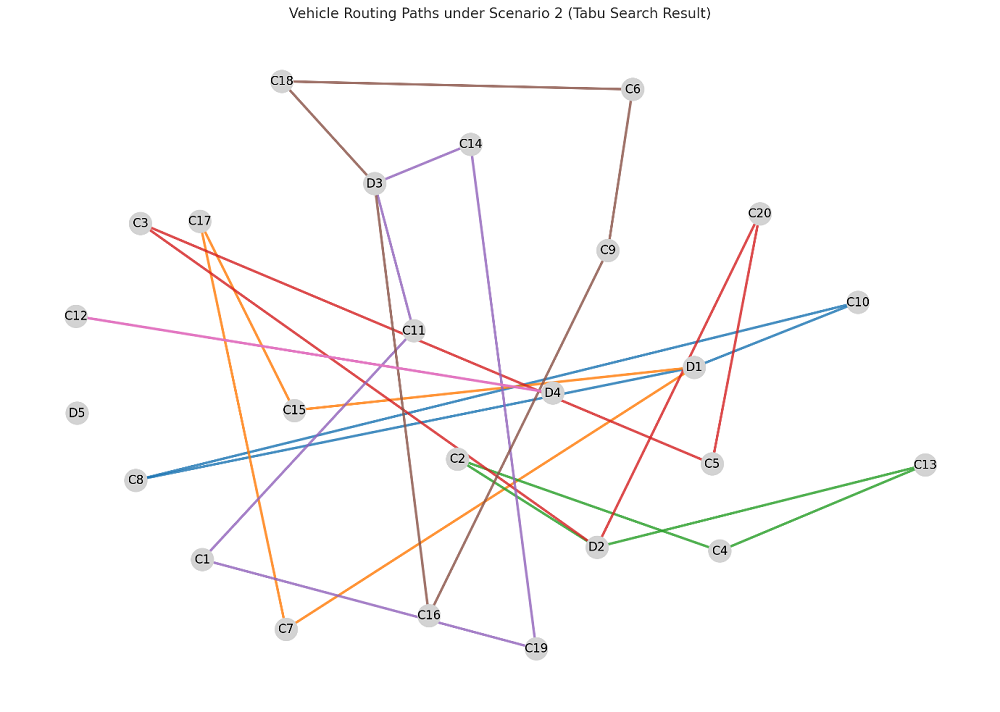
The object of this study is the multi-depot vehicle routing problem (MDVRP), which seeks optimal vehicle routes from multiple depots to geographically dispersed customers. The study addresses the problem of low reliability in traditional deterministic MDVRP models that fail to perform effectively under uncertain and disruptive conditions such as traffic congestion, infrastructure failures, demand fluctuations, and natural disasters. To overcome this limitation, a resilience-based optimization model is proposed by formulating the MDVRP with probability constraints that capture the likelihood of disturbances affecting route feasibility. The model integrates stochastic components into the routing process to balance cost minimization with service reliability under uncertainty. Computational experiments on an agro-logistics case involving five depots and twenty customers demonstrated that the proposed model reduced expected transportation costs by 36.4% compared with the Genetic Algorithm approach (494 vs. 777) and maintained service continuity in 100% of feasible scenarios with a reliability threshold of α = 0.7. Moreover, approximately 25–30% of potential routes were identified as infeasible under disturbance scenarios, validating the model’s probabilistic filtering mechanism. These results confirm that incorporating chance constraints and a Tabu search heuristic enhances the adaptability and robustness of multi-depot routing systems. The developed model can be practically applied to large-scale logistics systems, humanitarian relief operations, and distribution networks operating in regions prone to demand volatility or infrastructure disruptions, providing decision-makers with a reliable tool for sustainable and resilient route planning
References
- Mardešić, N., Erdelić, T., Carić, T., Đurasević, M. (2023). Review of Stochastic Dynamic Vehicle Routing in the Evolving Urban Logistics Environment. Mathematics, 12 (1), 28. https://doi.org/10.3390/math12010028
- Tien, N. H., Anh, D. B. H., Thuc, T. D. (2019). lGobal Supply Chain and Logistics Management. Dehli: Academic Publications.
- Zhu, R., Zhou, X. (2019). Cool Chain Logistics Distribution Routing Optimization for Urban Fresh Agricultural Products Considering Rejection of Goods. Proceedings of The First International Symposium on Management and Social Sciences (ISMSS 2019). https://doi.org/10.2991/ismss-19.2019.18
- Zhao, L., Yu, Q., Li, M., Wang, Y., Li, G., Sun, S. et al. (2022). A review of the innovative application of phase change materials to cold-chain logistics for agricultural product storage. Journal of Molecular Liquids, 365, 120088. https://doi.org/10.1016/j.molliq.2022.120088
- Wang, D., Ip, W. H. (2009). Evaluation and Analysis of Logistic Network Resilience With Application to Aircraft Servicing. IEEE Systems Journal, 3 (2), 166–173. https://doi.org/10.1109/jsyst.2009.2017395
- Lam, C. Y. (2016). Resilience of logistics network: analysis and design. 2016 World Congress on Industrial Control Systems Security (WCICSS), 1–5. https://doi.org/10.1109/wcicss.2016.7882936
- Mittal, A., Krejci, C., Craven, T. (2018). Logistics Best Practices for Regional Food Systems: A Review. Sustainability, 10 (1), 168. https://doi.org/10.3390/su10010168
- Keating, A. (2012). Food Security in Australia: The Logistics of Vulnerability. Food Security in Australia, 21–34. https://doi.org/10.1007/978-1-4614-4484-8_2
- Toth, P., Vigo, D. (2002). 1. An Overview of Vehicle Routing Problems. The Vehicle Routing Problem, 1–26. https://doi.org/10.1137/1.9780898718515.ch1
- Coelho, B., Andrade-Campos, A. (2014). Efficiency achievement in water supply systems – A review. Renewable and Sustainable Energy Reviews, 30, 59–84. https://doi.org/10.1016/j.rser.2013.09.010
- Jayarathna, N., Lanel, J., Juman, Z. A. M. S. (2020). Five years of multi-depot vehicle routing problems. Journal of Sustainable Development of Transport and Logistics, 5 (2), 109–123. https://doi.org/10.14254/jsdtl.2020.5-2.10
- Pillac, V., Gendreau, M., Guéret, C., Medaglia, A. L. (2013). A review of dynamic vehicle routing problems. European Journal of Operational Research, 225 (1), 1–11. https://doi.org/10.1016/j.ejor.2012.08.015
- Zhou, Y., Wang, J., Yang, H. (2019). Resilience of Transportation Systems: Concepts and Comprehensive Review. IEEE Transactions on Intelligent Transportation Systems, 20 (12), 4262–4276. https://doi.org/10.1109/tits.2018.2883766
- Figueiredo, B., Lopes, R. B., Sousa, A. de. (2025). Location–Routing Problems with Sustainability and Resilience Concerns: A Systematic Review. Logistics, 9 (3), 81. https://doi.org/10.3390/logistics9030081
- Vairo, T., Pettinato, M., Reverberi, A. P., Milazzo, M. F., Fabiano, B. (2023). An approach towards the implementation of a reliable resilience model based on machine learning. Process Safety and Environmental Protection, 172, 632–641. https://doi.org/10.1016/j.psep.2023.02.058
- Castro, M. P., Bodur, M., Shalaby, A. (2024). Incorporating Service Reliability in Multi-depot Vehicle Scheduling. arXiv. https://doi.org/10.48550/arXiv.2407.00836
- Rahimian, H., Mehrotra, S. (2022). Frameworks and Results in Distributionally Robust Optimization. Open Journal of Mathematical Optimization, 3, 1–85. https://doi.org/10.5802/ojmo.15
- Gmira, M., Gendreau, M., Lodi, A., Potvin, J.-Y. (2021). Tabu search for the time-dependent vehicle routing problem with time windows on a road network. European Journal of Operational Research, 288 (1), 129–140. https://doi.org/10.1016/j.ejor.2020.05.041
- Dong, L., Wang, J., Hu, X. (2025). Optimization of Joint Distribution Routes for Automotive Parts Considering Multi-Manufacturer Collaboration. Sustainability, 17 (14), 6615. https://doi.org/10.3390/su17146615
- Heakl, A., Shaaban, Y. S., Takac, M., Lahlou, S., Iklassov, Z. (2025). SVRPBench: A Realistic Benchmark for Stochastic Vehicle Routing Problem. arXiv. https://doi.org/10.48550/arXiv.2505.21887
- Rahmaniani, R., Ghaderi, A. (2015). An algorithm with different exploration mechanisms: Experimental results to capacitated facility location/network design problem. Expert Systems with Applications, 42 (7), 3790–3800. https://doi.org/10.1016/j.eswa.2014.12.051
- Zhang, Y., Qi, M., Lin, W.-H., Miao, L. (2015). A metaheuristic approach to the reliable location routing problem under disruptions. Transportation Research Part E: Logistics and Transportation Review, 83, 90–110. https://doi.org/10.1016/j.tre.2015.09.001
Downloads
Published
How to Cite
Issue
Section
License
Copyright (c) 2025 Herman Mawengkang, Intan Syahrini, Muhammad Romi Syahputra, Sutarman Sutarman

This work is licensed under a Creative Commons Attribution 4.0 International License.
The consolidation and conditions for the transfer of copyright (identification of authorship) is carried out in the License Agreement. In particular, the authors reserve the right to the authorship of their manuscript and transfer the first publication of this work to the journal under the terms of the Creative Commons CC BY license. At the same time, they have the right to conclude on their own additional agreements concerning the non-exclusive distribution of the work in the form in which it was published by this journal, but provided that the link to the first publication of the article in this journal is preserved.
A license agreement is a document in which the author warrants that he/she owns all copyright for the work (manuscript, article, etc.).
The authors, signing the License Agreement with TECHNOLOGY CENTER PC, have all rights to the further use of their work, provided that they link to our edition in which the work was published.
According to the terms of the License Agreement, the Publisher TECHNOLOGY CENTER PC does not take away your copyrights and receives permission from the authors to use and dissemination of the publication through the world's scientific resources (own electronic resources, scientometric databases, repositories, libraries, etc.).
In the absence of a signed License Agreement or in the absence of this agreement of identifiers allowing to identify the identity of the author, the editors have no right to work with the manuscript.
It is important to remember that there is another type of agreement between authors and publishers – when copyright is transferred from the authors to the publisher. In this case, the authors lose ownership of their work and may not use it in any way.







