Identifying the impact of forecast errors and flexibility preferences in decision support for optimal day-ahead prosumer operational planning
DOI:
https://doi.org/10.15587/1729-4061.2025.340758Keywords:
decision support system, prosumers, photovoltaics, operational planning, forecast errorAbstract
The object of the study is operational planning in decision support systems (DSSs) for prosumers. The study addresses a lack of explicit flexibility modeling in DSSs and a limited understanding of how forecast quality impacts planning results.
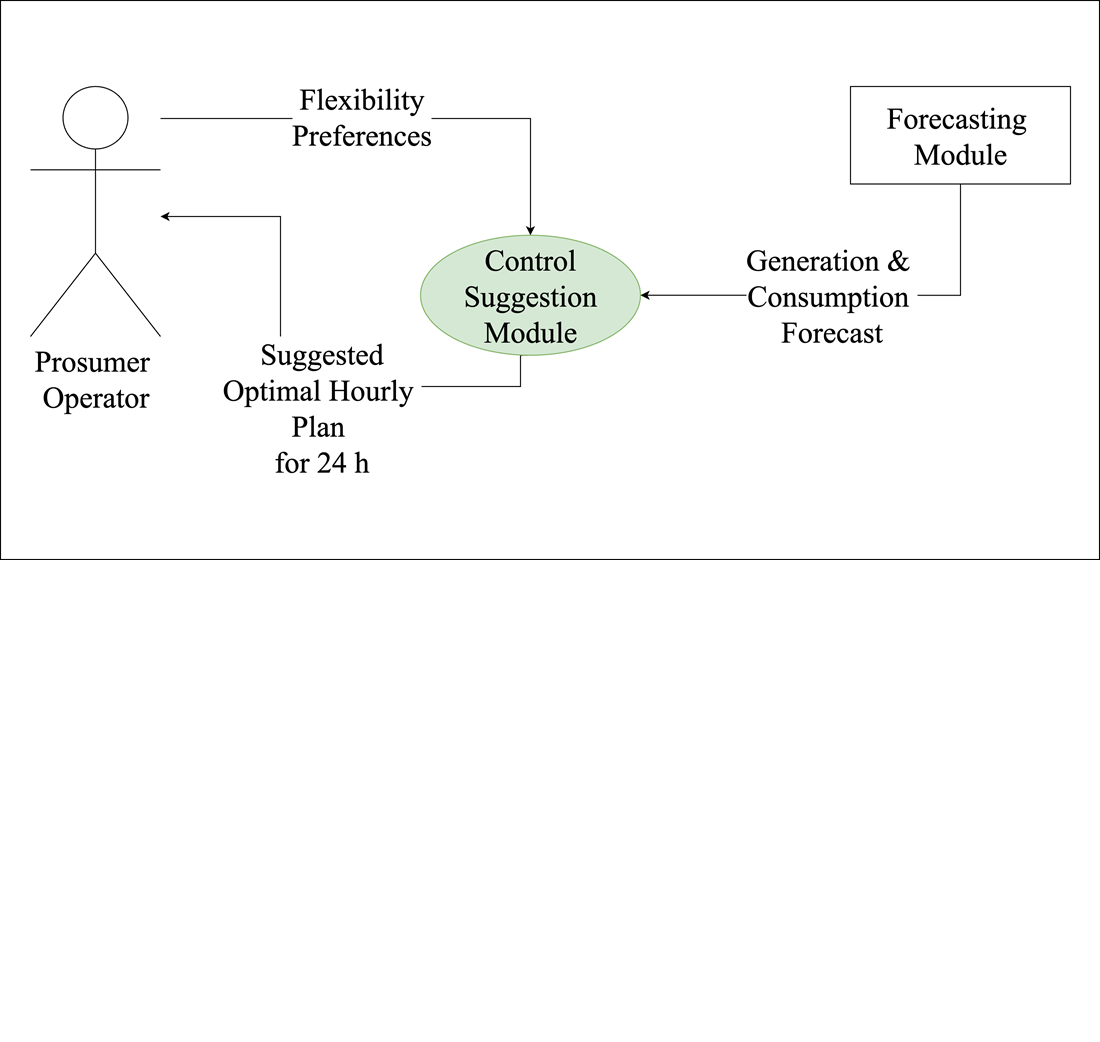
A novel control module for short-term planning of flexible energy demand and battery dispatch in prosumers is presented. The proposed solution improves prosumers’ information support by integrating consumption and generation forecasts, user-defined flexibility preferences, and battery constraints to reduce operational costs and increase profit from energy sales via optimal planning. Unlike methods that obscure decision logic, the module enables explicit flexibility modeling, enhancing transparency and better reflecting individual behaviors. Validation using real-world data across diverse prosumer segments confirms the module’s robustness and effectiveness in achieving cost savings.
The module maintained positive cost improvements under realistic and extreme forecast errors (up to 75%) across most flexibility settings, with performance influenced by forecast accuracy and flexibility configuration. A linear dependency was found between forecast error and cost savings. In rare edge cases – very low flexibility and high forecast error – the control plans led to underperformance. Increasing flexibility relaxes accuracy requirements, highlighting an important trade-off. Higher flexibility led to stronger initial performance but faster degradation as forecast errors increased. Lower flexibility setups declined more slowly but were more prone to underperformance in edge conditions.
These findings offer practical insights into flexibility modeling and forecast error tolerance, enabling improved planning and control design for prosumers
References
- Lopes, J. A. P., Madureira, A. G., Matos, M., Bessa, R. J., Monteiro, V., Afonso, J. L. et al. (2019). The future of power systems: Challenges, trends, and upcoming paradigms. WIREs Energy and Environment, 9 (3). https://doi.org/10.1002/wene.368
- Gržanić, M., Capuder, T., Zhang, N., Huang, W. (2022). Prosumers as active market participants: A systematic review of evolution of opportunities, models and challenges. Renewable and Sustainable Energy Reviews, 154, 111859. https://doi.org/10.1016/j.rser.2021.111859
- Alam, Md. S., Al-Ismail, F. S., Salem, A., Abido, M. A. (2020). High-Level Penetration of Renewable Energy Sources Into Grid Utility: Challenges and Solutions. IEEE Access, 8, 190277–190299. https://doi.org/10.1109/access.2020.3031481
- Shafiullah, M., Ahmed, S. D., Al-Sulaiman, F. A. (2022). Grid Integration Challenges and Solution Strategies for Solar PV Systems: A Review. IEEE Access, 10, 52233–52257. https://doi.org/10.1109/access.2022.3174555
- Mišljenović, N., Žnidarec, M., Knežević, G., Šljivac, D., Sumper, A. (2023). A Review of Energy Management Systems and Organizational Structures of Prosumers. Energies, 16 (7), 3179. https://doi.org/10.3390/en16073179
- Pöhler, J., Flegel, N., Mentler, T., Van Laerhoven, K. (2025). Keeping the human in the loop: are autonomous decisions inevitable? I-Com, 24 (1), 9–25. https://doi.org/10.1515/icom-2024-0068
- Marot, A., Rozier, A., Dussartre, M., Crochepierre, L., Donnot, B. (2022). Towards an AI Assistant for Power Grid Operators. HHAI2022: Augmenting Human Intellect. https://doi.org/10.3233/faia220191
- Donida Labati, R., Genovese, A., Piuri, V., Scotti, F., Sforza, G. (2020). A Decision Support System for Wind Power Production. IEEE Transactions on Systems, Man, and Cybernetics: Systems, 50 (1), 290–304. https://doi.org/10.1109/tsmc.2017.2783681
- Krueger, H., Cruden, A. (2020). Integration of electric vehicle user charging preferences into Vehicle-to-Grid aggregator controls. Energy Reports, 6, 86–95. https://doi.org/10.1016/j.egyr.2020.02.031
- Lukianykhin, O., Shendryk, V. (2025). Use of generative artificial intelligence to improve output message effectiveness in decision support systems for prosumers. Technology Audit and Production Reserves, 4 (2 (84)), 13–23. https://doi.org/10.15587/2706-5448.2025.333726
- Fotopoulou, M., Rakopoulos, D., Petridis, S. (2022). Decision Support System for Emergencies in Microgrids. Sensors, 22 (23), 9457. https://doi.org/10.3390/s22239457
- Iria, J., Soares, F. (2019). A cluster-based optimization approach to support the participation of an aggregator of a larger number of prosumers in the day-ahead energy market. Electric Power Systems Research, 168, 324–335. https://doi.org/10.1016/j.epsr.2018.11.022
- Mayadevi N., Vinod Chandra S. S., Ushakumari, S. (2014). A Review on Expert System Applications in Power Plants. International Journal of Electrical and Computer Engineering (IJECE), 4 (1). https://doi.org/10.11591/ijece.v4i1.5025
- Lukianykhin, O., Shendryk, V., Shendryk, S., Malekian, R. (2024). Promising AI Applications in Power Systems: Explainable AI (XAI), Transformers, LLMs. New Technologies, Development and Application VII, 66–76. https://doi.org/10.1007/978-3-031-66271-3_8
- Bose, B. K. (2017). Artificial Intelligence Techniques in Smart Grid and Renewable Energy Systems – Some Example Applications. Proceedings of the IEEE, 105 (11), 2262–2273. https://doi.org/10.1109/jproc.2017.2756596
- Lukianykhin, O., Bogodorova, T. (2021). Voltage Control-Based Ancillary Service Using Deep Reinforcement Learning. Energies, 14 (8), 2274. https://doi.org/10.3390/en14082274
- Qi, B., Liang, J., Tong, J. (2023). Fault Diagnosis Techniques for Nuclear Power Plants: A Review from the Artificial Intelligence Perspective. Energies, 16 (4), 1850. https://doi.org/10.3390/en16041850
- Panapakidis, I. P., Koltsaklis, N. E., Christoforidis, G. C. (2021). Forecasting Methods to Support the Decision Framework of Prosumers in Deregulated Markets. 2021 9th International Conference on Modern Power Systems (MPS), 1–5. https://doi.org/10.1109/mps52805.2021.9492725
- Benti, N. E., Chaka, M. D., Semie, A. G. (2023). Forecasting Renewable Energy Generation with Machine Learning and Deep Learning: Current Advances and Future Prospects. Sustainability, 15 (9), 7087. https://doi.org/10.3390/su15097087
- Teixeira, R., Cerveira, A., Pires, E. J. S., Baptista, J. (2024). Advancing Renewable Energy Forecasting: A Comprehensive Review of Renewable Energy Forecasting Methods. Energies, 17 (14), 3480. https://doi.org/10.3390/en17143480
- Xie, Y., Li, C., Li, M., Liu, F., Taukenova, M. (2023). An overview of deterministic and probabilistic forecasting methods of wind energy. IScience, 26 (1), 105804. https://doi.org/10.1016/j.isci.2022.105804
- Lukianykhin, O., Shendryk, V. (2025). Machine learning-driven photovoltaic generation forecasting for prosumer decision support. Artificial Intelligence, 30 (AI.2025.30 (1)), 107–119. https://doi.org/10.15407/jai2025.01.107
- Karagiannopoulos, S., Aristidou, P., Hug, G. (2019). Data-Driven Local Control Design for Active Distribution Grids Using Off-Line Optimal Power Flow and Machine Learning Techniques. IEEE Transactions on Smart Grid, 10 (6), 6461–6471. https://doi.org/10.1109/tsg.2019.2905348
- Linan-Reyes, M., Garrido-Zafra, J., Gil-de-Castro, A., Moreno-Munoz, A. (2021). Energy Management Expert Assistant, a New Concept. Sensors, 21 (17), 5915. https://doi.org/10.3390/s21175915
- Langtry, M., Wichitwechkarn, V., Ward, R., Zhuang, C., Kreitmair, M. J., Makasis, N. et al. (2024). Impact of data for forecasting on performance of model predictive control in buildings with smart energy storage. Energy and Buildings, 320, 114605. https://doi.org/10.1016/j.enbuild.2024.114605
- Pineda, S., Morales, J. M., Boomsma, T. K. (2016). Impact of forecast errors on expansion planning of power systems with a renewables target. European Journal of Operational Research, 248 (3), 1113–1122. https://doi.org/10.1016/j.ejor.2015.08.011
- Matthiss, B., Momenifarahaniy, A., Ohnmeissz, K., Felderx, M. (2018). Influence of Demand and Generation Uncertainty on the Operational Efficiency of Smart Grids. 2018 7th International Conference on Renewable Energy Research and Applications (ICRERA), 751–756. https://doi.org/10.1109/icrera.2018.8566733
- Eljand, K., Laid, M., Scellier, J.-B., Dane, S., Demkin, M., Howard, A. (2023). Enefit - Predict energy behavior of prosumers. Kaggle. Available at: https://kaggle.com/competitions/predict-energy-behavior-of-prosumers
- Virtanen, P., Gommers, R., Oliphant, T. E., Haberland, M., Reddy, T., Cournapeau, D. et al. (2020). SciPy 1.0: fundamental algorithms for scientific computing in Python. Nature Methods, 17 (3), 261–272. https://doi.org/10.1038/s41592-019-0686-2
- Knap, V., Molhanec, M., Gismero, A., Stroe, D.-I. (2021). Calendar Degradation and Self-Discharge Occurring During Short- and Long-Term Storage of NMC Based Lithium-Ion Batteries. ECS Transactions, 105 (1), 3–11. https://doi.org/10.1149/10501.0003ecst
- Kumar, M. (2023). Comparison on study of lithium ion and lead acid charging and discharging characteristics. International Scientific Journal of Engineering and Management, 02 (03). https://doi.org/10.55041/isjem00163
Downloads
Published
How to Cite
Issue
Section
License
Copyright (c) 2025 Oleh Lukianykhin, Vira Shendryk

This work is licensed under a Creative Commons Attribution 4.0 International License.
The consolidation and conditions for the transfer of copyright (identification of authorship) is carried out in the License Agreement. In particular, the authors reserve the right to the authorship of their manuscript and transfer the first publication of this work to the journal under the terms of the Creative Commons CC BY license. At the same time, they have the right to conclude on their own additional agreements concerning the non-exclusive distribution of the work in the form in which it was published by this journal, but provided that the link to the first publication of the article in this journal is preserved.
A license agreement is a document in which the author warrants that he/she owns all copyright for the work (manuscript, article, etc.).
The authors, signing the License Agreement with TECHNOLOGY CENTER PC, have all rights to the further use of their work, provided that they link to our edition in which the work was published.
According to the terms of the License Agreement, the Publisher TECHNOLOGY CENTER PC does not take away your copyrights and receives permission from the authors to use and dissemination of the publication through the world's scientific resources (own electronic resources, scientometric databases, repositories, libraries, etc.).
In the absence of a signed License Agreement or in the absence of this agreement of identifiers allowing to identify the identity of the author, the editors have no right to work with the manuscript.
It is important to remember that there is another type of agreement between authors and publishers – when copyright is transferred from the authors to the publisher. In this case, the authors lose ownership of their work and may not use it in any way.





