Визначення механізму захоплюючої здатності валків і прокатки на межі стійкості при асиметричному навантаженні
DOI:
https://doi.org/10.15587/1729-4061.2025.340835Ключові слова:
асиметрія навантаження, протиспрямована течія металу, втрата стійкості, напружено-деформований станАнотація
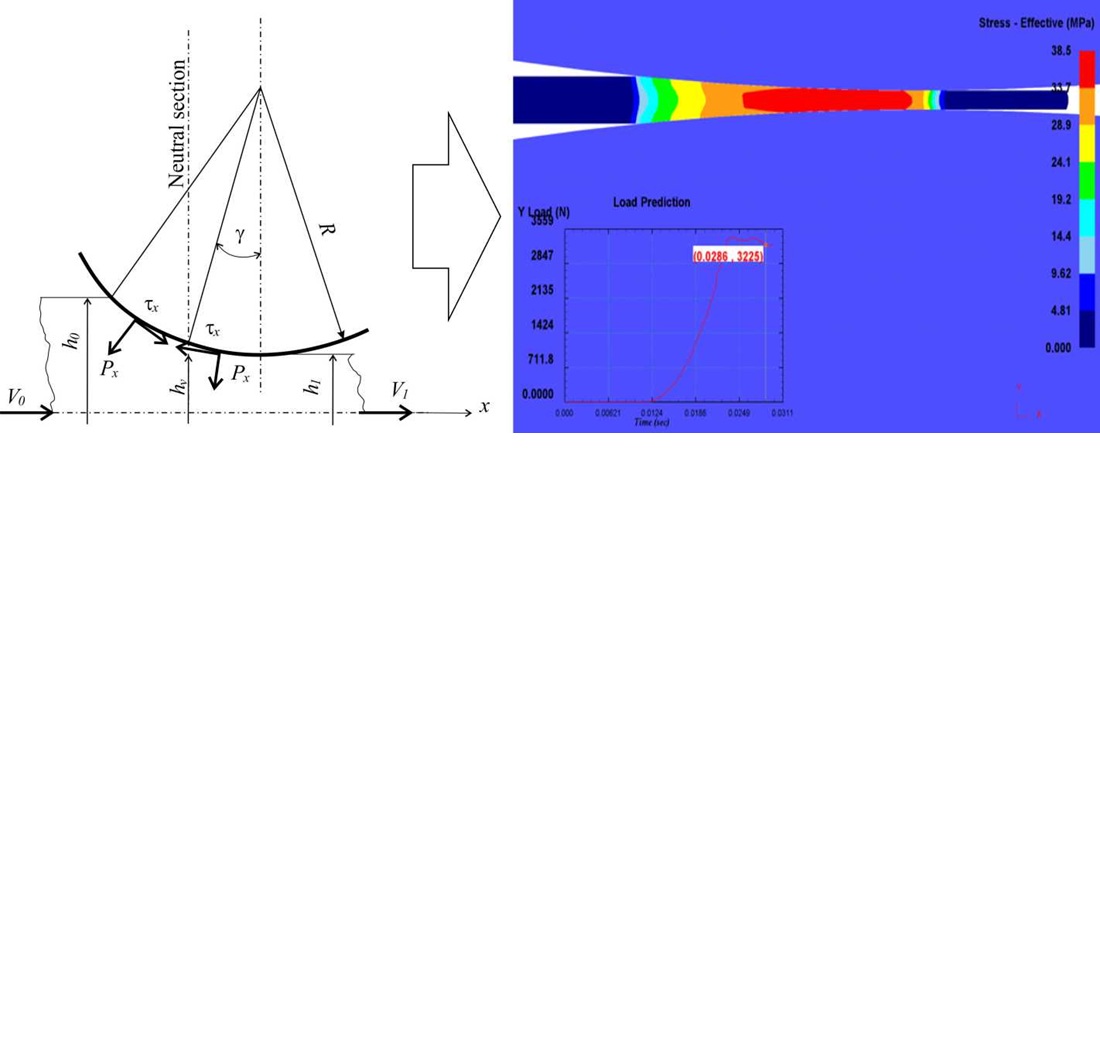
Об’єкт дослідження – напружений стан пластичного осередка деформації при асиметричному навантаженні, захоплені металу валками, визначальних режимах стійкості процесу.
Проблема, яка вирішувалася, це реалізація ефекту пластичної формозміни на межі стійкості процесу прокатки, пов'язаного зі зниженням силового навантаження при збільшеному деформаційному впливі.
Розроблено фізичну та математичну модель плоскої задачі теорії прокатки в умовах багатопараметричних чинників впливу на захоплюючу здатність валків, стійкість процесу прокатки.
Задачу теорії пластичності розв'язано аналітично з використанням методу аргумент функцій комплексної змінної. Показано розв'язання плоскої задачі з погляду асиметрії процесу, протиспрямованої течії металу. Враховано нелінійність задачі теорії пластичності.
На базі математичної моделі виявлено та досліджено новий силовий фактор: фактор силового розтягування з боку зони відставання. Виявлено новий однозонний режим деформації з мінімальною стійкістю процесу. Процес досліджено в умовах багатопараметричного впливу на захоплюючу здатність валків і його стійкість. Встановлені зони досяжності при факторі форми вогнища деформації в межах 5.00…15.00. Досліджено режим часткового пригнічувального впливу обнуляючих чинників напруженого стану металу на захоплюючу здатність валків і стійкість процесу. Визначено показники стійкості перехідних режимів, при α = 0.077 показник відношення f/α = 1.10…1.95; при α = 0.129 показник відношення f/α = 1.19…1.95; при α = 0.168 показник відношення f/α = 1.28…1.95.
Результати роботи дають змогу розв'язувати технологічну проблему, пов'язану з розробленням схем прокатки, коли в процесі формування виникають захоплювальна сила тертя і виштовхувальна сила нормального тиску
Посилання
- Chigirinsky, V., Naizabekov, A., Lezhnev, S., Naumenko, O., Kuzmin, S. (2024). Determining the patterns of asymmetric interaction of plastic medium with counter-directional metal flow. Eastern-European Journal of Enterprise Technologies, 1 (7 (127)), 66–82. https://doi.org/10.15587/1729-4061.2024.293842
- Chigirinsky, V., Naizabekov, A., Lezhnev, S., Kuzmin, S., Panin, E., Tolkushkin, A. et al. (2024). Effect of the limiting deformation zone under conditions of asymmetric loading during rolling of medium thickness strips. Journal of Chemical Technology and Metallurgy, 59 (4), 993–1002. https://doi.org/10.59957/jctm.v59.i4.2024.30
- Chigurinski, V. V. (1999). The study of stressed and deformed metal state under conditions of nonuniform plastic medium flow. Metalurgija, 38 (1), 31–37.
- Chigirinsky, V., Putnoki, A. (2017). Development of a dynamic model of transients in mechanical systems using argument-functions. Eastern-European Journal of Enterprise Technologies, 3 (7 (87)), 11–22. https://doi.org/10.15587/1729-4061.2017.101282
- Chigirinsky, V., Naumenko, O. (2021). Advancing a generalized method for solving problems of continuum mechanics as applied to the Cartesian coordinate system. Eastern-European Journal of Enterprise Technologies, 5 (7 (113)), 14–24. https://doi.org/10.15587/1729-4061.2021.241287
- Chigirinsky, V., Naizabekov, A., Lezhnev, S. (2021). Closed problem of plasticity theory. Journal of Chemical Technology and Metallurgy, 56 (4), 867–876. Available at: https://journal.uctm.edu/node/j2021-4/28_21-32p867-876.pdf
- Chigirinsky, V., Naizabekov, A., Lezhnev, S., Kuzmin, S., Naumenko, O. (2022). Solving applied problems of elasticity theory in geomechanics using the method of argument functions of a complex variable. Eastern-European Journal of Enterprise Technologies, 5 (7 (119)), 105–113. https://doi.org/10.15587/1729-4061.2022.265673
- Vasyliev, L., Malich, M., Vasyliev, D., Katan, V., Rizo, Z. (2023). Improving a technique to calculate strength of cylindrical rock samples in terms of uniaxial compression. Mining of Mineral Deposits, 17 (1), 43–50. https://doi.org/10.33271/mining17.01.043
- Drahobetskyi, V. V., Shapoval, O. O., Shchepetov, V. V., Zahirniak, M. V., Lotous, V. V., Lehotkin, H. I. et al. (2017). Kerovani efekty plastychnoho deformuvannia zahotovok vyrobiv dlia metalurhiyi ta transportu. Kharkiv: "Drukarnia Madryd", 244. Available at: https://www.kdu.edu.ua/new/PHD_vid/KEPDZVMT.pdf
- Dhinwal, S. S., Toth, L. S., Lapovok, R., Hodgson, P. D. (2019). Tailoring One-Pass Asymmetric Rolling of Extra Low Carbon Steel for Shear Texture and Recrystallization. Materials, 12 (12), 1935. https://doi.org/10.3390/ma12121935
- Banerjee, A., Wylie, A., Da Silva, L. (2022). Near-Net Shape Manufacture of Ultra-High Strength Maraging Steel Using Flow Forming and Inertia Friction Welding: Experimental and Microstructural Characterization. Journal of Manufacturing Science and Engineering, 145 (2). https://doi.org/10.1115/1.4055519
- Dhinwal, S. S., Toth, L. S., Hodgson, P. D., Haldar, A. (2018). Effects of Processing Conditions on Texture and Microstructure Evolution in Extra-Low Carbon Steel during Multi-Pass Asymmetric Rolling. Materials, 11 (8), 1327. https://doi.org/10.3390/ma11081327
- Nadai, A. (1954). Theory of low and fracture of solids. IL Publ., New York.
- Timoshenko, S. P., Goodier, J. N. (1952). Theory of Elasticity. Timoshenkoand Goodier . McGraw-Hill. New York 1951. 493 pp. 270 diagrams. 81s. net. (New Edition.). The Journal of the Royal Aeronautical Society, 56 (496), 308–308. https://doi.org/10.1017/s036839310012471x
- Dorofeyev, O. A., Kovtun, V. V. (2019). Estimation of the Stress-Strain State of a Discrete Medium by a Plastic Flow Model. PROBLEMS OF TRIBOLOGY, 93 (3), 29–38. https://doi.org/10.31891/2079-1372-2019-93-3-29-38
- El-Naaman, S. A., Nielsen, K. L., Niordson, C. F. (2019). An investigation of back stress formulations under cyclic loading. Mechanics of Materials, 130, 76–87. https://doi.org/10.1016/j.mechmat.2019.01.005
- Lopez-Crespo, P., Camas, D., Antunes, F. V., Yates, J. R. (2018). A study of the evolution of crack tip plasticity along a crack front. Theoretical and Applied Fracture Mechanics, 98, 59–66. https://doi.org/10.1016/j.tafmec.2018.09.012
- Li, J., Zhang, Z., Li, C. (2017). Elastic-plastic stress-strain calculation at notch root under monotonic, uniaxial and multiaxial loadings. Theoretical and Applied Fracture Mechanics, 92, 33–46. https://doi.org/10.1016/j.tafmec.2017.05.005
- Pathak, H. (2017). Three-dimensional quasi-static fatigue crack growth analysis in functionally graded materials (FGMs) using coupled FE-XEFG approach. Theoretical and Applied Fracture Mechanics, 92, 59–75. https://doi.org/10.1016/j.tafmec.2017.05.010
- Correia, J. A. F. O., Huffman, P. J., De Jesus, A. M. P., Cicero, S., Fernández-Canteli, A., Berto, F., Glinka, G. (2017). Unified two-stage fatigue methodology based on a probabilistic damage model applied to structural details. Theoretical and Applied Fracture Mechanics, 92, 252–265. https://doi.org/10.1016/j.tafmec.2017.09.004
- Sneddon, I. N., Berry, D. S. (1958). The Classical Theory of Elasticity. Elasticity and Plasticity / Elastizität Und Plastizität, 1–126. https://doi.org/10.1007/978-3-642-45887-3_1
- Hussein, N. S. (2014). Solution of a Problem Linear Plane Elasticity with Mixed Boundary Conditions by the Method of Boundary Integrals. Mathematical Problems in Engineering, 2014 (1). https://doi.org/10.1155/2014/323178
- Yu, T., Xue, P. (2022). Introduction to Engineering Plasticity. Elsevier. https://doi.org/10.1016/c2021-0-00546-0
- Muñoz, J. A., Avalos, M., Schell, N., Brokmeier, H. G., Bolmaro, R. E. (2021). Comparison of a low carbon steel processed by Cold Rolling (CR) and Asymmetrical Rolling (ASR): Heterogeneity in strain path, texture, microstructure and mechanical properties. Journal of Manufacturing Processes, 64, 557–575. https://doi.org/10.1016/j.jmapro.2021.02.017
##submission.downloads##
Опубліковано
Як цитувати
Номер
Розділ
Ліцензія
Авторське право (c) 2025 Valeriy Chigirinsky, Abdrakhman Naizabekov, Sergey Lezhnev, Olena Naumenko, Sergey Kuzmin, Sergey Melentyev

Ця робота ліцензується відповідно до Creative Commons Attribution 4.0 International License.
Закріплення та умови передачі авторських прав (ідентифікація авторства) здійснюється у Ліцензійному договорі. Зокрема, автори залишають за собою право на авторство свого рукопису та передають журналу право першої публікації цієї роботи на умовах ліцензії Creative Commons CC BY. При цьому вони мають право укладати самостійно додаткові угоди, що стосуються неексклюзивного поширення роботи у тому вигляді, в якому вона була опублікована цим журналом, але за умови збереження посилання на першу публікацію статті в цьому журналі.
Ліцензійний договір – це документ, в якому автор гарантує, що володіє усіма авторськими правами на твір (рукопис, статтю, тощо).
Автори, підписуючи Ліцензійний договір з ПП «ТЕХНОЛОГІЧНИЙ ЦЕНТР», мають усі права на подальше використання свого твору за умови посилання на наше видання, в якому твір опублікований. Відповідно до умов Ліцензійного договору, Видавець ПП «ТЕХНОЛОГІЧНИЙ ЦЕНТР» не забирає ваші авторські права та отримує від авторів дозвіл на використання та розповсюдження публікації через світові наукові ресурси (власні електронні ресурси, наукометричні бази даних, репозитарії, бібліотеки тощо).
За відсутності підписаного Ліцензійного договору або за відсутністю вказаних в цьому договорі ідентифікаторів, що дають змогу ідентифікувати особу автора, редакція не має права працювати з рукописом.
Важливо пам’ятати, що існує і інший тип угоди між авторами та видавцями – коли авторські права передаються від авторів до видавця. В такому разі автори втрачають права власності на свій твір та не можуть його використовувати в будь-який спосіб.