Розробка симулятора для підтримки планування успішності місій БПЛА в умовах бойових дій
DOI:
https://doi.org/10.15587/1729-4061.2025.340918Ключові слова:
моделювання мереж БпЛА, кіберфізична безпека, шкідливе програмне забезпечення, радіоелектронна протидіяАнотація
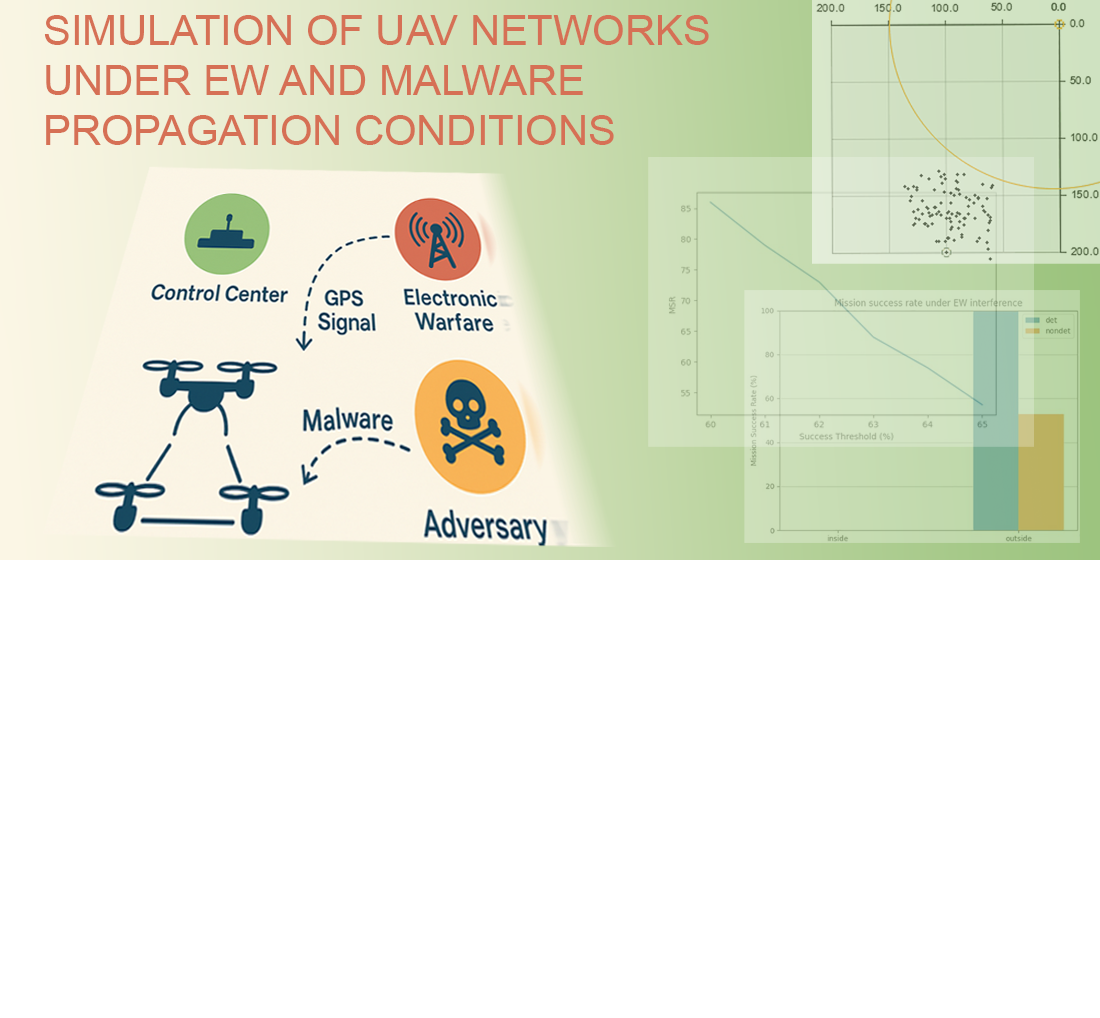
Об’єктом дослідження є мережі безпілотних літальних апаратів (БпЛА), що функціонують в умовах дії деструктивних та ворожих факторів. Серед деструктивних факторів враховано зміни потужності сигналу на боці приймача через вплив відстані та обмеження заряду батарей. Серед ворожих факторів розглянуто кіберфізичні загрози, спричинені системами радіоелектронної протидії (РЕП) та атаками на основі шкідливого програмного забезпечення. Для розв’язання цієї проблеми було розроблено алгоритмічні та програмні рішення для моделювання поведінки БпЛА в таких умовах. Запропонована модель відрізняється від існуючих інтеграцією таких факторів, як погіршення сигналу внаслідок дії систем РЕП та динаміка поширення шкідливого програмного забезпечення в мережі.
Сценарії включають поведінку БпЛА під впливом радіоперешкод, імовірнісне поширення шкідливого програмного забезпечення (ШПЗ), а також перехід між режимами роботи у відповідь на загрози. Результати досягнуто шляхом врахування широкого спектру параметрів, в тому числі: ідентифікатора пристрою, потужності сигналу, радіусу передавача, частоти передачі, геолокації, типу завдання, чутливості до шкідливого ПЗ, черги обробки повідомлень, затримок поширення та швидкості руху. Ці характеристики дозволяють моделі реалістично відтворювати поведінку системи в умовах невизначеності та загроз, забезпечуючи можливість аналізу як захисних, так і наступальних стратегій кібербезпеки та побудови відповідних сценаріїв операцій.
Запропоноване програмне рішення характеризується високим рівнем деталізації моделювання та використанням мови програмування Rust, що забезпечує продуктивність, модульність і можливість розширення. Розроблене рішення дозволяє візуалізувати поведінку до 100 БпЛА та більше у вигляді зображень та анімацій. Програмний пакет і його вихідний код оприлюднено у відкритому репозиторії GitHub, що забезпечує практичне застосування та подальше використання в дослідженнях
Посилання
- McNabb, M. (2025). Ukraine’s Trojan Horse Drones: A New Frontier in Cyber Warfare. DroneLife. Available at: https://dronelife.com/2025/04/10/ukraines-trojan-horse-drones-a-new-frontier-in-cyber-warfare/
- Yaacoub, J.-P., Noura, H., Salman, O., Chehab, A. (2020). Security analysis of drones systems: Attacks, limitations, and recommendations. Internet of Things, 11, 100218. https://doi.org/10.1016/j.iot.2020.100218
- Hartmann, K., Giles, K. (2016). UAV Exploitation: A New Domain for Cyber Power. 6 8th International Conference on Cyber Conflict. Tallinn, 205–221. Available at: https://ccdcoe.org/uploads/2018/10/Art-14-Assessing-the-Impact-of-Aviation-Security-on-Cyber-Power.pdf
- Abro, G., Zulkifli, S., Masood, R., Asirvadam, V., Laouiti, A. (2022). Comprehensive Review of UAV Detection, Security, and Communication Advancements to Prevent Threats. Drones, 6 (10), 284. https://doi.org/10.3390/drones6100284
- Riahi Manesh, M., Kaabouch, N. (2019). Cyber-attacks on unmanned aerial system networks: Detection, countermeasure, and future research directions. Computers & Security, 85, 386–401. https://doi.org/10.1016/j.cose.2019.05.003
- Drone Hacking: Exploitation and Vulnerabilities. Available at: https://spadok.org.ua/books/Drone+Hacking-+Exploitation+and+Vulnerabilities.pdf
- Throwback Attack: Keylogging virus infects U.S. drone fleet (2022). Control Engineering. Available at: https://www.controleng.com/throwback-attack-keylogging-virus-infects-u-s-drone-fleet/
- Zakharchenko, I., Tristan, A., Chornogor, N., Berdnik, P., Kalashnyk, G., Timochko, A. et al. (2022). Modeling of Object Monitoring Using 3D Cellular Automata. Problems of the Regional Energetics, 4 (56), 61–73. https://doi.org/10.52254/1857-0070.2022.4-56.06
- Song, Z., Zhang, H., Zhang, X., Zhang, F. (2019). Unmanned Aerial Vehicle Coverage Path Planning Algorithm Based on Cellular Automata. 2019 15th International Conference on Computational Intelligence and Security (CIS), 123–126. https://doi.org/10.1109/cis.2019.00034
- Ioannidis, K., Sirakoulis, G. Ch., Andreadis, I. (2011). A path planning method based on cellular automata for cooperative robots. Applied Artificial Intelligence, 25 (8), 721–745. https://doi.org/10.1080/08839514.2011.606767
- Adamatzky, A. I. (1996). Computation of shortest path in cellular automata. Mathematical and Computer Modelling, 23 (4), 105–113. https://doi.org/10.1016/0895-7177(96)00006-4
- Behring, C., Bracho, M., Castro, M., Moreno, J. A. (2001). An Algorithm for Robot Path Planning with Cellular Automata. Theory and Practical Issues on Cellular Automata, 11–19. https://doi.org/10.1007/978-1-4471-0709-5_2
- Xie, J., Chen, J. (2022). Multiregional Coverage Path Planning for Multiple Energy Constrained UAVs. IEEE Transactions on Intelligent Transportation Systems, 23 (10), 17366–17381. https://doi.org/10.1109/tits.2022.3160402
- Fedorova, A., Beliautsou, V., Zimmermann, A. (2022). Colored Petri Net Modelling and Evaluation of Drone Inspection Methods for Distribution Networks. Sensors, 22 (9), 3418. https://doi.org/10.3390/s22093418
- Xu, D., Borse, P., Altenburg, K., Nygard, K. (2006). A Petri Net Simulator for Self-organizing Systems. Proceedings of the 5th WSEAS Int. Conf. on Artificial Intelligence, Knowledge Engineering and Data Bases. Madrid, 31–35. Available at: https://www.researchgate.net/publication/234805596
- Gonçalves, P., Sobral, J., Ferreira, L. A. (2017). Unmanned aerial vehicle safety assessment modelling through petri Nets. Reliability Engineering & System Safety, 167, 383–393. https://doi.org/10.1016/j.ress.2017.06.021
- Wang, X., Guo, Y., Lu, N., He, P. (2023). UAV Cluster Behavior Modeling Based on Spatial-Temporal Hybrid Petri Net. Applied Sciences, 13 (2), 762. https://doi.org/10.3390/app13020762
- NS-3. Network Simulator. Available at: https://www.nsnam.org/
- OMNeT++. Available at: https://omnetpp.org/
- GAMA Platform. Available at: https://gama-platform.org/
- Nikolaiev, M., Novotarskyi, M. (2024). Comparative Review of Drone Simulators. Information, Computing and Intelligent Systems, 4, 79–98. https://doi.org/10.20535/2786-8729.4.2024.300614
- GPS Jamming, Spoofing and Hacking (2025). NorthStandard. Available at: https://north-standard.com/insights-and-resources/resources/articles/gps-jamming-spoofing-and-hacking
- Stopochkina, I., Novikov, O., Voitsekhovskyi, A., Ilin, M., Ovcharuk, M. (2025). Simulation of UAV networks on the battlefield, taking into account cyber- physical influences that affect availability. Theoretical and Applied Cybersecurity, 6 (2). https://doi.org/10.20535/tacs.2664-29132024.2.318182
- Pro zviazok vid Serhiya Flesh. Available at: https://t.me/s/serhii_flash
- McNabb, M (2024). What Kind of Drones is Ukraine Buying? DroneLife. Available at: https://dronelife.com/2024/11/04/what-kind-of-drones-is-ukraine-buying/
- Code and data for the paper: "Simulation of Unmanned Aerial Vehicles Networks under Electronic Warfare and Malware Propagation Conditions". Available at: https://github.com/KryvavyiPotii/drone-network
##submission.downloads##
Опубліковано
Як цитувати
Номер
Розділ
Ліцензія
Авторське право (c) 2025 Anton Tyshchenko, Iryna Stopochkina

Ця робота ліцензується відповідно до Creative Commons Attribution 4.0 International License.
Закріплення та умови передачі авторських прав (ідентифікація авторства) здійснюється у Ліцензійному договорі. Зокрема, автори залишають за собою право на авторство свого рукопису та передають журналу право першої публікації цієї роботи на умовах ліцензії Creative Commons CC BY. При цьому вони мають право укладати самостійно додаткові угоди, що стосуються неексклюзивного поширення роботи у тому вигляді, в якому вона була опублікована цим журналом, але за умови збереження посилання на першу публікацію статті в цьому журналі.
Ліцензійний договір – це документ, в якому автор гарантує, що володіє усіма авторськими правами на твір (рукопис, статтю, тощо).
Автори, підписуючи Ліцензійний договір з ПП «ТЕХНОЛОГІЧНИЙ ЦЕНТР», мають усі права на подальше використання свого твору за умови посилання на наше видання, в якому твір опублікований. Відповідно до умов Ліцензійного договору, Видавець ПП «ТЕХНОЛОГІЧНИЙ ЦЕНТР» не забирає ваші авторські права та отримує від авторів дозвіл на використання та розповсюдження публікації через світові наукові ресурси (власні електронні ресурси, наукометричні бази даних, репозитарії, бібліотеки тощо).
За відсутності підписаного Ліцензійного договору або за відсутністю вказаних в цьому договорі ідентифікаторів, що дають змогу ідентифікувати особу автора, редакція не має права працювати з рукописом.
Важливо пам’ятати, що існує і інший тип угоди між авторами та видавцями – коли авторські права передаються від авторів до видавця. В такому разі автори втрачають права власності на свій твір та не можуть його використовувати в будь-який спосіб.