Розробка мережевої архітектури на основі стратосферних дирижаблів для телекомунікації у віддалених районах
DOI:
https://doi.org/10.15587/1729-4061.2025.340990Ключові слова:
висотні платформні станції (HAPS), стратосферний дирижабль, телекомунікаційна мережа, технологія LoRa, частота нижче ГГцАнотація
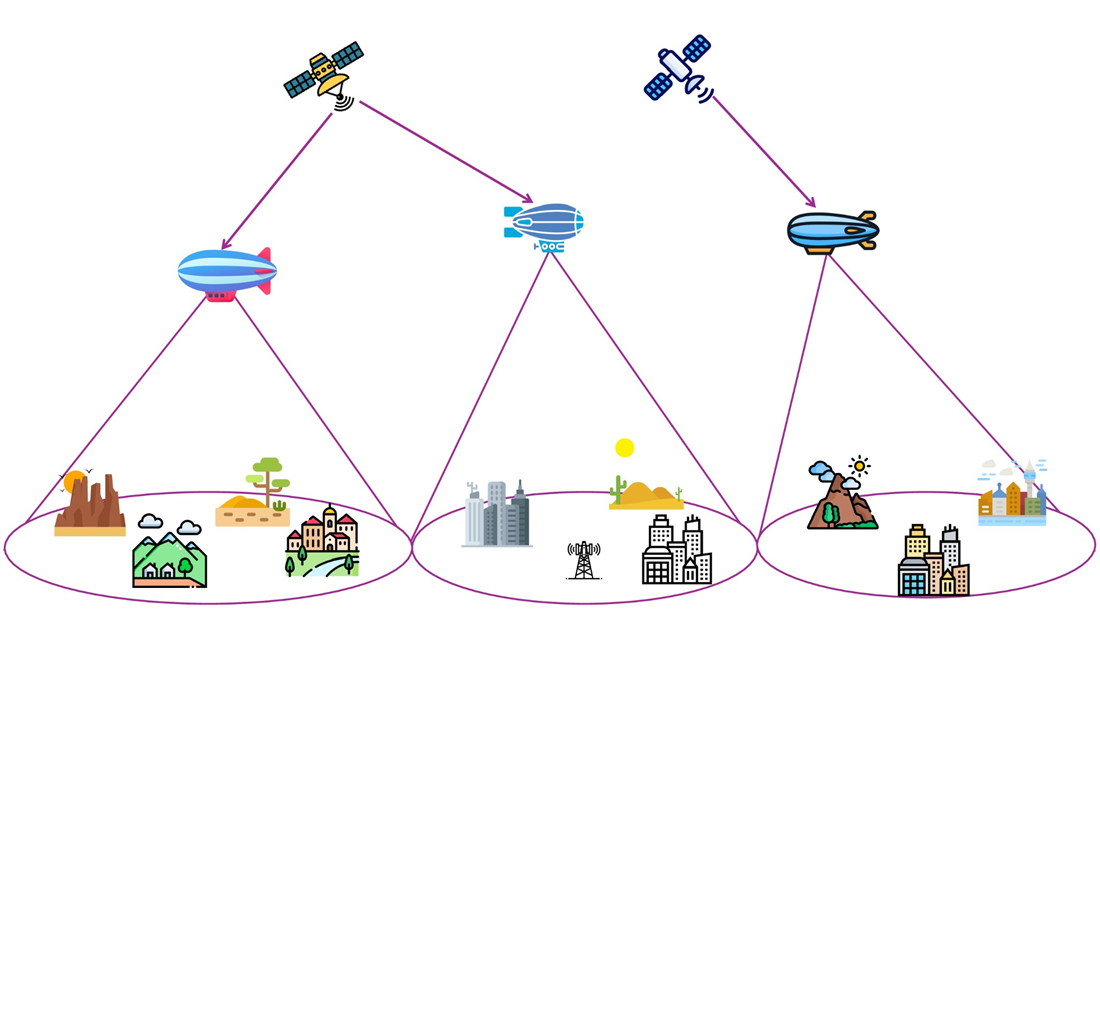
Об'єктом цього дослідження є телекомунікаційна платформа на базі стратосферного дирижабля, що використовується як висотна платформна станція (HAPS), призначена для роботи на висотах 20–30 км та забезпечення широкосмугового зв'язку в регіонах з обмеженою наземною інфраструктурою, таких як сільські та віддалені райони Республіки Казахстан. Ключовою проблемою дослідження є забезпечення стабільного зв'язку телекомунікаційних платформ на базі HAPS за умов сильних стратосферних вітрів, з обмеженою вантажопідйомністю та енергетичними ресурсами, а також розробка масштабованої мережевої архітектури для координації кількох дирижаблів.
У цій статті пропонується мережева концепція на основі модульних нанодирижаблів, яка зменшує опір, підвищує ремонтопридатність та забезпечує безперервне обслуговування. Були проведені розрахунки вантажопідйомності, аеродинамічного опору різних форм оболонки, енергетичного балансу та радіуса покриття однієї станції. Експериментальні випробування прототипу підтвердили можливість використання суб-ГГц діапазону (433 МГц) для забезпечення зв'язку на великі відстані в наземних випробувальних умовах, де ослаблення сигналу виявилося мінімальним порівняно з вищими частотами.
Завдяки отриманим характеристикам було підтверджено гіпотезу про використання групи менших дирижаблів замість одного великого носія. Це пояснюється їхньою зниженою чутливістю до вітрових навантажень, гнучкістю конфігурації мережі та нижчими експлуатаційними ризиками. На відміну від традиційних супутникових систем, запуск та обслуговування яких є дорогими, стратосферні дирижаблі можна відновлювати, ремонтувати та перерозгортати за відносно низькою ціною, що є економічно вигідним рішенням для регіонів, що розвиваються.
Результати можуть бути застосовані при створенні національних мереж зв'язку для віддалених та малонаселених районів Республіки Казахстан, в операціях з реагування на надзвичайні ситуації та як додатковий рівень до супутникових сузір'їв. Запропонована концепція демонструє, що модульні мережі HAPS є реалістичною та масштабованою альтернативою, здатною забезпечувати широкосмуговий доступ за реальних атмосферних та географічних обмежень
Посилання
- Abdullaev, M., Esnazarov, E. (2012). Organization of Broadband Communication Based on Stratospheric High-Altitude Platforms in the Territory of Kazakhstan. Information and Telecommunication Technologies: Education, Science, Practice, 232–236.
- Abdykadyrov, A., Abdullayev, M., Kuttybayeva, A., Tazhen, K., Kystaubayev, N., Ermekbayev, M. et al. (2025). Development and evaluation of radio frequency management approaches for stratospheric communication systems. Eastern-European Journal of Enterprise Technologies, 3 (5 (135)), 17–29. https://doi.org/10.15587/1729-4061.2025.331607
- Widiawan, A. K., Tafazolli, R. (2006). High Altitude Platform Station (HAPS): A Review of New Infrastructure Development for Future Wireless Communications. Wireless Personal Communications, 42 (3), 387–404. https://doi.org/10.1007/s11277-006-9184-9
- D’Oliveira, F. A., Melo, F. C. L. de, Devezas, T. C. (2016). High-Altitude Platforms - Present Situation and Technology Trends. Journal of Aerospace Technology and Management, 8 (3), 249–262. https://doi.org/10.5028/jatm.v8i3.699
- Karapantazis, S., Pavlidou, F. (2005). Broadband communications via high-altitude platforms: A survey. IEEE Communications Surveys & Tutorials, 7 (1), 2–31. https://doi.org/10.1109/comst.2005.1423332
- Alexandre, L. C., Linhares, A., Neto, G., Sodre, A. C. (2021). High-Altitude Platform Stations as IMT Base Stations: Connectivity from the Stratosphere. IEEE Communications Magazine, 59 (12), 30–35. https://doi.org/10.1109/mcom.001.2100477
- Abbasi, O., Yadav, A., Yanikomeroglu, H., Đào, N.-D., Senarath, G., Zhu, P. (2024). HAPS for 6G Networks: Potential Use Cases, Open Challenges, and Possible Solutions. IEEE Wireless Communications, 31 (3), 324–331. https://doi.org/10.1109/mwc.012.2200365
- Lou, Z., Youcef Belmekki, B. E., Alouini, M.-S. (2023). HAPS in the Non-Terrestrial Network Nexus: Prospective Architectures and Performance Insights. IEEE Wireless Communications, 30 (6), 52–58. https://doi.org/10.1109/mwc.004.2300198
- Arum, S. C., Grace, D., Mitchell, P. D. (2020). A review of wireless communication using high-altitude platforms for extended coverage and capacity. Computer Communications, 157, 232–256. https://doi.org/10.1016/j.comcom.2020.04.020
- Tang, J., Xie, W., Zhou, P., Yang, H., Zhang, T., Wang, Q. (2023). Multidisciplinary Optimization and Analysis of Stratospheric Airships Powered by Solar Arrays. Aerospace, 10 (1), 43. https://doi.org/10.3390/aerospace10010043
- Dumas, A., Pancaldi, F., Anzillotti, F., Trancossi, M. (2009). High Altitude Platforms for Telecommunications: Design Methodology. SAE Technical Paper Series, 1. https://doi.org/10.4271/2009-01-3159
- Trancossi, M. (2020). High Altitude Platform System Airship for Telecommunication and Border Monitoring Design and Physical Model. SAE Technical Paper Series. https://doi.org/10.4271/2020-01-0044
- Gong, W., Zhang, Y., Zhu, M., Chen, T., Zheng, Z. (2025). Dynamic control of multiple stratospheric airships in time-varying wind fields for communication coverage missions. Aerospace Science and Technology, 166, 110514. https://doi.org/10.1016/j.ast.2025.110514
- Luo, Q., Sun, K., Chen, T., Zhang, Y., Zheng, Z. (2024). Trajectory planning of stratospheric airship for station-keeping mission based on improved rapidly exploring random tree. Advances in Space Research, 73 (1), 992–1005. https://doi.org/10.1016/j.asr.2023.10.002
- Song, K., Li, Z., Zhang, Y., Wang, X., Xu, G., Zhang, X. (2023). Power Generation Calculation Model and Validation of Solar Array on Stratospheric Airships. Energies, 16 (20), 7106. https://doi.org/10.3390/en16207106
- Ning, X., Liu, P., Pan, Z. (2021). The Mechanical Characteristics and Experimental Study of the Stratospheric Airship. Journal of Applied Mathematics and Physics, 09 (01), 183–196. https://doi.org/10.4236/jamp.2021.91013
- Ilcev, St. D. (2011). Stratospheric communication platforms as an alternative for space program. Aircraft Engineering and Aerospace Technology, 83 (2), 105–111. https://doi.org/10.1108/00022661111120999
- Ilcev, D. S. (2016). Development of Airships Stratospheric Platform Systems (SPS). 2016 UBT International Conference, 65–75. https://doi.org/10.33107/ubt-ic.2016.54
- Bagarić, T., Rezo, Z., Steiner, S. (2025). High-Altitude Pseudo-Satellite platforms as support to air traffic management. Transportation Research Procedia, 83, 593–600. https://doi.org/10.1016/j.trpro.2025.03.030
- Chen, Z., Miao, M., Wu, H. (2025). Operational Effectiveness Evaluation of Stratospheric Airship Anti-stealth Penetration. Mechanical Design and Simulation: Exploring Innovations for the Future, 1283–1292. https://doi.org/10.1007/978-981-97-7887-4_113
- Chu, Y., Donaldson, R., Kumar, R., Grace, D. (2021). Feasibility of quantum key distribution from high altitude platforms. Quantum Science and Technology, 6 (3), 035009. https://doi.org/10.1088/2058-9565/abf9ae
- Hokazono, Y., Kishiyama, Y., Asai, T. (2022). Studies toward Practical Application of HAPS in the Space RAN. NTT Technical Review, 20 (12), 28–35. https://doi.org/10.53829/ntr202212fa3
- Zhou, D., Gao, S., Liu, R., Gao, F., Guizani, M. (2020). Overview of development and regulatory aspects of high altitude platform system. Intelligent and Converged Networks, 1 (1), 58–78. https://doi.org/10.23919/icn.2020.0004
- Skalski, P. (2021). Design and Energy Systems of Stratospheric Airships. 2021 IEEE 8th International Workshop on Metrology for AeroSpace (MetroAeroSpace), 13–18. https://doi.org/10.1109/metroaerospace51421.2021.9511752
- Holis, J., Pechac, P. (2008). Elevation Dependent Shadowing Model for Mobile Communications via High Altitude Platforms in Built-Up Areas. IEEE Transactions on Antennas and Propagation, 56 (4), 1078–1084. https://doi.org/10.1109/tap.2008.919209
- Dovis, F., Lo Presti, L., Mulassano, P. (2005). Support infrastructures based on high altitude platforms for navigation satellite systems. IEEE Wireless Communications, 12 (5), 106–112. https://doi.org/10.1109/mwc.2005.1522113
- Taissariyeva, K. N., Ilipbaeva, L., Dzhobalaeva, G. (2016). Researching the method of providing harmonicity to multi-level inverter. Photonics Applications in Astronomy, Communications, Industry, and High-Energy Physics Experiments 2016, 10031, 1003123. https://doi.org/10.1117/12.2249145
##submission.downloads##
Опубліковано
Як цитувати
Номер
Розділ
Ліцензія
Авторське право (c) 2025 Mukhit Abdullayev, Ainur Kuttybayeva, Kalmukhamed Tazhen, Anar Khabay, Nurzhamal Ospanova, Yerlan Tashtay, Arnur Sabyrbayev, Iliyas Samat, Rimma Abdykadyrqyzy, Daria Zhumakhanova

Ця робота ліцензується відповідно до Creative Commons Attribution 4.0 International License.
Закріплення та умови передачі авторських прав (ідентифікація авторства) здійснюється у Ліцензійному договорі. Зокрема, автори залишають за собою право на авторство свого рукопису та передають журналу право першої публікації цієї роботи на умовах ліцензії Creative Commons CC BY. При цьому вони мають право укладати самостійно додаткові угоди, що стосуються неексклюзивного поширення роботи у тому вигляді, в якому вона була опублікована цим журналом, але за умови збереження посилання на першу публікацію статті в цьому журналі.
Ліцензійний договір – це документ, в якому автор гарантує, що володіє усіма авторськими правами на твір (рукопис, статтю, тощо).
Автори, підписуючи Ліцензійний договір з ПП «ТЕХНОЛОГІЧНИЙ ЦЕНТР», мають усі права на подальше використання свого твору за умови посилання на наше видання, в якому твір опублікований. Відповідно до умов Ліцензійного договору, Видавець ПП «ТЕХНОЛОГІЧНИЙ ЦЕНТР» не забирає ваші авторські права та отримує від авторів дозвіл на використання та розповсюдження публікації через світові наукові ресурси (власні електронні ресурси, наукометричні бази даних, репозитарії, бібліотеки тощо).
За відсутності підписаного Ліцензійного договору або за відсутністю вказаних в цьому договорі ідентифікаторів, що дають змогу ідентифікувати особу автора, редакція не має права працювати з рукописом.
Важливо пам’ятати, що існує і інший тип угоди між авторами та видавцями – коли авторські права передаються від авторів до видавця. В такому разі автори втрачають права власності на свій твір та не можуть його використовувати в будь-який спосіб.