Increasing the yield of active chlorine from chlorine concentrates by improving electrodialysis processes
DOI:
https://doi.org/10.15587/1729-4061.2025.341353Keywords:
reverse osmosis, electrodialysis water purification, active chlorine, anodic current densityAbstract
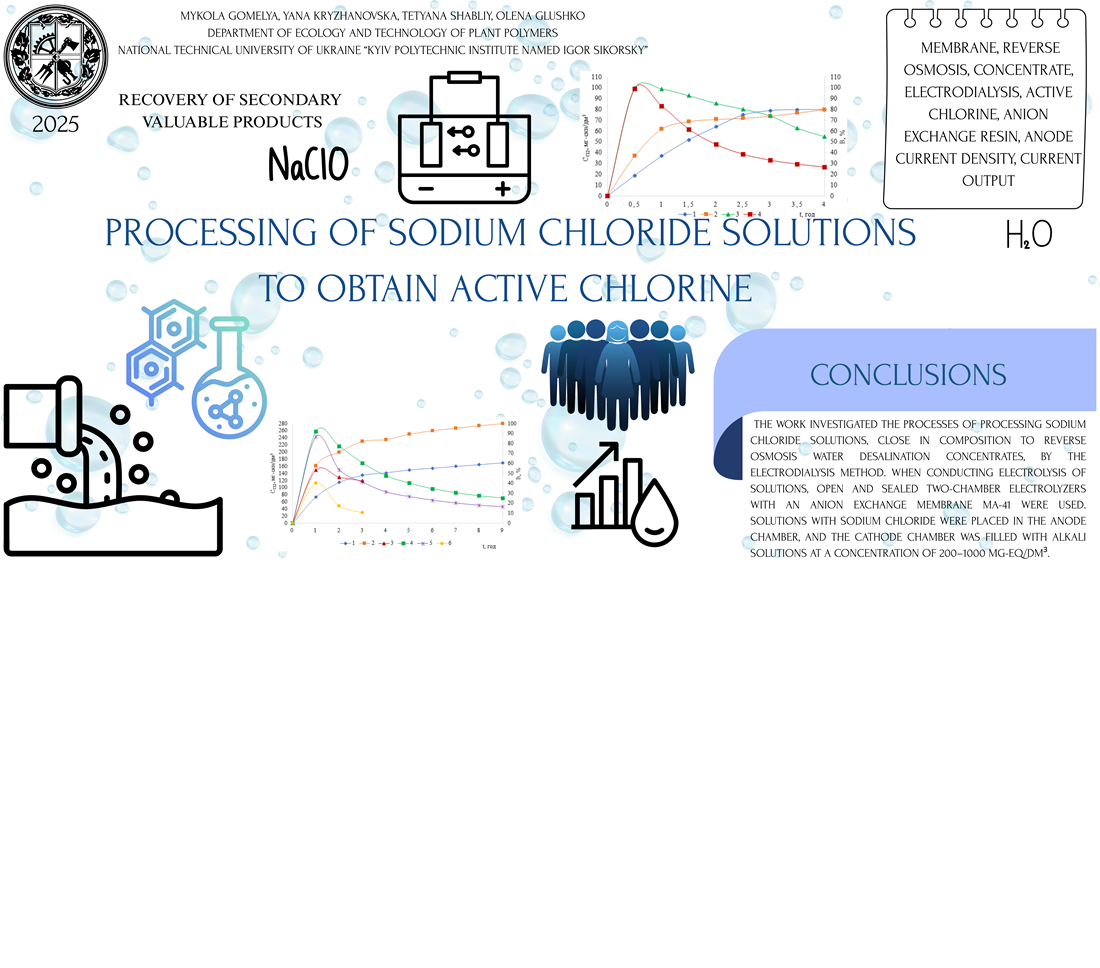
This study investigates processes related to processing sodium chloride solutions at a concentration of 3.5–120 g/dm3 by electrodialysis to solve the task of utilizing chlorine-containing concentrates of membrane water desalination to obtain active chlorine.
When electrolyzing the solutions, open and sealed two-chamber electrolyzers with an anion exchange membrane MA-41 were used. Solutions with NaCl were placed in the anode chamber, and the cathode chamber was filled with NaOH solutions (200–1000 mg-equiv./dm3).
The electrolysis processes were carried out at an anode current density of 1.67–12.5 A/dm2. With an increase in the anode current density and chloride concentration in the solution, the intensity of chloride oxidation increases. During the anodic oxidation of chlorides, hypochlorites and chlorides are formed along with the formation of chlorine in the presence of hydroxides. This confirms the ratio of the amounts of active chlorine and oxidized chlorides.
Prolonging the electrolysis time in an open electrolyzer does not contribute to an increase in the concentrations of oxidized chlorine in the anolyte because of its significant degassing. At low initial chloride concentrations (60 mg-equiv./dm3) and at low anodic current density (J = 0.83 A/dm2, 1.67 A/dm2), the yield of sodium hypochlorite reached 100.0–87.0%, respectively. At a current density of 4.17 A/dm2 and the same NaCl concentration, the yield of sodium hypochlorite decreased to 51.2%. The concentration of active chlorine in the solutions did not exceed 80–90 mg-equiv./dm3.
When using a sealed two-chamber electrolyzer, the bulk of the active chlorine was concentrated in the anolyte. To capture active chlorine vapors, gases from the anode zone were passed through a NaOH solution in the absorber. The concentrations of active chlorine in the anolytes reached 1240–1920 mg-equiv./dm3. The degree of degassing of active chlorine did not exceed 11–17%
References
- WHO Country Office in Ukraine annual report 2024 (2025). Copenhagen: WHO Regional Office for Europe, 116.
- Our Mission (2021). World Economic Forum.
- Trus, I., Gomelya, M., Tverdokhlib, M., Halysh, V., Radovenchyk, I., Benatov, D. (2022). Purification of Mine Waters Using Lime and Aluminum Hydroxochloride. Ecological Engineering & Environmental Technology, 23 (5), 169–176. https://doi.org/10.12912/27197050/152104
- Trus, I. M., Gomelya, M. D. (2021). Desalination of mineralized waters using reagent methods. Journal of Chemistry and Technologies, 29 (3), 417–424. https://doi.org/10.15421/jchemtech.v29i3.214939
- Pro yakist vody, pryznachenoi dlia spozhyvannia liudynoiu (1998). Dyrektyva Rady 98/83/IeS. 03.11.1998. Available at: https://online.budstandart.com/ua/catalog/doc-page.html?id_doc=60063
- Nyangi, M. J. (2023). Simultaneous removal of chloride and hardness from groundwater by cassava peel biosorption: Optimization and sorption studies. Remediation Journal, 34 (1). https://doi.org/10.1002/rem.21770
- Tsutano, K. (2022). Application of Monolithic Ion Exchange resins for the field of Ultrapure Water. Journal of Ion Exchange, 33 (3), 51–55. https://doi.org/10.5182/jaie.33.51
- Koliehova, A., Trokhymenko, H., Melnychuk, S., Gomelya, M. (2019). Treatment of Wastewater Containing a Mixture of Heavy Metal Ions (Copper-Zinc, Copper-Nickel) using Ion-Exchange Methods. Journal of Ecological Engineering, 20 (11), 146–151. https://doi.org/10.12911/22998993/112746
- Wang, Y., Yang, S. (2019). Thermodynamic analysis of an absorption-assisted multi-effect thermal desalination system with an extended operating temperature range. Desalination and Water Treatment, 155, 370–380. https://doi.org/10.5004/dwt.2019.23874
- Safder, U., Ifaei, P., Nam, K., Rashidi, J., Yoo, C. (2018). Availability and reliability analysis of integrated reverse osmosis – forward osmosis desalination network. Desalination and Water Treatment, 109, 1–7. https://doi.org/10.5004/dwt.2018.22147
- Vargas, C., Bórquez, R. (2020). Evaluation of the operation seawater and brackish water desalination system using two-pass nanofiltration. Desalination and Water Treatment, 204, 50–58. https://doi.org/10.5004/dwt.2020.26287
- Bagastyo, A. Y., Sari, P. P. I., Direstiyani, L. C. (2020). Effect of chloride ions on the simultaneous electrodialysis and electrochemical oxidation of mature landfill leachate. Environmental Science and Pollution Research, 28 (45), 63646–63660. https://doi.org/10.1007/s11356-020-11519-z
- Zhu, M., He, F., Feng, L., Chi, Y., Li, Y.-Y., Tian, B. (2024). Comparison of bipolar membrane electrodialysis, electrodialysis metathesis, and bipolar membrane electrodialysis multifunction for the conversion of waste Na2SO4: Process performance and economic analysis. Journal of Environmental Management, 370, 122513. https://doi.org/10.1016/j.jenvman.2024.122513
- Gomelya, M., Kryzhanovska, Y., Makarenko, I., Shabliy, T., Kyrylyuk, O. (2025). Evaluation of the efficiency of the processing of sodium chloride solutions by electrodialysis in a three-chamber electrolyzer using a high-basic anionite. Proceedings of the NTUU “Igor Sikorsky KPI”. Series: Chemical Engineering, Ecology and Resource Saving, 2, 60–69. https://doi.org/10.20535/2617-9741.2.2025.333975
- Gomelya, M., Kryzhanovska, Y., Pliatsuk, Y. (2024). Production of active chlorine and sodium hypochlorite in a closed electrolyser. Proceedings of the NTUU “Igor Sikorsky KPI”. Series: Chemical Engineering, Ecology and Resource Saving, 4, 41–50. https://doi.org/10.20535/2617-9741.4.2024.319015
- Liu, Q., Feng, T., Zhu, S., Lu, G. (2024). Simulation study of the electrothermal field in a chloride electrolysis cell with 16 electrode pairs. The Canadian Journal of Chemical Engineering, 102 (11), 3909–3921. https://doi.org/10.1002/cjce.25281
- Gomelya, M., Kryzhanovska, Y. (2023). Concentration of sodium chloride solutions in the processing of concentrates for reverse osmotic water desalification. Proceedings of the NTUU “Igor Sikorsky KPI”. Series: Chemical Engineering, Ecology and Resource Saving, 3, 85–93. https://doi.org/10.20535/2617-9741.3.2023.288253
- Akhter, M., Habib, G., Qamar, S. U. (2018). Application of Electrodialysis in Waste Water Treatment and Impact of Fouling on Process Performance. Journal of Membrane Science & Technology, 8 (2). https://doi.org/10.4172/2155-9589.1000182
- Martins, V. L., Ogden, M. D., Jones, M. R., Trowsdale, S. A., Hall, P. J., Jensen, H. S. (2020). Opportunities for coupled electrochemical and ion-exchange technologies to remove recalcitrant micropollutants in water. Separation and Purification Technology, 239, 116522. https://doi.org/10.1016/j.seppur.2020.116522
- Li, F., Jia, Y., Wang, M. (2024). Recovery of low-concentration waste acid by electrodialysis: Modeling and validation. Journal of Cleaner Production, 482, 144203. https://doi.org/10.1016/j.jclepro.2024.144203
- Gomelya, M., Kryzhanovska, Y., Shabliy, T., Makarenko, I., Hlushko, O., Vember, V. (2025). Synthesis of oxidized chlorine compounds by electrodialysis using a strongly basic anion exchange resin. Ecological Engineering & Environmental Technology, 26 (6), 98–107. https://doi.org/10.12912/27197050/204068
- Scarazzato, T., Panossian, Z., Tenório, J. A. S., Pérez-Herranz, V., Espinosa, D. C. R. (2017). A review of cleaner production in electroplating industries using electrodialysis. Journal of Cleaner Production, 168, 1590–1602. https://doi.org/10.1016/j.jclepro.2017.03.152
- Wang, D., Chen, X., Luo, J., Shi, P., Zhou, Q., Li, A., Pan, Y. (2024). Comparison of chlorine and chlorine dioxide disinfection in drinking water: Evaluation of disinfection byproduct formation under equal disinfection efficiency. Water Research, 260, 121932. https://doi.org/10.1016/j.watres.2024.121932
Downloads
Published
How to Cite
Issue
Section
License
Copyright (c) 2025 Mykola Gomelya, Yana Kryzhanovska, Tetyana Shabliy, Olena Hlushko

This work is licensed under a Creative Commons Attribution 4.0 International License.
The consolidation and conditions for the transfer of copyright (identification of authorship) is carried out in the License Agreement. In particular, the authors reserve the right to the authorship of their manuscript and transfer the first publication of this work to the journal under the terms of the Creative Commons CC BY license. At the same time, they have the right to conclude on their own additional agreements concerning the non-exclusive distribution of the work in the form in which it was published by this journal, but provided that the link to the first publication of the article in this journal is preserved.
A license agreement is a document in which the author warrants that he/she owns all copyright for the work (manuscript, article, etc.).
The authors, signing the License Agreement with TECHNOLOGY CENTER PC, have all rights to the further use of their work, provided that they link to our edition in which the work was published.
According to the terms of the License Agreement, the Publisher TECHNOLOGY CENTER PC does not take away your copyrights and receives permission from the authors to use and dissemination of the publication through the world's scientific resources (own electronic resources, scientometric databases, repositories, libraries, etc.).
In the absence of a signed License Agreement or in the absence of this agreement of identifiers allowing to identify the identity of the author, the editors have no right to work with the manuscript.
It is important to remember that there is another type of agreement between authors and publishers – when copyright is transferred from the authors to the publisher. In this case, the authors lose ownership of their work and may not use it in any way.





