Construction of a simulation model of the work of a warehouse enterprise as a link in the logistics chain
DOI:
https://doi.org/10.15587/1729-4061.2025.341456Keywords:
Abstract
This study investigates the process of organizing the work of a warehouse enterprise when servicing customers. The task set is to devise recommendations for planning the staffing of a warehouse enterprise, taking into account the duration of rendering services to customers.
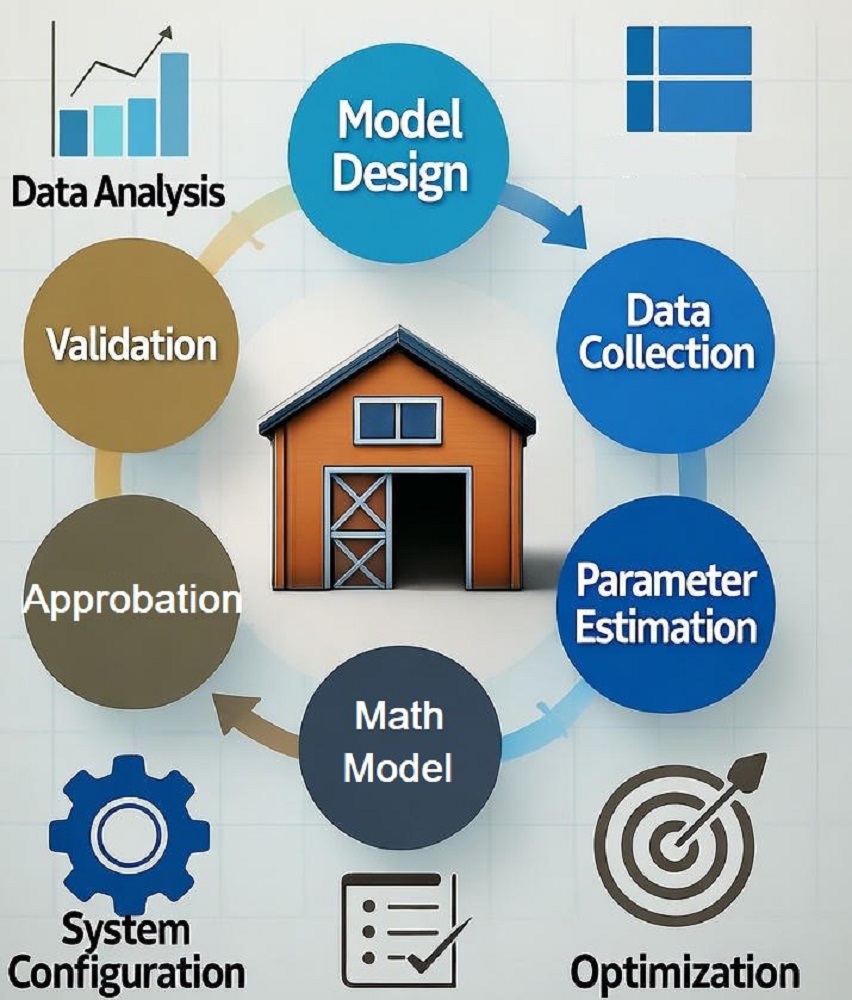
A simulation model of the work of a warehouse enterprise when servicing customers has been built and implemented in the GPSS World simulation modeling automation package. The model involves determining the duration of warehouse service and determining the required number of personnel to enable the work of the business entity by areas of activity.
When constructing the model, the duration of the types of work performed at individual stages of service performed by the warehouse enterprise personnel when processing foreign trade cargo was taken into account. In addition, the model takes into account the probability of errors and delays in rendering warehouse services at each stage of the business entity’s work, as well as the average delay time in the presence of errors. This can make it possible to determine the duration of additional employment of the enterprise personnel associated with the elimination of errors made in all types of work.
Applying the devised model in practice will allow owners of warehouse enterprises to organize and plan activities of the business entity when servicing customers. This will also make it possible to determine the duration of rendering warehouse services when performing foreign trade operations, taking into account the indicators of the efficiency of specialists.
At the same time, the probability of refusal to provide warehouse services to customers could decrease by 17% while the throughput capacity of the enterprise would increase by 22%
References
- Hosseini, M., Chalil Madathil, S., Khasawneh, M. T. (2025). Reinforcement learning-based simulation optimization for an integrated manufacturing-warehouse system: a two-stage approach. Expert Systems with Applications, 290, 128259. https://doi.org/10.1016/j.eswa.2025.128259
- Anoop, K. P., Panicker, V. V., Das, A. S., Abhishek, T., Vadlamani, P. S., Akhil, U. S. (2020). Simulation modelling and analysis of warehouse operations in a food grain supply chain. International Journal of Logistics Systems and Management, 37 (4), 465. https://doi.org/10.1504/ijlsm.2020.111853
- Erlangga, S. B., Yunita, A., Satriana, S. R. (2022). Development of Automatic Real Time Inventory Monitoring System using RFID Technology in Warehouse. JOIV : International Journal on Informatics Visualization, 6 (3), 636. https://doi.org/10.30630/joiv.6.3.1231
- Kim, T. Y. (2020). Improving warehouse responsiveness by job priority management: A European distribution centre field study. Computers & Industrial Engineering, 139, 105564. https://doi.org/10.1016/j.cie.2018.12.011
- Fedorko, G., Molnár, V., Mikušová, N. (2020). The Use of a Simulation Model for High-Runner Strategy Implementation in Warehouse Logistics. Sustainability, 12 (23), 9818. https://doi.org/10.3390/su12239818
- Zeng, Y., Li, W., Li, C. (2024). A dynamic simulation framework based on hybrid modeling paradigm for parallel scheduling systems in warehouses. Simulation Modelling Practice and Theory, 133, 102921. https://doi.org/10.1016/j.simpat.2024.102921
- Krynke, M. (2024). Virtual Simulation Modeling as a Key Element of Warehouse Location Optimization Strategy. Management Systems in Production Engineering, 32 (3), 339–344. https://doi.org/10.2478/mspe-2024-0032
- Dimitrov, R. (2024). Simulation Modelling of Multi-Agent Logistics Model in AnyLogistix Environment. Science, Engineering and Education, 9 (1), 75–82. https://doi.org/10.59957/see.v9.i1.2024.10
- Agalianos, K., Ponis, S. T., Aretoulaki, E., Plakas, G., Efthymiou, O. (2020). Discrete Event Simulation and Digital Twins: Review and Challenges for Logistics. Procedia Manufacturing, 51, 1636–1641. https://doi.org/10.1016/j.promfg.2020.10.228
- Hosseini, M., Chalil Madathil, S., Khasawneh, M. T. (2025). Reinforcement learning-based simulation optimization for an integrated manufacturing-warehouse system: a two-stage approach. Expert Systems with Applications, 290, 128259. https://doi.org/10.1016/j.eswa.2025.128259
- Erlangga, S. B., Yunita, A., Satriana, S. R. (2022). Development of Automatic Real Time Inventory Monitoring System using RFID Technology in Warehouse. JOIV : International Journal on Informatics Visualization, 6 (3), 636. https://doi.org/10.30630/joiv.6.3.1231
- Lebid, I., Luzhanska, N., Lebid, I., Mazurenko, A., Roi, M., Medvediev, I. et al. (2023). Development of a simulation model of the activities of a transport and forwarding enterprise in the organization of international road cargo transportation. Eastern-European Journal of Enterprise Technologies, 6 (3 (126)), 6–17. https://doi.org/10.15587/1729-4061.2023.291039
- GPSS World Reference Manual (20021). Holly Springs NC, 305. Available at: https://athena.ecs.csus.edu/~mitchell/csc148/gpssW/Reference%20Manual/reference_manual.htm
Downloads
Published
How to Cite
Issue
Section
License
Copyright (c) 2025 Ievgenii Lebid, Nataliia Luzhanska, Iryna Lebid, Alexander Mazurenko, Iryna Mykhailenko, Svitlana Sharai

This work is licensed under a Creative Commons Attribution 4.0 International License.
The consolidation and conditions for the transfer of copyright (identification of authorship) is carried out in the License Agreement. In particular, the authors reserve the right to the authorship of their manuscript and transfer the first publication of this work to the journal under the terms of the Creative Commons CC BY license. At the same time, they have the right to conclude on their own additional agreements concerning the non-exclusive distribution of the work in the form in which it was published by this journal, but provided that the link to the first publication of the article in this journal is preserved.
A license agreement is a document in which the author warrants that he/she owns all copyright for the work (manuscript, article, etc.).
The authors, signing the License Agreement with TECHNOLOGY CENTER PC, have all rights to the further use of their work, provided that they link to our edition in which the work was published.
According to the terms of the License Agreement, the Publisher TECHNOLOGY CENTER PC does not take away your copyrights and receives permission from the authors to use and dissemination of the publication through the world's scientific resources (own electronic resources, scientometric databases, repositories, libraries, etc.).
In the absence of a signed License Agreement or in the absence of this agreement of identifiers allowing to identify the identity of the author, the editors have no right to work with the manuscript.
It is important to remember that there is another type of agreement between authors and publishers – when copyright is transferred from the authors to the publisher. In this case, the authors lose ownership of their work and may not use it in any way.







