Розробка системи підтримки прийняття рішень для аргументованого вибору машин для виготовлення шкіряних виробів
DOI:
https://doi.org/10.15587/1729-4061.2025.341457Ключові слова:
вибір машини, база даних, технологічна операція, швейне виробництво, система підтримки рішеньАнотація
Об’єктом дослідження є процес відбору швейного обладнання для виготовлення швейних виробів зі штучної шкіри. Незважаючи на активний розвиток технологічних рішень для автоматизації, проблема вибору оптимального обладнання залишається актуальною, вимагаючи додаткових інструментів, які здатні забезпечити зв’язок між науковими підходами та умовами виробництва. У даній роботі представлено результати розробки автоматизованої системи підтримки прийняття рішень у процесах підбору швейного обладнання, що має на меті практичну адаптацію теоретичних моделей до потреб виробництва.
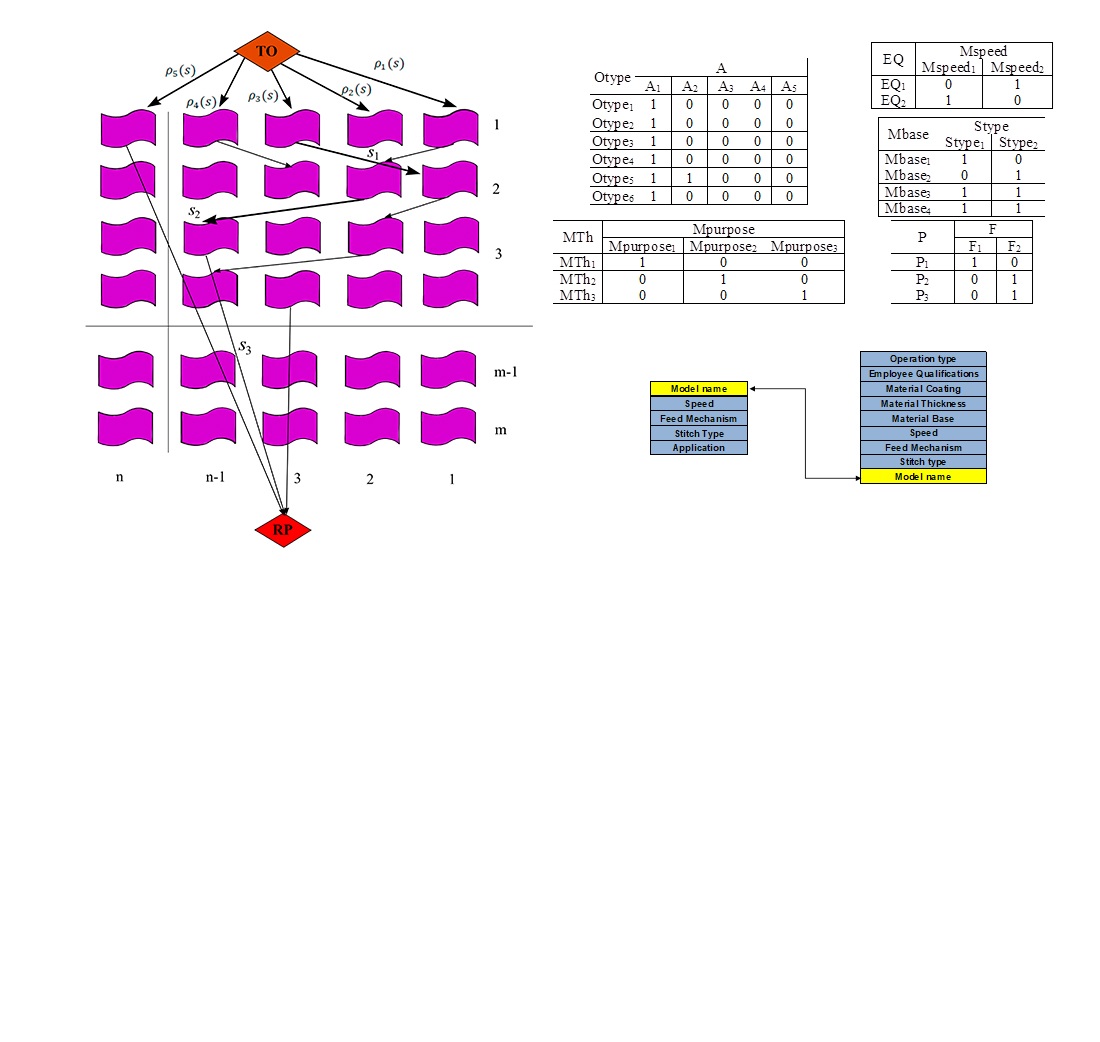
Розробка базується на трирівневій структурі бази даних: на рівні зберігання даних сформовано базу параметрів обладнання у вигляді матриці, що забезпечує узгодженість інформації про технологічні операції, матеріали та характеристики машин. На логічному рівні розроблено алгоритм багатофакторного аналізу, що використовує принципи теорії графів, бінарну матрицю та метод лінійного програмування для вибору оптимальної моделі обладнання. Презентаційний рівень представлено інтерактивним інтерфейсом на базі MS Excel (США). Вхідні параметри обираються простим натисканням на кнопки з відповідними назвами (тип шва, кваліфікація робітника, властивості та товщина матеріалу). Система автоматично проводить аналіз бази даних і формує перелік рекомендованого обладнання у вигляді таблиці.
Верифікація виконана шляхом опитування за участю 30 осіб (86,7% представники академічного середовища). При цьому, 93,3% респондентів відзначили високу швидкість роботи, 90,0% оцінили практичність, а 86,7% зручність. Разом із тим, 23,3% опитаних наголосили на потребі розширення бази даних, а 16,7% акцентували увагу на необхідності впровадження україномовної версії.
Встановлено, що розроблена система є універсальним інструментом, який поєднує освітній та виробничо-прикладний виміри. Впровадження в освітній процес сприятиме досягненню низки програмних результатів навчання
Посилання
- Meyer, M., Dietrich, S., Schulz, H., Mondschein, A. (2021). Comparison of the Technical Performance of Leather, Artificial Leather, and Trendy Alternatives. Coatings, 11 (2), 226. https://doi.org/10.3390/coatings11020226
- Tokuda, F., Murakami, R., Seino, A., Kobayashi, A., Hayashibe, M., Kosuge, K. (2025). Fixture-Free 2D Sewing Using a Dual-Arm Manipulator System. IEEE Transactions on Automation Science and Engineering, 22, 7927–7940. https://doi.org/10.1109/tase.2024.3474914
- Kong, R. W. M. (2025). Innovative Automated Stretch Elastic Waistband Sewing Machine for Garment Manufacturing. International Research Journal of Modernization in Engineering Technology and Science. https://doi.org/10.56726/irjmets70275
- Jindal, H., Kaur, S. (2021). Robotics and Automation in Textile Industry. International Journal of Scientific Research in Science, Engineering and Technology, 8 (3), 40–45. https://doi.org/10.32628/ijsrset21839
- Forlini, M., Ciccarelli, M., Carbonari, L., Papetti, A., Palmieri, G. (2024). Smart automation in luxury leather shoe polishing: a human centric robotic approach. International Journal of Computer Integrated Manufacturing, 38 (9), 1329–1343. https://doi.org/10.1080/0951192x.2024.2421313
- Huan, Y., Ren, G., Sun, J., Jin, G., Ding, X., Du, W. (2024). Efficient leather spreading operations by dual-arm robotic systems. Scientific Reports, 14 (1). https://doi.org/10.1038/s41598-024-66904-2
- Seino, A., Terayama, J., Tokuda, F., Kobayashi, A., Kosuge, K. (2022). Robot End-effector for Fabric Folding. https://doi.org/10.36227/techrxiv.21283725.v1
- Boz, S., Birkocak, D. T., Necef, Ö. K., Kiliç, A., Öndoğan, Z. (2022). Investigation of sewing parameters caused fabric damages. W: AUTEX 2022 : 21st World Textile Conference AUTEX 2022 - AUTEX Conference Proceedings. Lodz, 40–44. https://doi.org/10.34658/9788366741751.9
- Tang, K., Tokuda, F., Seino, A., Kobayashi, A., Tien, N. C., Kosuge, K. (2024). Time-Scaling Modeling and Control of Robotic Sewing System. IEEE/ASME Transactions on Mechatronics, 29 (4), 3166–3174. https://doi.org/10.1109/tmech.2024.3398713
- Martínez-Peral, F. J., Migallón, H., Borrell-Méndez, J., Martínez-Rach, M., Pérez-Vidal, C. (2024). Manipulation order optimization in industrial pick-and-place operations: application to textile and leather industry. The International Journal of Advanced Manufacturing Technology, 133 (1-2), 987–1010. https://doi.org/10.1007/s00170-024-13436-8
- Zakharkevich, O., Zhylenko, T., Koshevko, J., Shvets, G. (2023). Development of an algorithm for the reasoned selection of machines for leather garments manufacturing. Eastern-European Journal of Enterprise Technologies, 5 (3 (125)), 86–94. https://doi.org/10.15587/1729-4061.2023.287482
- Shahriar, M. M., Parvez, M. S., Talapatra, S. (2022). Hierarchizing the Product Characteristics of Industrial Plain Sewing Machine for Making Best Purchase Decision. Mathematical Problems in Engineering, 2022, 1–17. https://doi.org/10.1155/2022/2578875
- Kalwar, M. A., Khan, M. A., Wassan, A. N., Phul, Z., Shaikh, S. A., Marri, H. B. (2023). Automation of Post-Order Costing Analysis By Using Visual Basic For Applications In Microsoft Excel: A Case Study. WPOM-Working Papers on Operations Management, 14 (2), 101–136. https://doi.org/10.4995/wpom.18697
- Swaminathan, V., Saffiudeen, M. F., Gupta, S., Alamri, Y. A. (2024). Review of semiconductor laser diode technologies for sustainable energy in leather machining. Clean Technologies and Environmental Policy, 27 (2), 577–606. https://doi.org/10.1007/s10098-024-02976-y
- Werheid, J., Melnychuk, O., Zhou, H., Huber, M., Rippe, C., Joosten, D. et al. (2024). Designing an LLM-Based Copilot for Manufacturing Equipment Selection. arXiv. https://doi.org/10.48550/arXiv.2412.13774
- Kefale, G. Y., Bizuneh, B., Getachew, L., Karthikeyan, R. (2025). Innovative Pathways in Leather Industry: A Comprehensive Review of Sustainable Technologies and Strategies. Journal of Scientific & Industrial Research, 84 (6). https://doi.org/10.56042/jsir.v84i6.10781
- Kim, M., Ahn, J., Kang, J., Kim, S. (2020). A Systematic Review on Smart Manufacturing in the Garment Industry. Fashion & Textile Research Journal, 22 (5), 660–675. https://doi.org/10.5805/sfti.2020.22.5.660
- Zakharkevich, O., Poluchovich, I., Kuleshova, S., Koshevko, J., Shvets, G., Shvets, A. (2021). “CloStyler” – mobile application to calculate the parameters of clothing blocks. IOP Conference Series: Materials Science and Engineering, 1031 (1), 012031. https://doi.org/10.1088/1757-899x/1031/1/012031
- Zakharkevich, O., Koshevko, J., Shvets, G., Kuleshova, S., Bazyliuk, E., Paraska, O., Kazlacheva, Z. (2022). Development of the Mobile Application to Calculate Parameters of Underwear Patterns. Terotechnology XII, 24, 309–315. https://doi.org/10.21741/9781644902059-45
- Karakiş, E. (2021). Machine Selection for a Textile Company with CRITIC and MAUT Methods. European Journal of Science and Technology. https://doi.org/10.31590/ejosat.994697
- Ulutaş, A. (2020). New Grey Integrated Model to Solve Machine Selection Problem for a Textile Company. Fibres and Textiles in Eastern Europe, 28 (1 (139)), 20–25. https://doi.org/10.5604/01.3001.0013.5853
- Tama Birkocak, D. (2022). Effects of Needle Size and Sewing Thread on Seam Quality of Traditional Fabrics. Tekstil ve Konfeksiyon, 32 (3), 277–287. https://doi.org/10.32710/tekstilvekonfeksiyon.1088043
- Syabani, Muh. W., Devi, C., Hermiyati, I., Angkasa, A. D. (2020). The effect of PVC’s resin K-value on the mechanical properties of the artificial leather. Majalah Kulit, Karet, Dan Plastik, 35 (2), 75. https://doi.org/10.20543/mkkp.v35i2.5639
- Watanabe, S., Tominaga, S., Horiuchi, T. (2020). The Difference in Impression between Genuine and Artificial Leather: Quantifying the Feeling of Authenticity. Journal of Perceptual Imaging, 3 (2), 020501-1-020501–020511. https://doi.org/10.2352/j.percept.imaging.2020.3.2.020501
- Ersöz, T., Tenbeli, R., Ersöz, F. (2021). Visual analysis of turkey's textile sector with Gephi complex network. Proceding of 11th International Symposium on Intelligent Manufacturing and Service System. Sakarya, 519–529. https://doi.org/10.5281/zenodo.16411310
- Angeli. Available at: https://angeli.net.ua/uk/juki
- Amtex. Available at: https://amtex.com.ua/brands/shvejnoe_oborydovanie_juki/
- Lapka.com.ua. Available at: https://www.lapka.com.ua/ua/brand-juki.aspx
- Sewtech. Available at: https://sewtech.com.ua/uk/promislovi-shvejni-mashini/brand-juki/
- What is an Industrial Sewing Machine? Juki. Available at: https://www.juki.co.jp/en/products/industrial/
- How to Analyze Data in Excel? Quick and Easy Steps. Available at: https://techbii.com/how-to-analyze-data-in-excel-quick-and-easy-steps/
- Zakharkevich, O., Paraska, O., Koshevko, J., Shvets, G., Shvets, A., Zhylenko, T. (2023). Development of a Mobile Application to Study Sewing Techniques for Manufacturing Fur and Leather Clothes. Fibres & Textiles in Eastern Europe, 31 (2), 1–10. https://doi.org/10.2478/ftee-2023-0011
- TechLab. Available at: https://play.google.com/store/apps/details?id=appinventor.ai_zbirvukladach.TL1&hl=uk&gl=US
- ISO 4916:1991 (1991). Textiles – Seam types – Classification and terminology. Printed in Switzerland/lmprime en Suisse, 64.
- Osvitnia prohrama «Tekhnolohiyi lehkoi promyslovosti» (riven mahistr) (2025). Available at: https://khmnu.edu.ua/wp-content/op/m/g15-ktshv-2025.pdf
- Poluda, S. N., Koval, T. V., Boksha, N. I. (2016). Tekhnolohiya shveinoho vyrobnytstva ta osnastka. Mukachevo: MDU, 93.
- Tran, K. P. (2022). Machine Learning and Probabilistic Graphical Models for Decision Support Systems. CRC Press. https://doi.org/10.1201/9781003189886
- He, Z., Tran, K.-P., Thomassey, S., Zeng, X., Xu, J., Yi, C. (2021). A deep reinforcement learning based multi-criteria decision support system for optimizing textile chemical process. Computers in Industry, 125, 103373. https://doi.org/10.1016/j.compind.2020.103373
- Di Domenico, A. (2023). Entanglement, CPT, and Neutral Kaons. CPT and Lorentz Symmetry, 74–78. https://doi.org/10.1142/9789811275388_0016
##submission.downloads##
Опубліковано
Як цитувати
Номер
Розділ
Ліцензія
Авторське право (c) 2025 Oksana Zakharkevich, Julia Koshevko, Tetyana Zhylenko, Galina Shvets, Svitlana Kuleshova, Volodymyr Onofriichuk, Alona Diakova

Ця робота ліцензується відповідно до Creative Commons Attribution 4.0 International License.
Закріплення та умови передачі авторських прав (ідентифікація авторства) здійснюється у Ліцензійному договорі. Зокрема, автори залишають за собою право на авторство свого рукопису та передають журналу право першої публікації цієї роботи на умовах ліцензії Creative Commons CC BY. При цьому вони мають право укладати самостійно додаткові угоди, що стосуються неексклюзивного поширення роботи у тому вигляді, в якому вона була опублікована цим журналом, але за умови збереження посилання на першу публікацію статті в цьому журналі.
Ліцензійний договір – це документ, в якому автор гарантує, що володіє усіма авторськими правами на твір (рукопис, статтю, тощо).
Автори, підписуючи Ліцензійний договір з ПП «ТЕХНОЛОГІЧНИЙ ЦЕНТР», мають усі права на подальше використання свого твору за умови посилання на наше видання, в якому твір опублікований. Відповідно до умов Ліцензійного договору, Видавець ПП «ТЕХНОЛОГІЧНИЙ ЦЕНТР» не забирає ваші авторські права та отримує від авторів дозвіл на використання та розповсюдження публікації через світові наукові ресурси (власні електронні ресурси, наукометричні бази даних, репозитарії, бібліотеки тощо).
За відсутності підписаного Ліцензійного договору або за відсутністю вказаних в цьому договорі ідентифікаторів, що дають змогу ідентифікувати особу автора, редакція не має права працювати з рукописом.
Важливо пам’ятати, що існує і інший тип угоди між авторами та видавцями – коли авторські права передаються від авторів до видавця. В такому разі автори втрачають права власності на свій твір та не можуть його використовувати в будь-який спосіб.