Design of an alternative energy source based on a multistage thermoacoustic engine with external heat supply
DOI:
https://doi.org/10.15587/1729-4061.2025.341710Keywords:
thermoacoustic engine, low-grade heat, autonomous power supply, energy efficiency, geothermal, Stirling engineAbstract
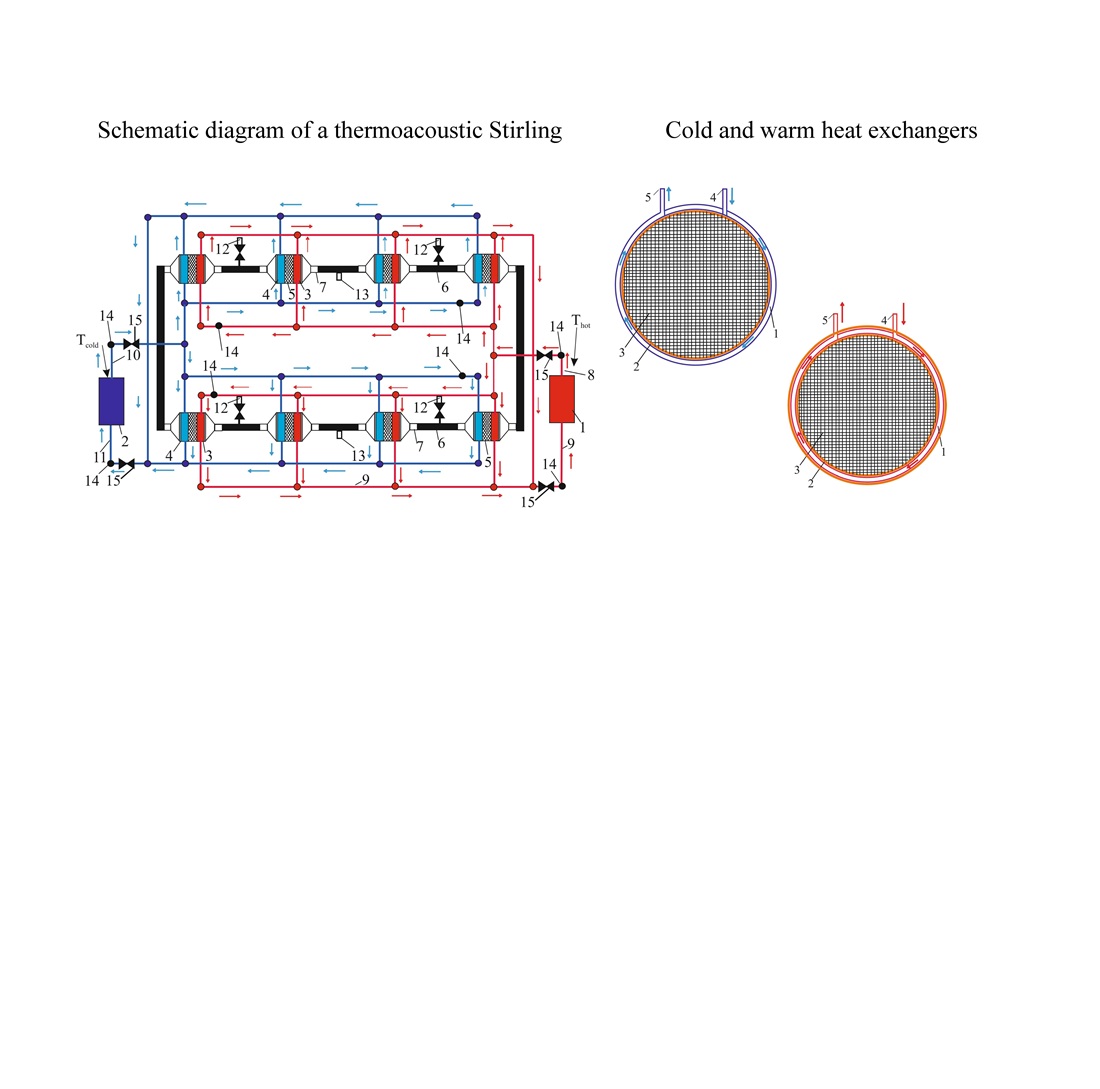
This study considers a multistage thermoacoustic engine with an external heat supply, used to convert low-grade heat from solar and geothermal sources into electrical energy.
The study [k of improving the efficiency of thermoacoustic engines using low-grade heat sources remains unresolved because of high self-starting temperatures and significant heat loss. This study examines an approach based on the design of a multistage thermoacoustic engine with an external heat supply, which reduces the starting temperature and improves efficiency.
To achieve this goal, mathematical modeling was performed in the DeltaEC environment using a linear approximation of Rott equations; a laboratory prototype of an eight-stage engine was designed. The results showed that at a heater temperature of 105°C and an average pressure of 2 bar, an acoustic oscillation frequency of 64 Hz and an electrical power of up to 80 W are achieved with an efficiency of approximately 12%.
Distinctive features of the proposed structure include optimized stage and resonator geometry, the use of a traveling acoustic wave, as well as the ability to operate at low heating temperatures, which distinguishes it from existing analogs. It has been established that increasing the stage diameter to an optimal ratio of 10:1 relative to the resonator, improving thermal insulation, and increasing pressure to 8 bar could increase efficiency by up to 40%.
The practical significance of this work is its potential for implementing the designed engine in autonomous power supply systems in rural and remote areas of the Republic of Kazakhstan where electricity costs are traditionally higher and fuel delivery is difficult. The results confirm the feasibility of using thermoacoustic technologies for sustainable and environmentally friendly energy supply
References
- Beisengazin, K. (2025). Coal Sector of Kazakhstan: Challenges and Opportunities for Decarbonizing the Economy. Integrated Policy Strategies and Regional Policy Coordination for Resilient, Green and Transformative Development: Supporting Selected Asian BRI Partner Countries to Achieve 2030 Sustainable Development Agenda. Available at: https://unctad.org/system/files/information-document/unda2030d26-kazakhstan-coal_en.pdf?
- Smatayeva, A., Temerbulatova, Z., Kakizhanova, T. (2024). The Impact of Economic and Environmental Factors on the Consumption of Renewable Energy: The Case of Kazakhstan. Eurasian Journal of Economic and Business Studies, 68 (4), 61–75. https://doi.org/10.47703/ejebs.v68i4.443
- Zhakiyev, N., Burkhanova, D., Nurkanat, A., Zhussipkaliyeva, S., Sospanova, A., Khamzina, A. (2025). Green energy in grey areas: The financial and policy challenges of Kazakhstan’s energy transition. Energy Research & Social Science, 124, 104046. https://doi.org/10.1016/j.erss.2025.104046
- Minazhova, S., Kurrat, M., Ongar, B., Georgiev, A. (2025). Deploying a rooftop PV panels in the southern regions of Kazakhstan. Energy, 320, 135205. https://doi.org/10.1016/j.energy.2025.135205
- Mouraviev, N. (2021). Renewable energy in Kazakhstan: Challenges to policy and governance. Energy Policy, 149, 112051. https://doi.org/10.1016/j.enpol.2020.112051
- Walker, G. (1980). Stirling Engines. Oxford: Clarendon Pres, 276. Available at: https://www.scribd.com/doc/45062130/Stirling-Engines-G-Walker-Oxford-1980-WW
- Fit, W. C. (Ed.) (1980). Steam Stirling Engines You Can Build. Village Press Publications, 169. Available at: https://www.scribd.com/document/820789063/Steam-Stirling-Engines-You-Can-Build
- Mekhtiyev, A. D., Sarsikeyev, Y. Zh., Yugay, V. V., Neshina, E. G., Alkina, A. D. (2021). Thermoacoustic engine as a low-power cogeneration energy source for autonomous consumer power supply. Eurasian Physical Technical Journal, 18 (12 (36)), 60–66. https://doi.org/10.31489/2021no2/60-66
- Tijani, M. E. H., Spoelstra, S. (2011). A high performance thermoacoustic engine. Journal of Applied Physics, 110 (9). https://doi.org/10.1063/1.3658872
- Kruse, A., Ruziewicz, A., Tajmar, M., Gnutek, Z. (2017). A numerical study of a looped-tube thermoacoustic engine with a single-stage for utilization of low-grade heat. Energy Conversion and Management, 149, 206–218. https://doi.org/10.1016/j.enconman.2017.07.010
- de Blok, K. (2010). Novel 4-Stage Traveling Wave Thermoacoustic Power Generator. ASME 2010 3rd Joint US-European Fluids Engineering Summer Meeting collocated with 8th International Conference on Nanochannels, Microchannels, and Minichannels, 73–79. https://doi.org/10.1115/fedsm-icnmm2010-30527
- Sarsikeyev, Y., Mekhtiyev, A., Neshina, Y., Alkina, A., Mekhtiyev, R., Sharipov, T. (2024). An Alternative Thermoacoustic Energy Source for Power Supply to Autonomous Consumers. International Journal on Energy Conversion (IRECON), 12 (5), 184. https://doi.org/10.15866/irecon.v12i5.24875
- Kropachev, P. A., Mekhtiyev, A. D., Bulatbayev, F. N., Sarsikeyev, Y. Zh. (2021). Method of restoring pivot connections cast iron Bushings of heat engine with external heat supply. Metalurgija, 60 (3-4), 343–346. Available at: https://hrcak.srce.hr/file/372269
- Nikonova, T., Zharkevich, O., Dandybaev, E., Baimuldin, M., Daich, L., Sichkarenko, A., Kotov, E. (2021). Developing a Measuring System for Monitoring the Thickness of the 6 m Wide HDPE/LDPE Polymer Geomembrane with Its Continuous Flow Using Automation Equipment. Applied Sciences, 11 (21), 10045. https://doi.org/10.3390/app112110045
- Mekhtiyev, A., Breido, I., Buzyakov, R., Neshina, Y., Alkina, A. (2021). Development of low-pressure electric steam heater. Eastern-European Journal of Enterprise Technologies, 4 (8 (112)), 34–44. https://doi.org/10.15587/1729-4061.2021.237873
- Huntingford, F., Kisha, W. (2022). Algorithmic optimisation of the electrical power output of a low-cost, multicore thermoacoustic engine with varying resonator pressure. Sustainable Energy Technologies and Assessments, 49, 101776. https://doi.org/10.1016/j.seta.2021.101776
- Farikhah, I., Elsharkawy, E. A., Nuroso, H., Novita, M., Marlina, D., Rahmatunnisa, K. et al. (2021). Study of Stack Length on Efficiency of Thermoacoustic Engine. 2021 IEEE 3rd Eurasia Conference on IOT, Communication and Engineering (ECICE), 580–582. https://doi.org/10.1109/ecice52819.2021.9645691
- Sun, D., Luo, K., Zhang, J., Yu, Y. S. W., Pan, H. (2021). A novel non-linear one-dimensional unsteady model for thermoacoustic engine and its application on a looped traveling-wave thermoacoustic engine. Applied Acoustics, 181, 108136. https://doi.org/10.1016/j.apacoust.2021.108136
- Guk, S., Lee, J., Kim, J., Lee, M. (2025). Advances and Challenges in Thermoacoustic Network Modeling for Hydrogen and Ammonia Combustors. Energies, 18 (2), 346. https://doi.org/10.3390/en18020346
- Korobko, V., Shevtsov, A., Serbin, S., Wen, H., Dzida, M. (2025). Experimental Study of a Phase-Change Thermoacoustic Engine for Maritime Waste Heat Recovery System. Polish Maritime Research, 32 (2), 84–93. https://doi.org/10.2478/pomr-2025-0023
- Baccoli, R., Di Meglio, A., Fenu, A., Massarotti, N. (2025). Design and performance of a ThermoAcoustic Electric Generator powered by waste-heat based on linear and nonlinear modelling. Applied Thermal Engineering, 276, 126938. https://doi.org/10.1016/j.applthermaleng.2025.126938
- Rodriguez, J., Dyson, R. W., Wernet, M. P., Leibach, R. J. (2025). Thermoacoustic Thermal Management for Electric Aircraft. NASA Technical Report. AIAA SciTech Forum. Available at: https://ntrs.nasa.gov/citations/20240015017
- Xiao, L., Luo, K., Zhao, D., Wu, Z., Xu, J., Luo, E. (2024). A highly efficient heat-driven thermoacoustic cooling system: Detailed study. Energy, 293, 130610. https://doi.org/10.1016/j.energy.2024.130610
- Farikhah, I., Elsharkawy, E. A., Nuroso, H., Novita, M., Marlina, D., Rahmatunnisa, K. et al. (2021). Study of Stack Length on Efficiency of Thermoacoustic Engine. 2021 IEEE 3rd Eurasia Conference on IOT, Communication and Engineering (ECICE), 580–582. https://doi.org/10.1109/ecice52819.2021.9645691
Downloads
Published
How to Cite
Issue
Section
License
Copyright (c) 2025 Aliya Alkina, Yermek Sarsikeyev, Ali Mekhtiyev, Yelena Neshina, Ruslan Mekhtiyev

This work is licensed under a Creative Commons Attribution 4.0 International License.
The consolidation and conditions for the transfer of copyright (identification of authorship) is carried out in the License Agreement. In particular, the authors reserve the right to the authorship of their manuscript and transfer the first publication of this work to the journal under the terms of the Creative Commons CC BY license. At the same time, they have the right to conclude on their own additional agreements concerning the non-exclusive distribution of the work in the form in which it was published by this journal, but provided that the link to the first publication of the article in this journal is preserved.
A license agreement is a document in which the author warrants that he/she owns all copyright for the work (manuscript, article, etc.).
The authors, signing the License Agreement with TECHNOLOGY CENTER PC, have all rights to the further use of their work, provided that they link to our edition in which the work was published.
According to the terms of the License Agreement, the Publisher TECHNOLOGY CENTER PC does not take away your copyrights and receives permission from the authors to use and dissemination of the publication through the world's scientific resources (own electronic resources, scientometric databases, repositories, libraries, etc.).
In the absence of a signed License Agreement or in the absence of this agreement of identifiers allowing to identify the identity of the author, the editors have no right to work with the manuscript.
It is important to remember that there is another type of agreement between authors and publishers – when copyright is transferred from the authors to the publisher. In this case, the authors lose ownership of their work and may not use it in any way.







