Improving the model of a system that maintains a microclimate regime in a single-family house by using a reversible heat pump
DOI:
https://doi.org/10.15587/1729-4061.2025.342027Keywords:
heat pump, energy saving, building's thermal state, thermal inertia, energy storage deviceAbstract
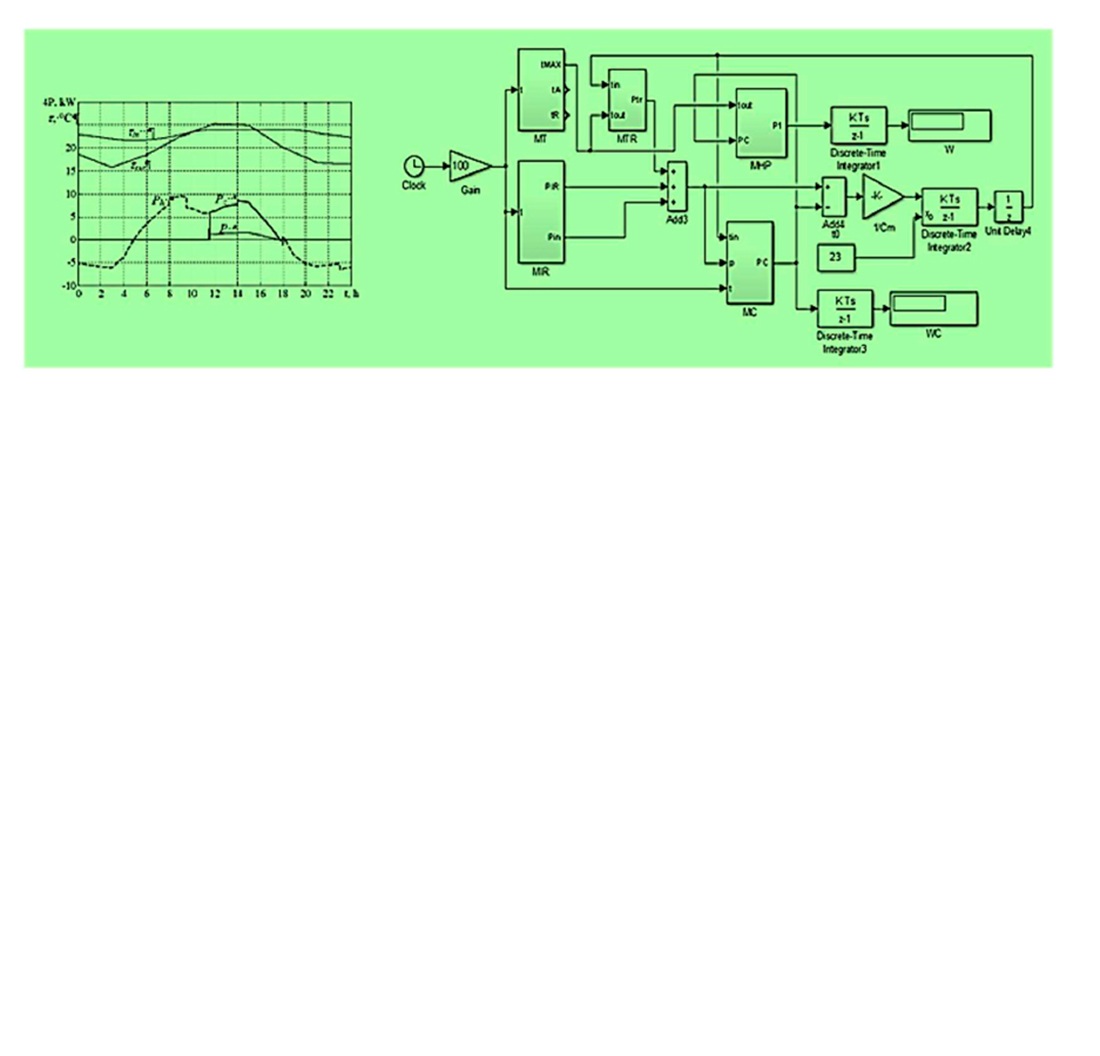
This study mathematically models energy processes within the microclimate control system in a single-family house equipped with a reversible heat pump.
This paper reports an improved model of the microclimate system considering the dynamics to construct plots of electricity consumption under various operating conditions. Data from the calculated thermal parameters of the building were applied. A model of the reversible heat pump has been proposed, based on manufacturer specifications, allowing for the assessment of electricity consumption across the full range of power and temperature variations.
The microclimate system model of the building with a heat pump has been improved by accounting for the building’s thermal inertia. This makes it possible to evaluate temperature regimes and energy consumption under dynamic modes, bringing the simulated electricity usage closer to real-world values.
Hourly profiles of solar radiation and outdoor temperature for the building’s location, along with expected schedules of internal heat gains, were used. Energy consumption and instantaneous power values, including peak loads, were assessed. It is shown that, for a building in Kyiv with a floor area of 120 m2, under a heating mode, minimum electricity consumption occurs at a minimum heat carrier temperature of 35°C at a COP of 3.44.
The selected heat pump may operate under a monovalent mode down to –13°C. The potential for reducing energy consumption by adjusting the temperature regime is limited because of a significant increase in power demand from the heat pump under a dynamic mode.
Under a cooling mode, hourly air temperature profiles from historical data were used, along with representative values, to evaluate the range of energy consumption variation. An example involving changes in window area demonstrates the model’s applicability for adjusting building parameters to reduce energy consumption
References
- Vanhoudt, D., Geysen, D., Claessens, B., Leemans, F., Jespers, L., Van Bael, J. (2014). An actively controlled residential heat pump: Potential on peak shaving and maximization of self-consumption of renewable energy. Renewable Energy, 63, 531–543. https://doi.org/10.1016/j.renene.2013.10.021
- Chaikovskaya, E. (2020). Development of Smart Grid technology for maintaining the functioning of a biogas cogeneration system. Eastern-European Journal of Enterprise Technologies, 3 (8 (105)), 56–68. https://doi.org/10.15587/1729-4061.2020.205123
- Niekurzak, M., Lewicki, W., Drożdż, W., Miązek, P. (2022). Measures for Assessing the Effectiveness of Investments for Electricity and Heat Generation from the Hybrid Cooperation of a Photovoltaic Installation with a Heat Pump on the Example of a Household. Energies, 15 (16), 6089. https://doi.org/10.3390/en15166089
- Zajacs, A., Lebedeva, K., Bogdanovičs, R. (2023). Evaluation of Heat Pump Operation in a Single-Family House. Latvian Journal of Physics and Technical Sciences, 60 (3), 85–98. https://doi.org/10.2478/lpts-2023-0019
- Wilbur, B., Fung, A. S., Kumar, R. (2024). Thermal System and Net-Zero-Carbon Least-Cost Design Optimization of New Detached Houses in Canada. Buildings, 14 (9), 2870. https://doi.org/10.3390/buildings14092870
- Installation instructions AERO ILM. Available at: https://www.c-o-k.ru/library/instructions/idm/teplovye-nasosy/29558/108525.pdf
- Zhou, K., Zhu, S., Wang, Y., Roskilly, A. P. (2024). Modelling and Experimental Characterisation of a Water-to-Air Thermoelectric Heat Pump with Thermal Energy Storage. Energies, 17 (2), 414. https://doi.org/10.3390/en17020414
- Kahsay, M. B., Völler, S. (2025). Thermal energy storage for increasing self-consumption of grid connected photovoltaic systems: A case for Skjetlein High School, Norway. Energy and Buildings, 335, 115563. https://doi.org/10.1016/j.enbuild.2025.115563
- Pater, S. (2023). Increasing Energy Self-Consumption in Residential Photovoltaic Systems with Heat Pumps in Poland. Energies, 16 (10), 4003. https://doi.org/10.3390/en16104003
- Nibe F2120 8 Manuals. Available at: https://www.manualslib.com/products/Nibe-F2120-8-6902998.html
- Mendaza, I. D. de C., Bak-Jensen, B., Chen, Z. (2013). Electric Boiler and Heat Pump Thermo-Electrical Models for Demand Side Management Analysis in Low Voltage Grids. International Journal of Smart Grid and Clean Energy, 2 (1), 52–59. https://doi.org/10.12720/sgce.2.1.52-59
- Shavolkin, O., Shvedchykova, I., Kolcun, M., Medved, D., Mazur, D., Kwiatkowski, B. (2024). Increasing photovoltaic self-consumption for objects using domestic hot water systems. Archives of Electrical Engineering, 73 (3), 573–573. https://doi.org/10.24425/aee.2024.150884
- Dejvises, J., Tanthanuch, N. (2016). A Simplified Air-conditioning Systems Model with Energy Management. Procedia Computer Science, 86, 361–364. https://doi.org/10.1016/j.procs.2016.05.099
- Kim, N.-K., Shim, M.-H., Won, D. (2018). Building Energy Management Strategy Using an HVAC System and Energy Storage System. Energies, 11 (10), 2690. https://doi.org/10.3390/en11102690
- House Heating System. MathWorks. Available at: https://www.mathworks.com/help/hydro/ug/house-heating-system.html
- Reversible Heat Pump. MathWorks. Available at: https://www.mathworks.com/help/hydro/ug/ReversibleHeatPumpExample.html
- Moctezuma-Sánchez, M., Espinoza Gómez, D., López-Sosa, L. B., Golpour, I., Morales-Máximo, M., González-Carabes, R. (2024). A Thermal Model for Rural Housing in Mexico: Towards the Construction of an Internal Temperature Assessment System Using Aerial Thermography. Buildings, 14 (10), 3075. https://doi.org/10.3390/buildings14103075
- Behravan, A., Obermaisser, R., Nasari, A. (2017). Thermal dynamic modeling and simulation of a heating system for a multi-zone office building equipped with demand controlled ventilation using MATLAB/Simulink. 2017 International Conference on Circuits, System and Simulation (ICCSS), 103–108. https://doi.org/10.1109/cirsyssim.2017.8023191
- Boodi, A., Beddiar, K., Amirat, Y., Benbouzid, M. (2020). Simplified Building Thermal Model Development and Parameters Evaluation Using a Stochastic Approach. Energies, 13 (11), 2899. https://doi.org/10.3390/en13112899
- Yuan, W., Guo, Y., Zhang, Y. (2024). Performance Research on Heating Performance of Battery Thermal Management Coupled with the Vapor Injection Heat Pump Air Conditioning. World Electric Vehicle Journal, 15 (1), 33. https://doi.org/10.3390/wevj15010033
- He, J., Yu, L., Chen, Z., Qiu, D., Yue, D., Strbac, G. et al. (2025). HMPC-assisted Adversarial Inverse Reinforcement Learning for Smart Home Energy Management. arXiv. https://doi.org/10.48550/arXiv.2506.00898
- Klepic, V., Wolf, M., Pröll, T. (2025). Streamlined Model Predictive Control for a Triple-Optimization of Thermal Comfort, Heating Costs, and Photovoltaic Self-Consumption. IEEE Access, 13, 115419–115432. https://doi.org/10.1109/access.2025.3584388
- Photovoltaic geographical information system. Available at: https://re.jrc.ec.europa.eu/pvg_tools/en/
Downloads
Published
How to Cite
Issue
Section
License
Copyright (c) 2025 Oleksandr Shavolkin, Iryna Shvedchykova, Oleksandr Demianchuk, Oleg Shcherbakov

This work is licensed under a Creative Commons Attribution 4.0 International License.
The consolidation and conditions for the transfer of copyright (identification of authorship) is carried out in the License Agreement. In particular, the authors reserve the right to the authorship of their manuscript and transfer the first publication of this work to the journal under the terms of the Creative Commons CC BY license. At the same time, they have the right to conclude on their own additional agreements concerning the non-exclusive distribution of the work in the form in which it was published by this journal, but provided that the link to the first publication of the article in this journal is preserved.
A license agreement is a document in which the author warrants that he/she owns all copyright for the work (manuscript, article, etc.).
The authors, signing the License Agreement with TECHNOLOGY CENTER PC, have all rights to the further use of their work, provided that they link to our edition in which the work was published.
According to the terms of the License Agreement, the Publisher TECHNOLOGY CENTER PC does not take away your copyrights and receives permission from the authors to use and dissemination of the publication through the world's scientific resources (own electronic resources, scientometric databases, repositories, libraries, etc.).
In the absence of a signed License Agreement or in the absence of this agreement of identifiers allowing to identify the identity of the author, the editors have no right to work with the manuscript.
It is important to remember that there is another type of agreement between authors and publishers – when copyright is transferred from the authors to the publisher. In this case, the authors lose ownership of their work and may not use it in any way.







