Implementation of interleaved bi-directional DC-DC converter with multi stage constant current charging based on fuzzy control for disturbance-resistant electric vehicle battery swapping stations
DOI:
https://doi.org/10.15587/1729-4061.2025.342160Keywords:
battery swapping station, multi stage constant current, interleaved bidirectional converterAbstract
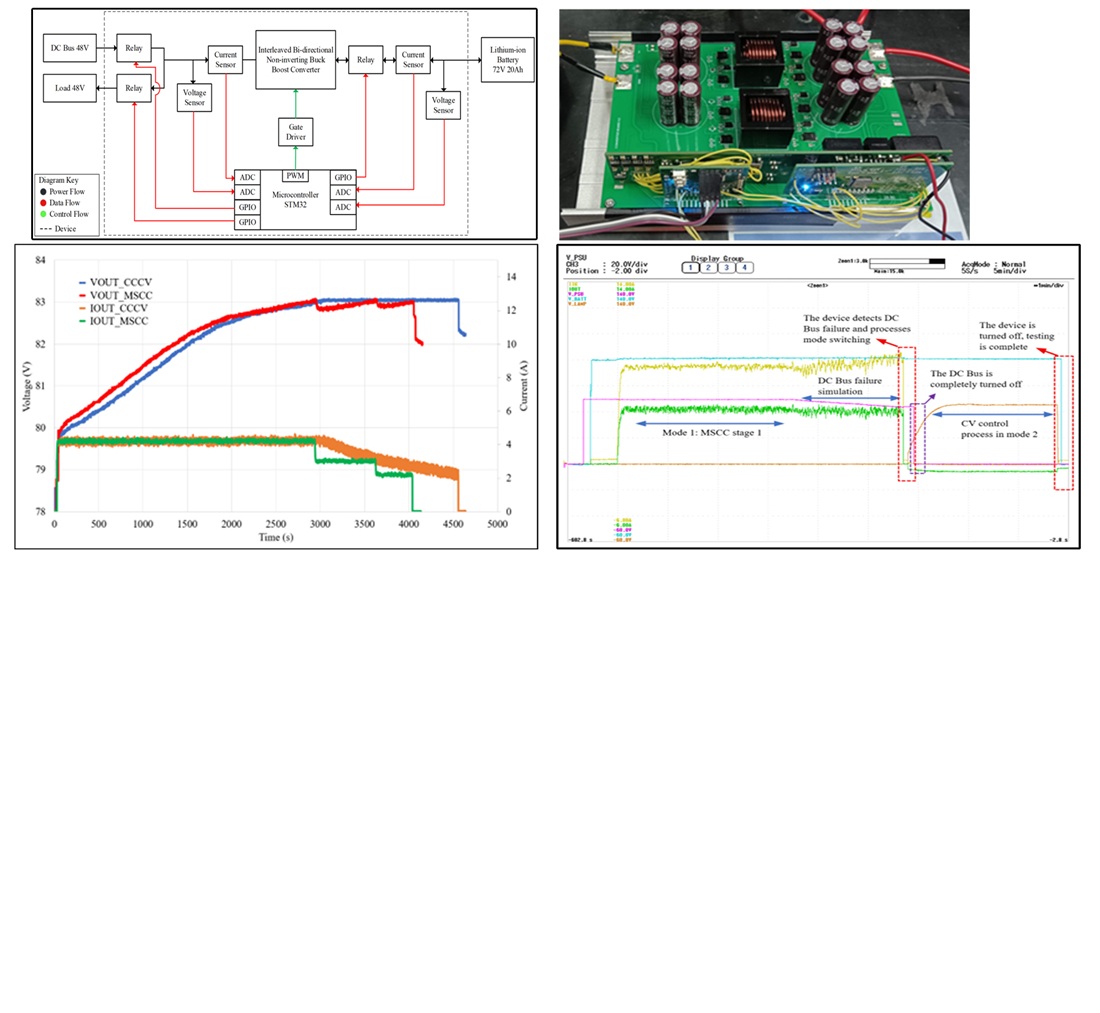
This research presents an interleaved bi-directional non-inverting buck-boost converter designed for public electric vehicle battery swapping stations (BSS). This study solves the critical problem of BSS vulnerability to main power outages, which threatens their operational reliability. The developed solution is a device that not only performs efficient charging but also functions as an emergency power source, utilizing power from connected batteries during a grid failure. The methodology incorporates an interleaved topology and a multi-stage constant current (MSCC) charging method controlled by a fuzzy logic controller (FLC). Experimental results show the interleaved operation successfully increased power capacity up to 1.1 kW, achieving an average efficiency of 93.44%. A distinctive feature of the result is the reduction of the output current ripple by 47.7% down to 0.92%. This is explained by the ripple-cancellation effect inherent to the interleaved design, which is a key feature for preserving long-term battery health. Furthermore, the MSCC method achieved a 13.7% reduction in execution time compared to the conventional constant current-constant voltage (CC-CV) method, with a total charging duration of 66.8 minutes. This validated prototype successfully demonstrated a seamless and automatic emergency mode transition during a power failure, directly answering the BSS reliability challenge. The prototype also confirmed its bidirectional functionality and seamless mode transition from standard charging to emergency power supply mode. The scope of this research provides a practical and high-performance integrated solution for BSS, effectively addressing vulnerability issues by improving reliability and charging time efficiency, ensuring continuous service.
References
- Asy’ari, M. K., Panggabean, D. K. S. H., Musyafa, A., Ginting, K. B. (2025). Development of a lithium-ion battery charging system under constant current and voltage conditions using STM-32 based on fuzzy logic control. Indonesian Physical Review, 8 (1), 340–348. https://doi.org/10.29303/ipr.v8i1.409
- Yousuf, A. K. M., Wang, Z., Paranjape, R., Tang, Y. (2023). Electric Vehicle Charging Station Infrastructure: A Comprehensive Review of Technologies, Challenges, and Mitigation Strategies. 2023 IEEE Canadian Conference on Electrical and Computer Engineering (CCECE), 588–592. https://doi.org/10.1109/ccece58730.2023.10289005
- Siddiqua, A., Cherala, V., Yemula, P. K. (2023). Optimal Sizing and Adaptive Charging Strategy for the Battery Swapping Station. 2023 IEEE PES 15th Asia-Pacific Power and Energy Engineering Conference (APPEEC), 1–6. https://doi.org/10.1109/appeec57400.2023.10561997
- Afshar, S., Macedo, P., Mohamed, F., Disfani, V. (2020). A Literature Review on Mobile Charging Station Technology for Electric Vehicles. 2020 IEEE Transportation Electrification Conference & Expo (ITEC), 1184–1190. https://doi.org/10.1109/itec48692.2020.9161499
- Reddy, N. A., Shreyash, K. S., Adithya, N. V., Namitha, D., Kalyan, C. P. (2023). Integration and Implementation of Renewable Energy based Charging Station. 2023 First International Conference on Cyber Physical Systems, Power Electronics and Electric Vehicles (ICPEEV), 1–5. https://doi.org/10.1109/icpeev58650.2023.10391903
- Teske, P., Gentejohann, M., Wiemann, D., Krüger, L., Kowal, J., Dieckerhoff, S. (2024). Open Battery Platform: Open-Source Power Electronic Devices for Renewable Generation and Energy Storage Technology. 2024 IEEE 15th International Symposium on Power Electronics for Distributed Generation Systems (PEDG), 1–6. https://doi.org/10.1109/pedg61800.2024.10667440
- Kumar, R., Verma, M., Kulkarni, A. (2024). Optimizing Bidirectional EV Charger with Rapid Charging Architecture using Fuzzy Logic Control. 2024 3rd International Conference for Innovation in Technology (INOCON), 1–6. https://doi.org/10.1109/inocon60754.2024.10511811
- Sharma, A., Veerachary, M. (2018). A DC-DC Bidirectional Converter with Improved Mode Transition Technique. 2018 IEEE International Conference on Power Electronics, Drives and Energy Systems (PEDES), 1–6. https://doi.org/10.1109/pedes.2018.8707722
- Schaltz, E., Rasmussen, P. O., Khaligh, A. (2008). Non-inverting buck-boost converter for fuel cell applications. 2008 34th Annual Conference of IEEE Industrial Electronics. https://doi.org/10.1109/iecon.2008.4758065
- Rao, A. V., Guruswamy, K. P. (2021). Analysis, Design and Simulation of Non-Inverting Buck-Boost DC-DC Converter for Battery Charging. 2021 International Conference on Disruptive Technologies for Multi-Disciplinary Research and Applications (CENTCON), 79–84. https://doi.org/10.1109/centcon52345.2021.9688165
- Polat, H., Hosseinabadi, F., Hasan, Md. M., Chakraborty, S., Geury, T., El Baghdadi, M. et al. (2023). A Review of DC Fast Chargers with BESS for Electric Vehicles: Topology, Battery, Reliability Oriented Control and Cooling Perspectives. Batteries, 9 (2), 121. https://doi.org/10.3390/batteries9020121
- Abdel-Rahim, O., Chub, A., Blinov, A., Vinnikov, D., Peftitsis, D. (2022). An Efficient Non-Inverting Buck-Boost Converter with Improved Step Up/Down Ability. Energies, 15 (13), 4550. https://doi.org/10.3390/en15134550
- Nguyen, V.-S., Tran, V.-L., Choi, W., Kim, D.-W. (2014). Analysis of the Output Ripple of the DC-DC Boost Charger for Li-Ion Batteries. Journal of Power Electronics, 14 (1), 135–142. https://doi.org/10.6113/jpe.2014.14.1.135
- Alharbi, M. A., Alcaide, A. M., Dahidah, M., P., M.-R., Ethni, S., Pickert, V., Leon, J. I. (2023). Rotating Phase Shedding for Interleaved DC–DC Converter-Based EVs Fast DC Chargers. IEEE Transactions on Power Electronics, 38 (2), 1901–1909. https://doi.org/10.1109/tpel.2022.3211864
- Zhang, C., Xu, B., Jasni, J., Radzi, M. A. M., Azis, N., Zhang, Q. (2022). Model Control and Digital Implementation of the Three Phase Interleaved Parallel Bidirectional Buck–Boost Converter for New Energy Electric Vehicles. Energies, 15 (19), 7178. https://doi.org/10.3390/en15197178
- Pirashanthiyah, L., Edirisinghe, H. N., De Silva, W. M. P., Bolonne, S. R. A., Logeeshan, V., Wanigasekara, C. (2024). Design and Analysis of a Three-Phase Interleaved DC-DC Boost Converter with an Energy Storage System for a PV System. Energies, 17 (1), 250. https://doi.org/10.3390/en17010250
- Suryoatmojo, H., Pratama, I. A., Soedibyo, S. (2021). Non-Inverting Cascaded Bidirectional Buck-Boost DC-DC Converter with Average Current Mode Control for Lithium-Ion Battery Charger. JAREE (Journal on Advanced Research in Electrical Engineering), 5 (2). https://doi.org/10.12962/jaree.v5i2.167
- Alajmi, B. N., Marei, M. I., Abdelsalam, I., Ahmed, N. A. (2022). Multiphase Interleaved Converter Based on Cascaded Non-Inverting Buck-Boost Converter. IEEE Access, 10, 42497–42506. https://doi.org/10.1109/access.2022.3168389
- Sunarno, E., Suhariningsih, Prasetyono, E., Nugroho, M. A. B., Eviningsih, R. P., Nizar, R. F. (2024). Interleaved Buck Converter as Current Regulator for Lithium Ion Battery Charging with Fuzzy Logic Control. 2024 International Electronics Symposium (IES), 13–18. https://doi.org/10.1109/ies63037.2024.10665860
- Batteries in a Portable World (2017). Isidor Buchmann. Available at: https://batteryuniversity.com/buy-the-book.
- Nugroho, M. A. B., Alifi, A. D., Suhariningsih, S., Sunarno, E., Prasetyono, E., Anggriawan, D. O. (2024). Multi-step constant current-constant voltage charging method to improve CC-CV method on lead acid batteries. TELKOMNIKA (Telecommunication Computing Electronics and Control), 22 (6), 1564. https://doi.org/10.12928/telkomnika.v22i6.25968
- Imran, R. M., Li, Q., Flaih, F. M. F. (2020). An Enhanced Lithium-Ion Battery Model for Estimating the State of Charge and Degraded Capacity Using an Optimized Extended Kalman Filter. IEEE Access, 8, 208322–208336. https://doi.org/10.1109/access.2020.3038477
- Khan, A. B., Pham, V.-L., Nguyen, T.-T., Choi, W. (2016). Multistage constant-current charging method for Li-Ion batteries. 2016 IEEE Transportation Electrification Conference and Expo, Asia-Pacific (ITEC Asia-Pacific), 381–385. https://doi.org/10.1109/itec-ap.2016.7512982
- Khan, A. B., Choi, W. (2018). Optimal Charge Pattern for the High-Performance Multistage Constant Current Charge Method for the Li-Ion Batteries. IEEE Transactions on Energy Conversion, 33 (3), 1132–1140. https://doi.org/10.1109/tec.2018.2801381
- Balamurugan, P., Agarwal, P., Khajuria, D., Mahapatra, D., Angalaeswari, S., Natrayan, L., Mammo, W. D. (2023). State-Flow Control Based Multistage Constant-Current Battery Charger for Electric Two-Wheeler. Journal of Advanced Transportation, 2023, 1–11. https://doi.org/10.1155/2023/4554582
- Yurkovich, S., Passino, K. M. (1999). A laboratory course on fuzzy control. IEEE Transactions on Education, 42 (1), 15–21. https://doi.org/10.1109/13.746327
- Shekhar, Y., Verma, S., Singh, N., Mishra, P., Ahmad, A. U., Bharati, K. K. (2024). Smart Control Strategies in Photovoltaic Systems: A Critical Review on Fuzzy Logic MPPT And PI Control For Charge Management. 2024 3rd International Conference on Power Electronics and IoT Applications in Renewable Energy and Its Control (PARC), 238–243. https://doi.org/10.1109/parc59193.2024.10486316
- Falih, A. Z., Efendi, M. Z., Murdianto, F. D. (2021). CC-CV Controlled Fast Charging Using Fuzzy Type-2 for Battery Lithium-Ion. JAREE (Journal on Advanced Research in Electrical Engineering), 5 (2). https://doi.org/10.12962/jaree.v5i2.200
- Faisal, M., Hannan, M. A., Ker, P. J., Hossain Lipu, M. S., Uddin, M. N. (2021). Fuzzy-Based Charging–Discharging Controller for Lithium-Ion Battery in Microgrid Applications. IEEE Transactions on Industry Applications, 57 (4), 4187–4195. https://doi.org/10.1109/tia.2021.3072875
- Wiryajati, I. K., Satiawan, I. N. W., Suksmadana, I. M. B., Wiwaha, B. B. P. (2025). Investigation and Analysis of Fuzzy Logic Controller Method on DC-DC Buck-Boost Converter. Jurnal Penelitian Pendidikan IPA, 11 (1), 1066–1074. https://doi.org/10.29303/jppipa.v11i1.9744
- Recommended External Circuitry for Transphorm GaN FETs (2018). Transphorm. Available at: https://www.mouser.com/pdfDocs/recommended-external-circuitry-transphorm-gan-fets-20190711-5.pdf?srsltid=AfmBOoqZ34XYpr2Q3s6cxq0_AcoadEeWW0I0yk4ZdjwhWCp1gheDbzZu
- STM32G441xB. Datasheet (2021). STMicroelectronics. Available at: https://www.st.com/resource/en/datasheet/stm32g441cb.pdf
Downloads
Published
How to Cite
Issue
Section
License
Copyright (c) 2025 Sonki Prasetya, Eka Prasetyono, Mochamad Ari Bagus Nugroho, Epyk Sunarno, Muhammad Fikri Rizki, Haolia Rahman, Muhammad Hidayat Tullah, Jazuli Fadil, Teguh Suprianto, Lauhil Mahfudz Hayusman

This work is licensed under a Creative Commons Attribution 4.0 International License.
The consolidation and conditions for the transfer of copyright (identification of authorship) is carried out in the License Agreement. In particular, the authors reserve the right to the authorship of their manuscript and transfer the first publication of this work to the journal under the terms of the Creative Commons CC BY license. At the same time, they have the right to conclude on their own additional agreements concerning the non-exclusive distribution of the work in the form in which it was published by this journal, but provided that the link to the first publication of the article in this journal is preserved.
A license agreement is a document in which the author warrants that he/she owns all copyright for the work (manuscript, article, etc.).
The authors, signing the License Agreement with TECHNOLOGY CENTER PC, have all rights to the further use of their work, provided that they link to our edition in which the work was published.
According to the terms of the License Agreement, the Publisher TECHNOLOGY CENTER PC does not take away your copyrights and receives permission from the authors to use and dissemination of the publication through the world's scientific resources (own electronic resources, scientometric databases, repositories, libraries, etc.).
In the absence of a signed License Agreement or in the absence of this agreement of identifiers allowing to identify the identity of the author, the editors have no right to work with the manuscript.
It is important to remember that there is another type of agreement between authors and publishers – when copyright is transferred from the authors to the publisher. In this case, the authors lose ownership of their work and may not use it in any way.







