Identifying the influence of adding plastic and paper waste on stabilization of subgrade for toll roads
DOI:
https://doi.org/10.15587/1729-4061.2025.342303Keywords:
plastic waste, paper waste, soil stabilization, California bearing ratio, toll roads, environmental sustainability, subgrade stabilizationAbstract
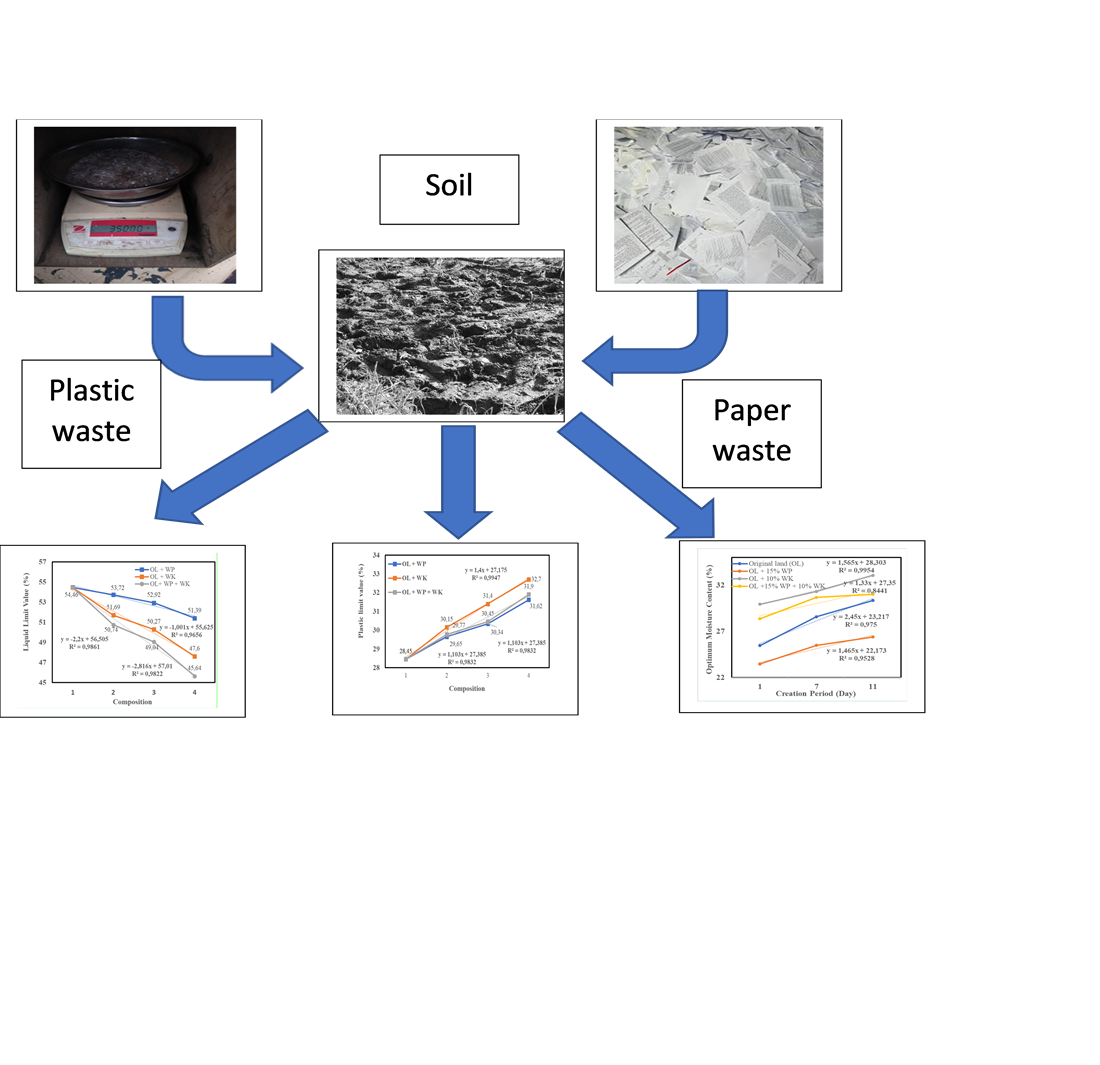
This paper discusses soil stability with high water content and low bearing capacity, which can damage the pavement and shorten the lifespan of the toll road. The problem is that high water content and low soil carrying capacity can trigger subgrade instability and decreased pavement performance. Experimental variations using plastic waste with a percentage of 7%, 10%, and 15%, paper waste with a percentage of 4%, 8%, and 10%into the original soil. The results showed that the addition of plastic and paper waste increases soil strength and CBR values significantly compared to conventional stabilizers. Plastic increases shear resistance and decreases development potential, while paper increases cohesion A combination of 10% plastic waste and 8% paper waste provides optimal results that meet the subgrade stabilization criteria, with a CBR value reaching 10.5% on the 11th day. Excessive use of these materials decreases soil density and CBR. This result is caused by a complementary mechanism, where plastic acts as a binder that reduces soil moisture content and plasticity, while paper fibers strengthen the soil matrix through increased cohesion. The synergy of two types of waste in the optimum proportion produces reliable, sustainable, and more economical stabilization performance than traditional alternatives such as cement or lime. Use is suitable for regions with unstable subgrade and high water content, with prerequisites for the availability of waste material, controlling proportions (± 10% plastic, ± 8% paper), homogeneous mixing, and compaction according to technical specifications. This approach offers practical, cost-effective and environmentally friendly solutions to improve road infrastructure.
References
- Saeed, K. A., Kassim, K. A., Nur, H., Yunus, N. Z. M. (2015). Strength of lime-cement stabilized tropical lateritic clay contaminated by heavy metals. KSCE Journal of Civil Engineering, 19 (4), 887–892. https://doi.org/10.1007/s12205-013-0086-6
- Vilasini, P. P., Thangasamy, L. (2025). Comparative long-term stabilization of pond ash using lime and cement: FTIR characterization, strength optimization and sustainable utilization. Next Materials, 8, 100908. https://doi.org/10.1016/j.nxmate.2025.100908
- Barman, D., Dash, S. K. (2022). Stabilization of expansive soils using chemical additives: A review. Journal of Rock Mechanics and Geotechnical Engineering, 14 (4), 1319–1342. https://doi.org/10.1016/j.jrmge.2022.02.011
- Hatefi, M. H., Arabani, M., Payan, M., Ranjbar, P. Z. (2025). Impact of recycled macro-synthetic fibers on kaolin soil stabilized with lime kiln dust and volcanic ash. Case Studies in Construction Materials, 22, e04830. https://doi.org/10.1016/j.cscm.2025.e04830
- Suhudi, S., Frida S, K., Damayanti, F. (2024). Analysis Of The Stability Plan For Kambaniru Weir, East Sumba District. Journal of Evrímata: Engineering and Physics, 2 (2), 138–143. https://doi.org/10.70822/journalofevrmata.v2i02.65
- Pahlavan, F., Kaur, H., Khodadaditirkolaei, H., Kabir, S. F., Lin, J.-Y., Ackerman-Biegasiewicz, L. K. G., Fini, E. H. (2025). A novel adsorbent for efficient metal recovery from aqueous solutions: Carbon-coated oil-treated plastic granules as a sustainable approach to resource conservation. Resources, Conservation and Recycling, 223, 108521. https://doi.org/10.1016/j.resconrec.2025.108521
- Ahmad, A., Sutanto, M. H., Al-Bared, M. A. M., Harahap, I. S. H., Abad, S. V. A. N. K., Khan, M. A. (2021). Physio-Chemical Properties, Consolidation, and Stabilization of Tropical Peat Soil Using Traditional Soil Additives – A State of the Art Literature Review. KSCE Journal of Civil Engineering, 25 (10), 3662–3678. https://doi.org/10.1007/s12205-021-1247-7
- Rangaswamy, K., Mohan, R. P. (2025). Strengthening the subgrade clay soil using nano chemical stabilisation. Soils and Foundations, 65 (4), 101638. https://doi.org/10.1016/j.sandf.2025.101638
- Shooshpasha, I., Shirvani, R. A. (2015). Effect of cement stabilization on geotechnical properties of sandy soils. Geomechanics and Engineering, 8 (1), 17–31. https://doi.org/10.12989/gae.2015.8.1.017
- Guo, K., Yu, B., Ma, Q., Liu, S., Tao, K., Zhou, B., Jiang, N. (2024). Calcium carbide residue-based material for the stabilization of dredged sludge and its use in road subgrade construction. Case Studies in Construction Materials, 21, e03452. https://doi.org/10.1016/j.cscm.2024.e03452
- Suhudi, S., Damayanti, F. (2024). Stability Analysis of Retaining Soil Walls Protecting Banu Canal, Ngantru Village, Ngantang District, Malang-Indonesia. Journal of Evrímata: Engineering and Physics, 2 (1), 95–103. https://doi.org/10.70822/journalofevrmata.vi.37
- Huang, M., Liu, J., Pokharel, S. K., Dagenais, T., Chatterjee, A., Lin, C. (2025). Full-scale testing and monitoring of geosynthetics-stabilized flexible pavement in Alberta, Canada. Geotextiles and Geomembranes, 53 (1), 427–444. https://doi.org/10.1016/j.geotexmem.2024.11.003
- Ren, X., Sha, A., Jiang, W., Jiao, W., Guan, Y., Cao, Y., Li, J. (2025). Evolution of rheological performance and chemical composition in crumb rubber/recycled plastic composite-modified asphalt binder during long-term aging. Chemical Engineering Journal, 519, 165534. https://doi.org/10.1016/j.cej.2025.165534
- Paul, S., Tasnim, A., Majumder, J. (2025). Enhancement of micro-mechanical characteristics of expansive soil through synergistic incorporation of jute and nylon fibers with cement. Results in Engineering, 26, 104685. https://doi.org/10.1016/j.rineng.2025.104685
- Ningrum, D., Wijaya, H. S., Van, E. (2023). Effect of Treatment Age on Mechanical Properties of Geopolymer Concrete. Asian Journal Science and Engineering, 1 (2), 121. https://doi.org/10.51278/ajse.v1i2.544
- Singh, K., Gupta, S. (2025). Engineered char from waste plastic: A review on the physicochemical properties, carbon dioxide uptake, and application in construction materials. Cleaner Materials, 17, 100321. https://doi.org/10.1016/j.clema.2025.100321
- Md. Isa, M. H., Koting, S., Hashim, H., Mo, K. H., Aziz, S. A. (2024). Utilising tile waste as an additive to enhance lime-based subgrade stabilisation. Case Studies in Construction Materials, 20, e03342. https://doi.org/10.1016/j.cscm.2024.e03342
- Chah, C. N., Sekharan, S., Katiyar, V. (2025). Geotechnical characterisation and sustainability assessment of plastic waste inclusions on a cement-treated fine-grained soil for pavement applications. Transportation Geotechnics, 51, 101515. https://doi.org/10.1016/j.trgeo.2025.101515
- Cui, G., Duan, M., Lian, X., Xiao, X. (2025). From solid waste to subgrade stabilizer: lithium slag-calcium carbide residue geopolymer for silty clay subgrade stabilization. Results in Engineering, 27, 106409. https://doi.org/10.1016/j.rineng.2025.106409
- Badiger, M., Mamatha, K. H., Dinesh, S. V. (2025). Laboratory study on the performance evaluation of RCA reinforced with geosynthetics for GSB layer application in low volume roads. Sustainable Materials and Technologies, 44, e01393. https://doi.org/10.1016/j.susmat.2025.e01393
Downloads
Published
How to Cite
Issue
Section
License
Copyright (c) 2025 Moch. Khamim, Raden Ajeng Mariyana, Rosoil Gasenda Suryaningrat, Mohamad Zenurianto, Sugeng Hadi Susilo

This work is licensed under a Creative Commons Attribution 4.0 International License.
The consolidation and conditions for the transfer of copyright (identification of authorship) is carried out in the License Agreement. In particular, the authors reserve the right to the authorship of their manuscript and transfer the first publication of this work to the journal under the terms of the Creative Commons CC BY license. At the same time, they have the right to conclude on their own additional agreements concerning the non-exclusive distribution of the work in the form in which it was published by this journal, but provided that the link to the first publication of the article in this journal is preserved.
A license agreement is a document in which the author warrants that he/she owns all copyright for the work (manuscript, article, etc.).
The authors, signing the License Agreement with TECHNOLOGY CENTER PC, have all rights to the further use of their work, provided that they link to our edition in which the work was published.
According to the terms of the License Agreement, the Publisher TECHNOLOGY CENTER PC does not take away your copyrights and receives permission from the authors to use and dissemination of the publication through the world's scientific resources (own electronic resources, scientometric databases, repositories, libraries, etc.).
In the absence of a signed License Agreement or in the absence of this agreement of identifiers allowing to identify the identity of the author, the editors have no right to work with the manuscript.
It is important to remember that there is another type of agreement between authors and publishers – when copyright is transferred from the authors to the publisher. In this case, the authors lose ownership of their work and may not use it in any way.







