Construction of an electron-optical scheme for electrostatic quasi-spherical deflector-type energy analyzer
DOI:
https://doi.org/10.15587/1729-4061.2025.342477Keywords:
multipole approach, electrostatic deflector-type energy analyzer, quasi-spherical field, axisymmetric multipole, angular aberrationsAbstract
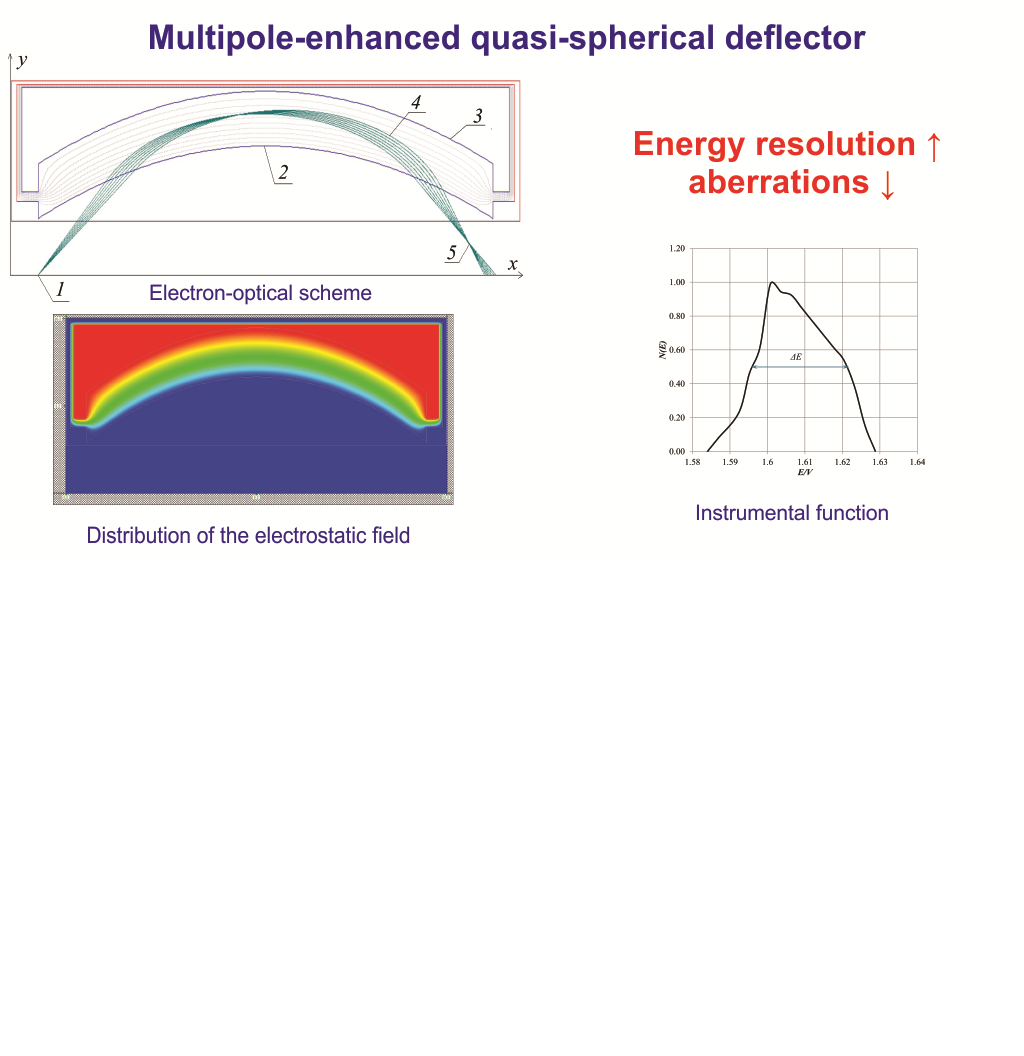
This study investigates electrostatic spherical deflector-type energy analyzers designed to analyze energy of charged particle beams. The research aims to eliminate quadratic angular aberrations characteristic of classical spherical deflector-type energy analyzers, which limit the quality of angular focusing and the energy resolution of the instruments. An electron-optical scheme of an electrostatic quasi-spherical deflector-type energy analyzer has been proposed, whose field is synthesized using a multipole approach.
The electrostatic field of the energy analyzer is a superposition of an axisymmetric hexapole and a spherical field. Analytical calculations have shown that by choosing the coefficient that determines the weighting contribution of the axisymmetric hexapole, it is possible to completely compensate for second-order angular aberrations and significantly improve the focusing properties of the quasi-spherical energy analyzer.
The profile of the deflecting electrodes of the energy analyzer has been determined, providing the necessary spatial distribution of the deflecting field potential to achieve the specified electron-optical parameters. Numerical simulation of the electron-optical scheme of the quasi-spherical energy analyzer and calculation of the trajectories of charged particles were carried out using the "Focus" numerical program. The electron-optical scheme of the energy analyzer implements a second-order angular focusing mode of the "axis-ring" type.
The instrumental function of the scheme has been constructed. The relative energy resolution and luminosity of the energy analyzer were estimated. The numerical results show that the relative energy resolution of the energy analyzer is 1.6% at a luminosity of 17.5% of 2π, which confirms effectiveness of the proposed scheme. The proposed electron-optical scheme could be used to design real structures of new high-resolution spectrometers intended for the analysis of charged particle beams.
References
- Cara, A., Lavraud, B., Fedorov, A., De Keyser, J., DeMarco, R., Marcucci, M. F. et al. (2017). Electrostatic analyzer design for solar wind proton measurements with high temporal, energy, and angular resolutions. Journal of Geophysical Research: Space Physics, 122 (2), 1439–1450. Portico. https://doi.org/10.1002/2016ja023269
- Hirahara, M., Takei, T., Yokota, S., Yanagimachi, T. (2023). Triple‐Dome Electrostatic Energy Analyzer With 360° Field‐Of‐View for Simultaneous Measurements of Ions and Electrons. Journal of Geophysical Research: Space Physics, 128 (10). https://doi.org/10.1029/2023ja031423
- Hénaff, G., Berthomier, M. (2025). Parametric Study of the Performance of an Electrostatic Analyzer With an Hemispheric Field‐of‐View Based on the Donut Topology. Journal of Geophysical Research: Space Physics, 130 (3). https://doi.org/10.1029/2024ja033367
- Sablik, M. J., Winningham, J. D., Gurgiolo, C., Johnstone, A. D. (1985). Computer simulation of an electrostatic spherical analyzer used as an energy spectrograph. Review of Scientific Instruments, 56 (7), 1320–1328. https://doi.org/10.1063/1.1137998
- Kisker, E., Campagna, M., Gudat, W., Kuhlmann, E. (1979). Properties and operation of a 90° spherical deflector as photoelectron energy analyzer in connection with spin-polarization measurements by Mott scattering. Review of Scientific Instruments, 50 (12), 1598–1601. https://doi.org/10.1063/1.1135773
- DeSerio, R. (1989). Spherical sector electrostatic analyzers for measurements of energy and angular distributions. Review of Scientific Instruments, 60 (3), 381–388. https://doi.org/10.1063/1.1140386
- Daimon, H., Ino, S. (1990). Improvement of the spherical mirror analyzer. Review of Scientific Instruments, 61 (1), 57–60. https://doi.org/10.1063/1.1141923
- Vilppola, J. H., Tanskanen, P. J., Barraclough, B. L. (1998). Simulations of a spherical section electrostatic analyzer. COSPAR Colloquia Series, 75–84. https://doi.org/10.1016/s0964-2749(98)80013-9
- McGarity, J. O., Huber, A., Pantazis, J., Oberhardt, M. R., Hardy, D. A., Slutter, W. E. (1992). Compact ion/electron analyzer for spaceflight or laboratory use. Review of Scientific Instruments, 63 (3), 1973–1977. https://doi.org/10.1063/1.1143314
- Tusche, C., Chen, Y.-J., Schneider, C. M., Kirschner, J. (2019). Imaging properties of hemispherical electrostatic energy analyzers for high resolution momentum microscopy. Ultramicroscopy, 206, 112815. https://doi.org/10.1016/j.ultramic.2019.112815
- Harkoma, M., Aksela, S. (2002). A study of the Double-pass Jost Electron Energy Analyzer. Journal of Electron Spectroscopy and Related Phenomena, 122 (3), 209–219. https://doi.org/10.1016/s0368-2048(01)00354-1
- Takahashi, N., Matsui, F., Matsuda, H., Hamada, Y., Nakanishi, K., Namba, H., Daimon, H. (2008). Improvement of display-type spherical mirror analyzer for real space mapping of electronic and atomic structures. Journal of Electron Spectroscopy and Related Phenomena, 163 (1-3), 45–50. https://doi.org/10.1016/j.elspec.2008.02.004
- Kotsugi, M., Miyatake, Y., Enomoto, K., Fukumoto, K., Kobayashi, A., Nakatani, T. et al. (2001). Construction of two-dimensional photoelectron spectrometer at SPring-8. Nuclear Instruments and Methods in Physics Research Section A: Accelerators, Spectrometers, Detectors and Associated Equipment, 467-468, 1493–1496. https://doi.org/10.1016/s0168-9002(01)00733-1
- Huber, A., Plies, E. (1999). Numerical ray tracing of electrons in different 3D fringing fields of spherical deflectors. Charged Particle Optics IV, 3777, 264–274. https://doi.org/10.1117/12.370136
- Sagara, T., Boesten, L., Nishida, S., Okada, K. (2000). Resolution improvements for hemispherical energy analyzers. Review of Scientific Instruments, 71 (11), 4201–4207. https://doi.org/10.1063/1.1319979
- Ceballos, G. A., Grzelakowski, K. P. (2021). Electron Optical Optimisation of an Imaging Energy Analyser: Real Model Field- and Trajectory Simulations Applied to k-Space Visualisation of Electronic States. Advances in Electrical and Electronic Engineering, 19 (4). https://doi.org/10.15598/aeee.v19i4.4289
- Grzelakowski, K. P. (2013). A flange on electron spectromicroscope with spherical deflector analyzer – simultaneous imaging of reciprocal and real spaces. Ultramicroscopy, 130, 29–35. https://doi.org/10.1016/j.ultramic.2013.02.015
- Grzelakowski, K. (2012). A novel imaging energy filter for cathode lens electron microscopy. Ultramicroscopy, 116, 95–105. https://doi.org/10.1016/j.ultramic.2012.03.010
- Nohno, T., Matsui, F., Hamada, Y., Matsumoto, H., Takeda, S., Hattori, K., Daimon, H. (2003). Development of High-Energy-Resolution Display-Type Photoelectron Spectrometer in the Ultraviolet Photoelectron Spectroscopy Region. Japanese Journal of Applied Physics, 42 (Part 1, No. 7B), 4752–4755. https://doi.org/10.1143/jjap.42.4752
- Kambarova, Z. (2023). Expansion of the functional capacities of electrostatic mirror analyzers for electron spectroscopy. Eastern-European Journal of Enterprise Technologies, 5 (5 (125)), 53–61. https://doi.org/10.15587/1729-4061.2023.289781
- Assylbekova, S. N., Saulebekov, А. О., Kambarova, Zh. T., Orakbai, A. (2016). Modeling of electrostatic collimator of charged particles beams on the basis of spherical mirror. Eurasian Physical Technical Journal, 13, 1 (25), 22–26.
- Kambarova, Zh. T. (2021). About the possibility of creating an efficient energy analyzer of charged particle beams based on axiallysymmetric octupole-cylindrical field. Eurasian Physical Technical Journal, 18 (2), 96–102. https://doi.org/10.31489/2021no2/96-102
- Kambarova, Zh. T., Trubitsyn, A. A., Saulebekov, A. O. (2018). Axially Symmetric Energy Analyzer Based on the Electrostatic Decapole-Cylindrical Field. Technical Physics, 63 (11), 1667–1671. https://doi.org/10.1134/s1063784218110142
- Zashkvara, V. V., Tyndyk, N. N. (1999). The method for the calculation of multipole-cylindrical fields. Nuclear Instruments and Methods in Physics Research Section A: Accelerators, Spectrometers, Detectors and Associated Equipment, 423 (2-3), 223–231. https://doi.org/10.1016/s0168-9002(98)01262-5
- Zashkvara, V. V., Tyndyk, N. N. (1996). Potential fields based on circular multipole series. Nuclear Instruments and Methods in Physics Research Section A: Accelerators, Spectrometers, Detectors and Associated Equipment, 370 (2-3), 452–460. https://doi.org/10.1016/0168-9002(95)00809-8
- Sautbekova, Z., Trubitsyn, A. (2022). Focus CPM software for trajectory analysis of real axially symmetric electrostatic mirrors: methods and algorithms. Eurasian Physical Technical Journal, 19 (3 (41)), 91–96. https://doi.org/10.31489/2022no3/91-96
Downloads
Published
How to Cite
Issue
Section
License
Copyright (c) 2025 Zhanar Kambarova, Serik Kassymov

This work is licensed under a Creative Commons Attribution 4.0 International License.
The consolidation and conditions for the transfer of copyright (identification of authorship) is carried out in the License Agreement. In particular, the authors reserve the right to the authorship of their manuscript and transfer the first publication of this work to the journal under the terms of the Creative Commons CC BY license. At the same time, they have the right to conclude on their own additional agreements concerning the non-exclusive distribution of the work in the form in which it was published by this journal, but provided that the link to the first publication of the article in this journal is preserved.
A license agreement is a document in which the author warrants that he/she owns all copyright for the work (manuscript, article, etc.).
The authors, signing the License Agreement with TECHNOLOGY CENTER PC, have all rights to the further use of their work, provided that they link to our edition in which the work was published.
According to the terms of the License Agreement, the Publisher TECHNOLOGY CENTER PC does not take away your copyrights and receives permission from the authors to use and dissemination of the publication through the world's scientific resources (own electronic resources, scientometric databases, repositories, libraries, etc.).
In the absence of a signed License Agreement or in the absence of this agreement of identifiers allowing to identify the identity of the author, the editors have no right to work with the manuscript.
It is important to remember that there is another type of agreement between authors and publishers – when copyright is transferred from the authors to the publisher. In this case, the authors lose ownership of their work and may not use it in any way.







